 Gaan na inhoud
Sungrow PowerStack ST255CS-2H and MegSolid Energon 261 sit in a similar 257–261 kWh C&I cabinet class, but they are not direct drop-in replacements. Required active power, discharge duration, AC voltage, temperature derating and future expansion matter more than the 4.24 kWh difference between the two nominal capacities.
Projects already evaluating PowerStack can place it beside the MegSolid Energon 261 and screen both against the same site duty before the cabinet is locked.

Energon 261 Sits in the Same 257–261 kWh Cabinet Class
Energon 261 is the closest current MegSolid comparison when a project sits around the 250–300 kWh integrated C&I cabinet class. It provides 261.24 kWh rated energy, a 125 kVA AC rating, 314 Ah LFP cells, liquid cooling and 400 V / 480 V ±15% rated-voltage options in an IP54 outdoor cabinet.
Sungrow currently lists the IEC PowerStack ST255CS-2H at 125 kW / 257 kWh and 400 V, while its North American ST255CS-2H-US is listed at 125 kW / 257 kWh and 480 V. The products are close enough in nominal energy to share an early shortlist, but their power ratings are defined differently and their electrical interfaces still need project-level verification.
| Selection point | Sungrow PowerStack ST255CS-2H | MegSolid Energon 261 | Procurement check |
|---|---|---|---|
| Gegradueerde energie | 257 kWh | 261,24 kWh | Required discharge duration and usable SOC window |
| Published AC rating | 125 kW | 125 kVA | Required active kW and project power factor |
| Verkoeling | Vloeistofkoeling | Vloeistofkoeling | Derating, auxiliaries and maintenance |
| AC-spanning | 400 V IEC; 480 V U.S. model | 400 V / 480 V ±15% | Existing LV bus and protection |
| Published dimensions | About 1150 × 2450 × 1610 mm | 1300 × 1350 × 2200 mm | Transport route, crane reach, slab footprint and service clearance |
| Published weight | ≤3200 kg | Not stated on the compared public page | Lifting plan, foundation loading and controlled quotation data |
| Enclosure protection | IP55 | IP54 | Dust, rain, washdown, salt exposure and local siting conditions |
| Ambient-temperature boundary | −30°C to 50°C; derating above 45°C | −20°C to 55°C; derating above 45°C | Available output at the design temperature |
| Published parallel limit | Grid-tied: up to 25 units; off-grid: up to 10 units | Up to 10 units | Switchgear, transformer, EMS, PCC limit and operating mode |
| System efficiency figure | 90% system RTE | Maximum system efficiency 90% | Do not compare unlike measurement boundaries as identical |
The 4.24 kWh nominal difference is about 1.6% relative to 257 kWh. Usable energy, power, voltage and environmental limits usually decide the project first.
PowerStack’s 125 kW rating and Energon 261’s 125 kVA rating also must not be presented as the same quantity. Active power available from the Energon configuration depends on power factor, reactive-power duty, temperature and the approved PCS capability for the project.
Dimensions, mass, enclosure protection and parallel limits can eliminate a cabinet before the 4.24 kWh energy gap matters. Treat the figures above as a screening table only; the released purchase specification should use the exact regional model and the latest controlled datasheet or quotation from each supplier. Energon 261 weight should remain an open item until MegSolid places it in the controlled project specification.
Six Engineering Checks Decide Whether Either Cabinet Fits
The 257–261 kWh nameplate only narrows the product class. Six engineering checks usually control the purchase: required active power, required energy, AC connection, physical installation, thermal operating condition and the expansion path around the first cabinet.
Required power comes from the load peak
Consider a factory with a measured peak of 420 kW and a target grid demand of 300 kW:
420 kW-300 kW=120 kW
The storage system needs about 120 kW of active power during that event. Battery energy can be sufficient while the approved active-power capability still fails the duty.
That is where the different PowerStack and Energon ratings matter. PowerStack publishes 125 kW, while Energon publishes 125 kVA, so the site power factor and required reactive-power operation must remain in the selection calculation.
Required energy comes from peak duration
If the 120 kW reduction is needed for 90 minutes:
120 kW×1.5 h=180 kWh
The roughly 260 kWh cabinet class now sits in a plausible range, but 180 kWh cannot simply be divided by nameplate energy and treated as the final design. The project still needs a permitted SOC window, reserve strategy, degradation basis, conversion-loss treatment and a recharge schedule.
Another site may need only 65 kW for three hours:
65 kW×3 h=195 kWh
The energy requirement is similar, while the power profile is very different. That difference can change the preferred PCS operating point and the final cabinet configuration.
AC connection can eliminate a candidate before capacity does
The existing electrical system needs to be checked before the two products are treated as substitutes. Site LV bus voltage, transformer margin, switchboard current, breaker arrangement, protection and the permitted import/export behavior all belong in the comparison.
Retrofits deserve particular care because replacing switchgear or modifying a transformer can create more cost and production disruption than the nominal battery-capacity difference. The BESS gids vir nul-uitvoerkontrole covers the PCC metering and control boundary when reverse power is restricted.
Temperature changes available power
Both candidates use liquid cooling, so the label itself no longer separates them. Energon 261 publishes an operating range of −20°C to 55°C with derating above 45°C, which means a 55°C upper operating limit must not be described as 55°C full-power operation.
Hot-site selection needs the approved available kW or kVA at the project temperature. The Riyadh BESS afgraderingvergeliking shows how to separate operating range from available output.
Expansion belongs in the first electrical design
Sites may need only one cabinet today and still benefit from reserving a clean path for another later. Busbar capacity, breaker positions, cable routes, transformer margin, EMS channels and the PCC limit should be checked before the first purchase so that “add one later” does not become “rebuild the electrical distribution later.”
Energon 261 Fits Best When Its Operating Boundaries Match the Site
Energon 261 becomes a strong candidate when its published operating boundaries align with the site and the project is still open to supplier selection. The clearest cases are roughly 260 kWh C&I duties, high-temperature sites that need a wider operating envelope, and phased installations where one cabinet can serve the current load before additional units are justified.
The project needs roughly 260 kWh without moving into a larger system class
Consider a site that needs 95 kW of peak reduction for two hours:
95 kW×2 h=190 kWh
Energon 261’s 261.24 kWh rated energy provides a realistic starting class once the final SOC window, reserve, losses and recharge plan are applied. The unused portion of the nameplate should not be assumed to be guaranteed reserve because usable AC energy remains project-specific.
This type of duty can justify an integrated cabinet without immediately moving into a several-hundred-kilowatt or megawatt-scale architecture. MegSolid’s 215 kWh versus 261 kWh commercial storage comparison provides the adjacent product-size screen when the project may fit either cabinet class.
The site operates above the comfortable range of an air-cooled cabinet
Energon’s published −20°C to 55°C operating range gives hot-climate projects a wider thermal starting point, but derating begins above 45°C. The procurement question is what output remains available at the required equipment-intake temperature for the required duration.
Die commercial battery storage guide for heat, dust, salt and noise covers the environmental boundary beyond temperature alone.
The customer wants one cabinet now and a defined path to add capacity later
Energon 261 publishes parallel connection of up to 10 units. The commercial value comes from sizing the first stage near the current load while reserving the electrical path for later growth.
The surrounding switchgear, transformer, protection and EMS still control whether the later cabinet can be added cleanly. Expansion should be planned from the PCC backward instead of by multiplying 261.24 kWh by the future cabinet count.
PowerStack Can Still Win on Ecosystem, Controls and Service
Ecosystem and Control Functions Can Outweigh the Capacity Gap
PowerStack remains a rational choice when an existing Sungrow ecosystem, standardized EPC engineering or PowerStack-specific controls carry more value than the 257 kWh nameplate alone.
Sites already operating Sungrow PV equipment and iSolarCloud may value familiar monitoring and integration. An EPC with completed protection settings, commissioning procedures and service arrangements around PowerStack may also save engineering effort by repeating a known platform.
Sungrow’s current PowerStack material publishes grid-forming capability, grid-tied and off-grid operation, MW-level black start and multi-unit commissioning. Those duties do not automatically transfer to Energon 261 because the cabinet sits in a similar energy class. The proposed MegSolid alternative must map each required operating mode to the PCS and EMS model, firmware, islanding or transfer architecture, protection logic and the FAT/SAT acceptance test. Grid-forming, black start and off-grid operation count only when the exact configured system supports them and the project acceptance plan proves them.
Service Coverage Can Be the Deciding Commercial Boundary
Service coverage can outweigh a small specification difference. Sungrow’s established distributor, commissioning and service network is a real reason many EPCs treat it as the lower-risk default.
MegSolid bids should make the service boundary explicit in the quotation: name who will commission the system, who holds critical spares, who provides remote escalation and what onsite response time is contractually available. If the project needs a 48-hour onsite response, write that requirement into the offer with the covered geography and exclusions; do not leave it as an assumed after-sales promise. Without that line-item definition, the buyer has no basis for treating the alternative as equal service risk.
Size the Cabinet From the Factory Load Curve
Cabinet selection starts with the factory load curve, not a preferred battery size. The 257 kWh or 261.24 kWh figure becomes useful only after the required power and the duration of that power have been calculated.
Consider the following example:
| Webwerf-invoer | Waarde |
|---|---|
| Normal production load | 280–320 kW |
| Short production peak | 420 kW |
| Target grid demand | 300 kW |
| Peak duration | 90 minutes |
| Candidate class | 257–261 kWh |
Required battery power:
420-300=120 kW
Required AC energy across the 90-minute window:
120×1.5=180 kWh
That result puts the roughly 260 kWh cabinet class into the discussion, but it does not release the product for purchase. The design still needs the actual interval load curve, SOC window, reserve, temperature, power factor and recharge period.
Do not size from the highest isolated peak
The 420 kW reading may last only a few minutes while a lower peak persists much longer. The more useful interval calculation is:
P_{BESS,i=\max(P_{load,i-P_{target,0)
E_{required=\sum P_{BESS,i×\Delta t
The PCS still has to meet the highest required instantaneous active power, while the battery energy is sized from the area above the target demand over time.
Confirm the recharge window
Correct discharge sizing can still fail the operating schedule if the battery cannot recover before the next peak.
If 180 kWh must be restored over four hours:
180÷4=45 kW
That is an average value before charging losses and operating limits. The one-hour recovery window creates a very different charging requirement and may expose transformer or import-limit constraints.
Die battery energy storage system design guide covers the full load-profile-to-PCC release path.
Keep reserve energy explicit
Peak shaving may not be the only duty. Backup reserve, forecast error or a later tariff peak can justify holding energy back, so the design sequence should remain:
load curve → target demand → required kW → required kWh → SOC window → reserve → recharge window
After installation, the kommersiële BESS-kapasiteitstoets can verify usable delivered energy at an agreed AC boundary instead of assuming nameplate kWh equals site-delivered kWh.
The 4.24 kWh Nameplate Gap Rarely Decides the Project
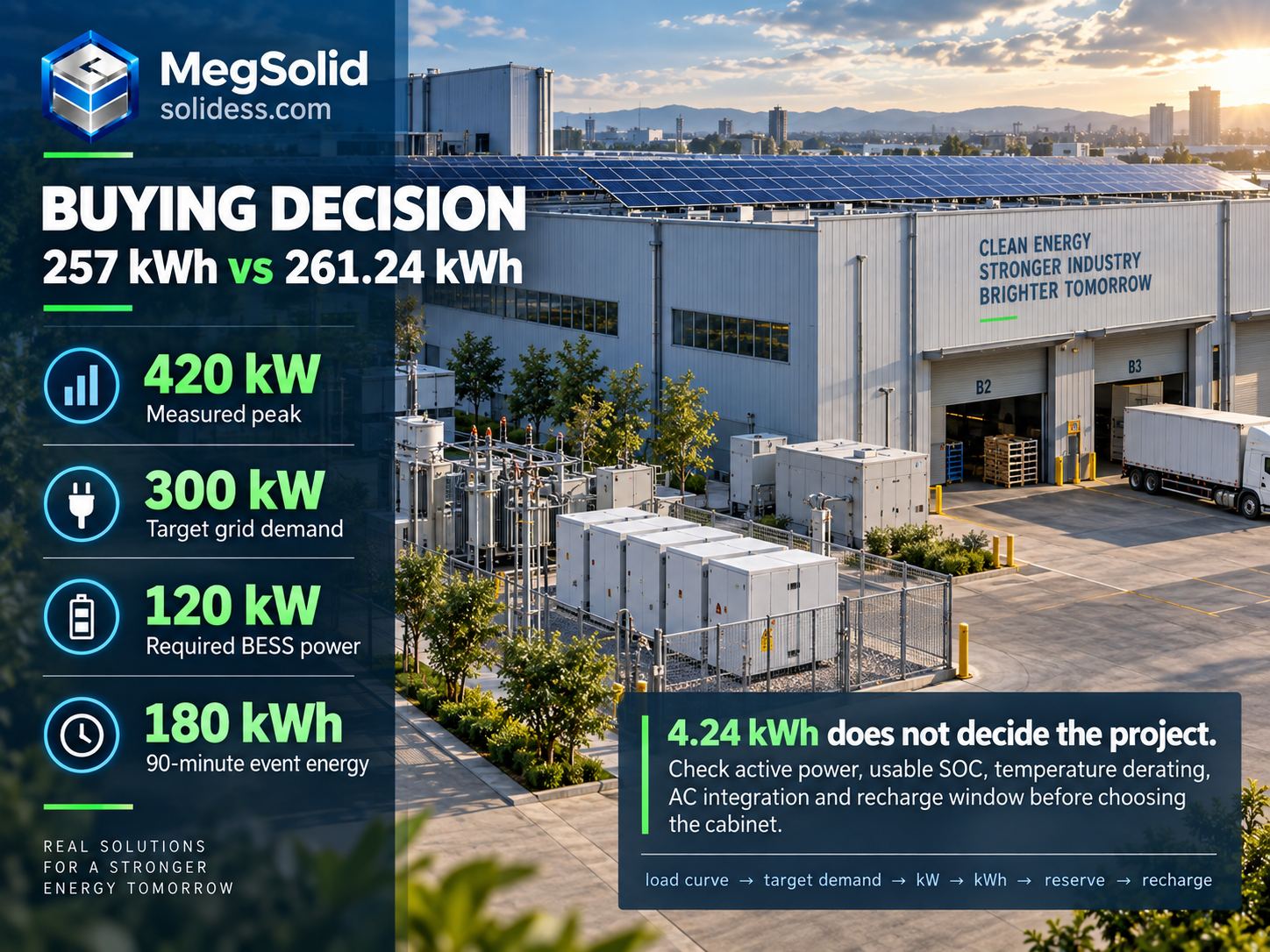
The nominal difference is 4.24 kWh, about 1.6% relative to PowerStack’s 257 kWh rating. SOC reserve, required active power, temperature derating, AC integration or the recharge schedule usually has a larger project effect.
Comparing only 257 kWh with 261.24 kWh focuses on the easiest number to read, not necessarily the one that controls the project.
Usable operating energy matters more than the nameplate gap because the EMS may reserve part of the SOC range for backup, a second peak or battery-protection limits. Power may also become the constraint first: a battery can contain enough energy while its approved active-power capability cannot meet the peak.
Electrical integration can overrule both capacity figures. Cabinets that fits the existing voltage, switchboard and transformer arrangement may create less project work than another cabinet with slightly more stored energy.
The useful buying question is:
Which system can deliver the required active power for the required duration under the actual electrical and environmental conditions?
Liquid Cooling Moves the Comparison to Derating and Maintenance
Liquid cooling does not separate PowerStack 255CS from Energon 261 because both use it. The useful comparison moves to derating behavior, cell-temperature control, auxiliary demand, heat rejection and service requirements.
| Thermal question | Betekenis van inkoop |
|---|---|
| Available power at design temperature | Confirms whether the cabinet can meet the peak in hot conditions |
| Derating threshold | Shows when nameplate output stops being available |
| Temperature spread | Helps assess thermal consistency across the battery system |
| Cooling auxiliary consumption | Affects site energy balance |
| Coolant-loop maintenance | Adds pumps, seals, piping and service procedures |
| Outdoor exposure | Requires enclosure, heat-rejection and corrosion checks |
Energon 261’s published range extends to 55°C, with derating above 45°C. That is a wider operating envelope, not proof of full rated output at 55°C. The project should request the approved output curve at the temperatures that actually matter.
Cooling equipment also consumes power, so published efficiency figures should not be compared without understanding their boundaries. Sungrow publishes 90% system RTE for the ST255CS-2H, while Energon publishes maximum system efficiency of 90%; the latter should not be relabeled as round-trip efficiency unless the same test boundary is documented.
Liquid cooling also does not remove maintenance. Reliable maintenance plans should use the delivered O&M manual and the exact cabinet configuration instead of generic coolant assumptions.
Multi-Cabinet Expansion Becomes a Site Electrical-System Problem

One cabinet is mainly a product-selection problem. Several cabinets turn into a site electrical-system problem because charging power, discharge power, switchboard current, transformer loading, protection and EMS control all scale together.
Energon 261 publishes parallel connection of up to 10 units. PowerStack’s current platform is also promoted for multi-unit commissioning. Neither published cabinet count overrides the electrical limits at the site.
Using Energon 261 only as a nominal-energy illustration:
| Cabinet count | Nominal rated energy |
|---|---|
| 1 | 261,24 kWh |
| 2 | 522.48 kWh |
| 3 | 783.72 kWh |
| 4 | 1,044.96 kWh |
The energy arithmetic is straightforward. The AC design is not. Additional cabinets increase charging demand, potential discharge power and the burden on the switchboard, transformer and control system.
Expansion Must Pass the Transformer and PCC Again
Transformer capacity needs to be checked during both charge and discharge. The transformer may look comfortable when the BESS reduces grid import but become constrained when production load and battery charging occur together.
Export limits can also stop expansion before the cabinet hardware does. PCC metering and coordinated EMS dispatch become more important as total available BESS power rises.
Projects that begin to outgrow a cabinet array should re-screen the architecture instead of adding units indefinitely. MegSolid’s energy storage PCS range and larger C&I configurations provide alternative architecture paths when power and energy need to be sized separately.
Match the Cabinet to the Site Boundary
PowerStack 255CS and Energon 261 belong in the same early discussion when the project is looking around the 257–261 kWh integrated C&I class. The final choice should come from the site boundary, not a brand-first comparison.
| Toestand van die terrein | Buying direction |
|---|---|
| Existing Sungrow PV, monitoring or standardized Sungrow EPC design | PowerStack may reduce integration work |
| Supplier still open and project needs about 260 kWh | Compare both products directly |
| Crane route, slab loading or maintenance clearance is tight | Compare published dimensions and mass before the energy gap |
| Site environment requires a specific enclosure boundary | Check IP55 vs IP54 together with coating, drainage and maintenance requirements |
| Site temperature can exceed 45°C | Request available output at temperature; both products publish derating above 45°C |
| Peak reduction approaches one cabinet’s power capability | Verify active kW, power factor and thermal capability |
| 400 V or 480 V LV architecture | Verify the exact product variant and protection design |
| Grid-forming, black start or off-grid duty is required | Map the exact PCS/EMS model, firmware, transfer/islanding architecture and FAT/SAT acceptance |
| Future cabinet additions are likely | Check the published unit limit, then reserve switchgear, transformer and EMS capacity now |
| Export is restricted | Define PCC meter location and reverse-power control |
| Several cabinets approach 1 MWh | Recheck whether a larger system architecture is cleaner |
| Existing Sungrow service and commissioning workflow carries high value | Keep PowerStack unless the alternative quotation names commissioning, spares and response SLA |
| Staged deployment and a 261.24 kWh liquid-cooled cabinet fit the load | Energon 261 deserves direct evaluation |
Seven project inputs should be fixed before the supplier decision: required active kW, required usable kWh, AC voltage, cabinet dimensions and lifting mass, design equipment-intake temperature, required operating mode and future cabinet count. Service responsibility and response SLA then belong in the commercial offer, not in an assumed brand promise.
Energon 261 is most relevant when the project needs this energy class, can use the 125 kVA platform appropriately and benefits from liquid cooling, staged expansion and a −20°C to 55°C operating envelope with the required derating accounted for.
PowerStack remains a rational choice where its ecosystem, standardized engineering or control functions create more project value.
VGV
Is Energon 261 a direct replacement for Sungrow PowerStack 255CS?
Not automatically. Their nominal energies are close, but active power, AC voltage, protection, EMS functions, certification, temperature capability and the site electrical boundary must still be checked.
Is 261.24 kWh significantly larger than 257 kWh?
No. The difference is 4.24 kWh, about 1.6% relative to 257 kWh. Usable SOC, power capability, temperature derating and integration usually matter more.
Can one 261 kWh cabinet handle a 125 kW factory peak?
Battery capacity alone cannot answer that question. Energon 261 is rated at 125 kVA, so the required active kW, project power factor, reactive duty and temperature condition must be checked before release.
Should PCS power or battery capacity be selected first?
Both should be derived from the load profile. The difference between measured load and the target demand determines required kW, while the duration of that reduction determines required kWh.
Does liquid cooling make PowerStack and Energon 261 equivalent?
No. Both use liquid cooling, so the comparison continues into derating, auxiliary demand, maintenance, voltage, controls and the actual site duty.
Which cabinet is more suitable for a hot industrial site?
Use the exact output curve at the project temperature. Energon 261 publishes a −20°C to 55°C operating range with derating above 45°C, so the 55°C limit should not be interpreted as full rated output at 55°C.
Can another Energon 261 cabinet be added later?
Energon 261 publishes parallel connection of up to 10 units, but the site still needs adequate switchgear, transformer capacity, protection, cabling and EMS capability for the later stage.
Does a two-hour C&I battery always discharge for exactly two hours?
No. Actual duration depends on dispatch power, usable SOC range, reserve, efficiency, temperature and operating strategy.
Can PowerStack and Energon 261 connect to any low-voltage factory bus?
No. The exact AC voltage, current, protection and transformer arrangement must be verified. PowerStack has regional 400 V and 480 V versions, while Energon publishes 400 V / 480 V ±15%.
When should a project move beyond a single 260 kWh-class cabinet?
Reconsider the architecture when power exceeds one cabinet’s approved capability, the required duration becomes too long, or several cabinets create a more complex AC and EMS system than a larger engineered configuration.
What is the closest MegSolid product to a 257 kWh PowerStack?
Energon 261 is the closest current MegSolid option by nominal-energy class, with 261.24 kWh rated energy, a 125 kVA rating, 314 Ah LFP cells and liquid cooling.
Is PowerStack 255CS suitable for multi-cabinet C&I projects?
Sungrow markets the current platform for multi-unit operation and commissioning. Actual unit count still depends on the site AC system, transformer, protection and grid limits.
What should an EPC compare before choosing a PowerStack alternative?
Compare required active power, usable energy, AC voltage, operating temperature, PCC restrictions, EMS functions, expansion, certification and local commissioning and service capability.
