 Gaan na inhoud
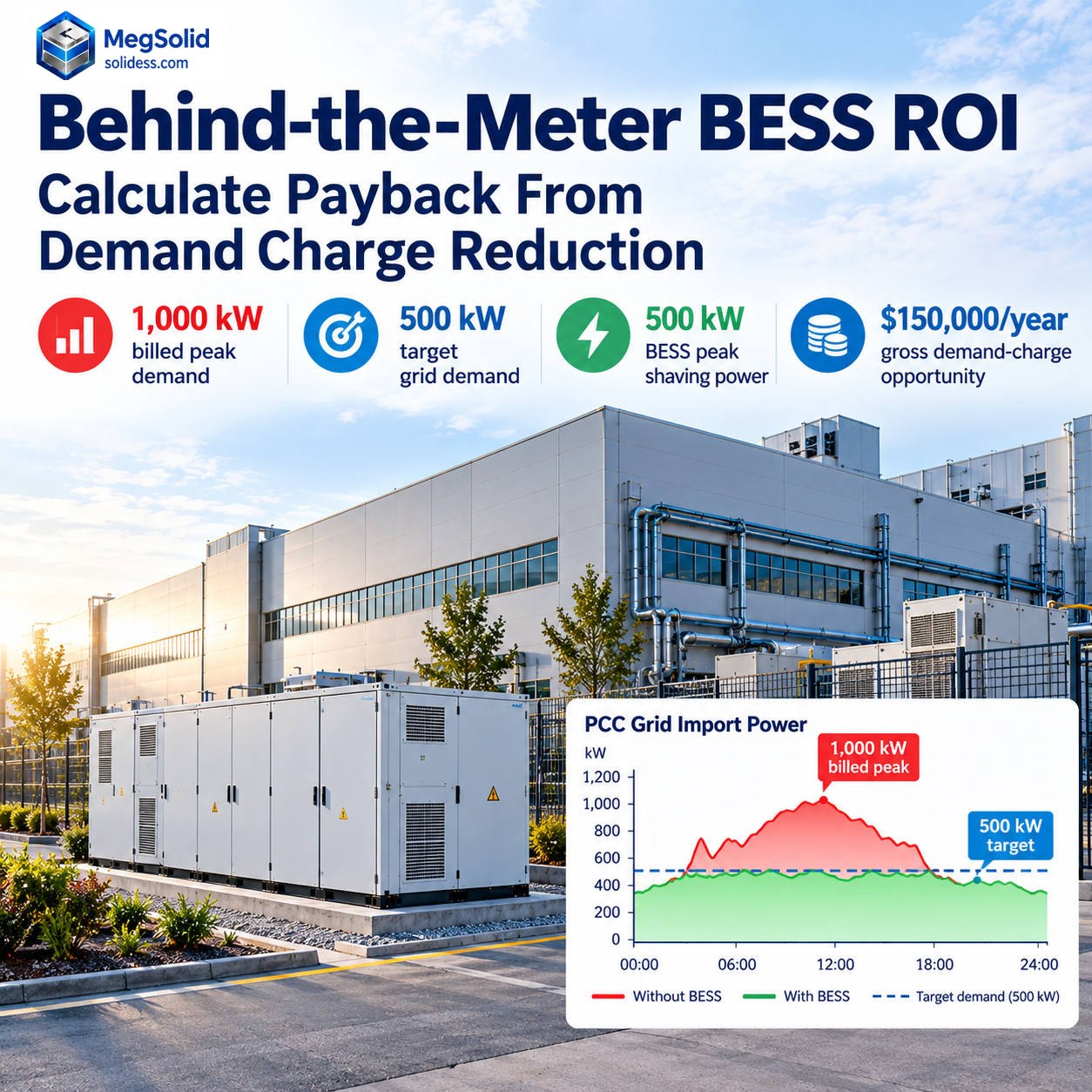
Commercial facilities can spend heavily on electricity even when total kWh consumption is not the main problem. The larger cost may come from the highest 15- or 30-minute demand interval on the bill. One production surge, HVAC peak, EV charging block or simultaneous motor load can establish the kW value used for the month's demand charge.
MegSolid C&I energy storage systems address that billed-demand problem by supplying the power above the selected grid limit.
Behind-the-meter BESS ROI starts with the peak-reduction calculation:
Billed peak demand − target grid demand = required peak-shaving power
Facility demand of 1,000kW against a 500kW utility-meter target requires approximately 500kW of BESS output during the billing peak.
Set the Investment Boundary From Annual Demand Savings
How much annual demand-charge savings can that 500kW reduction create, and how much net BESS CAPEX can those savings support at the required payback period?
Separate Energy Charges From Demand Charges Before Sizing BESS
BESS ROI analysis becomes unreliable when the financial model starts with battery size instead of the tariff.
The first document to review is the utility bill. The second is the interval load file.
Read kWh and kW as Different Billing Inputs
kWh represents total energy consumed over time.
kW represents the demand level reached during the billing interval.
Facilities may consume the same monthly kWh but pay more when they create a higher short-duration demand peak.
Consider:
- Monthly energy consumption: 300,000kWh
- Existing peak demand: 1,000kW
- Demand tariff: $25/kW-month
- Target demand after BESS: 500kW
Calculate the Annual Demand-Charge Opportunity
- Existing monthly demand charge: 1,000kW × $25/kW = $25,000
- After peak shaving: 500kW × $25/kW = $12,500
- Monthly gross reduction: $12,500
- Annual gross demand-charge opportunity: $12,500 × 12 = $150,000
The $150,000 becomes the first cash-flow line in the investment model.
Check Demand Ratchets Before Setting the BESS Target
Some commercial tariffs do not simply reset demand every month.
Demand ratchets can establish minimum future billed demand from a percentage of a previous peak. One extreme demand event can affect more than one billing period.
Before specifying BESS, collect:
- demand charge in $/kW or $/kVA
- billing interval
- ratchet formula
- seasonal demand rates
- TOU periods
- current billed peak
- interval demand history
MegSolid se 15-minute demand and ratchet analysis explains why the tariff clock matters before battery power is selected.
Control Behind-the-Meter Peak Shaving at the PCC
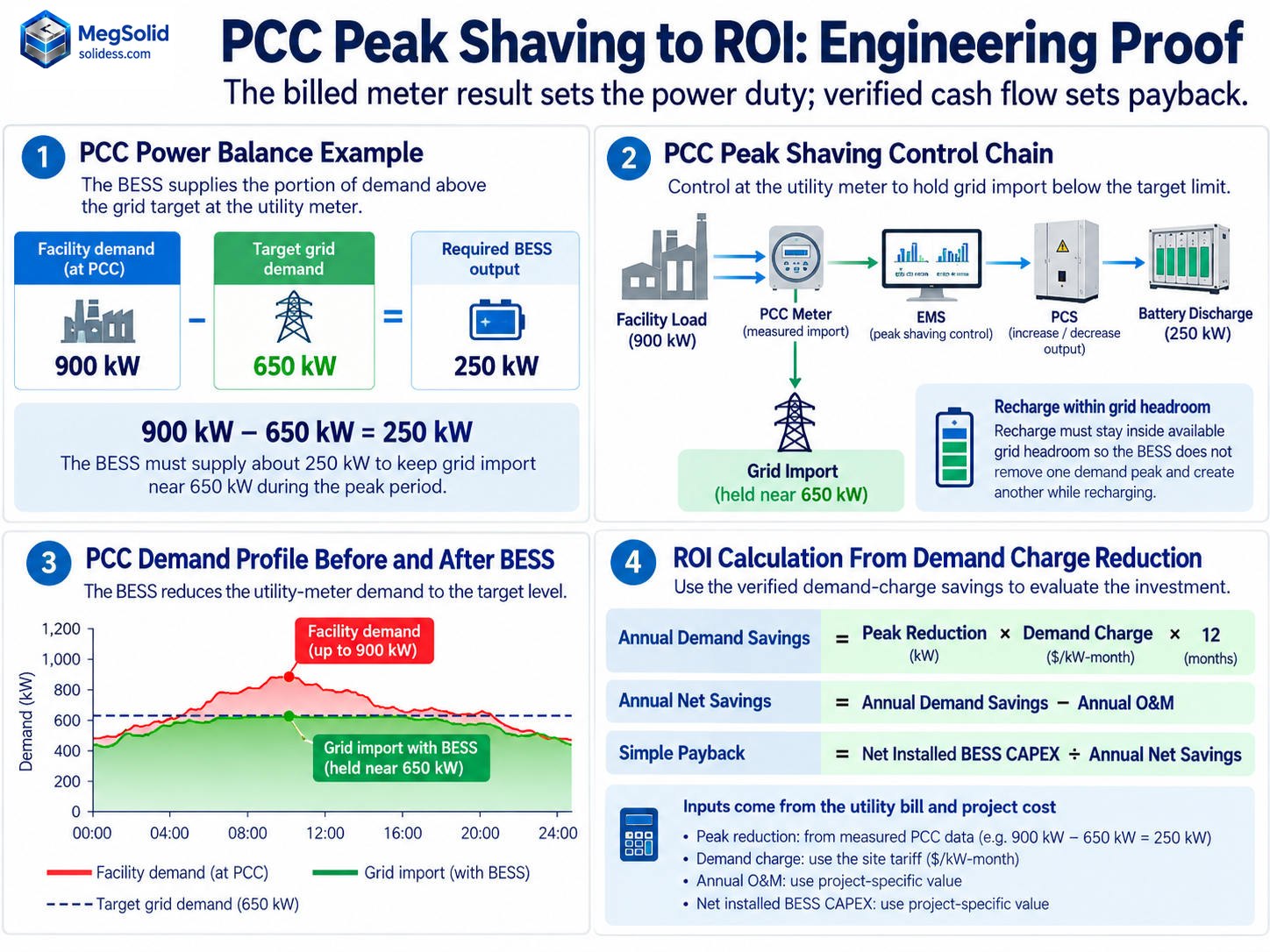
Behind-the-meter BESS supplies the portion of facility demand above the selected utility-meter target.
The facility still receives the full load power it requires.
The utility meter sees the controlled import level.
Measure the Billed Peak at the PCC
Peak shaving should be controlled at the PCC.
Site demand of 900kW against a 650kW target requires:
900kW − 650kW = 250kW required BESS output
The grid supplies approximately 650kW, while the BESS supplies approximately 250kW.
MegSolid se battery peak shaving control at the PCC focuses on the billed meter result rather than the PCS display.
Recharge must also stay inside available grid headroom. BESS EMS-prioriteitslogika coordinates discharge, charging, reserve and other operating priorities so the battery does not remove one demand peak and create another while recharging.
Keep Solar Savings Separate From Dispatchable Peak Shaving
Solar can reduce purchased kWh and daytime demand, but PV output is variable.
Cloud events, late-afternoon production peaks or high load outside the solar window can still create the month's maximum billed demand.
BESS adds dispatchable control over the residual peak.
The battery can discharge when the meter approaches the demand limit instead of depending on real-time irradiance.
Solar, load controls and demand response can all reduce demand. BESS handles the residual peak when the facility needs a dispatchable power source.
Build BTM BESS ROI From Demand Savings, TOU Value and Incentives
Demand-charge reduction should carry the base-case ROI.
TOU arbitrage and incentives should improve a viable project, not rescue a weak demand-charge business case.
Use Demand-Charge Reduction as the Base-Case Cash Flow
Demand-charge reduction is the core value stream when the tariff has a material demand component.
First-pass demand-savings formula: peak reduction × demand rate × applicable billing months.
500kW × $25/kW-month × 12 = $150,000/year
The final model should adjust for seasonal rates, ratchets, battery availability and whether the BESS can capture every relevant monthly peak.
Engineering detail behind peak-shaving power and duration is available in MegSolid's commercial peak-shaving design guide.
Add TOU Arbitrage Only After Demand Protection
TOU arbitrage adds another cash-flow stream when the peak/off-peak price spread is large enough.
If the battery charges at $0.05/kWh and offsets electricity worth $0.25/kWh, the gross price spread is $0.20/kWh before:
- conversion losses
- auxiliary consumption
- degradation
- tariff restrictions
- demand-charge interactions
Demand-charge protection should keep priority.
Battery dispatch should not chase a small TOU gain and then enter the facility's demand peak with insufficient SOC.
Apply Incentives After Technical Sizing and Base-Case Savings
U.S. projects can add applicable federal tax treatment to an already viable demand-charge business case.
Eligible storage projects may qualify for the Section 48E Clean Electricity Investment Credit. The base credit is not automatically 30%; the increased credit depends on the applicable project conditions and labor requirements.
Qualified storage may also be eligible for five-year MACRS depreciation.
Projects outside the United States should substitute the applicable local incentive, rebate and depreciation rules.
Incentives belong after technical sizing and base-case savings.
Incentives should improve the project, not justify an oversized system.
Calculate the Investment Ceiling for a 500kW Peak-Shaving Project
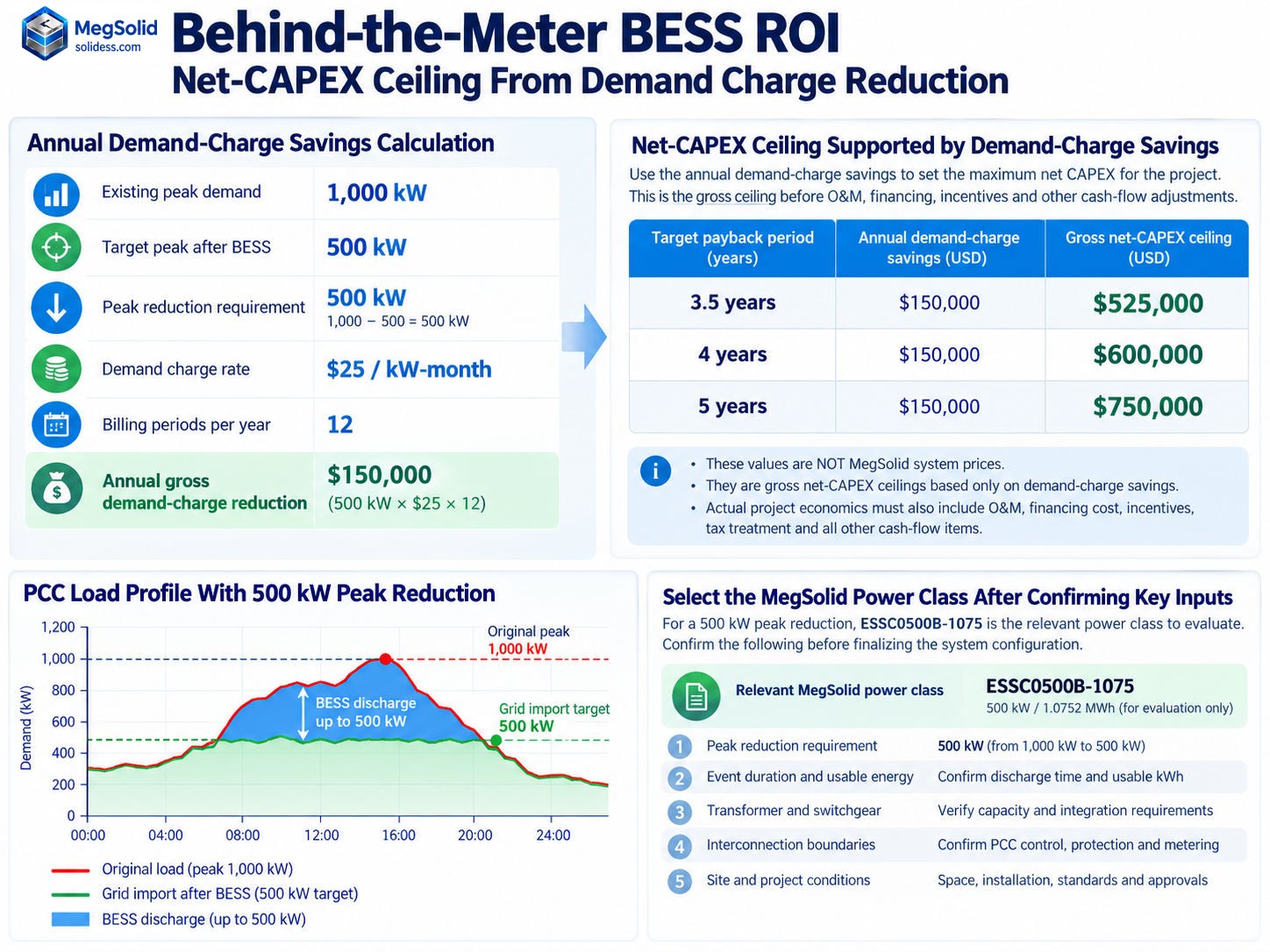
The 500kW peak-shaving project provides a useful scale for understanding the investment ceiling.
The Facility Profile
Assume:
| Financial Input | Waarde |
|---|---|
| Existing peak demand | 1 000 kW |
| Target peak reduction | 500kW |
| New grid-demand target | 500kW |
| Demand charge | $25/kW-month |
| Billing periods | 12/year |
Die ESSC0500B-1075 500kW / 1.0752MWh power class can be evaluated for this duty after event duration, usable energy and site electrical boundaries are confirmed.
The Financial Breakdown
Convert Peak Reduction Into Annual Savings
- Gross monthly demand-charge reduction: 500kW × $25/kW = $12,500
- Gross annual reduction: $12,500 × 12 = $150,000
Convert the annual savings into an investment ceiling.
Convert Annual Savings Into a Net-CAPEX Ceiling
- 5-year target: $150,000 × 5 = $750,000
- 4-year target: $150,000 × 4 = $600,000
- 3.5-year target: $150,000 × 3.5 = $525,000
These figures are not MegSolid system prices.
They show how much net project CAPEX the demand-charge savings can support at different simple-payback targets before O&M and other cash-flow adjustments.
The calculation gives the CFO a clearer procurement boundary:
| Target Payback | Gross Net-CAPEX Ceiling From Demand Savings |
|---|---|
| 3.5 years | $525,000 |
| 4 years | $600,000 |
| 5 jaar | $750,000 |
If the final net installed CAPEX is above the CFO's target ceiling, the project needs additional value from TOU savings, incentives or another verified cash-flow stream.
If it falls below the ceiling, the project may beat the target payback.
Die 500kW BESS grid and transformer boundaries must also be included before CAPEX is finalized because transformer, switchgear or interconnection work can materially change the investment.
The Internal Rate of Return (IRR)
IRR requires a complete annual cash-flow model.
Inputs should include:
- installed CAPEX
- tax credits
- depreciation treatment
- annual demand savings
- TOU savings
- O&M
- degradation
- augmentation or replacement assumptions
- project life
- residual value
Generic 15%–25% IRR claims should not be presented as guaranteed project results.
The correct answer is the IRR produced by the facility's actual cash flows.
Build a BTM Energy Storage ROI Calculator From Real Cash-Flow Inputs
True ROI calculation needs more than peak demand and tariff data.
Otherwise it is only a demand-savings calculator.
Define the Calculator Inputs and Outputs
The calculator should request:
- Current Peak Demand (kW)
- Target Peak Reduction (kW)
- Demand Charge ($/kW-month)
- Net Installed BESS CAPEX
- Annual O&M
- Project Location
Return Four Core Financial Outputs
- Annual Demand Savings
- Annual Net Savings
- Simple Payback
- 10-Year Net Cash Benefit
Use These Base Calculator Formulas
- Annual Demand Savings = Peak Reduction × Demand Charge × 12
- Annual Net Savings = Annual Demand Savings − Annual O&M
- Simple Payback = Net Installed CAPEX ÷ Annual Net Savings
The next-stage calculator can add TOU value, incentives, degradation and annual cash flows for an IRR calculation.
The customer should then upload real utility bills and interval data for engineering verification.
Convert Demand-Charge Savings Into a Supportable BESS CAPEX
Behind-the-meter BESS ROI should be calculated from the utility meter backward.
Use the Meter-to-CAPEX Decision Sequence
Start with the billed peak, calculate the required kW reduction, convert that reduction into annual demand-charge savings, then convert the savings into a maximum supportable net CAPEX at the CFO's required payback period.
With 500kW of peak shaving at $25/kW-month, annual gross demand savings = $150,000. Before O&M and other cash-flow adjustments, that supports approximately:
- $525,000 net CAPEX at 3.5-year payback
- $600,000 at 4 years
- $750,000 at 5 years
Demand-charge reduction answers the ROI question through this cash-flow relationship:
the avoided utility cost becomes the cash flow that pays back the storage asset.
Send the Data Needed for the ROI Model
Stuur:
- three recent utility bills
- 15-minute interval data
- demand tariff
- ratchet terms
- TOU schedule
- transformer rating
- target payback period
MegSolid can use those inputs to define the required power and energy window and build a project-specific ROI model.
