
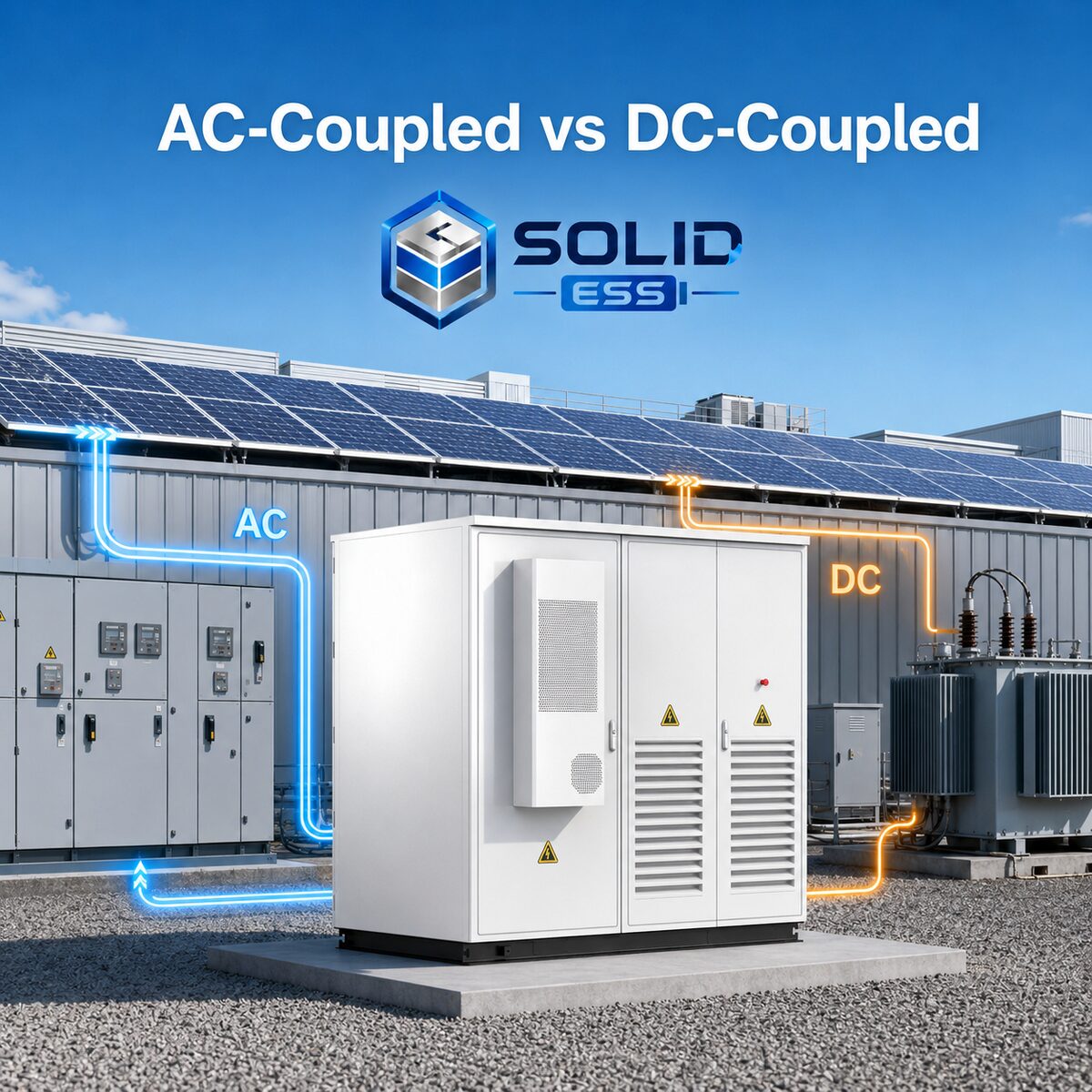
For an existing commercial PV plant with a healthy inverter, AC-coupled battery storage is usually the first retrofit architecture to test, provided the switchboard, transformer and PCC can accept the added battery PCS. DC coupling moves higher when PV repowering is already planned, measurable clipping has recoverable value, or local grid-connection rules favor one integrated solar-plus-storage plant.
Coupling topology does not determine battery size. Required PCS power and battery energy come from the site's load, discharge duration and operating duty; the AC/DC decision determines how that storage interfaces with the PV plant. Those separate design steps are covered in the C&I BESS design guide, BESS power-to-energy ratio guide en 400 V BESS-aansluitingsgids.
For a brownfield project, the architecture has to justify every part of the solar plant it forces the EPC to reopen. Fewer PV-to-battery conversion stages matter only when the recovered energy or operating benefit exceeds the cost of changed equipment, additional shutdown time, revised protection and control work.
Start With the Existing PV Asset, Not the Battery
A commercial PV retrofit should begin with the equipment already earning value on site. Before comparing AC-coupled and DC-coupled battery storage, establish what can stay, what is already due for replacement, and what electrical boundary the new BESS must work within.
| Kyk eers | Why it can change the architecture |
|---|---|
| PV inverter model and firmware | Determines available interfaces and control capability |
| Commissioning date | Shows how much service life may remain |
| Remaining warranty | Replacement can discard warranty value |
| PV DC nameplate | Establishes array size |
| Inverter AC rating | Establishes the present AC conversion ceiling |
| Strings and MPPT allocation | Shows how much DC-side redesign a retrofit would require |
| PV production data | Shows when usable solar energy is available |
| Site load data | Shows when PV surplus and battery demand actually overlap |
| PCC and export limit | Defines the grid-facing power boundary |
| Transformer and switchboard | Determines whether a separate battery PCS can be added |
Use synchronized operating data rather than monthly generation totals. Annual kWh cannot show whether the battery would have had energy available to charge when the target operating event occurred.
Inverter age changes the cost comparison immediately. A supported inverter commissioned three years ago still carries usable asset life and possibly warranty value. An eleven-year-old unit already listed for replacement is different: some inverter, protection and recommissioning cost already belongs to the site's repowering budget.
AC and DC Coupling Only Define the Electrical Meeting Point
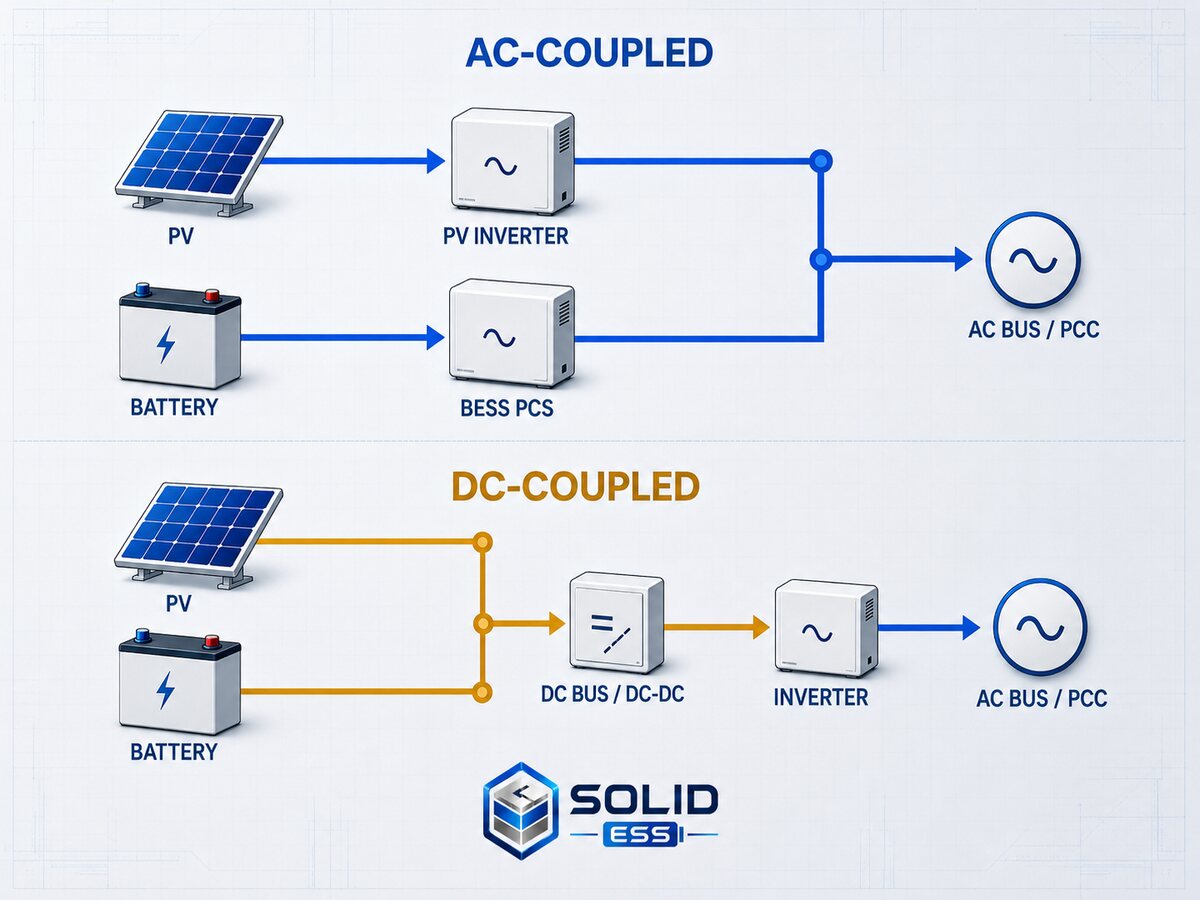
Coupling describes where the PV and battery power paths meet. It does not determine battery kWh, backup capability or export-control performance by itself.
AC-Coupled Path
The main energy paths are:
-
PV → Load:
PV → PV inverter → AC load -
PV → Battery:
PV → PV inverter → AC bus → BESS PCS → battery -
Battery → Load/Grid:
Battery → BESS PCS → AC bus
DC-Coupled Path
| argitektuur | Main retrofit consequence |
|---|---|
| AC coupled | Preserves more of the existing PV DC system, but adds another AC converter |
| DC coupled | Integrates PV and battery more tightly, but can reopen voltage, MPPT, current and DC-protection design |
A battery should not be assumed compatible with the DC inputs of an existing grid-tied inverter. Voltage windows, current, MPPT allocation, protection, isolation and converter control all require verification.
Application and Dispatch Can Reverse the Obvious Architecture Choice
“Existing PV favors AC; greenfield solar-plus-storage favors DC” is only a first screen. Realistic dispatch assumptions can change BESS sizing, project economics and the preferred architecture. pv magazine
| Primary duty | Architecture question to resolve |
|---|---|
| Piekvlakvermindering | Can BESS dispatch independently against the PCC target? |
| Son-selfverbruik | How much PV surplus exists when the battery can charge? |
| Clipping recovery | Can storage reach energy above the existing inverter ceiling? |
| Grid arbitrage | How often will charging come from the grid? |
| Export control | Which controller and actuator enforce the PCC target? |
| Hybrid dispatch | What common limit constrains PV + BESS? |
| Backup | How much SOC must remain reserved? |
| Grid services | Does the PCS and interconnection path support the duty? |
Freeze an operating-mode table before topology selection:
Mode → Charge source → Discharge target → SOC window → Power limit → PCC target
The First Commercial Decision: Keep or Replace the Existing PV Inverter
Before a DC retrofit assumes inverter replacement, answer:
- 1. Is the installed inverter still supported?
- 2. Is replacement already in the repowering budget?
- 3. What new value becomes available only after replacement?
- 4. Does that value exceed the incremental equipment, engineering and outage cost?
| Inverter condition | Architecture implication |
|---|---|
| Healthy + supported | Preserve first; evaluate AC |
| Significant warranty value | Replacement needs a stronger case |
| End of life / obsolete | Compare AC and DC again |
| Replacement already funded | Do not charge all replacement cost to DC |
| Major repowering planned | DC becomes more credible |
| Existing inverter cannot support future duty | Redesign may be unavoidable |
Current Australian hybrid-project discussions have similarly identified inverter age and existing connection agreements as material retrofit constraints. Energy-Storage.News
AC Coupling Can Preserve an Operating Solar Asset
The main brownfield advantage of AC coupling is scope preservation.
| Preserve where possible | Add or revalidate |
|---|---|
| PV modules and strings | BESS cabinet |
| Existing PV inverter | Battery PCS |
| PV MPPT configuration | AC feeder and breaker |
| PV DC cable routes | Switchboard capacity |
| Existing PV monitoring | PCC meter / CTs |
| PV-side maintenance procedures | EMS / plant controller |
| Existing PV warranty boundary | Protection coordination |
This also limits responsibility creep between the original solar EPC and the new BESS scope.
At Australia's Mokoan Solar Farm, an 80 MWh BESS is being AC-coupled to an operational 58 MW solar farm, sharing the grid connection and operating with it as one asset. RenewEconomy
Do not reopen a working PV package unless the added value requires it.
DC Coupling Becomes Stronger When the PV Architecture Is Already Changing
DC coupling gains weight when the project is already replacing or redesigning the PV system.
Typical triggers include:
- inverter replacement;
- funded repowering;
- PV expansion;
- new PV+BESS construction;
- measured recurring clipping;
- grid-connection advantages from integration.
| Potential value | What must be proven |
|---|---|
| Less duplicated conversion / BoS | Which equipment actually disappears? |
| Clipping recovery | How many recoverable kWh exist? |
| Integrated connection architecture | Does the grid process actually treat it differently? |
Compare scheduled repowering + AC BESS with scheduled repowering + DC BESS, not a new DC system against a fictional zero-cost existing inverter.
Grid-Connection Rules Can Make DC Coupling the Faster Project
In Australia, 2026 industry discussions reported that some DC-coupled hybrid projects could reduce Generator Performance Standard or connection processing by up to about six months because PV and BESS were assessed as one integrated system. The same discussion warned that older inverter technology in retrofit projects can reopen connection work. Energy-Storage.News
That six-month figure is not a universal C&I assumption.
Check:
- Does a separate BESS PCS trigger a new study?
- Does PV inverter replacement reopen the existing approval?
- Can PV+BESS share the existing export allocation?
- Are they registered as one or separate assets?
- Which option preserves an already-approved connection?
Connection time and approval risk belong in the architecture cost model.
Compare Efficiency at the Same Path, Boundary and Operating Point
An efficiency comparison is valid only when three fields match:
- 1. Same energy path
- 2. Same measurement boundary
- 3. Comparable operating point
| Path | Architecture relevance |
|---|---|
| PV → Load | Battery conversion may not participate |
| PV → Battery → Load | DC may remove conversion stages |
| Grid → Battery → Load | PV-side advantage may disappear |
| Clipped PV → Battery → Load | Value may come from recovering inaccessible energy |
When reviewing an efficiency claim, ask:
- DC terminals or AC terminals?
- one-way or round-trip?
- auxiliaries included?
- what C-rate/power?
- what SOC and temperature?
For MegSolid Energon 261, the published 90% figure is maximum system efficiency, not a stated RTE.
Measure PV Clipping Before Assigning It a Dollar Value
ILR = PV DC nameplate ÷ inverter AC rating
Example:
600 kWp PV ÷ 500 kW inverter = 1.20
That does nie mean 100 kW is continually being lost.
Use:
- inverter AC output;
- DC / MPPT data;
- irradiance;
- temperature;
- operating status;
- timestamps.
Then calculate:
Measured clipped energy
↓
Energy available while BESS has charge headroom
↓
Energy recoverable by the proposed architecture
Only the final quantity belongs in the business case.
Clipping Is Not the Same as Export Curtailment
| Condition | Cause | Architecture implication |
|---|---|---|
| Inverter clipping | Conversion ceiling | DC storage may access otherwise lost energy |
| Export curtailment | PCC control action | AC or DC storage may help |
| Thermal derating | Temperature | Topology does not fix the root cause |
| Grid dispatch limit | External command | Depends on operating rights |
Do not put all curtailed energy into a spreadsheet labeled “clipping recovery.”
Export Limits Can Change the Architecture Decision
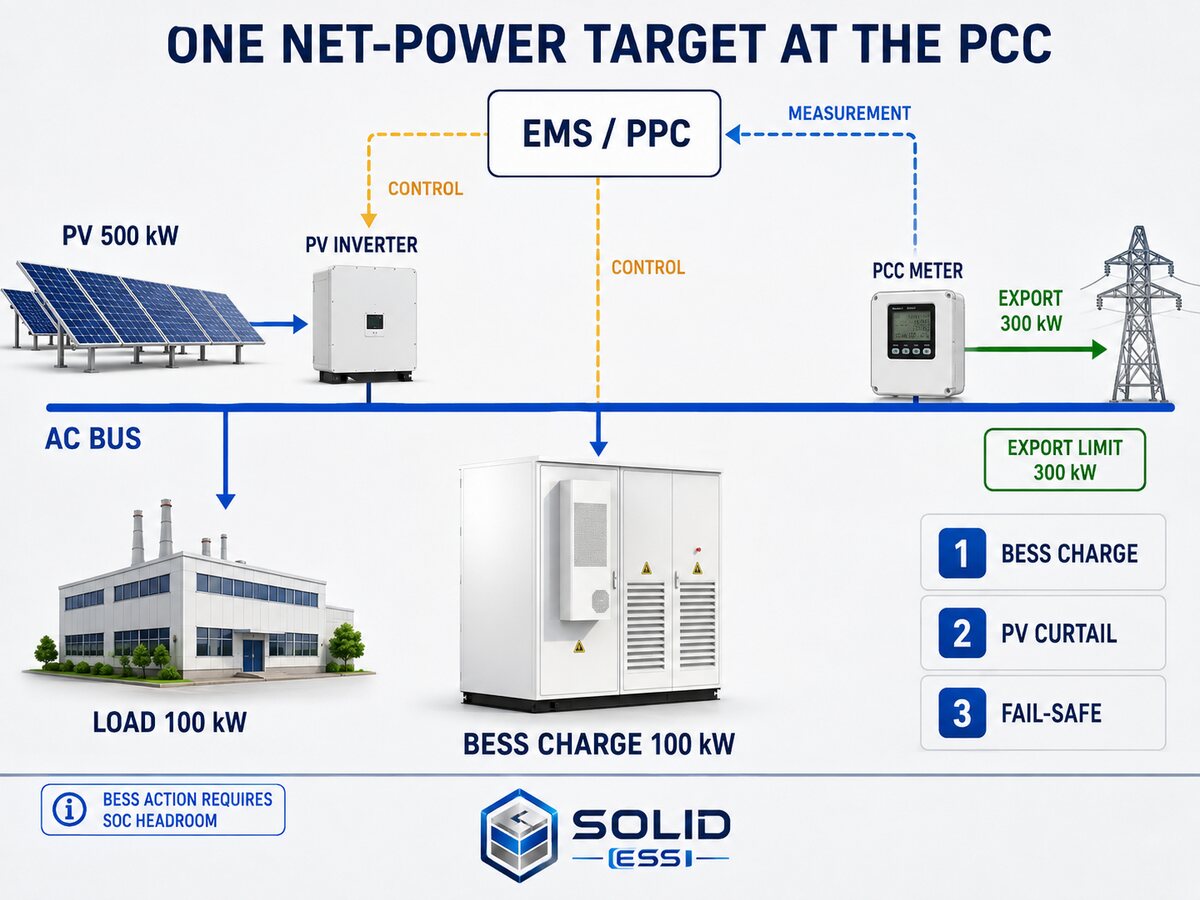
Example:
| Operating value | Krag |
|---|---|
| PV | 500 kW |
| Laai | 100 kW |
| Export limit | 300 kW |
500 − 100 = 400 kW potential export
The controller must remove 100 kW.
A practical hierarchy:
- 1. PCC meter detects excess export.
- 2. EMS requests BESS charging.
- 3. PV curtailment handles any remaining excess.
- 4. At full SOC, PV becomes the remaining actuator.
- 5. Communications failure invokes the defined fail-safe.
The selected architecture must support one net-power target at the PCC.
AC-Coupled Does Not Mean Operationally Separate
The Quorn Park project combines 98 MW solar with a 20 MW / 40 MWh AC-coupled BESS under a single hybrid Generator Performance Standard and one power plant controller. ESS News
| Laag | Verantwoordelikheid |
|---|---|
| BMS | Battery limits |
| PCS | Battery power execution |
| PV inverter | PV output |
| EMS / PPC | Coordinated plant target |
| PCC-meter | Actual boundary measurement |
Electrical coupling ≠ control integration ≠ grid registration.
Shared and Separate Inverters Create Different Power Ceilings
PV available    = 450 kW
Battery request = 150 kW
Shared inverter = 500 kW
The sources total 600 kW, but only 500 kW can pass the shared converter.
AC coupling separates converter limits, but combined output can still be constrained by:
Switchboard → Transformer → PCC → Export agreement
Always distinguish:
- converter ceiling
- interconnection ceiling
Existing Switchboard and Transformer Can Reject an AC Retrofit
| Check | Possible failure |
|---|---|
| Busbar | Insufficient current capacity |
| Breaker / feeder | No valid connection path |
| Transformer | Charge/load case exceeds rating |
| Cable | Ampacity fails |
| Beskerming | Coordination fails |
| Metering | PCC boundary incomplete |
| EMS | Cannot enforce actual headroom |
Preliminary charging screen:
Permitted BESS grid charge
≤ import/transformer headroom
− concurrent load
− margin
A 250 kW PCS does not create 250 kW of permitted charging power when only 80 kW of grid headroom remains.
Backup Power Is a Separate Architecture Decision
Battery installed ≠ backup available.
Backup still needs:
- grid-forming source;
- essential-load bus;
- utility isolation;
- anti-islanding;
- neutral/earthing design;
- PV behavior in island mode;
- generator coordination;
- restoration sequence.
AC/DC coupling only answers where PV and battery meet.
Compare Failure Domains and Serviceability
| Equipment unavailable | Separate AC architecture | Shared DC architecture |
|---|---|---|
| PV inverter | BESS may remain | Depends on shared converter |
| BESS PCS | PV normally remains | Depends on integration |
| Battery/BMS | PV may remain | Hybrid controls require review |
| PV DC fault | Battery may be separate | Common DC boundary needs study |
| EMS/PPC | Fail-safe required | Fail-safe required |
| PCC-meter | Control fallback required | Control fallback required |
Ask:
If this component is isolated for four hours, which site functions remain?
Expansion Means Three Different Things
| Expansion | Main effect |
|---|---|
| More PV kW | Solar production / inverter / clipping |
| More battery kW | Charge-discharge power |
| More battery kWh | Duur |
Specify future phases as:
Phase → PV kW → BESS kW → BESS kWh → PCC requirement
—not simply “expandable.”
AC Coupling Is Not Limited to Small Retrofit Systems
Current commercial products show AC coupling being engineered for three-phase C&I and modular MWh-scale storage. Enphase's 2026 C80 platform, for example, is AC-coupled and described as scaling from 80 kWh to 2 MWh while supporting third-party commercial PV inverters. Enphase
Project size alone does not choose topology.
Do Not Transfer Utility-Scale Cost Percentages Into a C&I Retrofit
Compare actual scope:
| Cost item | lugversorging | DC |
|---|---|---|
| Existing PV inverter | Usually retained | May change |
| Strings / MPPT | Usually retained | May change |
| Battery converter | Separate PCS | Shared/integrated |
| AC feeder | Usually added | Depends |
| DC protection | Limited changes | May expand |
| Recommissioning | Usually less PV-side work | Can increase |
| Approval impact | Site-specific | Site-specific |
Use:
Incremental installed cost
÷
Incremental lifetime value
—not a generic percentage from another project class.
Compare Total Retrofit Scope and Downtime
Track:
- PV outage;
- main-board outage;
- control cutover;
- recommissioning.
Total retrofit impact = CAPEX + engineering + shutdown cost + lost PV value + recommissioning
Where MegSolid Fits the Architecture
| Project need | Starting route | Grenze |
|---|---|---|
| ~100 kW cabinet-scale duty | ESSA0100B-0215 | 100 kW / 215,04 kWh |
| More cabinet energy / liquid cooling | Energon 261 | 261.24 kWh / 125 kVA |
| Separate PCS architecture | MEGA TS | 30–500 kW |
ESSA0100B-0215 controlled values include 100 kW, 215.04 kWh, 768 V, 0.5C at 25°C and intelligent air cooling. PV configuration choices are shown as 120 / 180 / 240 kW.
Energon 261 uses 314 Ah LFP and liquid cooling. Keep 125 kVA as apparent power and 90% as maximum system efficiency.
MEGA TS controlled PCS ratings run from 30 to 500 kW.
AC-Coupled vs DC-Coupled Commercial Solar Decision Matrix
| Condition | lugversorging | DC | Main evidence |
|---|---|---|---|
| Healthy existing inverter | Strong | Lower | Remaining asset value |
| Replacement planned | Strong | Strong | Incremental cost |
| Minimal PV modification | Strong | Lower | Retrofit scope |
| Material clipping | Limited | Stronger | Recoverable kWh |
| Piekvlakvermindering | Strong | Possible | Independent dispatch |
| AC connection constrained | Study | Potential | Final interface |
| New PV+BESS | Strong | Strong | Dispatch / BoS / grid |
| Backup | Separate study | Separate study | Island architecture |
Six Inputs Required Before Architecture Release
- 1. Existing PV inverter model, age and warranty
- 2. PV DC / inverter AC ratings and clipping evidence
- 3. Synchronized PV and load data
- 4. PCC, transformer, switchboard and export limit
- 5. Battery operating duty
- 6. Local interconnection treatment
Without these inputs, the topology is still a concept.
Final Selection Rule
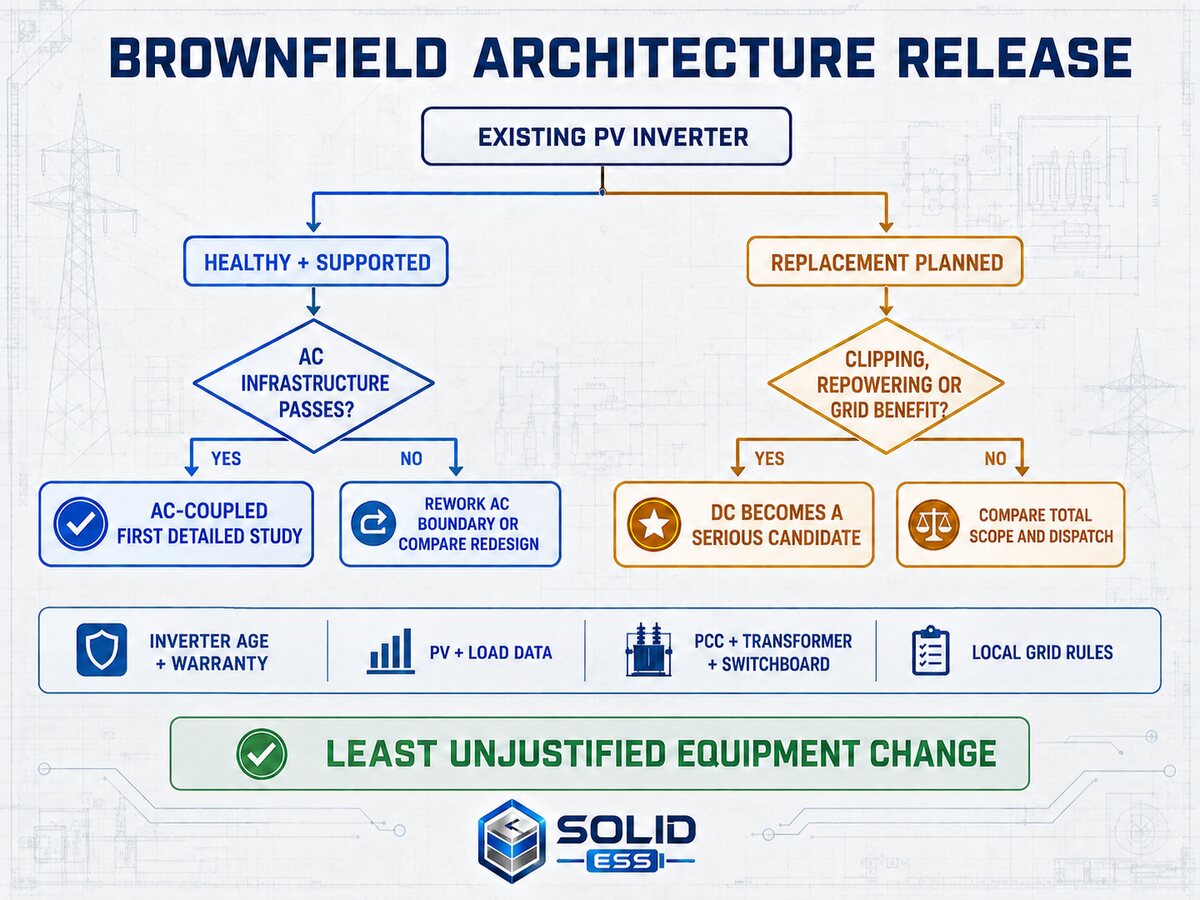
- Do not replace a useful PV asset without measurable added value.
- Do not claim clipping value without operating data.
- Do not release AC coupling before the common AC boundary passes.
The preferred architecture is the one that delivers the required dispatch at the PCC with the least unjustified equipment change and the strongest lifetime business case.
VGV
Is AC-coupled battery storage usually better for existing commercial solar?
AC coupling is normally the first retrofit screen when the existing PV inverter has useful life remaining and the AC system can accept another PCS. It preserves more of the installed PV asset, but switchboard, transformer, PCC and controls still have to pass.
When does DC-coupled battery storage become more attractive?
DC coupling moves higher when inverter replacement or PV repowering is already planned, measured clipping has recoverable value, or the local interconnection process favors an integrated solar-plus-storage plant.
Is DC coupling always more efficient than AC coupling?
No. Compare the same energy path, measurement boundary and operating point. DC coupling can remove conversion stages for PV-to-battery charging, but that advantage may matter less in a project dominated by grid charging or peak shaving.
Can an AC-coupled BESS recover PV clipping?
It can absorb surplus power that reaches the AC bus, but it cannot automatically recover DC energy the existing PV inverter cannot convert after reaching its AC ceiling.
How should a commercial project calculate solar clipping?
Use timestamped inverter AC output with available DC/MPPT data, irradiance and operating status. PV DC nameplate minus inverter AC rating is not annual clipped energy.
Is export curtailment the same as inverter clipping?
No. Clipping comes from a conversion ceiling. Export curtailment is an intentional control action at the PCC or another grid boundary.
Can AC-coupled PV and BESS operate as one coordinated plant?
Yes. A site EMS or power plant controller can coordinate separate PV and BESS converters against one PCC target.
Does a DC-coupled battery work with any existing PV inverter?
No. Battery voltage, PV voltage, current, MPPT, DC/DC conversion, protection and inverter control capability all require verification.
Does adding solar battery storage automatically provide backup?
No. Backup requires an island boundary, utility isolation, grid-forming capability where required, protected loads, protection and a defined restoration sequence.
Is DC coupling always cheaper?
No. Greenfield projects may remove duplicated equipment, while brownfield sites may already own valuable PV inverters and DC infrastructure. Compare the actual incremental installed scope.
What is AC-coupled commercial solar battery storage?
It uses separate PV and battery conversion paths connected on the AC side. In a retrofit, the existing PV inverter can often remain while the BESS uses its own bidirectional PCS.
What is DC-coupled commercial solar battery storage?
PV and battery are coordinated on the DC side before the main AC conversion stage, often using DC/DC stages and a shared or integrated inverter architecture.
What data should be collected before choosing AC or DC coupling?
Collect the PV inverter model and age, PV DC and inverter AC ratings, clipping evidence, synchronized PV/load data, PCC and transformer limits, battery operating duty and local interconnection requirements.