 Gaan na inhoud
'n Kommersiële BESS-kapasiteitstoets verander 'n katalogus-energiewaardering in projekbewys. MegSolid ondersteun EPC's, verspreiders en fasiliteitspanne wat moet vasstel hoeveel WS-energie 'n geleverde stelsel lewer oor 'n gedefinieerde ladingstoestandvenster, teen 'n ooreengekome kraginstelpunt, onder aangetekende werftoestande. Die toets beantwoord 'n oorhandigingsvraag: kan die geïnstalleerde stelsel die plig ondersteun wat in die projekdokumente geskryf is?
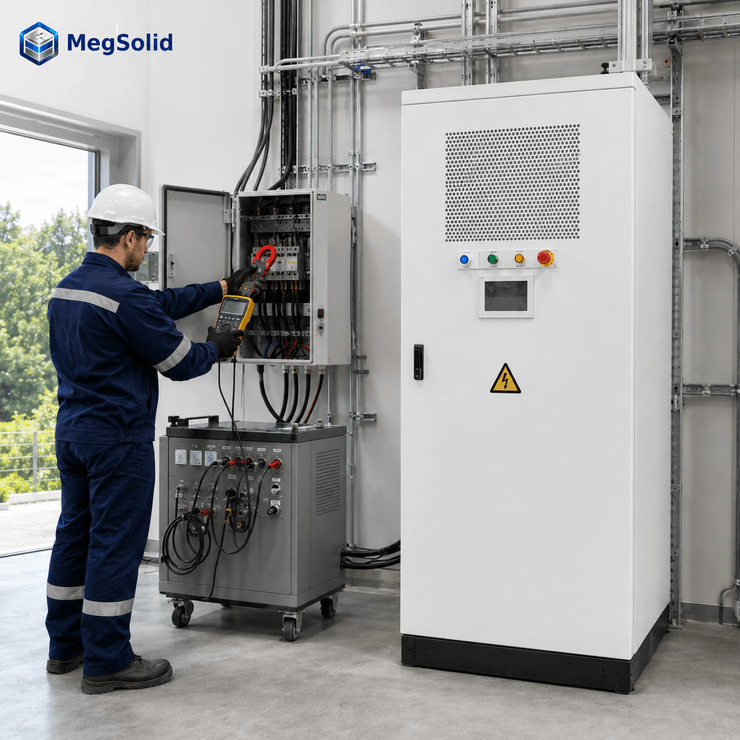
Hierdie bladsy dien kopers wat reeds 'n voorgestelde kas- of houerkonfigurasie het en 'n herhaalbare manier benodig om gelewerde energie te verifieer. Dit verskil van 'n groottebepalingsblad. Grootebeplanning gebruik die lasprofiel om 'n krag- en energieroete te kies. Kapasiteitstoetsing kontroleer die gelewerde resultaat na aanlegstelling of by 'n ooreengekome projekmylpaal. Daardie onderskeid beskerm beide kante van die aankoop: die koper ontvang 'n meetbare aanvaardingsrekord, terwyl die verskaffer werk volgens 'n vermelde toetsmetode in plaas van 'n ongedefinieerde verwagting.
| Projekvraag | Bewys om voor die toets saam te stem | Besluit beskerm |
|---|---|---|
| Hoeveel energie bereik die WS-grens? | Tydgestempelde WS kW en geïntegreerde WS kWh | Bruikbare energie vir die gedefinieerde taak |
| Kan die stelsel die aangevraagde uitset handhaaf? | Kraginstelpunt, kragfaktor en ontladingsduur | Piekvlakvermindering of rugsteunprestasie |
| Watter toestande het die resultaat gevorm? | SOC-venster, omgewingstemperatuur en bylas-opname | Regverdige vergelyking op kontrakgrondslag |
| Wat bewys aanvaarding? | Getekende metode, rou meter-uitvoer en finale verslag | EPC-oordrag en eienaarsrekords |
Wat 'n kommersiële BESS-kapasiteitstoets behoort te meet
'n Baterynaamplaat gee 'n beoordeelde energiewaarde volgens sy produkdefinisie. 'n Terreinproef meet die energie wat deur 'n gekose elektriese grens afgelewer is tydens 'n gespesifiseerde gebeurtenis. Albei waardes is belangrik, maar hulle beantwoord verskillende vrae. Vir 'n kommersiële projek moet die aanvaardingmetode aandui waar energie gemeet word en watter stelselladinge binne daardie grens lê. 'n Meter by die wisselstroom-uitset kan die energie beskryf wat beskikbaar is vir die terrein-kantverbinding. 'n Lezing aan die battery-kant beskryf 'n ander laag van die stelsel.
Gebruik die term afgelewerde AC-energie vir die toetsresultaat wanneer die ooreengekome meter by die AC-grens geplaas is. Dit kan bereken word uit die gemeete AC-krag oor die ontladingsinterval: Lewer AC-energie = Σ Plugversorging × Δt. Die verslag moet die meterinterval, begin tyd, eindtyd en totale geïntegreerde energie bewaar, sodat die eienaar die resultaat kan naspoor.
- Gegradueerde energie uit die ondertekende produkdokument
- Ooreengekome SOC-begin- en eindpunte
- AC-metinggrens en meteridentifikasie
- Aktiewe krag-setpunt en vereiste kragfaktor
- Duur van ontslag en enige vasgehoude periodes
- Omgewingstemperatuur, termiese beheerstatus en hulpenergierekord
Die Fabrieksaanvaardingstoetsgids vir batterye-energiebergingstelsel Help om die omvang van die fabrieksgetuie voor versending te bepaal. 'n Kommersiële kapasiteitstoets gebruik dieselfde dissipline ná installasie: goedgekeurde metode, geïdentifiseerde instrumente, aangetekende toestande en 'n resultaat wat met die ooreengekome aanvaarbasis vergelyk kan word.
Stel die aanvaardingbasis voor energisering in
'n Nuttige aanvaardinggrondslag is spesifiek genoeg vir 'n EPC om uit te voer en eenvoudig genoeg vir 'n eienaar om te oudit. Dit behoort ingesluit te word in die tegniese aanhangsel, inbedryfstellingsplan of terrein-aanvaardingprosedure. Om die betekenis van bruikbare energie oop te laat, skep vermybare geskille omdat die gemeete resultaat sal wissel met die bedryfsvenster en die meetpunt.
| veld | Wat die dokument moet stateer | Waarom dit die resultaat verander |
|---|---|---|
| Energiegrens | AC-uitset, battery-DC-terminale of 'n ander gedefinieerde punt | Omskakeling en bykomstigheidsverbruik sit aan verskillende kante van elke grens. |
| SOC-venster | Begin SOC, einde SOC en BMS-limiete gebruik | Die toeganklike batteryvenster definieer die toetsenergie |
| Uitvoerplig | Teiken kW, kVA, drywingsfaktor en ontladingsprofiel | Hoër of veranderende uitset verander die bedryfsgebeurtenis. |
| Site conditions | Ambient temperature, ventilation state and thermal-control operation | Thermal conditions influence the permitted operating range |
| Meter method | Meter ID, accuracy class if specified, interval and export format | The team needs one traceable record |
| Pass criterion | Required value, tolerance, calculation method and sign-off roles | Everyone compares the same result |
For a facility with several critical loads, the buyer may choose an AC boundary after the essential-load panel. For a peak-shaving project, the boundary may sit at the BESS output or at a project-defined point that matches the demand-control architecture. The chosen boundary should follow the commercial duty and the single-line diagram. How EPCs evaluate energy storage systems in project deployment gives the wider engineering context for connecting this test scope to site interfaces and handover responsibilities.
Measure Delivered Energy at the Agreed AC Boundary
The AC-side result is especially valuable where the owner buys a complete storage system rather than a battery rack. The meter then captures the combined outcome of the battery, PCS, control settings and any agreed auxiliary loads inside the defined scope. It also lets the commissioning team compare the measured power trace with the requested duty cycle.
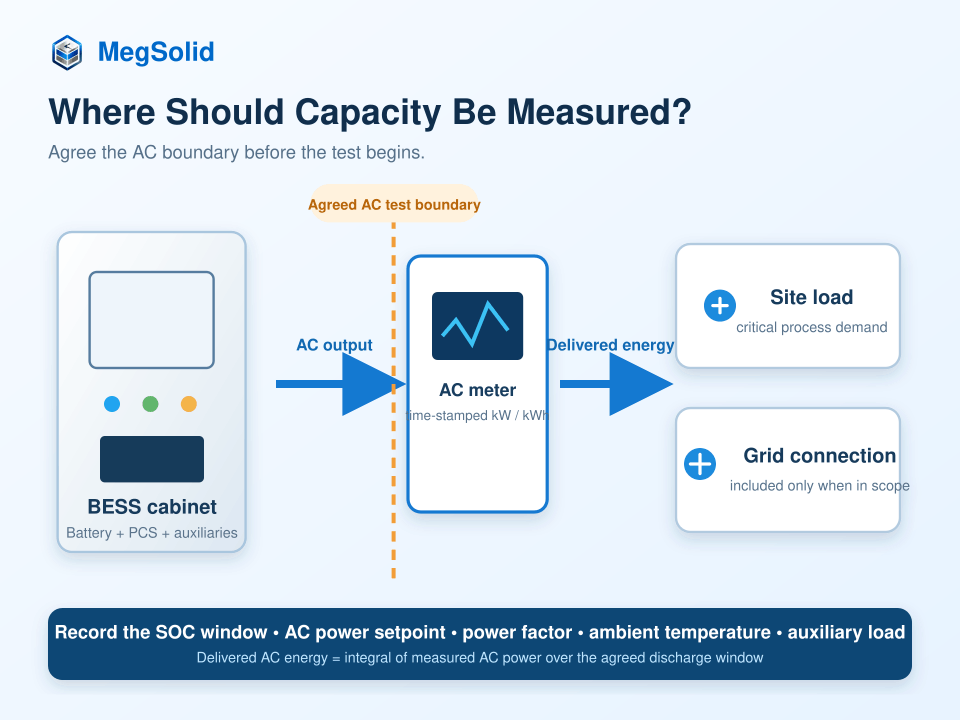
The PCS has a direct role in this measurement because it converts DC battery energy into AC output. The koopgids vir energieopberging-omsetters explains why AC rating, grid interface and control mode require project review. During capacity testing, document the PCS operating mode, setpoint and power factor alongside the meter values. A kVA line expresses apparent power; the corresponding kW depends on the agreed operating power factor.
Auxiliary consumption also needs a clear treatment. Cooling, controls and other support systems serve the operating system, yet the commercial meaning of their energy use depends on the chosen boundary. The procedure should identify whether the meter result includes these loads, whether they are reported separately, and how the contract compares the final figure.
Run the Test as a Controlled Operating Event
A practical test sequence gives every participant a common record. The exact values come from the approved project procedure, since model configuration, site grid conditions and owner duty vary. The sequence below provides an engineering structure rather than a universal pass value.
- Confirm the supplied model, serial-number record, software configuration and approved single-line diagram.
- Inspect the AC meter installation, clock synchronisation and data-export method.
- Record ambient conditions, thermal-control state, alarms and the agreed SOC start point.
- Charge or prepare the system according to the approved starting condition.
- Apply the agreed AC power setpoint and power factor for the defined discharge window.
- Export the interval data, record the ending SOC and attach event logs to the signed report.
The discharge profile should represent the intended duty. A constant-output test can support a defined runtime obligation. A site-load-following test can support a peak-shaving or critical-load duty when the procedure states how the load trace will be applied. A separate power step or transient test can verify response behaviour when that requirement belongs to the contract. Each test should retain its own boundary and calculation method.
Use Product Ratings Correctly When Defining the Test
MegSolid product data gives a starting point for a test plan, while the acceptance value still requires project confirmation. The ESSA0100B-0215 is a 100kW AC, 215.04kWh LFP outdoor cabinet with intelligent air cooling. The Meg-Solid Energon C&I system is rated at 261.24kWh, uses 314Ah LFP cells in a 1P260S configuration, carries a 125kVA PCS rating and uses liquid cooling. These are rated product values, rather than a site-specific delivered-energy promise.
| Model route | Verified product data | Capacity-test planning point |
|---|---|---|
| ESSA0100B-0215 | 100kW AC; 215.04kWh; LFP; intelligent air cooling | Agree the AC power setpoint, SOC window, ambient conditions and AC boundary before setting the acceptance method |
| Meg-Solid Energon C&I | 125kVA PCS; 261.24kWh; 314Ah LFP; 1P260S; liquid cooling | Agree power factor with the required AC kW, then define the SOC window and boundary for the capacity result |
| Containerized route | System design depends on the selected container and integration scope | Use a project-specific test protocol covering pooled power, controls and site interfaces |
Die outdoor cabinet energy storage system page provides the ESSA series context, while the 261.24kWh liquid-cooled C&I system page provides the Energon route. For the 261.24kWh system, the published 90% figure is a maximum-system-efficiency value. Keep that figure separate from a capacity-test energy result and from any project round-trip-efficiency requirement.
Cooling belongs in the condition record because temperature management affects the operating event. The correct selection discussion sits in how to choose between liquid-cooled and air-cooled BESS for commercial projects. A capacity report should identify the observed ambient temperature and thermal-control state, rather than trying to use a single test as a general cooling comparison.
Build an Evidence Package the Owner Can Use
The final value gains commercial meaning when an owner can review how it was produced. A complete package lets the project team trace the result months later during performance review, maintenance planning or an expansion decision. It also provides an efficient basis for supplier support because the actual configuration and event data travel together.
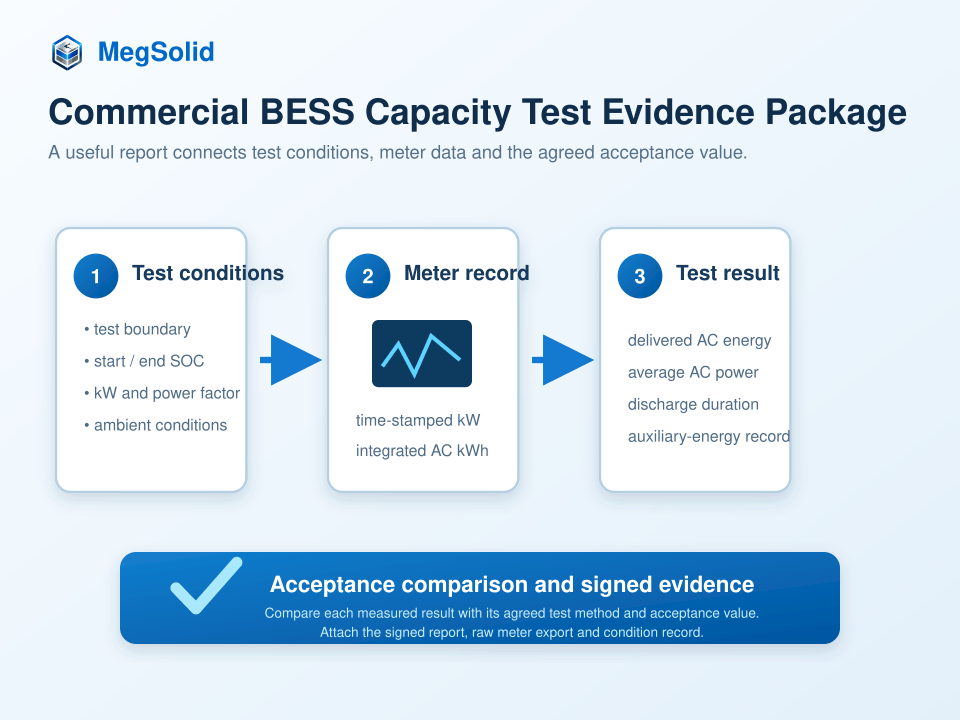
- Approved test procedure and signed acceptance criterion
- Single-line diagram showing the selected measurement boundary
- Meter identification, installation record and interval export
- SOC record, BMS event log and PCS operating-mode record
- Ambient and thermal-control condition record
- Calculated AC energy, average output, duration and sign-off page
When the test shows that the project needs a larger engineering route, capacity evidence helps the team explain why. A cabinet-scale project may move toward a larger pooled architecture when the required power, duration, controls or expansion plan change. Modular cabinets versus containerized ESS helps an EPC frame that wider system decision without treating a capacity result as an isolated number.
Information to Submit for a Project-Specific Test Plan
MegSolid engineering can review a project-specific capacity-test plan when the buyer shares the operating duty and acceptance basis early. The useful inputs are the proposed model, single-line diagram, required AC kW and kVA, power factor, target discharge duration, operating mode, SOC limits, test boundary, site temperature range and the owner acceptance format. This creates a focused engineering conversation and keeps the final test relevant to the actual commercial duty.
For a broader thermal or protection review, the commercial energy storage thermal-safety guide is a useful companion page. It covers a separate engineering question from capacity acceptance, helping project teams keep performance evidence and protection design in their proper workstreams.
VGV
What is a commercial BESS capacity test?
It is a controlled discharge test that records how much energy a completed BESS delivers through an agreed measurement boundary during a defined operating window. The procedure records SOC limits, output duty, meter data and site conditions.
Why does a BESS capacity test need an AC measurement boundary?
The AC boundary tells every participant where delivered energy is measured. It establishes whether the result represents a complete system output or another defined layer of the installation.
What is the difference between rated energy and delivered AC energy?
Rated energy is a product value under the product definition. Delivered AC energy is the measured test result through the agreed AC boundary, using the stated SOC window and operating conditions.
Which conditions belong in a BESS capacity test record?
Record the SOC start and end points, active-power setpoint, power factor, test duration, ambient conditions, thermal-control status, meter identification and auxiliary-load treatment.
Can a 125kVA BESS test be defined only in kW?
The test can use a kW output target when the project also states the operating power factor and the approved AC capability. The 125kVA rating expresses apparent power, so the operating point needs both parts of the electrical duty.
How should auxiliary energy be handled during capacity testing?
State whether the selected meter includes auxiliary loads and report the treatment in the method. Cooling, controls and related support loads can change the commercial interpretation of the result when they sit inside the chosen boundary.
What documents should accompany the final capacity result?
Attach the approved procedure, single-line diagram, meter export, SOC record, event logs, environmental record, calculation sheet and sign-off page. These items make the result traceable for the EPC and owner.
How does cooling affect a commercial BESS capacity test?
Cooling affects the operating conditions that accompany the discharge event. Record the ambient temperature and thermal-control state so the buyer can understand the conditions under which the energy result was obtained.
Which MegSolid cabinet data is relevant to a capacity test?
For ESSA0100B-0215, relevant published data includes 100kW AC, 215.04kWh LFP and intelligent air cooling. For the Energon route, relevant published data includes 125kVA, 261.24kWh, 314Ah LFP, 1P260S and liquid cooling. The project method defines the measured acceptance result.
When should an EPC prepare the capacity-test method?
Prepare it during detailed engineering and align it with the technical annex, single-line diagram, commissioning plan and owner acceptance process. Early agreement lets the site team install the right meters and capture the required evidence.
How should a South African C&I EPC document a BESS capacity test?
Use the same project-specific method: record the selected AC boundary, interval meter export, SOC window, AC power duty, ambient conditions and sign-off roles. Align the result with the local interconnection scope and the owner handover package.
What should a Nigerian commercial storage buyer request before site handover?
Request the signed capacity-test procedure, AC meter data, final energy calculation, BMS and PCS event record, thermal-condition record and the stated acceptance comparison. These records make the delivered-system discussion clearer for the owner and EPC.
How can a Saudi Arabia C&I project account for high ambient temperature during testing?
Record the actual ambient temperature, thermal-control condition, output duty, SOC window and any approved derating logic that applies to the supplied configuration. Compare the result with the project-specific acceptance method for that operating condition.
How is delivered AC energy calculated in a commercial BESS capacity test?
Delivered AC energy is calculated by integrating measured AC power over the agreed discharge interval: Plugversorging multiplied by each time interval and summed across the test. The meter export and calculation method should be attached to the report.
Does the 215.04kWh value equal the usable energy for every project?
The 215.04kWh figure is the published rated energy for ESSA0100B-0215. The project-specific usable-energy acceptance value depends on the agreed SOC window, AC boundary, output duty, site conditions and signed technical documents.
What should an owner approve before a commercial BESS capacity test begins?
Approve the measurement boundary, SOC window, power setpoint, power factor, test duration, meter method, environmental record, auxiliary-load treatment, calculation method and acceptance criterion. These items make the final sign-off process clear.
