
The wrong BESS layout can lock in an expensive exit before the first battery cycle. At 2 MW / 4.3008 MWh, two MegSolid ESSC1000B-2150 containers deliver the same combined rated power and energy as four ESSC0500B-1075 units, with two fewer containers to remove. That handling advantage holds only where the site can accommodate each 38-tonne lift and its transport route.
The place to settle this is the initial equipment and civil design. MegSolid publishes the dimensions and equipment mass for its ESSC containerized BESS series. Use those numbers to check the grid and civil constraints of 500 kW containers and compare available options in the MegSolid C&I range. Changing a layout on paper costs far less than rebuilding access after commissioning.
How Does Container Selection Change Future Decommissioning Costs?
The exit route deserves the same attention as the delivery route. A crane may be able to position a container during construction but struggle to retrieve it once fences, cables and neighboring equipment are in place. Confirm turning room, lift radius, ground bearing, per-unit mass and haul restrictions before finalizing the location of each unit.
MegSolid's ESSC models allow a direct comparison without changing the specified total rating. Both the 500 kW and 1 MW units list LFP cells, intelligent temperature-controlled air cooling and 400 V rated AC connection. Unit length and weight differ substantially, so the civil and decommissioning scopes differ as well.
| Same project rating | Four ESSC0500B-1075 units | Two ESSC1000B-2150 units |
|---|---|---|
| Combined rated AC power | 2,000 kW | 2,000 kW |
| Combined rated energy | 4.3008 MWh | 4.3008 MWh |
| Number of complete containers | 4 | 2 |
| Published mass per container | 21 000 kg | 38 000 kg |
| Combined published container mass | 84,000 kg | 76,000 kg |
| Individual container length | 6,058 mm | 12,192 mm |
| Published cooling method | Intelligente lugafkoeling | Intelligente lugafkoeling |
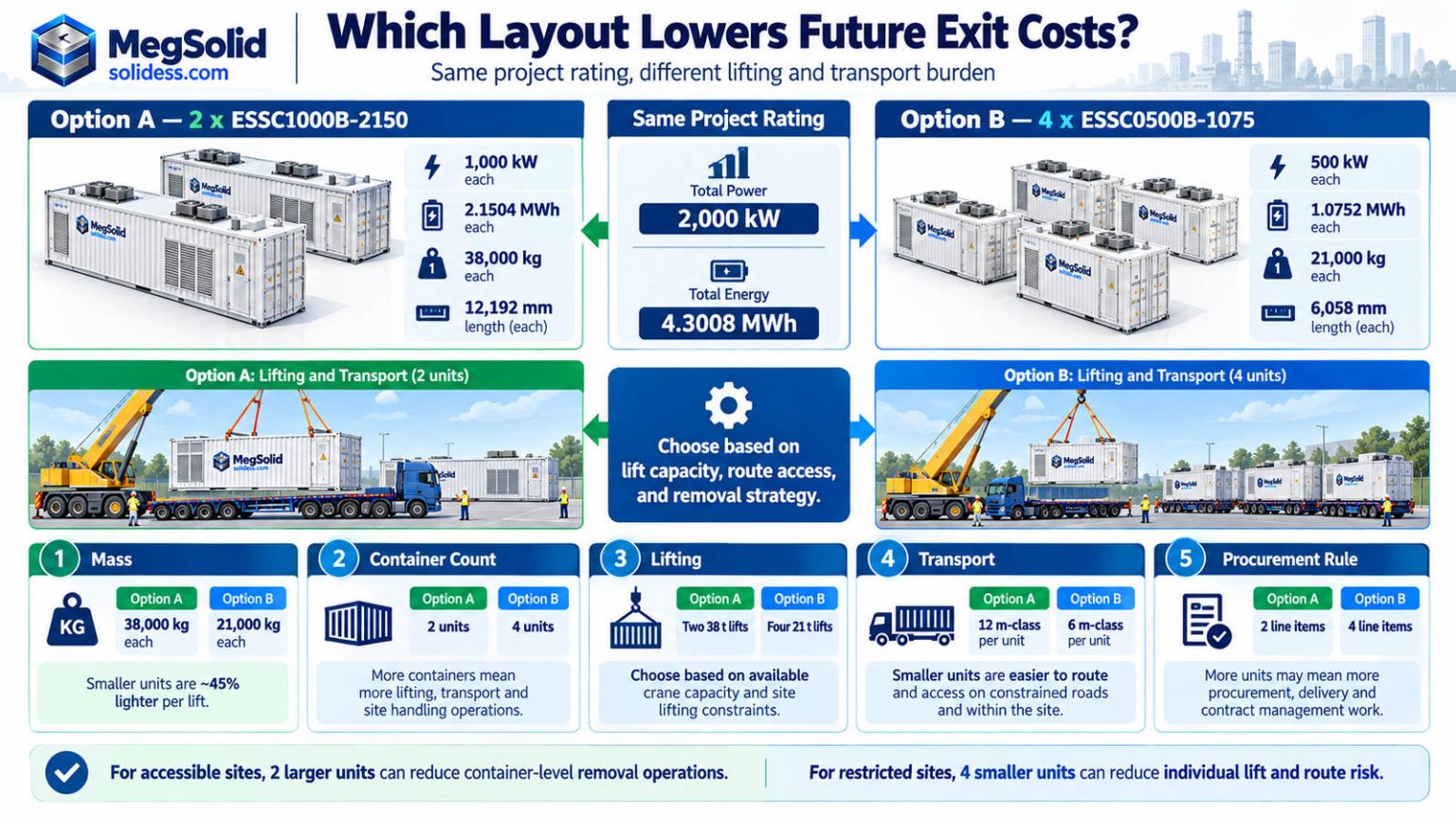
The comparison is striking: two units versus four, 76 tonnes versus 84 tonnes of combined published equipment mass, yet both layouts total 2 MW / 4.3008 MWh rated. Two larger units reduce the number of complete containers to disconnect and move. However, cranes are hired against the actual lift and radius, and transport contractors will price a 12.192 m load against the permitted route. Secure those quotations before calling either layout cheaper overall.
For an accessible 2 MW site, begin with two MegSolid ESSC1000B-2150 containers. The owner gets the specified total rating with fewer container-level removal operations. If the 38-tonne individual lift, access width or transport length exceeds the available site envelope, use four ESSC0500B-1075 units at 21 tonnes each instead. The right purchase depends on the physical site as much as the electrical schedule.
Die MegSolid 5000INTL requires its own retirement scope. Its 2.7 MW / 5.0159 MWh rating, 690 V AC interface and smart liquid cooling introduce different electrical and mechanical equipment into the removal plan. Lifting and shipping particulars must come from the controlled documents for the supplied unit. The 5 MWh system architecture also determines which cooling and auxiliary components need separate handling.
What Is the Safe Procedure for Decommissioning a Containerized BESS?
The moment a BESS stops operating is not the moment its hazards disappear. Battery DC energy, auxiliary circuits, connected equipment and fire-protection systems remain relevant during removal. A credible project plan assigns electrical, mechanical, battery and heavy-lift work to qualified parties with clearly defined boundaries.
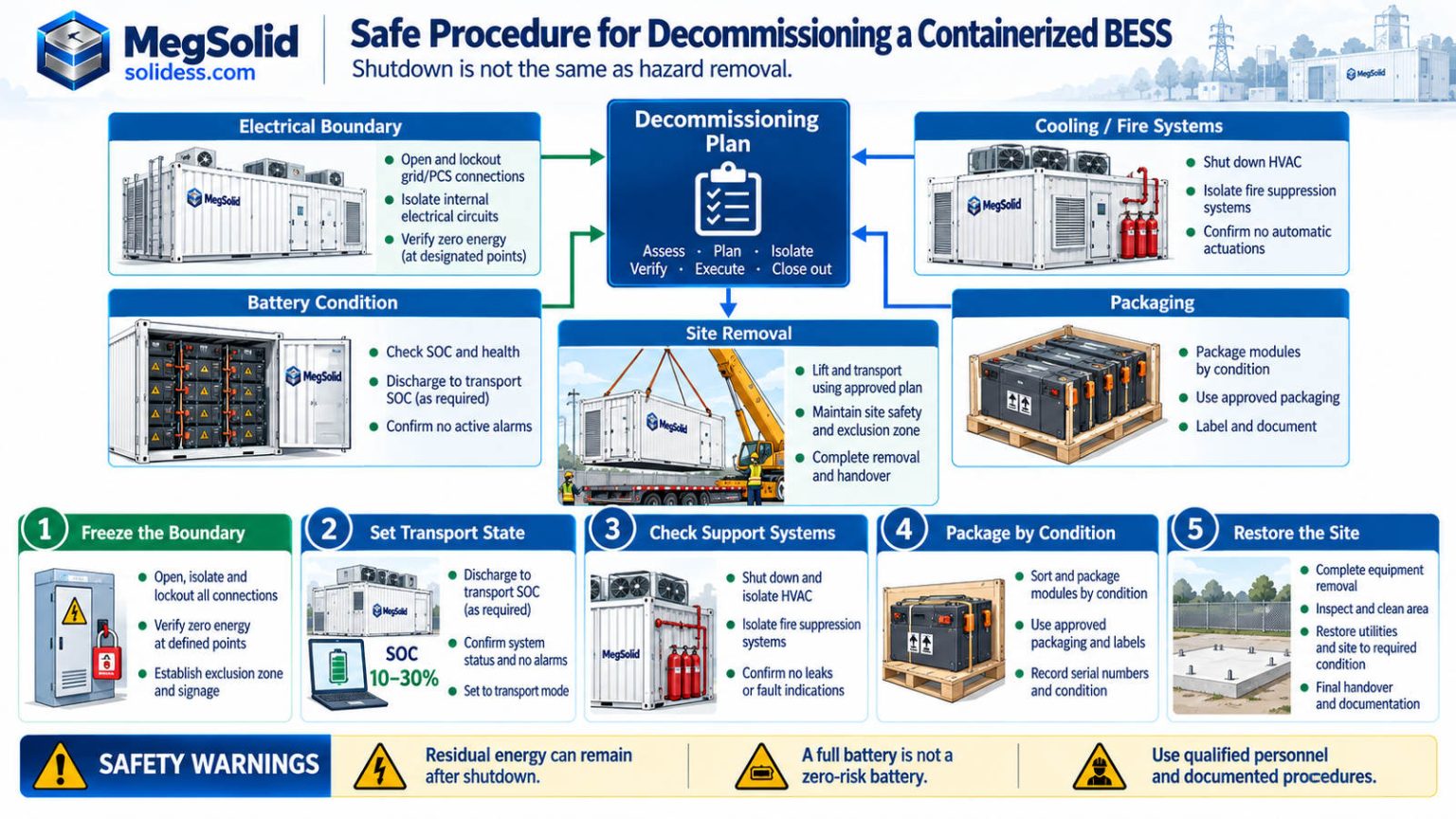
1. Freeze the electrical boundary and record the battery condition
Before scheduling the shutdown, gather the latest as-built single-line, string and module inventory, BMS fault records, nameplates and the locations of isolation devices. Identify equipment nearby that will remain energized. Qualified personnel can then plan switching authorizations and verify the appropriate energy controls; missing records often create avoidable delays on the first day of work.
Disconnecting the PCS is insufficient evidence that the DC side is safe. Battery strings, capacitors, contactors and auxiliary feeds each require their relevant hazard controls. In the United States, OSHA 29 CFR 1910.147 covers certain hazardous-energy activities but has exclusions, including some utility-controlled installations. The applicable electrical rules and site controls must be established by qualified personnel for the actual facility.
2. Establish a battery-condition-specific transport state
Remove any universal requirement to discharge retired batteries to 0% SOC. The value shown by a BMS cannot establish that the pack is harmless, and forced deep discharge can itself present problems. Battery condition, manufacturer guidance, transport mode and applicable dangerous-goods regulations determine what must be done before shipment.
Create a separate pathway for intact assemblies and for failed, damaged or potentially unstable ones. This early distinction helps select an appropriate specialist contractor, packaging approach, carrier and recycler. A single generic freight rate cannot cover all of these conditions honestly.
3. Account for cooling and fire-protection inventories
The cooling specification is a direct cost control. MegSolid ESSC0500B-1075 and ESSC1000B-2150 are air-cooled, so a liquid-coolant draining charge should not be included as though it were standard. Their published specification lists FM-200 / Novec 1230 suppression; a qualified service provider must determine what is actually installed and price the relevant recovery or disposal work.
The liquid-cooled 5000INTL changes that service scope. Its installed coolant circuit, piping and pumps require consideration alongside the fire-protection equipment. Treating every MegSolid container as if it contained identical thermal-management hardware would misstate the cost estimate.
4. Package batteries according to their actual condition
Battery consignment preparation needs specialist oversight. Before transport, the responsible parties must establish the batteries' condition and classification, short-circuit protection, packaging, shipping documents and a facility willing and permitted to accept them. Compare logistics quotations only after the same transport scope has been specified.
For US shipments, 49 CFR 173.185 applies to lithium batteries. Damage, defects or recalls may trigger additional requirements compared with screened intact batteries. Recycling is a destination, not a waiver of dangerous-goods transport controls.
5. Remove equipment and close the site boundary
When the batteries depart, the property may still contain containers, PCS equipment, cabling, foundations, trenches, drainage and fences. The executed lease and permits determine which assets must be removed and what condition the ground must be left in. These activities deserve their own civil work package and cost allowance.
Physical packaging changes that workload. In the cabinet-versus-container comparison, smaller cabinets can make individual handling easier, but a larger number of cabinets can increase isolation and lifting tasks. The EPC should price the complete installed yard and its restoration obligations.
Which Work Packages Belong in a Decommissioning Cost Estimate?
A site-wide $/MWh allowance makes serious omissions easy to miss. Specialist electrical work, battery packaging, road transport, crane hire and foundation removal have different quantities and contractor rates. Separate these packages in the estimate and show any salvage credit on its own line with its supporting terms.
| Werkspakket | Cost driver | What the EPC must fix before equipment purchase |
|---|---|---|
| Engineering and permits | Method statement, site surveys, waste classifications, approvals | Decommissioning boundary, jurisdiction and responsible contractor |
| Shutdown and electrical safing | Qualified labor, access time, switching, testing | Single-line diagram, points of isolation and live neighboring assets |
| Battery handling | Number, condition, mass and packaging of battery assemblies | Model-specific inventory, battery condition and receiving-facility requirements |
| Transport | Vehicle type, road restrictions, route distance and dangerous-goods status | Per-unit lift mass, length, loading method and destination |
| Cooling and suppression | Installed agent/coolant inventories, licensed service work | Exact purchased cooling and fire-protection configuration |
| Cranes and civil work | Lift radius, ground bearing, foundation design, access road | Whether 21-tonne or 38-tonne ESSC units can be handled |
| Treatment and recycling | Chemistry, acceptance rules, processing contract and fees | Recycler quotation and chain-of-custody terms |
| Site restoration | Pads, underground assets, drainage, soil and land-use agreement | Which civil assets remain and what ‘restore’ actually means |
| Contingency and financial assurance | Cost escalation, changed regulation and asset condition | Review intervals, security instrument and owner responsibility |
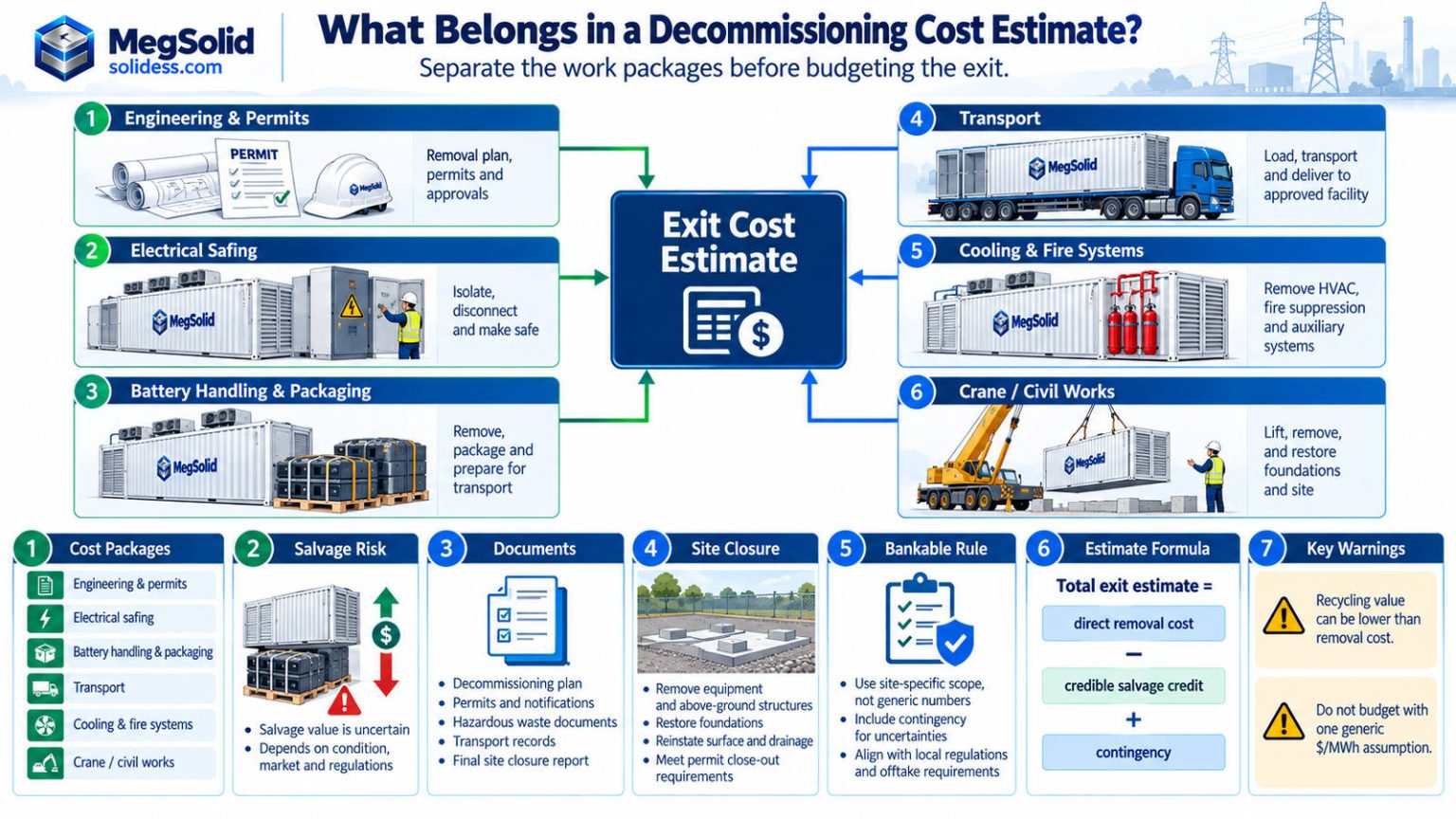
Start with the gross cost of dismantling, shipment, treatment and restoration. Reduce it by salvage only when lawful recovery and credible net proceeds can be demonstrated. Required financial assurance may be calculated under a permit or lease with its own rules; apply those obligations independently of the commercial model.
Equipment outside the battery containers can also affect the budget. The MegSolid MEGA PCS products are separate power-conversion equipment; any external transformer, PCS, cables and their removal or scrap value must be recorded explicitly if included in the project.
Get the equipment information while it can still influence the design. Contact MegSolid to compare its 500 kW and 1 MW ESSC configurations and obtain the model dimensions and interface information a qualified removal contractor needs for a realistic quotation.
What Do Real BESS Decommissioning Estimates Say About Cost per MWh?
Published BESS decommissioning estimates reveal which costs were counted; they do not provide a reusable $/MWh price. Project size, equipment scope, dollar year and treatment assumptions differ. The assumptions behind each total matter far more than dividing that figure by installed MWh and presenting it as the budget for a new site.
| Public estimate | Project basis | Published cost | Essential limitation |
|---|---|---|---|
| Midwater BESS decommissioning plan, Minnesota, September 2024 | 150 MW / 600 MWh | Approx. $1,215,643 gross; $596,492 estimated salvage; $619,152 net for the BESS site | The published itemized estimate does not separately price full battery-cell recycling and treatment as a distinct work package |
| EPRI model cited in the Indiana Office of Energy Development’s 2025 study | Modeled 20 MW / 10 MWh California BESS | Approx. $1.2 million in 2030 dollars | Includes modeled dismantling/packaging ($348,000), equipment removal ($292,000) and recycling ($545,500); not a current MegSolid quote |
The Minnesota Midwater estimate uses projected salvage for selected nonbattery infrastructure. Its published net site cost does not independently establish the price to recycle every cell in the 600 MWh system. The EPRI-based calculation cited in Indiana includes a modeled recycling item for a different project and dollar year. Neither figure is an all-inclusive MegSolid contractor quotation.
Applying the Midwater unit ratio directly to ESSC0500B-1075, or the Indiana estimate to 5000INTL, would ignore site work, contractor boundaries and actual battery condition. Obtain bids for lifting, transport and destination-facility acceptance against the specific equipment and location instead.
Include a finance case with no guaranteed salvage recovery. Separate any mid-life battery replacement or repowering from eventual plant decommissioning, and assign each cash flow to its expected period. An apparently simple terminal allowance can conceal a major difference in timing and responsibility.
Can Battery Recycling and Salvage Value Offset the Removal Bill?
Recycling proceeds are the most tempting number to overstate. Steel, aluminum and copper may be recoverable, yet pricing depends on condition, location, processing charges and future material markets. Show both a supportable recovery case and one with no salvage credit so the owner can see how much cash must remain available.
The chemistry matters: MegSolid ESSC units specify LFP batteries. A recovery estimate for nickel-rich chemistry does not translate directly to LFP. Get processor acceptance terms for the actual batteries and calculate the net result after compliant packaging, hauling and treatment fees.
Black mass is produced by battery processors using specialist methods. Ordinary waste-handling status does not authorize shredding batteries to produce it; the US EPA addresses that boundary for universal-waste handlers under 40 CFR Part 273. Engage appropriately authorized facilities and include their acceptance and processing costs.
Second-life resale cannot be treated as guaranteed income twenty years from now. Reuse requires acceptable battery condition, documented history, compatible controls and a destination that meets applicable requirements. Remaining capacity shown in a report is not a signed resale contract.
Record salvage income only where the recipient, battery condition and transfer terms are credible. The owner must still be able to pay for safe transport and site closure if the reuse market offers nothing at retirement.
Which Regulations Control Retired Batteries, Shipping and Site Restoration?
Three separate obligations often become one underestimated budget: electrical safing, lawful battery movement and restoration of the land. Product safety testing supports equipment evaluation; it cannot replace work authorizations, waste documentation or a lease-compliant closure. Assign the responsible party for each requirement under the governing jurisdiction.
United States: transport, waste handling and electrical isolation
US EPA guidance indicates that many discarded lithium-ion batteries will likely be hazardous waste, although applicable universal-waste provisions under 40 CFR Part 273 can offer a management route. State law, battery condition, storage arrangements and recipient facilities must be evaluated for the actual case. A low SOC display does not eliminate these duties.
US DOT requirements, including 49 CFR 173.185, address transport. Site electrical work follows separate applicable hazardous-energy rules and approved procedures. OSHA 29 CFR 1910.147 has scope limitations, including exclusions covering certain utility-controlled installations, so it should be applied only after confirming the facility and activity fall within its coverage.
The land agreement and local law determine restoration duties and any required security. Texas Utilities Code Chapter 303 took effect in September 2025 and sets financial-assurance provisions for covered battery energy storage facility agreements, including removal, recycling or disposal and restoration estimates with legally permitted salvage considerations. Other jurisdictions impose different requirements.
European Union: waste industrial batteries and producer responsibility
Regulation (EU) 2023/1542 covers industrial batteries and waste batteries and includes producer-responsibility, collection and treatment provisions. The responsible entities depend on the market-placement and ownership arrangements and the rules applied in the Member State. Contracts should identify each party's responsibilities for the actual project.
EU projects need a clear handover trail from battery holder to carrier and authorized treatment operator. The EU battery passport and traceability requirements support that recordkeeping, but documentation alone does not move or recycle the batteries. Price those licensed services separately.
Technical standards and the purchased configuration
IEC 62933-5-2 addresses safety for grid-integrated electrochemical storage; IEC 62619 concerns industrial lithium cells and batteries. Their technical boundaries can inform safety records for future maintenance and removal. Decommissioning still requires site-specific procedures and verified documents for any certification attributed to the selected MegSolid model.
What Should a Bankable EPC Contract Lock Down Before Ordering?
Leave “by others” in the EPC contract and the owner may spend years arguing over the bill. Spell out who maintains removal access, supplies records, appoints the hazardous-goods carrier and arranges removal of foundations. These decisions belong in the procurement contract while the parties still have leverage.
For the specified 2 MW / 4.3008 MWh installation, two MegSolid ESSC1000B-2150 units are the first option to evaluate where 38-tonne lifts and 12.192 m transport lengths are feasible. If the site rules them out, four ESSC0500B-1075 units, each 21 tonnes and 6.058 m long, maintain the aggregate rated output and energy. Compare real civil and logistics prices before signing.
Allocate as-built documentation, battery inventories, site access, electrical isolation, waste classification, shipping, receiving-facility contracts, underground services and restoration to named parties. Set a schedule for reviewing retirement estimates. Work left outside every party's scope has not become free work.
Any decommissioning security must follow the permit and land agreement, with reassessment when the plant or its cost environment changes. The commercial BESS procurement checklist helps connect the original AC and civil package to the responsibilities that will eventually be retired. A projected lifetime and uncontracted salvage income cannot substitute for funded obligations.
Before civil drawings are issued, confirm the exact equipment. Contact MegSolid for the selected ESSC model's dimensions, ratings and connections; those details allow qualified crane, freight and waste specialists to estimate work from a defined hardware scope.
Containerized BESS Decommissioning Costs: The Procurement Decision
Cheap hardware becomes expensive when the exit was never designed. Containerized BESS decommissioning costs are shaped by the unit size, count, access route and recordkeeping chosen at procurement, plus the removal and restoration obligations written into the contract.
MegSolid gives buyers an actionable decision between ESSC0500B-1075 and ESSC1000B-2150 through published ratings, mass and physical dimensions. Use them to settle an accessible layout now and obtain contractor-backed retirement costs. An owner should not reach the end of the asset's life only to discover that nobody priced how to take it off the property.
VGV
Which charges belong in a containerized BESS retirement budget?
Allow for electrical isolation, battery handling, compliant packaging and freight, treatment or recycling, installed fire-protection and cooling equipment, heavy lifts, other equipment, civil works, permits and contingency.
Is one decommissioning cost per MWh reliable?
Not across different sites. Battery condition, crane availability, transport routes, legal treatment and restoration obligations create material differences.
Does one 1 MW container always cost less to remove than two 500 kW units?
No. Fewer units can reduce handling steps, while the larger lift or longer load may increase contractor charges.
What changes between two ESSC1000B-2150 and four ESSC0500B-1075 units?
Both deliver 2 MW / 4.3008 MWh rated. Published equipment masses total 76 tonnes for two larger units and 84 tonnes for four smaller ones.
Can an EPC send retired lithium batteries to a general scrap yard?
No. Condition assessment, classification, packaging, dangerous-goods transport and approved receiving facilities all matter.
Is 0% indicated SOC required before transporting every battery?
No. Use manufacturer guidance, actual battery condition and the applicable shipping requirements. The SOC display does not determine safety by itself.
Will LFP battery recycling always return a profit?
No. Processing, packaging and transportation can outweigh any material value. Obtain a processor's actual terms.
Is the liquid-cooled 5000INTL retired like an air-cooled ESSC unit?
No. Its coolant circuit and associated mechanical components add work absent from the ESSC air-cooling configuration.
Must every BESS owner provide a retirement bond?
Requirements vary by local rules, permits and lease terms. Confirm the instrument and estimate for the specific project.
Which MegSolid data helps a contractor estimate removal?
ESSC power and energy ratings, published unit mass and dimensions, cooling method and electrical interfaces provide a starting equipment scope.
When do two ESSC1000B-2150 containers make sense?
For 2 MW / 4.3008 MWh when the electrical design, 38-tonne individual lift and 12.192 m transport envelope are feasible.
What makes supplier decommissioning bids comparable?
Equal rated power and energy, identical removal boundaries, verified lift loads, battery condition, freight conditions and recycling and restoration scope.
How can developers control restoration exposure over time?
Preserve haul access, keep accurate civil records, allocate liability in contracts and update removal prices and financial assurance.