
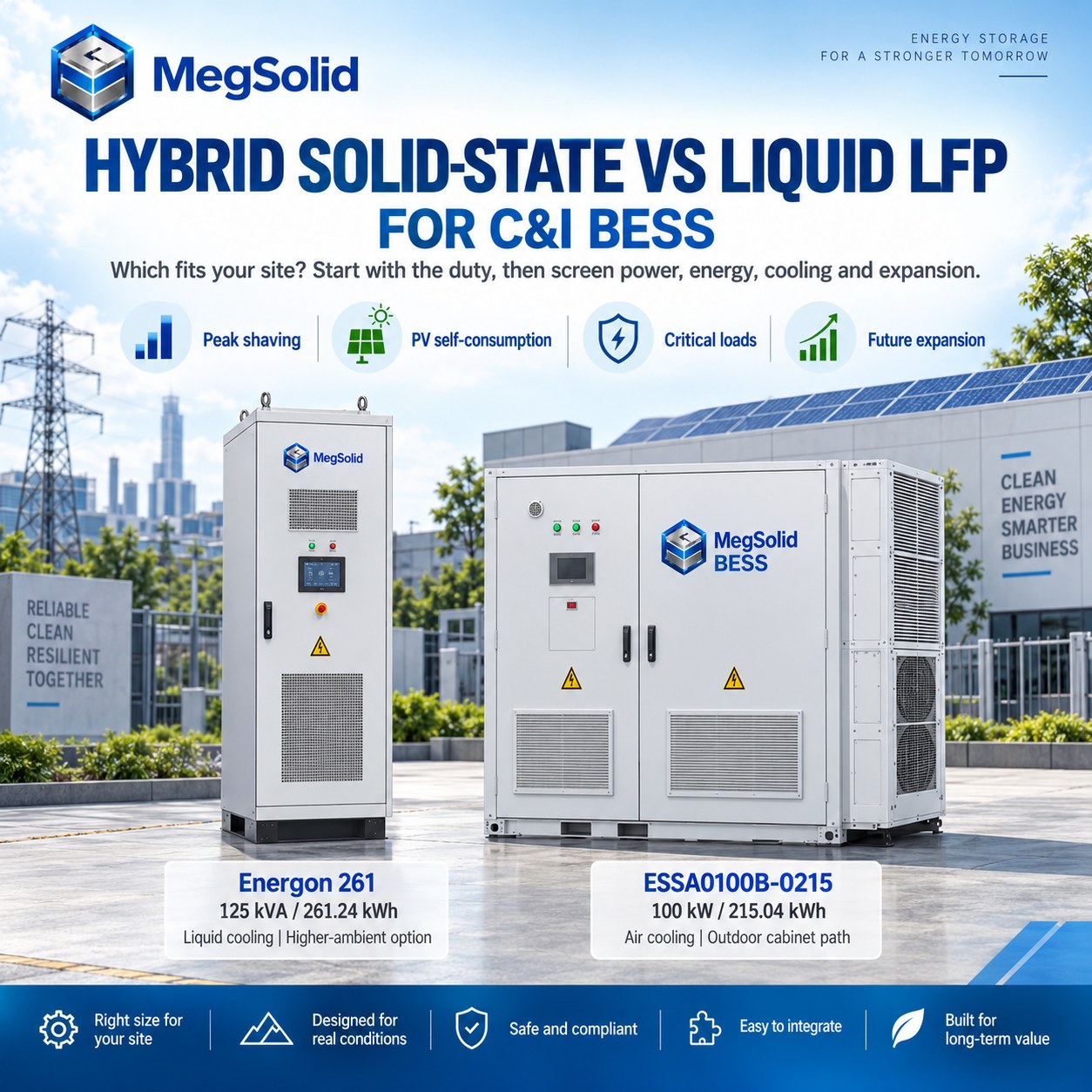
C&I-kopers wat hibriede vaste toestand met vloeibare LFP vergelyk, probeer gewoonlik eers 'n terreinprobleem oplos: vraagpieke sny, oortollige PV-energie stoor, kritieke laste ondersteun of kapasiteit byvoeg sonder om die elektriese kamer te herbou. MegSolid spreek daardie take aan met buite-kaste en vloeibare-gekoelde C&I-bergingsopsies wat by krag-, energie-, verkoeling- en uitbreidingsvereistes aangepas kan word.
Die 100 kW / 215 kWh buite-kas is geskik vir terreine wat 'n kompakte piekvermindering- of lasverskuiwingstelsel met parallelle uitbreiding benodig.
Die 261 kWh/125 kVA vloeistofgekoelde opsie bied kopers 'n ander keuse waar verkoelingargitektuur en hoër omgewingsbedryf meer saak maak. Die chemiese vergelyking kom nadat die terreinplig duidelik is en die toerustingpad teen krag-, energie-, verkoeling- en uitbreidingsbehoeftes geëvalueer kan word.
Begin met die webwerfplig, kies dan die bergingspad.
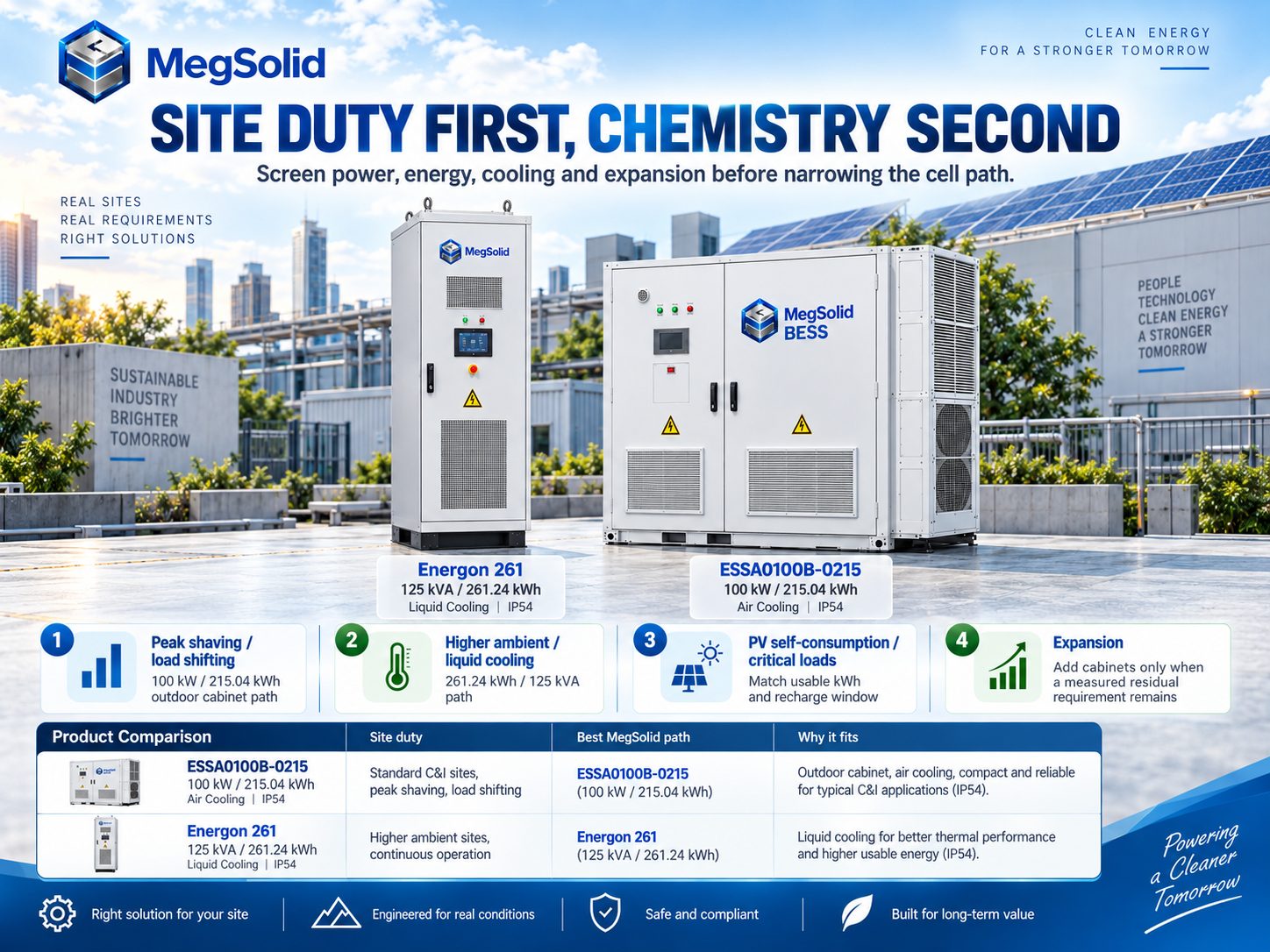
Fabrieke wat probeer om kort vraagpieke af te sny, begin nie met dieselfde vereiste as 'n terrein wat probeer om verskeie ure se kritieke las te dra nie.
Die operasionele taak stel die eerste skerm in:
| Webwerfvereiste | Wat eers saak maak | MegSolid se pad na hersiening |
|---|---|---|
| Piekvlakvermindering | Benodigde aflaaivermoë en piekduur | 100 kW / 215 kWh buite-kaste |
| Belastingverskuiwing | Gebruikbare energie en herlaaivenster | 100 kW / 215 kWh-kaste of parallelle eenhede |
| PV-selfverbruik | Middag-oorskot en latere vrag | Kastepad van omtrent dieselfde grootte as die werklike surplus |
| Hoër omgewingsbedryf | Koelargitektuur en bedryfsomstandighede | 261 kWh / 125 kVA vloeistofgekoelde pad |
| Groter terrein of mikronetwerk | Totaal krag, energie en uitbreidingsskaal | Veelkassie- of gekontainerde pad |
Twee terreine kan dieselfde batterychemie gebruik en steeds baie verskillende PCS-krag, bergingsenergie en verkoelingreëlings benodig.
Die 100 kW / 215 kWh buite-kaste Gee kleiner en mediumgrootte C&I-projekte 'n gedefinieerde beginpunt wanneer die toepassing piekvermindering of lasverskuiwing is.
ESSA0100B-0215 pas by gedefinieerde piekvermindering- en lasverskuiwingstake
Die 100 kW/215 kWh-roete is geskik vir terreine wat met een buite-kas kan begin en later kapasiteit kan byvoeg as die oorblywende vereiste groei.
Die gepubliseerde stelselpad sluit in:
- 100 kW krag
- 215 kWh-klas energie
- buitekasargitektuur
- IP54
- parallelle uitbreiding
- ingeboude isolasie
- THDi <3% aan die netwerk gekoppel soos gepubliseer
- EMS en wolkmonitering
Daardie parameters maak net saak in verhouding tot die terreinvereiste.
Die 100 kW PCS los nie elke 100 kW-terreinprobleem op sigself op nie. Kort pieke, 'n twee-uur-ladingsverskuiwing en 'n rugsteunvereiste stel verskillende eise aan bruikbare energie en bedryfsreserwe.
Die kas word kommersieel nuttig wanneer sy krag en energie ooreenstem met die werklike las, nie wanneer die model net na die kliënt se gekoppelde las lyk nie.
Die 261 kWh / 125 kVA Path Fits Thermal en hoër-omgewingsprioriteite
Die 261 kWh/125 kVA-roete bied C&I-kopers 'n ander argitektuur wanneer vloeibare verkoeling verkies word of wanneer die terreintemperatuur verkoelingsontwerp 'n groter deel van die besluit maak.
Sy rol is breër as om net meer batterystroom by te voeg.
Die koper moet nog vergelyk:
- koelargitektuur
- beskikbare energie
- PCS-gradering
- terrein-omgewing
- bedryfsplig
- opstellingsreël
- en toekomstige uitbreiding.
Hou 125 kVA apart van aktiewe kW
The 125 kVA rating also needs to remain separate from kW during project sizing. Apparent power and active power are not interchangeable, so the usable active-power boundary has to come from the exact project configuration.
The liquid-cooled path becomes relevant when thermal management and operating conditions matter more than minimizing cabinet footprint.
Hybrid Solid-State Changes the Cell-Level Discussion, Not the System Boundary
Hybrid solid-state, also described as semi-solid or solid-liquid hybrid, changes the cell-level chemistry discussion. It does not remove the rest of the BESS engineering work.
Chemistry labels do not settle the C&I purchase decision.
The selected system needs to fit across:
- site duty
- thermal behavior
- controls
- cooling
- fire protection
- integration
- and lifecycle expectations.
The Chemistry Still Sits Inside a Complete BESS
MegSolid positions hybrid solid-state technology inside an integrated stationary storage system, not as a standalone cell claim. The battery still operates with PCS, BMS, EMS, cooling and fire-protection functions as part of the complete system.
The cell specification is only one layer of the equipment being installed.
Compare Hybrid Solid-State and Liquid LFP on the Same Procurement Criteria
| Procurement question | Hybrid solid-state path | Conventional liquid LFP path |
|---|---|---|
| Cell-level thermal discussion | Different electrolyte architecture changes the starting chemistry discussion | Familiar LFP path with established market use |
| System controls | BMS, EMS, cooling and protection remain required | BMS, EMS, cooling and protection remain required |
| Installasie | Depends on the selected cabinet or block | Depends on the selected cabinet or block |
| Cycle-life review | Check the exact model and stated operating conditions | Check the exact model and stated operating conditions |
| Cooling decision | Must follow the selected product architecture | Must follow the selected product architecture |
| Procurement route | Can be supplied as an integrated MegSolid system path | Can remain attractive when the tender and service structure are already built around it |
| Uitbreiding | Determined by the selected system and parallel architecture | Determined by the selected system and project design |
The detailed comparison should stay tied to exact models; chemistry is not a shortcut for weight, civil cost, cooling or future augmentation.
Where a project needs a deeper row-by-row engineering comparison, the solid-state vs Tier 1 liquid LFP comparison can support that stage of the review.
Chemistry Still Sits Inside the Full BESS Safety Stack
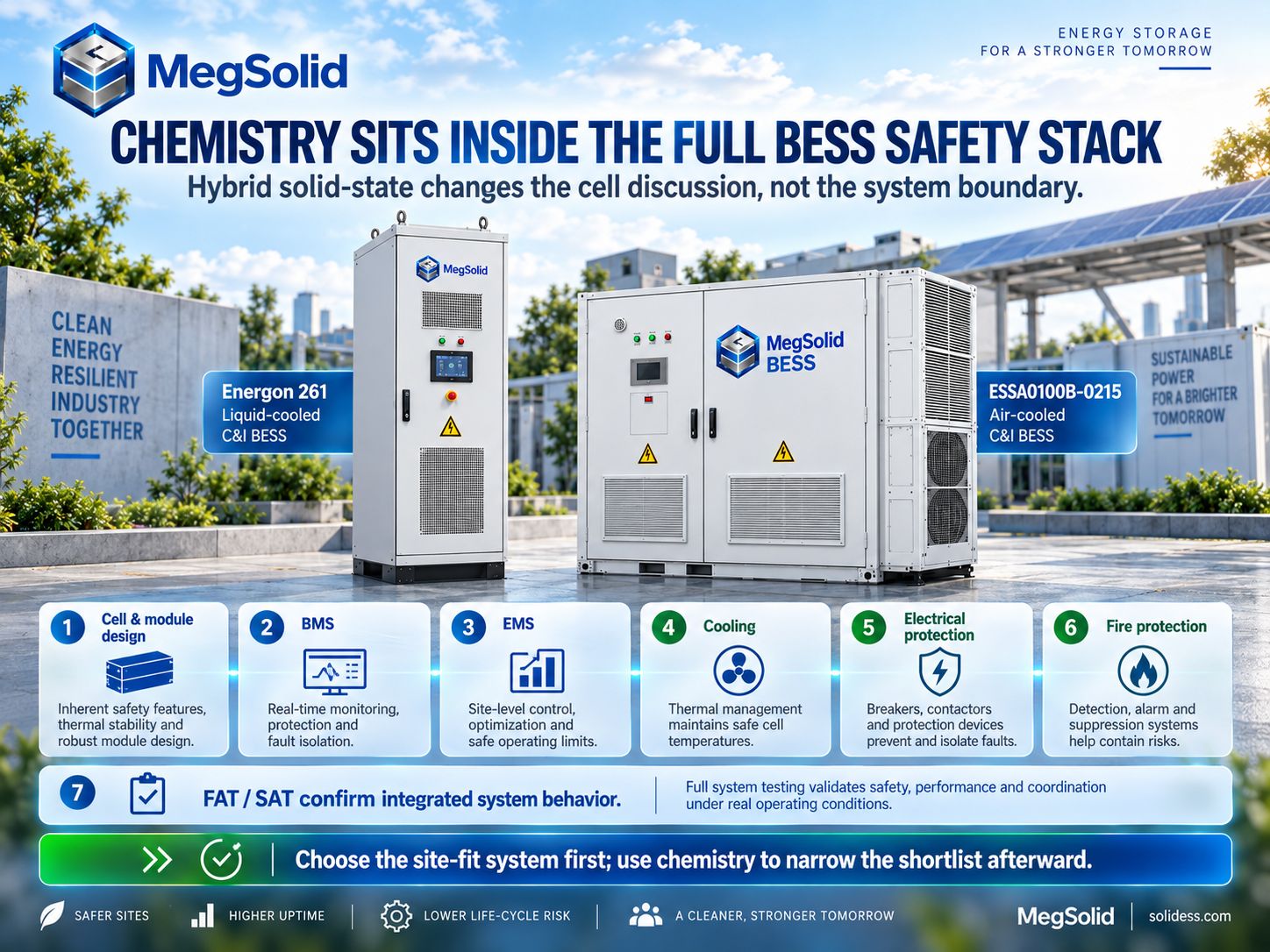
Changing chemistry does not remove the need for system-level controls.
The installed BESS still relies on several layers working together:
- Cell and module design establish the electrochemical operating boundary.
- BMS monitors voltage, current, temperature and SOC.
- EMS coordinates charging, discharging and site-level operating targets.
- Cooling keeps the system inside its intended thermal operating range.
- Electrical protection handles system faults and connection boundaries.
- Fire-protection provisions address detection, suppression and propagation control.
- FAT and SAT confirm that the integrated system behaves as specified.
The integrated system matters more than the chemistry headline at this stage.
Die thermal runaway prevention guide goes deeper into the protection chain when the project review reaches fire detection, suppression and propagation control.
Shortlist the Hybrid Solid-State Path When the Full System Fits
The hybrid solid-state route becomes more relevant when the buyer wants the chemistry discussion tied to a complete MegSolid storage system instead of a standalone cell purchase.
Keep it on the shortlist when:
- The project needs an integrated outdoor C&I cabinet path.
- Peak shaving or load shifting is the main operating task.
- Parallel expansion may be required after the first cabinet is installed.
- The buyer wants battery, PCS, BMS and EMS responsibilities kept within one system route.
- Thermal behavior and system-level safety documentation are part of the customer’s procurement review.
- Cycle-life claims need to remain tied to a named model and stated operating conditions.
Keep Cycle Claims Tied to the Named Model
The ESSA0100B-0215 path publishes ≥5,000 cycles under specified conditions. That figure should stay attached to the model and its stated conditions instead of being used as a generic claim for every battery carrying the same chemistry label.
MegSolid’s broader solid-state energy storage platform provides the next reference point when the project moves beyond a single cabinet.
Liquid-Cooled LFP Still Fits Projects Already Built Around That Architecture
Liquid LFP can remain the practical choice when the project is already built around that architecture.
Examples include:
- a tender that specifically requires liquid LFP
- civil drawings already frozen around the selected package
- cooling design already completed
- local service arrangements based on that equipment path
- or a site where changing chemistry would create redesign work without solving a meaningful operating problem.
MegSolid can still address that project through the 261 kWh / 125 kVA liquid-cooled C&I path.
No project should be forced toward one chemistry without a site reason.
Commercial fit comes from matching the battery architecture to the actual site duty and project constraints.
Match the MegSolid Product Path to the Site Requirement
| Webwerfvereiste | MegSolid path | What it solves |
|---|---|---|
| Small to mid-size peak shaving | 100 kW / 215 kWh buite-kaste | Adds a defined outdoor storage block for demand management and load shifting |
| Future expansion | Parallel outdoor cabinet path | Lets the project begin with one cabinet and add capacity as the residual requirement grows |
| Higher ambient / liquid cooling preference | 261 kWh / 125 kVA liquid-cooled C&I path | Moves thermal management into a liquid-cooled architecture |
| Larger commercial site | Multi-cabinet configuration | Extends power and energy without changing the basic C&I system approach |
| Multi-MWh requirement | Containerized path | Moves the project into larger power and energy blocks |
Keep Power, Energy, Cooling and Chemistry as Separate Decisions
C&I storage selection becomes unreliable when power, energy, cooling and chemistry are collapsed into one decision.
kilo-watt answers how much active power the system needs to deliver or absorb.
kilo-wattuur answers how long that power requirement needs to be supported.
Cooling architecture determines how the selected cabinet or system manages heat under its operating conditions.
Chemistry influences the cell-level behavior and becomes one part of the wider system selection.
Customers with a 100 kW peak lasting only a short period may need a very different energy reserve from a customer expecting the BESS to carry a critical load for several hours.
The MegSolid path should come from the site duty first, with chemistry used afterward to narrow the remaining options.
Add Capacity Only When a Residual Requirement Remains
Parallel expansion is useful only when an additional cabinet solves a measured remaining requirement.
Extra cabinet capacity is not justified simply because the architecture allows it.
The next unit needs a reason:
- remaining peak power
- additional usable energy
- new PV surplus
- changed operating hours
- higher load
- or a new backup requirement.
That keeps expansion tied to the site instead of turning “modular” into a generic sales claim.
VGV
What is hybrid solid-state in a C&I BESS?
Hybrid solid-state, also described as semi-solid or solid-liquid hybrid, changes the electrolyte architecture compared with a conventional liquid-electrolyte battery. The chemistry still has to be evaluated as part of the complete BESS instead of as a standalone cell feature.
What site problem should be defined before comparing battery chemistry?
Start with the operating requirement: peak shaving, load shifting, PV self-consumption, critical-load support or another defined site duty. That determines the required power and energy before chemistry narrows the equipment shortlist.
Which MegSolid path is relevant for a smaller C&I peak-shaving project?
Die 100 kW / 215 kWh buite-kaste is the first path to review for smaller and mid-size C&I peak-shaving or load-shifting applications.
Can the 100 kW / 215 kWh cabinet be expanded later?
The published cabinet path supports parallel expansion. Additional cabinets should be added against the remaining site power or energy requirement instead of simply because parallel operation is available.
When should a buyer review the 261 kWh / 125 kVA liquid-cooled path?
Review it when liquid cooling, site ambient conditions or the project’s preferred thermal-management architecture make the liquid-cooled configuration more suitable than the smaller air-cooled cabinet path.
Is 125 kVA the same as 125 kW?
No. kVA and kW describe different electrical quantities. The active-power capability has to be checked against the exact PCS and project configuration instead of treating 125 kVA as automatically equal to 125 kW.
Does hybrid solid-state chemistry remove the need for BMS or EMS?
No. The battery still requires BMS and EMS functions to manage cell conditions, SOC and site-level charging and discharging behavior.
Does chemistry alone determine BESS fire safety?
No. Fire safety depends on the complete protection chain, including monitoring, BMS, cooling, electrical protection, fire-protection provisions and the acceptance of the integrated system.
Should cycle-life claims be compared by chemistry alone?
No. The cycle claim should remain tied to the named model and its stated operating conditions. Keep Cycle Claims Tied to the Named Model. The ESSA0100B-0215 path publishes ≥5,000 cycles under specified conditions.
When does conventional liquid LFP still make sense?
It remains practical when the written tender, cooling design, civil layout or local service structure has already been built around that architecture and changing chemistry would not solve a meaningful site requirement.
How should a high-ambient C&I site affect the product shortlist?
Higher ambient conditions make the cooling architecture and the selected system’s operating conditions more important. The buyer should compare the outdoor cabinet and liquid-cooled paths against the actual site environment.
Do local fire or landlord requirements change the chemistry decision?
They can change the system requirements around the battery. Local stakeholders may focus on detection, suppression, propagation controls, access or other installation conditions, so chemistry should be reviewed together with the complete safety stack.
Can the same C&I BESS shortlist be used in every country?
The basic comparison method can remain the same, but site conditions, local acceptance requirements, service arrangements and installation constraints can change which architecture is practical for the project.