
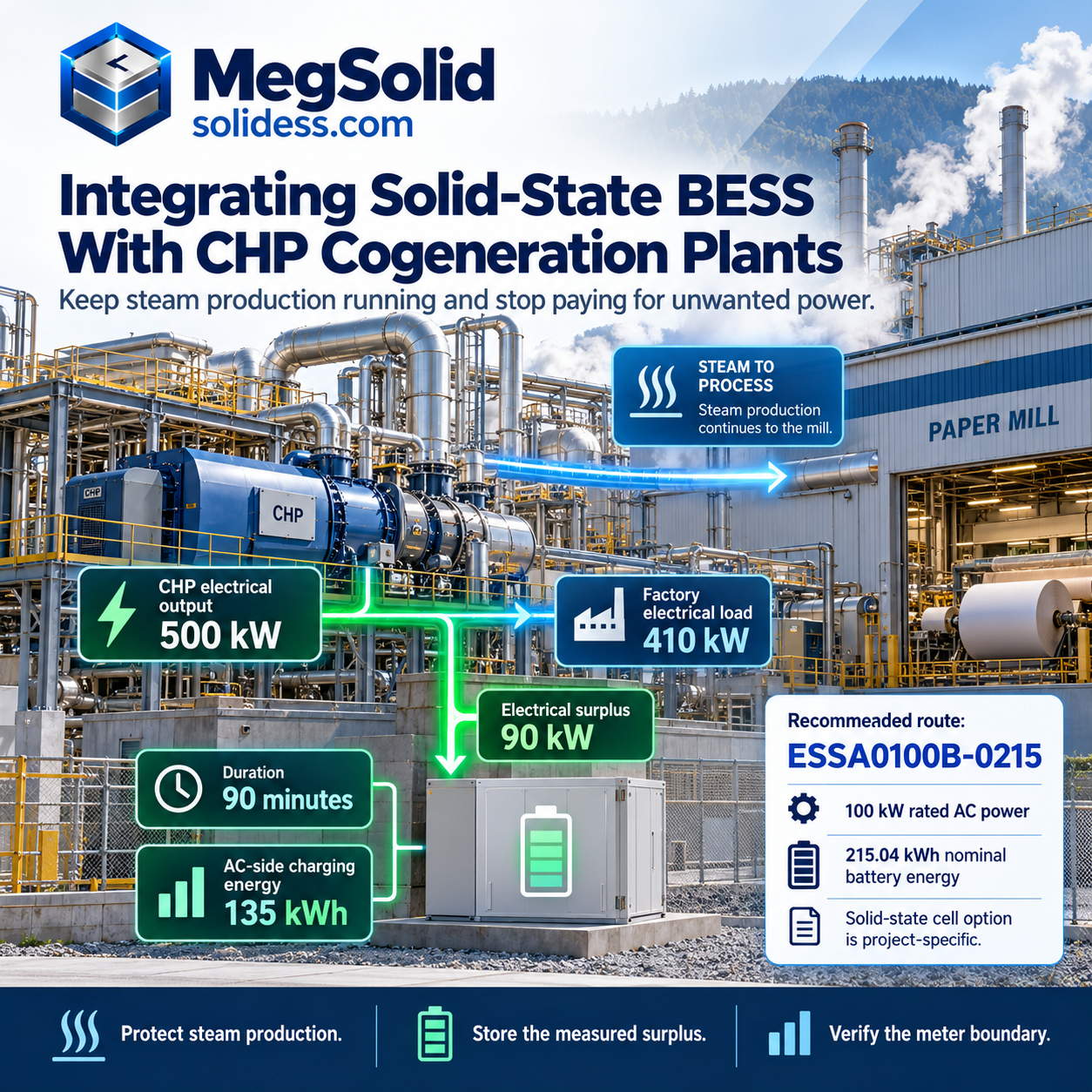
A German paper mill still needs steam when wholesale electricity prices collapse. Its CHP may have to keep running to serve that steam demand, even when the electrical output has little value—or the export contract makes it a liability. MegSolid's ESSA0100B-0215 gives a measured 90 kW mismatch a controllable storage route through its C&I BESS platform.
Do not let a bad export hour dictate the steam schedule. MegSolid's EMS priority architecture coordinates the battery with the CHP's permitted electrical operating envelope, export constraints and future factory demand. Steam stays in the process. Surplus electrical power goes into a battery when its charging window permits it; the energy returns when the factory needs it.
Keep Steam Production Running When Export Power Turns Unprofitable
The dryers do not stop asking for steam just because the day-ahead market posts an ugly price. Cutting CHP output may disrupt drying conditions, shift the burden to an auxiliary boiler or force an unwanted process adjustment. None of those is a free response to falling electricity prices. Protect the steam header. Deal with the unwanted kilowatts separately.
A back-pressure turbine, an extraction-condensing turbine and a gas-engine CHP will not have the same flexibility. Some plants have an auxiliary boiler or controllable heat demand. Others must hold a narrow operating point to protect steam conditions. The BESS case begins only after those existing options and their costs are understood. Exporting all surplus electricity without checking its actual settlement can be just as expensive as forcing an unnecessary CHP load change.
Nord Pool and other European markets can show negative spot prices when electricity supply outruns demand. That matters most when the CHP's real export settlement follows those prices. A fixed PPA, support mechanism, balancing arrangement or trader contract can produce a different outcome. Read the export contract before calling any megawatt-hour a loss. The dispatch target should reflect what this plant actually earns—or pays—at its meter.
Put the Electrical Mismatch on One Meter
Put numbers against a paper mill's CHP operating point. Its steam-led schedule holds electrical output at 500 kW while the factory is consuming only 410 kW. These figures define the equipment-sizing duty; they are not a record of a MegSolid installation.
| Site variable | Defined operating point |
|---|---|
| CHP electrical output at the required steam operating point | 500 kW |
| Concurrent factory electrical consumption | 410 kW |
| Electrical surplus at the site boundary | 90 kW |
| Duration of this surplus | 90 minute |
| AC-side energy available to charge | 135 kWh |
| Target export in the evaluated operating mode | 0 kW |
CHP electrical output − factory electrical load = 500 − 410 = 90 kW.
That excess 90 kW cannot disappear into the controls. The plant must export it where permitted, change CHP output within OEM limits, put it into a genuinely useful load or charge storage. MegSolid BESS gives the electrical surplus another destination without telling the steam process to shut down. When the battery is full or charge power falls, the approved fallback must take over. Zero export is a physical balance, not an EMS checkbox.
A 500 kW CHP does not automatically require a 500 kW battery. The measured surplus is 90 kW. Start there.
Put MegSolid ESSA0100B-0215 on the 90 kW CHP Surplus
Specify MegSolid ESSA0100B-0215 for the defined 90 kW surplus. The cabinet provides 100 kW beoordeelde wisselstroomkrag against that electrical gap and 215.04 kWh nominal battery energy to assess against the 90-minute charging window. Battery, bidirectional PCS, isolation transformer and EMS come together in an outdoor cabinet, giving the EPC a defined equipment interface to connect to the existing CHP bus.
| Aankoopgrens | Required by CHP scenario | MegSolid ESSA0100B-0215 |
|---|---|---|
| AC charging-power screen | 90 kW | 100 kW rated power class |
| Rated-power difference | — | 10 kW |
| Charging window | 1.5 h | Must be checked against live charge limits |
| Available AC charging energy | 135 kWh | 215.04 kWh nominal battery energy |
| Gegradueerde wisselstroomspanning | Site interface to verify | 400 V |
| Gegradueerde wisselstroomsterkte | Project-specific | 144 A |
| Afkoeling en omhulsel | Site placement review | Intelligente lugafkoeling; IP54 |
| Kommunikasies | CHP controller and plant SCADA interface | RS485; TCP/IP |
A 50 kW cabinet misses the target by 40 kW. On a no-export site, those 40 kW still need an authorized destination. ESSA0100B-0215 moves the full 90 kW request into one 100 kW-rated cabinet class. There is no case for jumping straight to a 250 kW PCS on this load profile.
The nameplate is the starting point, not the charge command. Confirm the 90 kW continuous charging capability under the specified SOC, temperature and BMS limits, then check the AC interface and any simultaneous reactive-power demand. Only the approved CHP/BESS operating envelope belongs in the order.
Specify Solid-State Cells Only in the Verified MegSolid Configuration
Do not let a supplier sell the word ‘solid-state’ and leave the actual cells off the order. ESSA's standard table identifies LFP chemistry. That identifies the cathode, not the electrolyte in every possible configuration. MegSolid offers a project-specific solid-state cell option for the ESSA platform; the delivered cell model, electrolyte architecture, rated energy, charge limits, safety evidence and warranty must be fixed in the signed specification and BOM.
Keep the published 215.04 kWh attached to the listed ESSA model. A changed battery BOM needs its own confirmed energy, cycle data, dimensions, thermal design and certification evidence. The sales brochure is not a substitute for the ordered configuration.
That is MegSolid's commercial case: one defined 100 kW C&I platform, with the requested battery architecture tied to an actual deliverable specification. HSE can assess what will be installed. Procurement can reject a chemistry premium unsupported by the BOM.
Give the ESSA Enough Charging Headroom for 135 kWh AC
A 100 kW converter solves the power mismatch only while the battery has room to accept the energy. At 90 kW for 90 minutes, the CHP presents 135 kWh of AC-side charging energy:
E_AC,in = 90 kW × 1.5 h = 135 kWh.
The 135 kWh is available at the AC charging boundary, not guaranteed inside the cells. Conversion losses, auxiliary demand and BMS restrictions all matter. So does the starting SOC. A nearly full 215.04 kWh cabinet can leave a steam-led CHP with surplus power it still cannot absorb.
Reserve Actual SOC Headroom for the Steam-Led Run
Make the charging room available before the low-value export period, not halfway through it. A planning band of 20%–90% across 215.04 kWh yields 150.528 kWh of nominal energy span. That does not establish the approved SOC limits, usable AC capture or warranted performance. The signed BMS operating window and the acceptance test must show whether the cabinet can take the required 135 kWh AC input over 90 minutes.
A full battery is not a zero-export strategy. At upper SOC, during temperature derating or whenever CHP surplus exceeds permissible charge power, another approved action must take over: adjust CHP within OEM limits, redirect energy to a useful controllable load, use an allowed heat-side option or export under the agreed terms. Leave that fallback undefined and the claimed zero-export scheme fails at the first saturation event.
Later in the shift, the factory may draw 560 kW while CHP generation remains at 500 kW. BESS then needs 60 kW, and a one-hour discharge takes 60 kWh delivered at the AC boundary. The earlier 135 kWh charge opportunity cannot be equated to stored or later deliverable energy. Test both halves of the operating cycle.
MegSolid se commercial BESS capacity-test method defines the distinction between nominal, usable and delivered energy. Specify the charge acceptance, delivered AC output and meter location in the contract. Do not sign for kWh that nobody measured.
The purchase target is concrete: absorb the allowed surplus during the constrained window, then supply the later factory deficit with verified AC energy.
Get Past the HSE Review with a Defensible Battery Installation
At a chemical works or paper mill, the BESS can lose its site approval before it ever reaches a purchase order. Solvents, gas-release points, combustible dust and fire-appliance access narrow the available locations. HSE can reject an impressive battery proposal that has no defensible installation plan.
Sell HSE a buildable installation, not a safety adjective. MegSolid's proposal needs the ordered ESSA cell configuration, an acceptable equipment location, fire and electrical interfaces, and site-specific test and approval evidence.
Separate Battery Fire Safety from Hazardous-Area Permission
Evaluate the project-specific solid-state configuration against the alternatives using test evidence for electrolyte behavior, thermal response and propagation. It cannot confer fireproof status on the full cabinet or grant permission to operate in a hazardous zone. That conclusion belongs to the full equipment assessment and the actual site classification.
ATEX Directive 2014/34/EU concerns equipment intended for potentially explosive atmospheres. The site must determine its classified zones and whether the actual BESS or auxiliary electrical equipment falls within them. A standard ESSA IP54 enclosure is not, by that fact, an ATEX-certified enclosure. A MEGA0150TS PCS is listed as IP21, so it likewise cannot be treated as suitable for an exposed hazardous location without an engineered enclosure and the applicable approvals.
For a European CHP site, put the evidence in one approval set: hazardous-area drawings, the actual cell and cabinet configuration, equipment declarations, applicable battery/fire test reports, separation distances, ventilation, emergency isolation, fire-response interfaces and local authority or insurer requirements. IEC 62933-5-2 provides relevant grid-integrated EES safety context; NFPA 855 is a US code reference, not a substitute for European or national requirements.
MegSolid se BESS fire-safety engineering guide offers a supporting engineering framework for fire-risk reviews; it must never be mistaken for an ATEX or other product certification.
Put the Cabinet Where It Can Actually Be Approved
An engineered outdoor location outside the classified area may achieve approval faster and with a more defensible risk assessment than placing a standard cabinet beside solvent handling or a combustible-dust process. Location is part of the product decision.
Win the approval with drawings, certificates scoped to the supplied equipment, fire strategy and clear responsibility for each hazard. Do not promise a shortcut around HSE.
Let MegSolid EMS Manage the Surplus Without Fighting CHP Controls
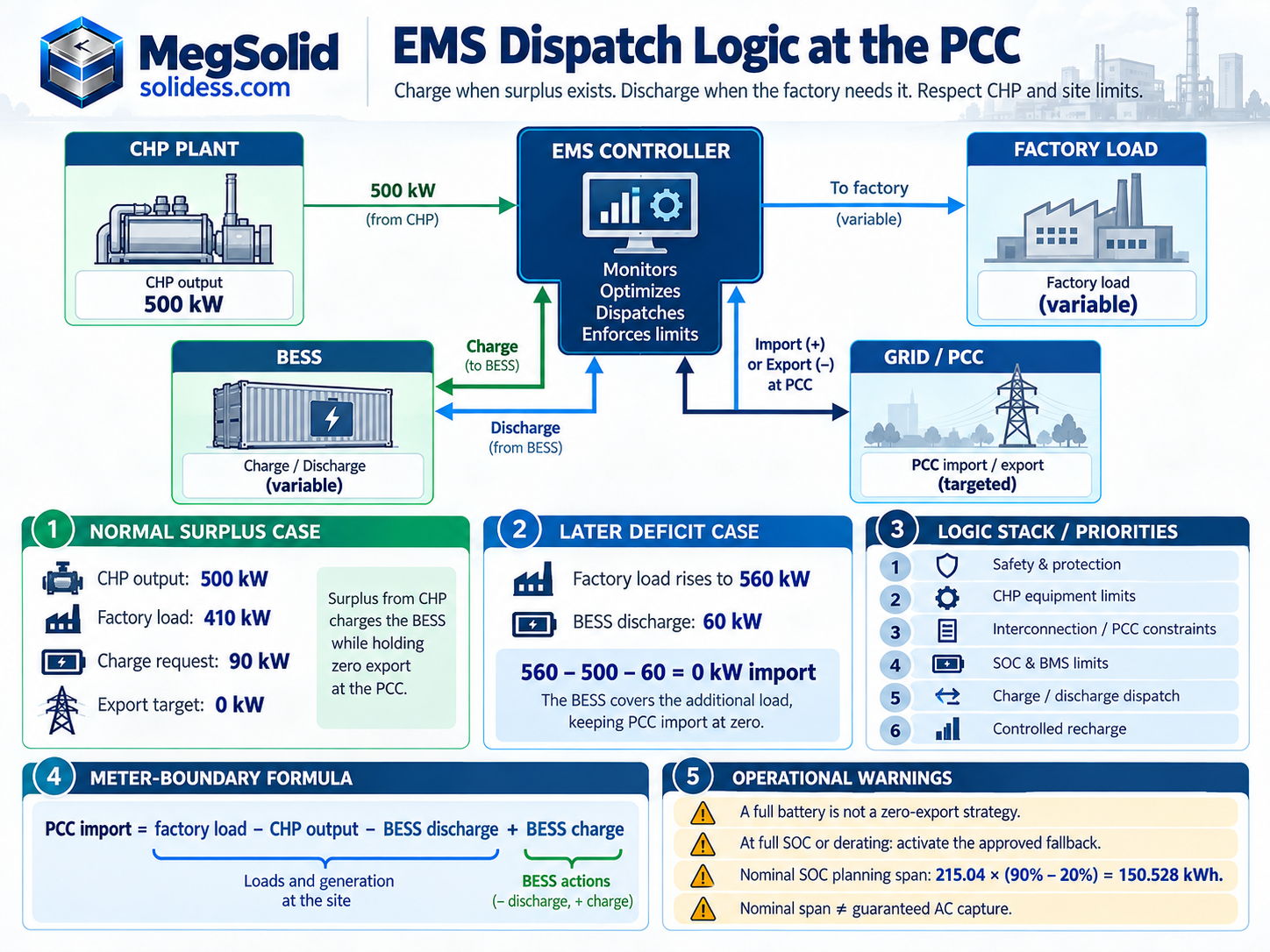
Keep the CHP governor and plant controls in charge of the machine and steam. Give the MegSolid EMS the electrical assignment: measure surplus, request allowed charging, cover later factory demand and observe the PCC limit. Two controllers fighting over one setpoint can trip a CHP faster than a bad electricity price can hurt its margin. Define command ownership before the BESS is connected.
Strategy 1 — Absorb CHP Surplus When Export Is Restricted or Poorly Priced
An unfavorable export price is a reason to use available storage—not permission to overcharge it. MegSolid EMS charging requests must remain within actual CHP surplus, permitted PCS charge power, BMS limits, SOC headroom and the approved PCC conditions. Contract settlement matters; protective limits still win.
A trader's spot-price feed may help set the schedule if the plant's contract passes those prices through. A fixed export arrangement can make the same feed irrelevant. Schedule against the contract's realized value, then check the live plant conditions before dispatch.
Strategy 2 — Discharge Into the Factory's Electrical Gap
When electrical demand climbs above CHP production, the battery changes direction and covers the approved part of the deficit. It can do this only within its tested kW, kWh and SOC window. Show the result at the PCC meter. Battery feeder readings alone do not prove the import reduction the factory is buying.
PCC import = factory load − CHP electrical output − BESS discharge + BESS charge.
For the defined later condition, 560 − 500 − 60 = 0 kW import before boundary-specific losses and measurement tolerances. This does not imply the entire factory can island or that a 60 kW power change is a motor-start transient test.
MegSolid se PCC control engineering details meter polarity, controller limits and measured import/export behavior.
Strategy 3 — Protect CHP Stability Before Considering Black Start
Any backup, grid-forming or black-start function needs a separate approved operating sequence: CHP governor/AVR characteristics, synchronizing permission, breaker interlocks, island load, power-sharing scheme and protection. The presence of an ESSA grid-connected/off-grid mode or a MEGA PCS does nie establish that an existing CHP plant can be black-started or transferred without interruption.
MegSolid se Uitvalgids vir roostergekoppelde BESS explains why a charged BESS is not automatically a functioning backup system.
The EMS should expose one traceable hierarchy: safety and protection → CHP equipment limits → interconnection constraints → preserved energy reserve → commercial surplus capture → later discharge → controlled recharge. The BMS en EMS kommunikasie-argitektuur defines where supervisory commands stop and local protection takes over.
Keep Short Electrical Swings Off the CHP Prime Mover
A CHP prime mover was bought to supply industrial heat and power, not to chase every second-by-second electrical swing at the factory bus. Depending on the turbine or engine design, load ramps can disturb preferred heat-led operation and add mechanical or thermal stress. Where the OEM permits it, let the PCS handle part of the fast electrical movement and keep the CHP closer to its approved operating schedule.
MegSolid BESS can charge or discharge across those electrical changes while the CHP follows its approved heat-led schedule. Fewer forced ramps may be valuable, but do not price in an extended turbine overhaul interval without machine logs and the OEM's maintenance rules. A battery cannot rewrite the prime mover's service contract.
Put starts, stops, loading ramps, thermal cycles, trips and derates next to the OEM maintenance schedule, before and after commissioning. If there is no measured improvement, there is no verified overhaul saving to claim. The electrical-buffer case should stand on its own commercial duty first.
The PCS takes the electrical swings it is rated to handle; CHP protection retains final authority over the machine. The wider C&I interconnection-readiness process makes that ownership visible on the site single-line diagram.
Move to MEGA0150TS When CHP Surplus Climbs to 140 kW
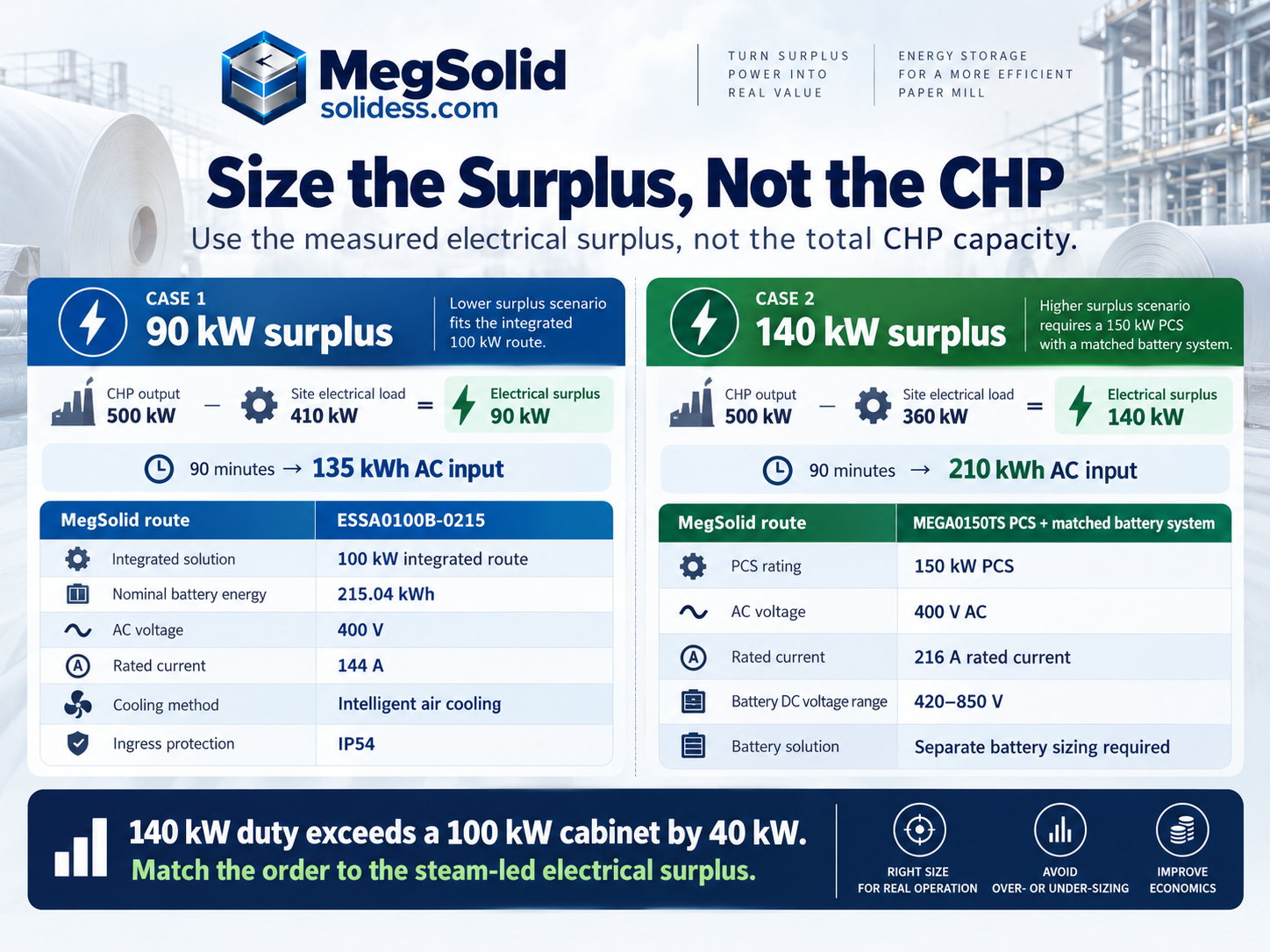
Do not force a 140 kW charging requirement into a 100 kW cabinet. The remaining 40 kW does not vanish. Once the sustained mismatch exceeds ESSA's confirmed charging limit, specify a higher-power PCS and battery combination—or provide another approved outlet for the surplus.
For example, if the process still requires 500 kW CHP electrical production but factory demand falls to 360 kW, the residual electrical surplus becomes 140 kW. Over 90 minutes, the plant presents 210 kWh AC-side charging opportunity.
| Aankoopfaktor | Initial CHP duty | Larger mismatch |
|---|---|---|
| CHP electrical output | 500 kW | 500 kW |
| Factory electrical demand | 410 kW | 360 kW |
| BESS charge-power request | 90 kW | 140 kW |
| 90-minute AC charging opportunity | 135 kWh | 210 kWh |
| First MegSolid route | ESSA0100B-0215 | MEGA0150TS PCS + matched battery system |
Die MegSolid MEGA0150TS provides the 150 kW PCS class, 400 V AC, 216 A rated current and a published 420–850 V battery DC range. The PCS handles the power-conversion role; it does not arrive as a complete 210 kWh battery system.
Size the battery against the 210 kWh AC charging opportunity, permitted SOC headroom, discharge duty, BMS power and voltage limits, auxiliary consumption and reserve policy. A solid-state battery request needs a signed BOM identifying the cells, plus confirmation that the battery configuration operates with the selected PCS. Do not advertise the standard 215.04 kWh ESSA battery as a ready-made 150 kW / 210 kWh MEGA pack.
Larger multi-MWh CHP installations may justify MegSolid's containerized storage systems, but a 140 kW mismatch alone does not justify purchasing a 500 kW container.
Match the order to the steam-led electrical surplus. For 90 kW, start with the MegSolid 100 kW integrated cabinet. At 140 kW, move to the 150 kW PCS path with a separately engineered battery. Oversizing the hardware is not a substitute for knowing the CHP operating curve.
Witness the CHP Bus and PCC Results Before Acceptance
Make the supplier prove the power balance at the CHP bus and the grid meter. A charging icon on the HMI says nothing about steam stability, captured AC energy or unauthorized export. Witness the actual or suitably reproduced operating duty and record the results.
Log CHP kW, steam demand and process limits, building electrical demand, PCC import/export, BESS AC power and energy, SOC, BMS permissions, protective status and controller timestamps on the same clock. Without synchronized evidence, nobody can prove where the surplus went.
| Witness condition | Result that must be demonstrated |
|---|---|
| CHP held in approved thermal operating condition | Steam/process constraints maintained while BESS commands change |
| 90 kW surplus, 90-minute test | Battery absorbs permitted power within live limits; captures energy at the declared boundary |
| Rising factory electrical load | Discharge reduces approved PCC import without unstable CHP interactions |
| Battery nearing upper SOC limit | Charging clips or stops without unacceptable export or protection trips |
| CHP/BESS meter or communications fault | Agreed fail-safe command and alarm are produced |
| HSE and protection events | Local trips, isolation, fire signals and restart permissions follow approved drawings |
| Optional island / black-start mode | Tested only if separately designed and contracted |
IEC 62933-2-1 and IEC TS 62933-2-2 can structure the power and application-duty testing. The BESS FAT and SAT guide supports factory and installed-system verification; the site acceptance checklist covers protection, communications, metering and control handover.
The acceptance pack needs a time-aligned record of CHP output, steam demand, plant load, BESS AC energy, SOC, control response and PCC import/export. Do not sign the acceptance record until those measurements tell the same story.
VGV
Can solid-state BESS decouple heat and power in a CHP plant?
A BESS buffers electrical energy while the CHP continues to satisfy approved thermal-process requirements. It does not independently produce steam or alter the prime mover's heat-to-power relationship.
Which MegSolid product fits a 90 kW CHP electrical surplus?
ESSA0100B-0215 is the first 100 kW-class integrated cabinet to evaluate; its 215.04 kWh nominal energy must be assessed against actual SOC headroom and metered AC capture.
Is ESSA0100B-0215 always a solid-state battery cabinet?
No. Its published product table identifies LFP cells, while a solid-state cell configuration is a project-specific option requiring confirmation of the delivered BOM and technical specifications.
How much electricity can a 90 kW surplus supply over 90 minutes?
It provides 135 kWh at the stated AC charging boundary before battery conversion, auxiliary and operating losses. Stored energy will be lower and depends on live limits.
What happens when the CHP surplus exceeds 100 kW?
A 100 kW cabinet cannot absorb a sustained 140 kW surplus. The MEGA0150TS 150 kW PCS is a higher-power route with a separately specified compatible battery system.
Can ESSA be installed inside a classified chemical-plant zone?
An IP54 rating does not establish ATEX suitability. The actual hazardous-area classification and product/equipment certifications must be reviewed; locating equipment outside classified zones may be preferable.
Does solid-state chemistry eliminate thermal runaway and fire risk?
No battery chemistry alone establishes zero system fire risk. Review cell-level evidence, complete-system design, fault response, cooling, fire protection and the actual ordered configuration.
Does a negative Nord Pool price mean the CHP operator always pays to export?
No. The plant's actual power contract, market participation, subsidy and settlement rules determine export economics. The BESS dispatch calculation must use the realized price and fees.
Can the BESS black-start an existing CHP plant?
Only if the project includes a compatible grid-forming/black-start topology, controls, protection and a witnessed operating sequence. Nameplate storage capacity does not prove it.
Does BESS operation extend CHP turbine overhaul intervals?
Not automatically. Any claim must be supported by measured operating changes and the prime mover manufacturer's maintenance criteria.