
Many South African EPC contractors request a BESS quotation by sending only one number:
“We need a 1MWh battery system. Please provide your price.”
However, a 1MWh request does not define the actual engineering requirement.
Different suppliers may interpret the same request as:
- 1MWh DC battery capacity
- 1MWh usable AC energy
- 1MWh at beginning of life
- 1MWh at end of warranty
- 1MWh including or excluding auxiliary consumption
These differences directly affect:
- System size
- PCS selection
- Transformer requirements
- Installation cost
- Long-term performance
A reliable BESS quotation must define the complete system boundary before price comparison.
Provide your required power, energy, load profile and grid conditions for preliminary engineering review.
Why a 1MWh BESS Request Is Not Enough
Battery energy and battery power describe different engineering requirements.
A project with the same 1MWh battery capacity can have completely different configurations.
| System Type | PCS Power | Battery Energy | Ubude bexesha |
|---|---|---|---|
| High-power application | 1MW | 1MWh | 1 hour |
| Peak shaving application | 500kW | 1MWh | iiyure ezimbini |
| Long-duration application | 250kW | 1MWh | 4 hours |
The supplier needs to understand:
- Required continuous power
- Maximum discharge power
- Required discharge duration
- Charging window
- Daily cycling profile
- Reserve SOC requirement
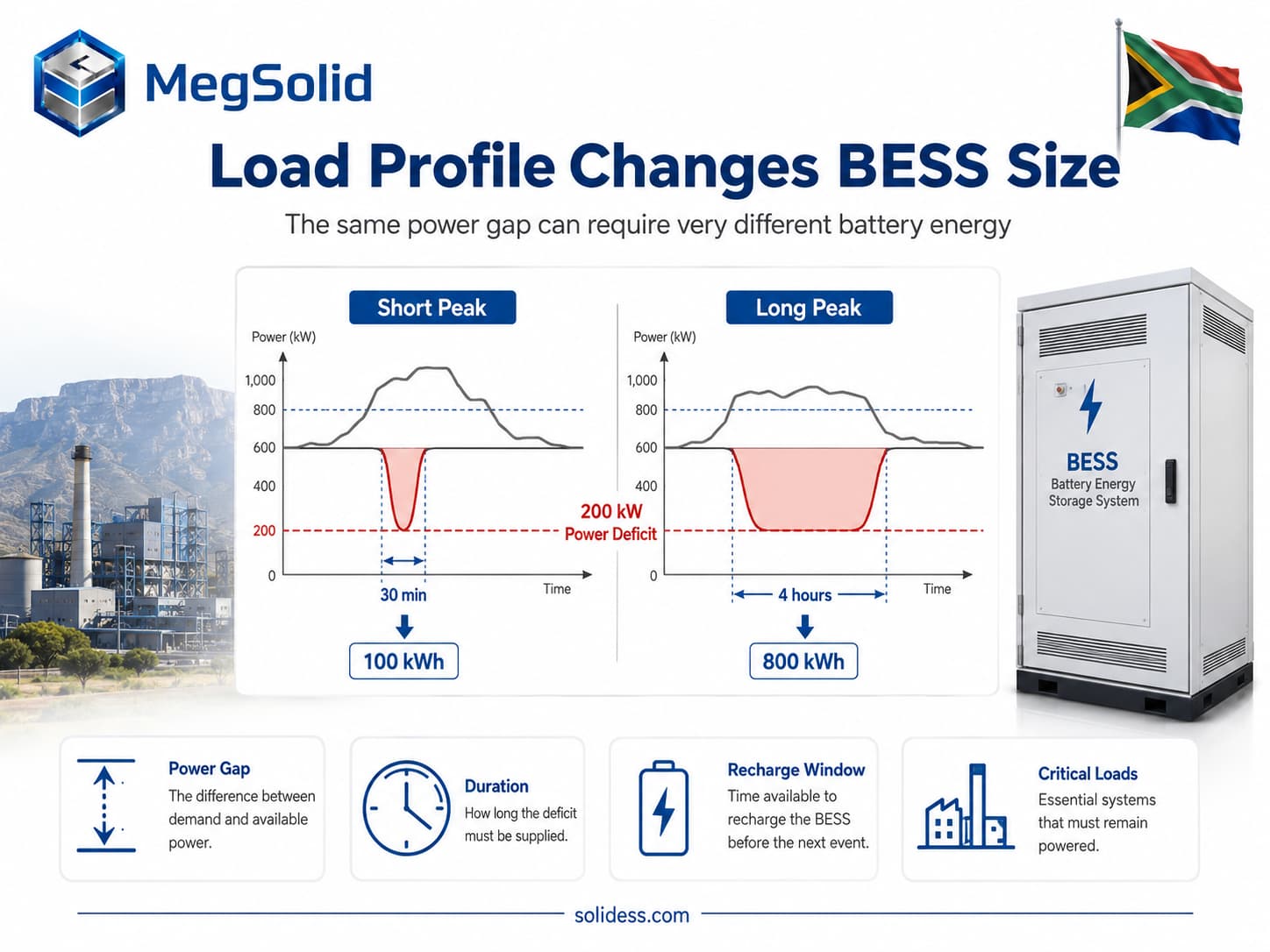
For example, a factory with a 200kW power shortage does not automatically require the same battery size.
A 200kW shortage lasting 30 minutes and a 200kW shortage lasting 4 hours represent completely different projects.
The first question should be “How much power is required, and for how long?” not only “How many kWh are required?”
I- inkqubo yokugcina amandla architecture should always start from the operating requirement.
7 Data Gaps That Create Unreliable BESS Quotations
1. Missing Load Profile
A monthly electricity bill is not enough for accurate BESS sizing.
It shows energy consumption and maximum demand, but it does not show the actual operating pattern.
A supplier should receive:
- 15-minute or 30-minute interval load data
- Production schedule
- Peak demand duration
- Imithwalo ebalulekileyo
- Future expansion plans
- Existing PV or generator operation
Two facilities may have the same maximum demand but completely different battery requirements.
Umzekelo:
| Site Condition | Power Gap | Ubude bexesha | Energy Requirement |
|---|---|---|---|
| Short peak event | 200kW | 30 minutes | 100kWh |
| Production peak | 200kW | 4 hours | 800kWh |
Without load-profile data, the supplier is only estimating.
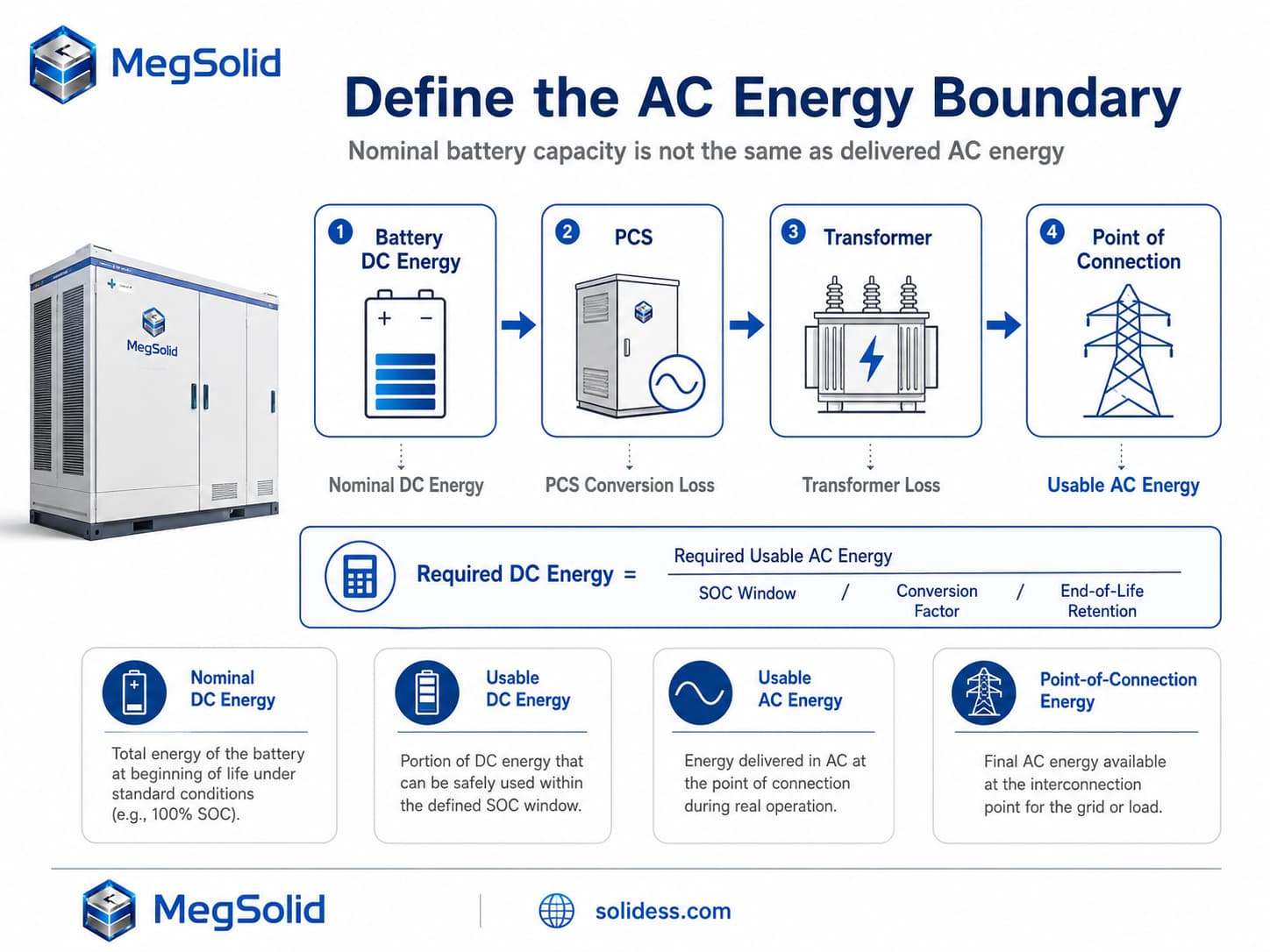
2. Undefined AC and DC Energy Boundary
One of the biggest quotation mistakes is comparing battery capacity from different measurement points.
A quotation must clearly define whether energy is measured at:
- Battery DC terminals
- PCS AC output
- Transformer output
- Point of connection
A complete BESS evaluation should consider:
- Battery conversion losses
- PCS efficiency
- Transformer losses
- Ukusetyenziswa okongezelelweyo
- Ugcino lwe-SOC
- Amandla okuphela kobomi
A supplier providing 1MWh nominal battery capacity is not necessarily providing 1MWh usable AC energy.
The buyer must define the required delivery point before comparing proposals.
I- South Africa BESS ROI model should also use the same energy boundary.
3. Incorrect PCS Selection
Battery capacity does not determine PCS size.
The PCS must match:
- Required output power
- Grid voltage
- Power factor requirement
- Overload capability
- Indlela yokusebenza
- Communication requirements
A 1MWh battery can use:
- 250kW PCS
- 500kW PCS
- 1MW PCS
depending on the application.
For commercial and industrial projects, the PCS is often the equipment that determines:
- Peak shaving capability
- Backup performance
- Ukusebenzisana kwegridi
- Installation complexity
I- I-inverter yokugcina amandla selection should be completed together with the battery sizing process.
4. Missing Grid and Transformer Information
A BESS cannot be evaluated separately from the electrical infrastructure.
The RFQ should include:
- Grid voltage
- Transformer rating
- Transformer impedance
- Switchgear rating
- Import limitation
- Export limitation
- Protection requirements
- Metering location
For South African commercial projects, zero-export requirements and grid connection conditions can significantly affect:
- EMS control logic
- Ukusebenza kwe-PCS
- Protection settings
- Commissioning requirements
A technically suitable battery can still fail a project if the electrical interface is not correctly designed.
5. Ignoring Temperature and Derating
A BESS installed in South Africa may experience:
- High ambient temperature
- Direct solar exposure
- Dust conditions
- Coastal corrosion
- Limited ventilation space
The quotation should define:
- Full-power operating temperature
- Battery derating conditions
- PCS derating conditions
- Cooling auxiliary consumption
- Maintenance requirements
The cooling method should be selected according to:
- Power density
- Cycling frequency
- Installation environment
- Maintenance capability
Not every project requires the same thermal design.
6. Unclear Equipment Scope
Different suppliers may use the term “complete BESS” differently.
A quotation should clearly define whether it includes:
| Equipment Scope | Included |
|---|---|
| Inkqubo yebhetri | Yes / No |
| PCS | Yes / No |
| Iinkonzo zonyango ezingxamisekileyo | Yes / No |
| Iguquleli | Yes / No |
| MV switchgear | Yes / No |
| Ukhuselo lomlilo | Yes / No |
| Installation | Yes / No |
| Isisumbu | Yes / No |
| Uvavanyo lwe-SAT | Yes / No |
Before comparing prices, EPCs should confirm:
- Equipment responsibility
- Warranty boundary
- Commissioning responsibility
- Spare parts scope
- Remote monitoring scope
I- C&I; Ugcino-amandla solution should be evaluated as a complete system, not only as a battery cabinet.
7. Missing FAT and SAT Requirements
A quotation without acceptance criteria creates uncertainty during delivery.
A professional BESS procurement document should define FAT testing:
- Battery performance verification
- PCS communication test
- EMS control test
- Alarm verification
- Protection test
- SOC management test
SAT should verify:
- Site electrical connection
- Transformer interface
- Grid communication
- Load response
- Operating sequence
The supplier and EPC should agree on:
- Test procedure
- Acceptance limits
- Measurement method
- Responsibility for correction
I- BESS Factory Acceptance Test guide provides a framework for defining these requirements.
How EPCs Should Prepare a Quote-Ready BESS RFQ
Before requesting a final quotation, prepare:
- Indawo yeprojekthi
- Required power (kW/MW)
- Required usable energy (kWh/MWh)
- Storage duration
- Load profile
- Grid voltage
- Transformer information
- Installation environment
- Iqondo lobushushu lokusebenza
- Application objective
The application objective should be clearly stated:
- Ukucheba incopho
- Amandla ombane okuxhasa
- Solar shifting
- Microgrid operation
- Iinkonzo zegridi
A complete RFQ reduces engineering uncertainty and allows suppliers to provide comparable proposals.
Preliminary MegSolid System Selection Direction
The system architecture depends on project requirements.
For projects up to 100kW AC output, EPCs can evaluate:
ESSA0100B-0215 Outdoor C&I Cabinet
Key parameters:
- 100kW AC rated power
- 215.04kWh nominal energy
- LFP chemistry
- Ukupholisa umoya okubukrelekrele
- IP54 outdoor cabinet design
For projects requiring higher power integration:
261.24kWh Liquid-Cooled C&I System
Key parameters:
- 261.24kWh rated energy
- 125kVA AC capacity
- 314Ah LFP cell
- Ukupholisa okuthe tyiwa
For larger industrial applications:
MEGA PCS based engineered BESS architecture can be evaluated according to:
- Required MW output
- Storage duration
- Grid connection requirements
- Future expansion plan
I- Ugcino-amandla lwezoRhwebo nezoShishino platform provides different configurations according to project scale.
Conclusion: A Better BESS Quotation Starts With Better Engineering Data
The lowest BESS quotation is not always the lowest project cost.
A reliable quotation must clearly define:
- Power requirement
- Amandla asetyenziswayo
- AC boundary
- PCS configuration
- Ujongano lwegridi
- Thermal conditions
- Equipment scope
- FAT and SAT requirements
When these parameters are defined, EPCs can compare suppliers based on engineering value instead of only price per kWh.
Imibuzo Ebuzwa Rhoqo
Q1: Why can’t a BESS supplier quote accurately from a “1MWh” request alone?
A 1MWh figure defines only an energy target. It does not define PCS power, discharge duration, usable AC energy, reserve SOC, end-of-life capacity or the measurement boundary. A 1MWh system could be configured as: 1MW/1MWh for one hour 500kW/1MWh for two hours 250kW/1MWh for four hours Each configuration requires a different PCS rating, battery discharge rate, transformer capacity, cable design and cooling strategy.
Q2: What information should be submitted before requesting a BESS quotation?
A quote-ready inquiry should provide: Required continuous and peak power in kW or MW Required usable energy in kWh or MWh Required discharge duration 15-minute or 30-minute load profile Grid voltage and transformer data Site temperature, altitude and environmental conditions Primary operating application Required equipment and commissioning scope Without these inputs, the supplier must base the quotation on assumptions.
Q3: Should a BESS RFQ specify nominal energy or usable energy?
The RFQ should specify the required usable energy and the point at which it must be measured. Possible measurement boundaries include: Battery DC terminals PCS AC output Low-voltage switchboard Transformer secondary Point of connection The supplier can then calculate the nominal battery capacity required after considering SOC limits, conversion losses, auxiliary consumption and end-of-life retention.
Q4: Why is a load profile required for BESS sizing?
A load profile shows the magnitude, duration and timing of power demand. A monthly electricity bill may show the maximum demand, but it does not show whether the peak lasts for 15 minutes, one hour or several hours. Without interval data, the BESS may be oversized or undersized.
Q5: How does peak duration change the required battery capacity?
Battery energy depends on both the power deficit and the time for which that deficit must be supplied. For example: 200kW for 30 minutes requires approximately 100kWh before system adjustments 200kW for two hours requires approximately 400kWh before system adjustments 200kW for four hours requires approximately 800kWh before system adjustments The final system size must also account for SOC limits, efficiency, auxiliary consumption, temperature derating and lifecycle requirements.
Q6: Why must PCS power be selected separately from battery energy?
Battery energy determines runtime, while PCS power determines how much AC power can be delivered at one time. PCS selection should consider: Continuous AC output Maximum apparent power DC operating-voltage range Grid voltage Power-factor requirement Grid-connected or off-grid operation Communication and control requirements A large battery connected to an undersized PCS cannot supply the required peak load.
Q7: What transformer and grid information is required?
The EPC should provide: Transformer rated capacity Primary and secondary voltage Transformer impedance Existing transformer loading Available spare capacity Grid import and export limits Switchgear rating Protection and metering information Current single-line diagram These parameters determine whether the proposed PCS can connect without electrical upgrades.
Q8: How should zero-export operation be defined?
A statement such as “zero export required” is not sufficient. The RFQ should define: Meter location Maximum permitted export Required EMS response PCS control method Communication protocol Communication-loss fallback Permitted transient export, if applicable These requirements should also be included in the FAT and SAT procedures.
Q9: What environmental data should South African EPCs provide?
The project should provide: Maximum and minimum equipment-intake temperature Altitude Dust exposure Direct solar exposure Coastal corrosion conditions Installation clearance Ventilation restrictions Expected cycling frequency The supplier should then confirm the full-power temperature range, battery derating, PCS derating and cooling auxiliary consumption.
Q10: What should be included in a complete BESS quotation?
The quotation should clearly state whether it includes: Inkqubo yebhetri PCS BMS EMS or plant controller Thermal-management system Fire detection and suppression Iguquleli Medium-voltage switchgear SCADA integration Shipping and installation I-FAT ne-SAT Ukuvunywa Spare parts and training Two BESS quotations cannot be compared accurately when their equipment and responsibility boundaries are different.
Q11: What information is required for a South Africa BESS quotation?
A quote-ready South Africa BESS inquiry should include: Required kW or MW Required usable kWh or MWh Storage duration Iprofayile yomthwalo ngexesha elinqamlezileyo Grid voltage Transformer data Site temperature and altitude Operating application Equipment scope Target commissioning date
Q12: How should South African EPCs compare BESS suppliers?
South African EPCs should compare: Usable AC energy PCS power Energy measurement boundary Ukuncitshiswa komlinganiselo ngenxa yendawo Equipment inclusions Degradation assumptions FAT and SAT scope Commissioning responsibility Long-term service support Price per kWh should only be compared after these technical boundaries are aligned.
Q13: Which BESS configuration is suitable for a South African C&I project?
The appropriate configuration depends on the project power, storage duration, load profile, transformer capacity, grid conditions, site temperature and operating objective. Smaller projects may use modular outdoor cabinets. Higher-power or longer-duration projects may require engineered battery capacity, larger PCS ratings or containerized BESS architecture.