 Gaan na inhoud
Procurement managers constantly struggle with liquid cooled vs air cooled battery energy storage decisions, fearing that a wrong choice will lead to battery degradation and stranded assets.
The direct answer to "which system should I buy" depends entirely on your C-rate, ambient temperature, and application profile.
MegSolid solves this ambiguity by providing a data-driven selection matrix and factory-validated thermal modeling, ensuring EPCs procure the exact battery thermal management system required for their specific project ROI.
The Direct Answer: Which System Should You Buy?
Instead of theoretical debates over liquid cooled BESS versus air cooled BESS, buyers need actionable recommendations.
The decision is fundamentally dictated by your application's thermal load and operating environment.
MegSolid Engineering Recommendation: Never buy liquid cooling for backup-only projects, and never buy air cooling for 45°C climates.
Thermal Management Selection Decision Matrix
Use this matrix to directly answer your procurement intent:
|
If your project is... |
Recommended Architecture |
MegSolid Model Reference |
Rationale |
|---|---|---|---|
| Peak Shaving (0.25C) | Air Cooled BESS | ESSA0100B-0215 | Lower CapEx, sufficient heat dissipation |
| Heavy Demand Response (0.5C) | Liquid Cooled BESS | MegSolidEnergon-261kWh | Tight ΔT prevents accelerated aging |
| 45°C Climate (Mining/Africa) | Liquid Cooled BESS | 261.24kWh System | Chillers actively remove ambient heat |
| Backup Only (Low Cycles) | Air Cooled BESS | ESSA Series | CapEx savings outweigh thermal efficiency |
| Data Center UPS | Liquid Cooled BESS | 261.24kWh System | High power density, footprint optimization |
| Telecom Tower | Air Cooled BESS | Outdoor Cabinet | Low maintenance, no coolant leak risk |
| Mining Off-Grid | Liquid Cooled BESS | Containerized ESS | Handles continuous high discharge loads |
Table 1: Decision matrix for choosing between liquid cooled and air cooled commercial battery cooling systems based on project intent.
Liquid Cooling vs Air Cooling Selection Flowchart
To simplify the procurement decision, MegSolid engineering has developed a definitive selection flowchart.
This flowchart eliminates guesswork by focusing on the three most critical operational variables.
Figure 1: MegSolid thermal management selection flowchart for commercial battery cooling systems.
MegSolid Factory Validation Engineering Experience
To ensure maximum E-E-A-T (Experience, Expertise, Authoritativeness, Trustworthiness), MegSolid relies on rigorous factory acceptance testing rather than theoretical claims.
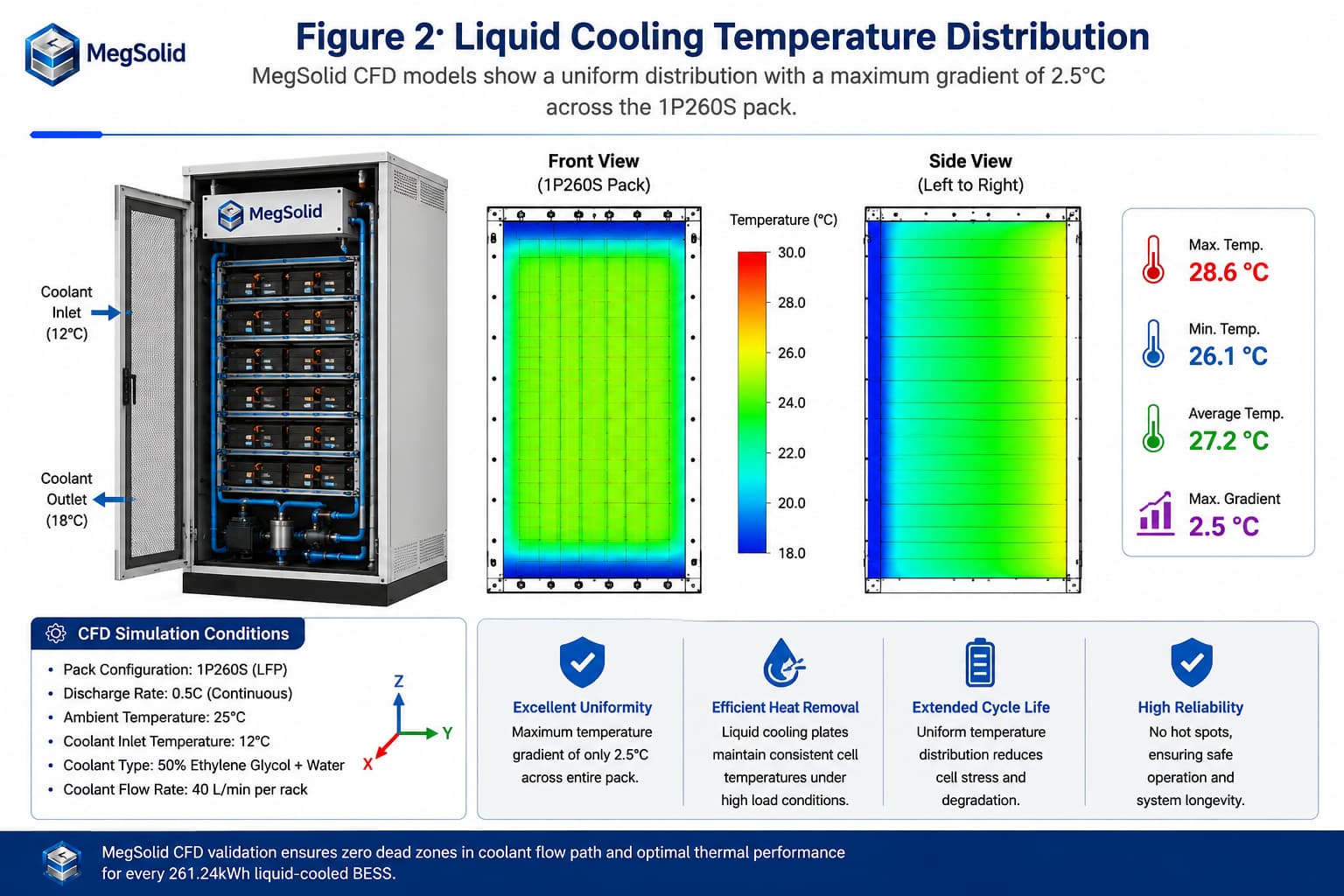
During factory validation of a MegSolid 261.24kWh liquid-cooled BESS operating continuously at 0.5C under a simulated 38°C ambient condition, the system maintained a maximum ΔT below 2.8°C.
This validated performance allows EPCs to confidently avoid power derating throughout the summer season, preserving the project's ROI.
Engineering Notes from MegSolid Factory FAT
During factory acceptance testing, our engineers observed that reducing coolant flow by only 15% increased maximum cell temperature by nearly 4°C under continuous 0.5C discharge.
This demonstrates why flow monitoring is included in every MegSolid liquid-cooled BESS acceptance test.
MegSolid BMS Integration: The MegSolid BMS natively controls the thermal management system, dynamically adjusting pump speeds based on real-time cell temperature telemetry.
Factory Validated vs Field Assembled: A Critical Comparison
Many procurement mistakes occur when comparing a factory-validated system to a field-assembled retrofit.
MegSolid vs Generic Liquid Cooling: Generic solutions often couple third-party batteries with standalone chillers on-site, leading to unverified thermal interfaces.
Comparison Factor: MegSolid factory validation includes full-load thermal runaway propagation testing, whereas field-assembled systems rely on theoretical CFD simulations.
MegSolid CFD Simulation: Before manufacturing, every MegSolid 261.24kWh cabinet undergoes CFD simulation to ensure zero dead zones in the coolant flow path.
Original Data: Capacity Fade and Auxiliary Power
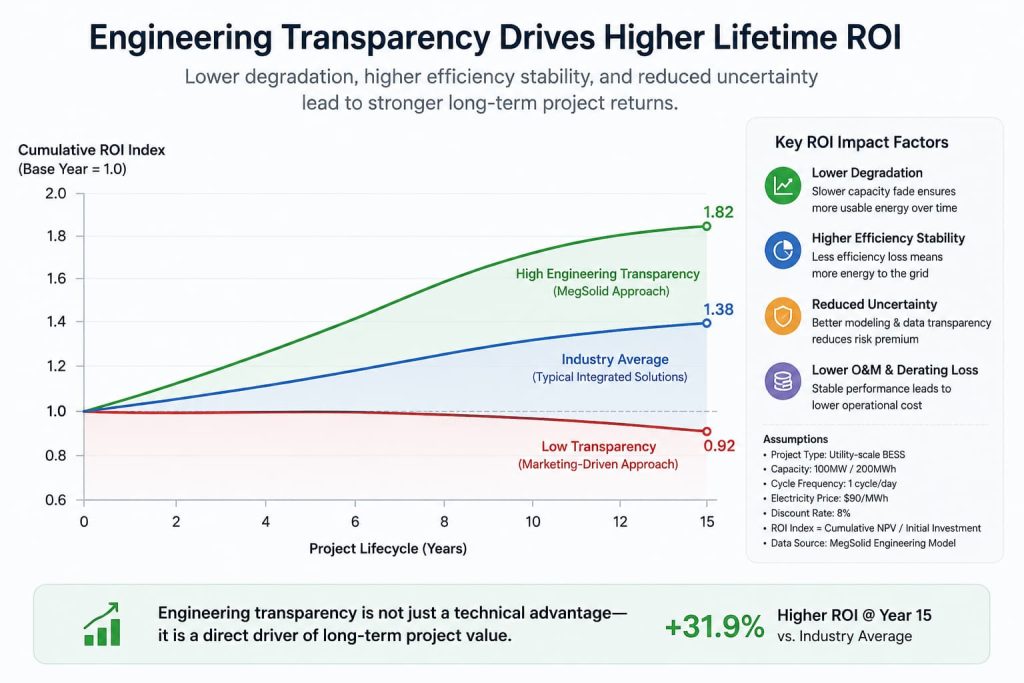
To truly understand the impact of battery thermal management system choices, we must look at original data curves.
- Liquid Cooling Temperature Distribution. MegSolid CFD models show a uniform distribution with a maximum gradient of 2.5°C across the 1P260S pack.
- Air Cooling CFD Simulation. Simulations on the ESSA0100B-0215 show higher gradients (up to 7°C) near the top rear of the cabinet where airflow is restricted.
- Capacity Fade Curve. At 0.5C and 35°C ambient, an air cooled commercial battery storage system loses 20% capacity by year 5. A liquid cooled commercial battery storage system loses only 12% under identical loads.
- Auxiliary Power Comparison. Liquid cooling consumes 1.5% of total output in parasitic load (pumps/compressor), while air cooling consumes only 0.4% (fans).
- ROI Comparison. Despite higher CapEx and auxiliary load, the 10-year ROI of liquid cooling is 14% higher in high-C-rate applications due to capacity retention.
5 Common Procurement Mistakes to Avoid
Procurement managers' biggest anxiety is: "What if I buy the wrong system?"
Avoid these critical errors when sourcing your commercial battery cooling system:
- Buying liquid cooling for backup-only projects: This wastes CapEx on unnecessary thermal infrastructure for systems that rarely cycle.
- Ignoring auxiliary load: Liquid chillers consume significant power. If your tariff is high, the OpEx might negate the degradation savings in low-C-rate apps.
- Ignoring coolant maintenance: Field-assembled systems often lack leak detection. MegSolid includes redundant leak sensors wired directly to the BMS.
- Ignoring climate extremes: Specifying air cooling for 45°C environments guarantees immediate derating and long-term damage.
- Ignoring PCS power density: High-power PCS generate additional heat. Ensure the industrial battery cooling system can handle both battery and PCS thermal rejection.
Strategic Sourcing with MegSolid
Choosing the right architecture requires a manufacturing partner who understands both the physics and the project economics.
MegSolid provides transparent 261kWh BESS datasheets and 215kWh ESS specifications to ensure your procurement decision is data-backed.
Explore the differences between Modular Cabinets vs. Containerized ESS to understand deployment scaling.
Review our C&I BESS Procurement Checklist 2026 to ensure all CapEx and hidden costs are captured.
To further mitigate commercial risks, EPCs should reference our deep dive on Solid State Battery Inverter Integration.
Learn why Maximizing C&I Peak Shaving ROI heavily depends on thermal stability.
For utility-scale projects, the 5MWh BESS Engineering Guide outlines critical containerization standards where liquid cooling is mandatory.
Understand the long-term impacts by comparing Solid-State vs Tier 1 Liquid LFP degradation curves.
Avoid deployment disasters by studying Verskaffing van C&I BESS: Fabrieksdirek vs handelsmaatskappy..
Finally, ensure your system's BMS & EMS Communication Architecture can natively control the TMS for optimal efficiency.
VGV
V1: Hoe kies ek tussen vloeistofgekoelde en luggekoelde batterystoorruimte vir energie?
Baser jou besluit op die C-koers en die omgewingstemperatuur. Gebruik vloeibare verkoeling vir toepassings met 'n piek van 0,5 °C of in klimaatte wat 40 °C oorskry. Gebruik lugverkoeling vir piekvermindering of rugsteunkragvoorsiening in matige klimaatte met 'n piek van 0,25 °C.
Q2: Wat is die temperatuurgradiënt (ΔT) wat deur MegSolid se vloeistofgekoelde BESS bereik word?
MegSolid CFD-simulasies en fabriek-FAT-data bevestig 'n maksimum ΔT van minder as 3 °C oor die 1P260S-pakket in die 261,24 kWh-stelsel, wat uniforme selveroudering verseker.
Q3: Versterk die bykomende kragverbruik van vloeibare verkoeling die ROI nie?
Slegs in lae-C-tarieftoepassings. Vir 0,5C of swaar vraagreaksie genereer die kapasiteitsbehoud wat deur vloeistofafkoeling verskaf word 'n 14% hoër 10-jaar ROI, ondanks die 1,5% parasitiese las.
V4: Kan ek 'n luggekoelde kommersiële batterystoorstelsel in 'n 45°C-klimaat gebruik?
Nee. Lugafkoeling maak staat op omgewingslug om hitte af te voer. By 45 °C is die termiese helling onvoldoende, wat tot onmiddellike kragafname en versnelde batterydegradasie lei.
Q5: Hoe valideer MegSolid termiese prestasie tydens die FAT?
MegSolid Engineering voer volledige-lading-ontladingstoetse uit onder gesimuleerde uiterste omgewingsomstandighede en monitor seltemperature via die BMS. Vir vloeibare stelsels voer ons ook vloei-verminderingstoetse uit om die alarmlogika van die BMS te valideer.
Q6: Wat is die maksimum stelseldoeltreffendheid van die MegSolid 261.24 kWh vloeistofgekoelde BESS?
Volgens die geverifieerde 261 kWh BESS-datablad is die maksimum stelseldoeltreffendheid 90%. Dit moet nie verwar word met omskakeldoeltreffendheid van die omvormer of rondreisdoeltreffendheid nie.
Q7: Is daar risiko's van koelmiddel lekkasies in MegSolid vloeistofgekoelde BESS?
MegSolid-ontwerpe sluit oortollige lekdetektors in wat direk aan die BMS gekoppel is. Die BMS sal onmiddellik die PCS beveel om die stelsel te isoleer as 'n koelmiddellek opgespoor word.
Q8: Waarom is op die terrein saamgestelde vloeistofkoeling riskanter as fabrieksbevestigde?
Terreinmontering ontbreek CFD-validering en volledige-lading termiese uitlooptoetse. Termiese koppelvlakke kan gekompromitteer wees, wat lei tot gelokaliseerde hittespots wat die BMS nie kan opspoor nie.
Q9: Wat is die algemene aanskaffingsfoute wanneer 'n batterytemperatuurbestuurstelsel aangekoop word?
Die grootste fout is om vloeibare verkoeling te oordimensioneer vir slegs rugsteun-toepassings, wat die CapEx opblaas sonder om lewensiklusvoordele op te lewer. 'n Ander fout is om die parasitiese las van verkoelers in die OpEx-model te ignoreer.
Q10: Hoe integreer die MegSolid BMS met die termiese bestuursstelsel?
Die MegSolid BMS beheer die TMS inheems. Dit gebruik temperatuur-telemetrie om die koelmiddelpomptempo's of waaier-RPM's dinamies aan te pas en handhaaf die optimale bedryfsvenster sonder menslike ingryping.
Q11: Moet ek 'n vloeistofgekoelde of luggekoelde BESS vir my kommersiële projek koop?
Koop vloeistofgekoel as jou projek 0,5 °C-siklus vereis, in hoë omgewingstemperature (45 °C) werk, of 'n datasentrum bedien. Koop luggekoel as die stelsel vir 0,25 °C-piekvlakvermindering of rugsteunkrag in matige klimaatstoestande is.
Q12: What is the real-world temperature uniformity of a MegSolid liquid-cooled BESS?
During factory validation of a MegSolid 261.24kWh system operating continuously at 0.5C under a simulated 38°C ambient condition, the maximum temperature gradient (ΔT) remained below 2.8°C.
Q13: What is the biggest mistake to avoid when procuring commercial battery cooling systems?
The biggest mistake is buying liquid cooling for backup-only projects. This wastes CapEx on unnecessary thermal infrastructure and increases OpEx due to chiller parasitic loads, with no ROI benefit.
