 Yiya kumxholo
In the global energy transition, off-grid energy storage systems have become the backbone of electrification in regions such as Sub-Saharan Africa, Southeast Asia, and South Asia.
For many rural communities, a solar-plus-storage system is no longer optional infrastructure—it is the entire power supply.
But beneath this progress lies a critical and often overlooked question:
- Are we delivering energy systems, or are we deploying long-term safety risks?
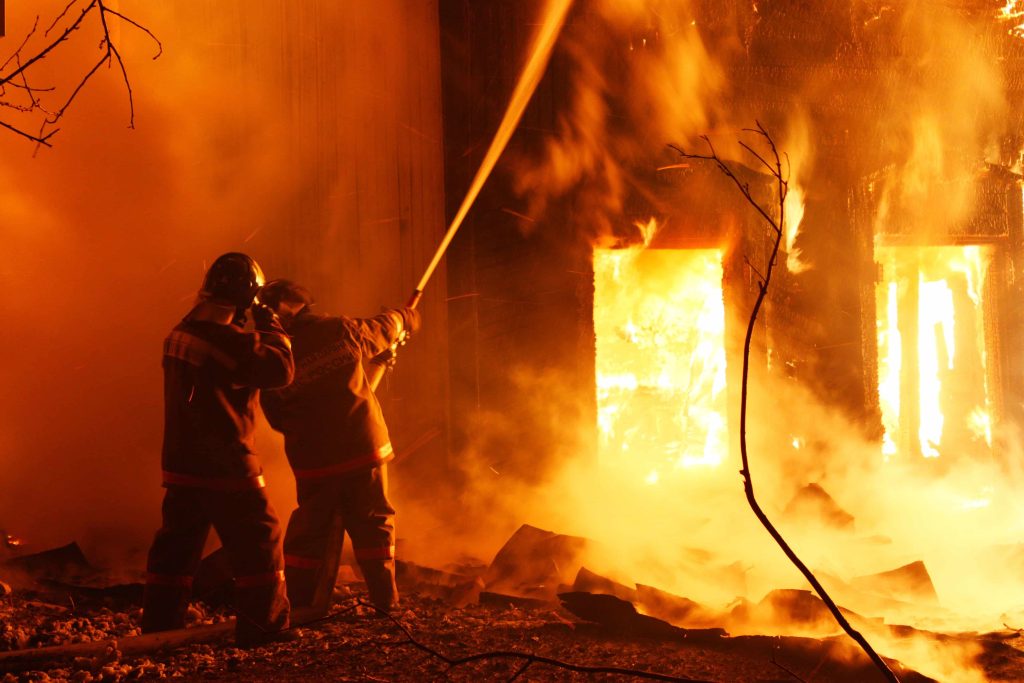
The Reality of Off-Grid Energy Storage: Extreme Conditions, Minimal Protection
A typical rural microgrid system may support:
- 100–500 households
- Water pumping systems
- Medical refrigeration and clinics
- Communication base stations
- Community lighting and small businesses
However, these systems usually operate under extreme constraints:
- Ambient temperatures frequently exceed 40–50°C
- No dedicated maintenance teams (1–2 inspections per year)
- No fire protection infrastructure
- No rapid emergency response (often hundreds of kilometers away)
In such environments, a storage system failure is not just a technical issue—it becomes a community-level disaster.
The Core Risk: Thermal Runaway in Conventional Lithium-Ion Batteries
Most off-grid storage systems today still rely on:
- Lithium Iron Phosphate (LFP)
- Nickel-based lithium chemistries
All of them share a common component:
- Flammable liquid organic electrolyte
Flammable liquid organic electrolyte
According to the <>4-stage thermal runaway mechanism of conventional liquid lithium batteries, the failure process evolves as follows:
Stage 1: SEI Layer Decomposition (~80–100°C)
The Solid Electrolyte Interphase (SEI) begins to break down.
- Initial release of flammable gases
- Internal chemical instability begins
- No visible external warning in most cases
The battery is already entering an irreversible degradation phase.
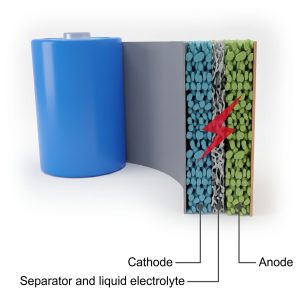
Stage 2: Exothermic Reaction Between Electrode and Electrolyte (~120–150°C)
The anode reacts violently with the liquid electrolyte.
- Rapid temperature increase
- Accelerated gas generation
- Internal pressure buildup
This stage acts as the thermal “acceleration point.”
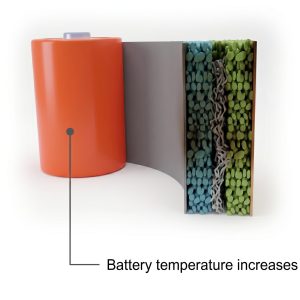
Stage 3: Separator Melting and Internal Short Circuit (~130–160°C)
The separator fails.
- Direct contact between anode and cathode
- Internal short circuit occurs
- Sudden energy release
Electrical failure transitions into thermal catastrophe.
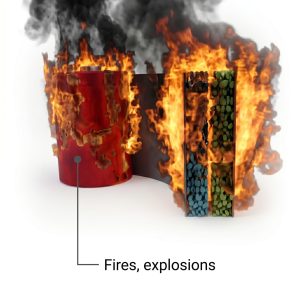
Stage 4: Electrolyte Combustion and Explosion (≥200°C)
The flammable electrolyte ignites.
- Open flame
- Thermal propagation to adjacent cells
- Possible explosion in confined systems
Full thermal runaway fire event occurs.
Critical Insight
From Stage 1 to Stage 4:
- The entire process can complete in 30–60 seconds, often without any external intervention possible.
In urban environments, mitigation systems may include:
- HVAC cooling
- Fire suppression systems
- 24/7 monitoring
- Rapid emergency response
But in remote off-grid regions:
- No firefighting infrastructure
- No trained maintenance teams
- No system redundancy
A single thermal runaway event can escalate into a full system-level failure and community-wide blackout.
The Structural Problem: Risk Control vs Risk Elimination
Over the past decade, the industry has introduced multiple mitigation measures:
- Advanced Battery Management Systems (BMS)
- Liquid cooling systems
- Aerosol fire suppression
- Ceramic-coated separators
- Pack-level insulation and containment
While these improvements reduce risk probability, they do not eliminate the root cause.
Because one fundamental element remains unchanged:
- The presence of flammable liquid electrolyte
This leads to a structural limitation:
- You cannot fully “control” combustion risk in a system that inherently contains flammable liquid chemicals.
It is analogous to:
- Installing advanced smoke detectors inside a gasoline storage facility instead of removing the gasoline itself.
The Fundamental Shift: Solid-State Electrolytes Remove the Root Cause of Thermal Runaway
solid-state battery technology introduces a structural transformation:
- Replacing flammable liquid electrolyte with non-flammable solid electrolyte materials
This single change fundamentally alters the thermal runaway mechanism.
Why Solid-State Batteries Interrupt the 4-Stage Thermal Runaway Chain
In hybrid solid-state architectures such as those developed by MegSolid, the system behavior changes at the material level:
Elimination of Flammable Electrolyte
- No liquid organic solvent
- No vapor-phase flammable gas generation
- Stage 1 ignition pathway is effectively removed
Thermal runaway initiation becomes structurally impossible.
High Thermal Stability (>200–300°C)
Solid electrolytes maintain structural integrity under high temperature conditions.
- No decomposition chain reaction
- No rapid exothermic breakdown
The “acceleration phase” of thermal runaway is neutralized.
No Liquid Leakage or Flow Propagation
Even under internal stress:
- No electrolyte leakage
- No spreading of flammable medium
- No cascading chemical reaction between cells
Fire propagation pathway is physically blocked.
Transition from Reactive System to Inert System
The key transformation is conceptual:
- Conventional lithium batteries → reactive chemical system
- Solid-state batteries → stable electrochemical system
Thermal runaway is not just reduced—it is structurally disrupted.
MegSolid Hybrid Solid-State BESS vs. Traditional LFP BESS
Comprehensive comparison verifies that hybrid solid-state technology fundamentally addresses the weaknesses of traditional energy storage solutions. Its performance and cost advantages amplify over long-term operation, creating substantial gaps in project investment returns.
|
Comparison Item |
Traditional LFP BESS |
MegSolid Hybrid Solid-State BESS |
|---|---|---|
| Electrolyte Type | Liquid Electrolyte | Hybrid Solid-State Electrolyte |
| Thermal Runaway Risk | High, reliant on external protection | Greatly reduced, intrinsic cell safety |
| Cycle Life | 6,000–8,000 cycles | More than 10,000 cycles |
| Operating Temperature Range | -10℃~50℃ | -30℃~60℃ |
| Energy Density | Standard industry level | Higher than traditional liquid batteries |
| Extreme Safety Tests | Partially passed | Fully passed all test items |
| Microgrid Adaptability | Good | Excellent, optimized for weak grids |
| Full Lifecycle Cost | High, with expensive maintenance and replacement | Lower, superior long-term cost performance |
Field Evidence: Why Remote Regions Benefit the Most
Turkana County, Kenya (Off-Grid Microgrid Case)
A 1.2 MWh LFP-based system initially deployed for village electrification experienced:
- Ambient temperatures exceeding 45–55°C
- Frequent over-temperature alarms
- Battery swelling risk
- Limited maintenance access (>300 km distance)
Operators stated:
- “We are not afraid of power loss. We are afraid of fire.”
After upgrading to a hybrid solid-state system:
- No thermal alarms
- Stable operation under high temperature
- Significantly reduced maintenance visits
- Zero safety incidents recorded
Mindanao Island, Philippines (Typhoon-Prone Microgrid)
Initial system (800 kWh lithium-ion):
- Moisture-induced micro short circuits
- Thermal runaway event triggered post-typhoon
- 47 days of system downtime
- 800 households affected
After system upgrade:
- Zero failure during subsequent typhoon seasons
- System availability increased to 98.8%
- Maintenance frequency significantly reduced
Industry Conclusion: The Real Requirement Is No Longer “Better Lithium Batteries”
In remote off-grid environments, the equation is fundamentally different:
In urban grids:
- Safety = engineering optimization problem
In rural microgrids:
- Safety = survival-level infrastructure requirement
Final Insight: The Next Stage of Energy Storage Is Not Capacity Growth—It Is Risk Elimination
Globally, more than 770 million people still lack reliable electricity access.
Energy storage systems are becoming the foundation of electrification.
However:
- If the system still relies on flammable liquid electrolytes, thermal runaway remains an inherent possibility.
Solid-state battery technology does not simply reduce risk.
It changes the physics of the system:
- Thermal runaway becomes structurally impossible rather than statistically unlikely.
Imibuzo Ebuzwa Rhoqo
Q1: What is thermal runaway in lithium-ion batteries?
Thermal runaway is a self-accelerating failure process in lithium-ion batteries where internal temperature rises uncontrollably, triggering a chain reaction of heat, gas release, and combustion. In conventional liquid electrolyte batteries, this process can escalate from initial degradation to fire within 30–60 seconds.
Q2: What are the 4 stages of lithium battery thermal runaway?
The thermal runaway process in conventional liquid lithium batteries typically includes:
1.SEI layer decomposition (~80–100°C)
2.Exothermic reaction between electrode and electrolyte (~120–150°C)
3.Separator melting and internal short circuit (~130–160°C)
4.Electrolyte combustion and explosion (≥200°C)
Once initiated, this chain reaction is extremely difficult to stop externally.
Q3: Why are off-grid energy storage systems more vulnerable to thermal runaway?
Off-grid systems often operate under extreme conditions such as high ambient temperatures, limited maintenance access, and lack of fire protection infrastructure. These conditions significantly increase the risk of undetected thermal runaway escalation in remote microgrids.
Q4: Can Battery Management Systems (BMS) fully prevent thermal runaway?
No. BMS can help detect early warning signals such as over-temperature, over-voltage, or imbalance, but it cannot stop the internal chemical reaction once thermal runaway begins. It is a risk control tool, not a risk elimination solution.
Q5: What is the main limitation of traditional lithium-ion battery safety systems?
The fundamental limitation is the presence of flammable liquid organic electrolyte. Even with advanced cooling, monitoring, and fire suppression systems, the root cause of combustion risk still exists within the battery chemistry itself.
Q6: How do solid-state batteries eliminate thermal runaway risk?
Solid-state batteries replace the flammable liquid electrolyte with a non-flammable solid electrolyte. This structural change removes the key conditions required for thermal runaway, such as flammable vapor generation and electrolyte combustion.
Q7: Does solid-state battery technology completely prevent fire?
Solid-state battery systems significantly reduce and structurally disrupt the conditions required for fire. By eliminating liquid electrolytes and improving thermal stability, the traditional 4-stage thermal runaway pathway cannot fully develop in the same way as conventional lithium-ion batteries.
Q8: What is a hybrid solid-state energy storage system?
A hybrid solid-state system combines solid electrolyte materials with optimized ionic conduction components. For example, MegSolid develops hybrid architectures where solid-state layers exceed 60%, balancing safety, efficiency, and performance for commercial and off-grid applications.
Q9: Why is solid-state energy storage especially important for rural microgrids?
Rural microgrids often lack fire response infrastructure, trained technicians, and rapid maintenance support. In such environments, preventing failure at the material level is more effective than relying on external protection systems.
Q10: What industries benefit most from solid-state energy storage systems?
Solid-state energy storage is particularly suitable for:
Off-grid rural electrification projects
Commercial & industrial (C&I) energy storage systems
Critical infrastructure (hospitals, telecom, water systems)
Remote renewable energy projects
Island and harsh-environment microgrids
These scenarios require high safety, low maintenance, and long-term system stability.
