
Solid state battery thermal runaway cannot be ruled out from the electrolyte label alone. Reducing flammable liquid can lower one combustion hazard, while the electrodes, electrolyte interfaces, internal faults and cell design still determine heat release. For off-grid energy storage systems in Sub-Saharan Africa, Southeast Asia and South Asia, evaluate the offered cell chemistry and configuration-specific evidence. UL 9540A evaluates thermal-runaway fire propagation under defined test conditions; it does not establish zero risk for every solid-state system.
When an off-grid battery stops, water pumping, refrigeration and communications may stop with it. The bill can extend beyond replacement hardware: emergency transport, lost production and the time needed to restore critical services all belong in the buying decision. Choose the system for that outage duty before comparing battery prices. Request a MegSolid ESS proposal for your critical loads.
But beneath this progress lies a critical and often overlooked question:
- Are we delivering energy systems, or are we deploying long-term safety risks?
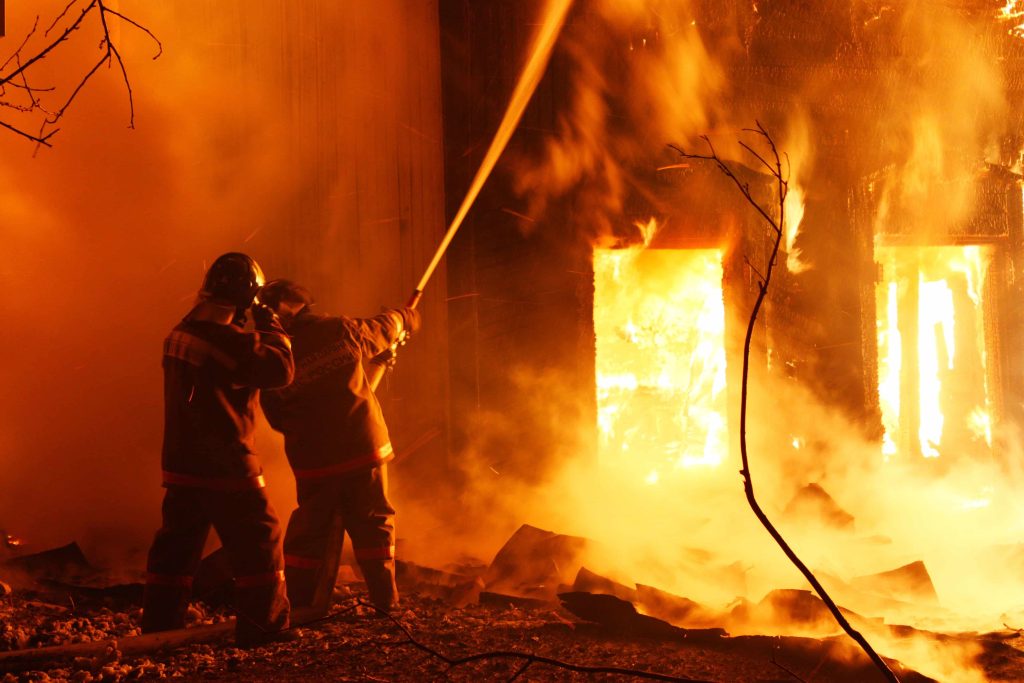
The Reality of Off-Grid Energy Storage: Extreme Conditions, Minimal Protection
A typical rural microgrid system may support:
- 100–500 households
- Water pumping systems
- Medical refrigeration and clinics
- Communication base stations
- Community lighting and small businesses
However, these systems usually operate under extreme constraints:
- Ambient temperatures frequently exceed 40–50°C
- No dedicated maintenance teams (1–2 inspections per year)
- No fire protection infrastructure
- No rapid emergency response (often hundreds of kilometers away)
Do not pay for a “safer battery” slogan while the emergency duty is still undefined. Put the critical-load kW, required hours and recovery window on one page. That brief lets MegSolid screen the power stage and usable-energy requirement against an actual product configuration, so the quotation answers the job your site must keep running.
The Core Risk: Thermal Runaway in Conventional Lithium-Ion Batteries
Most off-grid storage systems today still rely on:
- Lithium Iron Phosphate (LFP)
- Nickel-based lithium chemistries
All of them share a common component:
- Flammable liquid organic electrolyte
Flammable liquid organic electrolyte
To compare thermal runaway gas production from NCM/liquid-electrolyte cells with semi-solid or solid-state cells, match the cathode chemistry, state of charge, electrolyte loading, initiation method and test atmosphere, including oxygen concentration. Review the measured gas release, composition and flammability in the relevant reports; reduced liquid content does not establish zero gas release. The 4-stage thermal runaway mechanism of conventional liquid lithium batteries outlined below is illustrative. Reaction order and onset temperatures depend on chemistry and test conditions, so the listed ranges are not universal approval limits.
Stage 1: SEI Layer Decomposition (~80–100°C)
The Solid Electrolyte Interphase (SEI) begins to break down.
- Initial release of flammable gases
- Internal chemical instability begins
- No visible external warning in most cases
The battery is already entering an irreversible degradation phase.
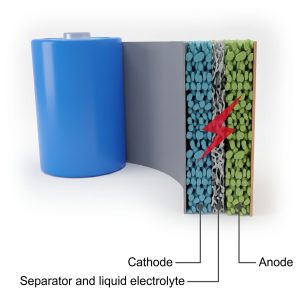
Stage 2: Exothermic Reaction Between Electrode and Electrolyte (~120–150°C)
The anode reacts violently with the liquid electrolyte.
- Rapid temperature increase
- Accelerated gas generation
- Internal pressure buildup
This stage acts as the thermal “acceleration point.”
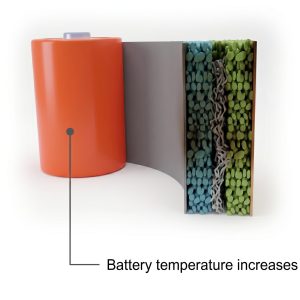
Stage 3: Separator Melting and Internal Short Circuit (~130–160°C)
The separator fails.
- Direct contact between anode and cathode
- Internal short circuit occurs
- Sudden energy release
Electrical failure transitions into thermal catastrophe.
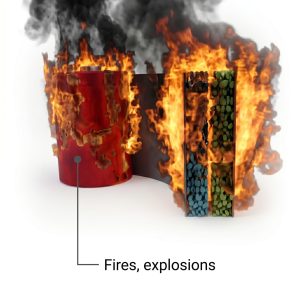
Stage 4: Electrolyte Combustion and Explosion (≥200°C)
The flammable electrolyte ignites.
- Open flame
- Thermal propagation to adjacent cells
- Possible explosion in confined systems
Full thermal runaway fire event occurs.
Critical Insight
From Stage 1 to Stage 4:
- Failure can accelerate rapidly; the available response time depends on the specific cell, fault and test conditions.
In urban environments, mitigation systems may include:
- HVAC cooling
- Fire suppression systems
- 24/7 monitoring
- Rapid emergency response
But in remote off-grid regions:
- No firefighting infrastructure
- No trained maintenance teams
- No system redundancy
Start with a product that matches the duty. MegSolid’s ESSA0100B-0215 outdoor cabinet combines 100 kW rated AC power with 215.04 kWh nominal storage for C&I projects. A separately engineered battery-and-PCS package can use the 30–500 kW MEGA Series PCS when its voltage, power and operating modes fit the site. Compare those published specifications with the required usable AC energy, then confirm the cell/BOM and backup topology in the offer.
The Structural Problem: Risk Control vs Risk Elimination
Over the past decade, the industry has introduced multiple mitigation measures:
- Advanced Battery Management Systems (BMS)
- Liquid cooling systems
- Aerosol fire suppression
- Ceramic-coated separators
- Pack-level insulation and containment
Monitoring, cooling, electrical protection and containment address different hazards. Their effectiveness must be evaluated with the cell chemistry and installation, including any remaining liquid-electrolyte and electrode-reaction risks.
Because one fundamental element remains unchanged:
- The presence of flammable liquid electrolyte
This leads to a structural limitation:
- Flammable electrolyte is one hazard; internal shorts, electrode reactions and stored electrical energy also require controls.
The useful distinction is between reducing a material hazard and validating the remaining cell and system hazards:
- A less-flammable electrolyte still requires model-specific abuse testing and system-level propagation assessment.
The Fundamental Shift: Solid-State Electrolytes Change Thermal-Runaway Hazards
For solid-state battery projects, make the MegSolid quotation identify the offered cell architecture, production BOM, battery-to-PCS interface and test scope in one supply package. The practical value is a named configuration and a clear acceptance record—not a chemistry label attached to unrelated certificates. Confirm any hybrid cell option and its test evidence for the equipment actually ordered.
- Reducing or replacing flammable liquid electrolyte, with the remaining liquid content and solid-electrolyte chemistry specified for the cell.
This change can alter heat-release pathways; the effect depends on the electrolyte, electrodes and cell construction.
How Solid-State Batteries Change the Thermal-Runaway Failure Pathways
The hybrid solid-state architectures discussed by MegSolid require the same distinction between reduced solvent hazards and verified cell/system performance:
Reduced Flammable-Electrolyte Content
- Identify the electrolyte chemistry and residual liquid content
- Assess gas composition and flammability under the tested conditions
- Verify the offered cell model instead of assuming that ignition pathways are absent
Thermal-runaway initiation is not structurally impossible. Sandia's original thermodynamic and calorimetric research examined specific NMC/LLZO/lithium-metal configurations and identified substantial heat release from short circuits or mechanical failure of the solid electrolyte. These findings establish a failure-mechanism concern, not the performance of any particular MegSolid model.
Thermal Stability Depends on the Materials and Interfaces
Solid-electrolyte stability and electrode-interface reactions must be assessed together under the relevant conditions.
- Assess electrolyte decomposition and electrode-interface reactions
- Measure heat release and its dependence on the offered cell construction
Reduced solvent combustion does not neutralize every exothermic reaction or internal-short-circuit pathway.
Leakage and Propagation Depend on the Architecture
Even under internal stress:
- Verify residual liquid and leakage behaviour for the offered design
- Review heat, gas and pressure release under the test conditions
- Assess propagation between cells, modules and complete units
A solid electrolyte alone does not prove that fire propagation is blocked; review the tested module, enclosure and installation arrangement.
A Different Electrochemical System, with Remaining Hazards
The key transformation is conceptual:
- Conventional liquid-electrolyte batteries → assess solvent, electrode and electrical hazards
- Solid-state and hybrid batteries → assess the changed materials, interfaces and remaining electrical hazards
Safety improvement must be demonstrated for the cell and system configuration; solid-state chemistry does not establish immunity to thermal runaway. Use the solid-state thermal-runaway buyer checklist for the separate task of matching the offered BOM to reports and acceptance evidence.
MegSolid Hybrid Solid-State BESS vs. Traditional LFP BESS
The table below lists comparative claims to verify for the exact quoted models. Its cycle-life and temperature figures require the underlying datasheet, test conditions and warranty scope; the chemistry label alone cannot establish a performance, safety or lifetime-cost advantage.
|
Comparison Item
|
Traditional LFP BESS
|
MegSolid Hybrid Solid-State BESS
|
|---|---|---|
|
Electrolyte Type
|
Liquid Electrolyte
|
Hybrid Solid-State Electrolyte
|
|
Thermal Runaway Risk
|
Model- and configuration-dependent; review cell and system evidence
|
Assess the offered cell and system test evidence
|
|
Cycle Life
|
6,000–8,000 cycles
|
More than 10,000 cycles
|
|
Operating Temperature Range
|
-10℃~50℃
|
-30℃~60℃
|
|
Energy Density
|
Standard industry level
|
Confirm from the quoted-model datasheet
|
|
Extreme Safety Tests
|
Request applicable test reports and limitations
|
Request model/BOM-linked test reports and results
|
|
Microgrid Adaptability
|
Good
|
Verify the offered PCS/EMS and weak-grid operating scope
|
|
Full Lifecycle Cost
|
Calculate maintenance and replacement assumptions
|
Compare using documented lifetime-cost inputs
|
Field Evidence: Why Remote Regions Benefit the Most
Turkana County, Kenya (Off-Grid Microgrid Case)
A 1.2 MWh LFP-based system initially deployed for village electrification experienced:
- Ambient temperatures exceeding 45–55°C
- Frequent over-temperature alarms
- Battery swelling risk
- Limited maintenance access (>300 km distance)
Operators stated:
- “We are not afraid of power loss. We are afraid of fire.”
After upgrading to a hybrid solid-state system:
- No thermal alarms
- Stable operation under high temperature
- Significantly reduced maintenance visits
- Zero safety incidents recorded
Mindanao Island, Philippines (Typhoon-Prone Microgrid)
Initial system (800 kWh lithium-ion):
- Moisture-induced micro short circuits
- Thermal runaway event triggered post-typhoon
- 47 days of system downtime
- 800 households affected
After system upgrade:
- Zero failure during subsequent typhoon seasons
- System availability increased to 98.8%
- Maintenance frequency significantly reduced
Industry Conclusion: The Real Requirement Is No Longer “Better Lithium Batteries”
In remote off-grid environments, the equation is fundamentally different:
In urban grids:
- Safety = engineering optimization problem
In rural microgrids:
- Safety = survival-level infrastructure requirement
Final Insight: Energy Storage Needs Demonstrated Risk Reduction
Globally, more than 770 million people still lack reliable electricity access.
Get a MegSolid model shortlist and quotation built around your actual outage duty. Send the critical-load kW, required backup hours, site voltage, ambient conditions and available recharge source. Add the single-line diagram if you have one. Ask the team to return the proposed cabinet or PCS route, confirmed battery configuration, usable-energy basis and the FAT/SAT scope needed to move your project forward.
However:
- If the system still relies on flammable liquid electrolytes, thermal runaway remains an inherent possibility.
Solid-state battery technology can change the risk profile.
Its remaining failure mechanisms still need assessment:
- Solid state battery thermal runaway remains possible; evaluate the exact chemistry, construction and system test evidence.
FAQ
Q1: What is thermal runaway in lithium-ion batteries?
Thermal runaway is a self-accelerating failure process in which heat generation exceeds heat removal. It can involve gas release, internal faults and exothermic reactions. The onset and escalation time depend on the cell chemistry, state of charge and failure conditions; there is no universal 30–60-second rule.
Q2: What are the 4 stages of lithium battery thermal runaway?
The four-stage outline is an illustrative description of liquid-electrolyte battery failure, covering SEI degradation, electrode/electrolyte reactions, separator failure and possible ignition. These events can overlap or follow different sequences. Use cell-specific test data for onset temperatures, gas release and escalation timing.
Q3: Why are off-grid energy storage systems more vulnerable to thermal runaway?
Off-grid systems often operate under extreme conditions such as high ambient temperatures, limited maintenance access, and lack of fire protection infrastructure. These conditions significantly increase the risk of undetected thermal runaway escalation in remote microgrids.
Q4: Can Battery Management Systems (BMS) fully prevent thermal runaway?
No. BMS can help detect early warning signals such as over-temperature, over-voltage, or imbalance, but it cannot stop the internal chemical reaction once thermal runaway begins. It is a risk control tool, not a risk elimination solution.
Q5: What is the main limitation of traditional lithium-ion battery safety systems?
Flammable liquid electrolyte is one contributor to fire risk. Internal short circuits, electrode reactions, manufacturing defects and external heating also matter, so chemistry selection and system protections must be evaluated together.
Q6: How do solid-state batteries change thermal-runaway risk?
Reducing or replacing flammable liquid electrolyte can reduce a solvent-related hazard, but it does not eliminate thermal-runaway risk. Solid-electrolyte chemistry, electrodes, interfaces and cell construction still require safety assessment; hybrid systems may retain liquid electrolyte.
Q7: Does solid-state battery technology completely prevent fire?
No. Solid-state and hybrid designs can still experience hazardous heat release and fire under some failure conditions. The absence of a conventional liquid-electrolyte pathway does not establish zero risk; review the exact cell and system evidence.
Q8: What is a hybrid solid-state energy storage system?
A hybrid solid-state system uses a combination of solid-electrolyte structures and other components to support ionic conduction. Request the offered cell architecture and residual liquid content from MegSolid; a generic solid-state percentage does not establish safety or performance for every model.
Q9: Why is solid-state energy storage especially important for rural microgrids?
Remote projects may face limited maintenance and emergency-response resources. Assess material hazards, monitoring, isolation, propagation control and the site response plan together; a chemistry change does not replace the other safety layers.
Q10: What industries benefit most from solid-state energy storage systems?
Solid-state energy storage is particularly suitable for: Off-grid rural electrification projects Commercial & industrial (C&I) energy storage systems Critical infrastructure (hospitals, telecom, water systems) Remote renewable energy projects Island and harsh-environment microgrids These scenarios require high safety, low maintenance, and long-term system stability.