 Yiya kumxholo
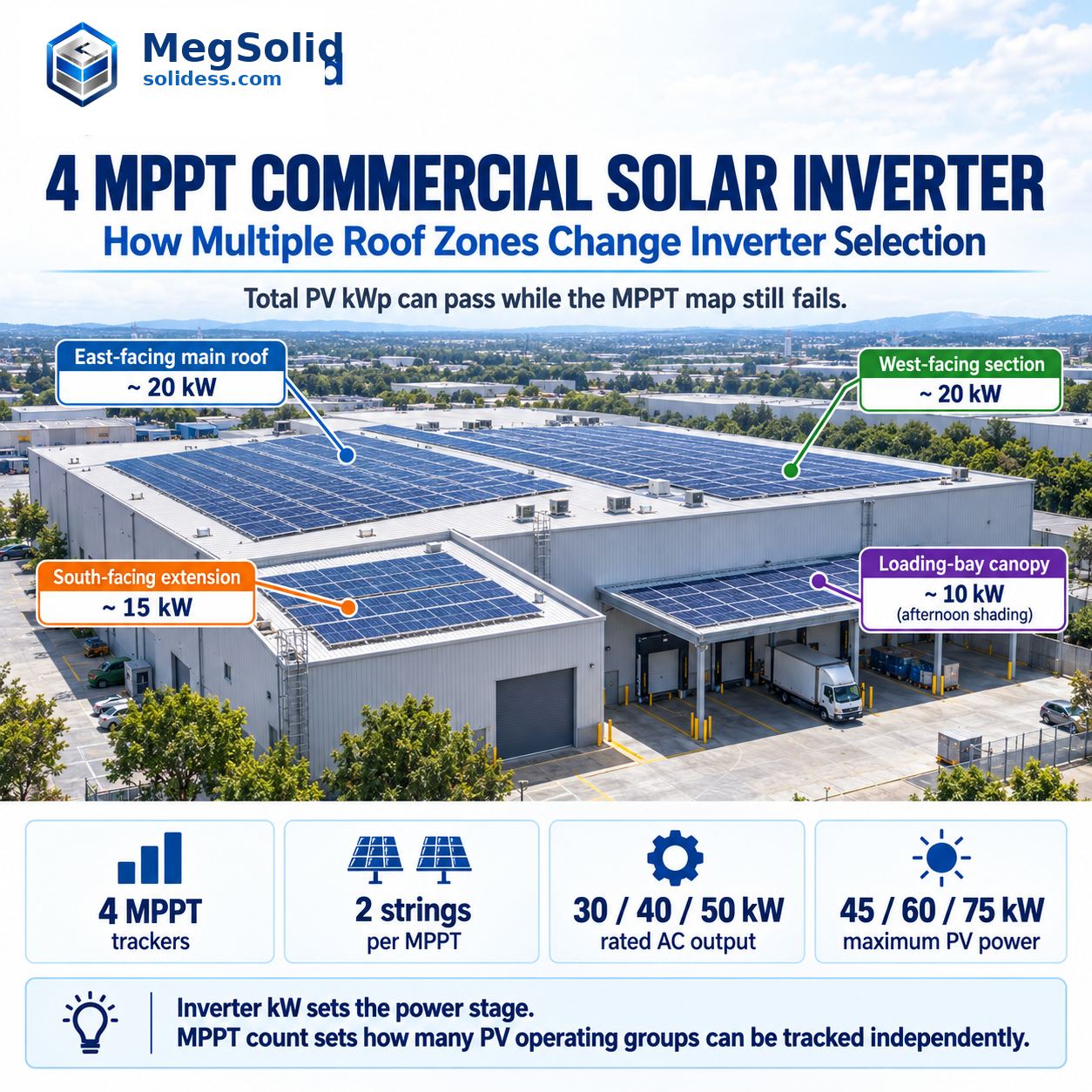
Amandla elanga asezindlini zorhwebo ahlala ajongwa ngenani elinye eliphambili, i-total PV kWp, nangona ukucwangciswa kophahla kunokuba ngumqobo wokwenene kwi-inverter. I-inverter eyi-50 kW inokuba namandla aneleyo e-AC kodwa isenokuba yimveliso engeyiyo ukuba uphahla lufuna amaqela amaninzi azimeleyo e-PV asebenzayo kunalawo isakhiwo sayo se-MPPT esinokuxhasa.
Umzekelo wegumbi lokugcina impahla: Khawucinge ngendawo yokugcina impahla ecwangcisa malunga ne-65–70 kW ye-PV kophahla oluphambili olujonge empuma, icandelo elijonge entshona, isongezelelo esijonge emazantsi kunye nesigqubuthelo sendawo yokulayisha esinomthunzi emva kwemini. Umthamo uphela we-PV unokungena ngaphakathi kwesigcina esiphezulu se-75 kW se-PV sikaMegSolid. I-R50KH3 i-inverter ye-hybrid enezigaba ezintathu, kodwa uphahla akufuneki luvunywe nge-kW kuphela kuba ezo zithili zine zisenokufuna ukulandelela ngokuzimeleyo.
I-R30KH3, i-R40KH3 kunye ne-R50KH3 nganye inikezela Iitracker zeMPPT ezine, zineestrings ezimbini kwitracker nganye., ngelixa imveliso yabo ye-AC elinganisiweyo iyi-30, 40 ne-50 kW kwaye amandla abo aphezulu e-PV angama-45, 60 ne-75 kW. Ii-port ze-string ezimbini phantsi kwe-MPPT enye zisabelana ngomlandeli omnye, ngoko ke unxibelelwano lwe-string olusibhozo lwenza kuphela amaqela amane alandelelwayo ngokuzimeleyo.
I-Inverter kW imisela inqanaba lamandla; inani le-MPPT limisela ukuba mangaphi amaqela asebenzayo e-PV anokulandelelwa ngokuzimeleyo.
Impendulo yombuzo wobukhulu obahlukeneyo ye-MPPT Count ne-AC Power
Amandla ombane we-AC aveliswayo, amandla aphezulu e-PV kunye nenani le-MPPT ziphendula imibuzo eyahlukeneyo malunga nobungakanani.
| Umzekelo | Umphumo we-AC oqikelelweyo | Amandla aphezulu e-PV | Izilandeleli ze-MPPT | Imitya ngeMPPT nganye |
|---|---|---|---|---|
| R30KH3 | 30 kW | 45 kW | 4 | 2 |
| R40KH3 | 40 kW | 60 kW | 4 | 2 |
| R50KH3 | Amashumi amahlanu eekhilowathi | 75 kW | 4 | 2 |
Umphumo oqikelelweyo umisela udidi lwamandla e-AC ye-inverter, elona mandla aphezulu e-PV achaza imida epapashiweyo ye-array ye-PV, kwaye inani le-MPPT limisela ukuba zingaphi iqela le-PV ezinokusebenza ngokulandelela ngokuzimeleyo. Ii-rooftops ezifanayo ze-50 kW kunye nee-rooftops ze-50 kW ezohlulwe zaya kwiinkalo ezahlukeneyo zinokufuna udidi olufanayo lwamandla e-AC kodwa zibe nesakhiwo esahluke kakhulu sokungenisa i-PV.
Iskrini sokuqala sokuthenga sifuna iimpendulo zombini: udidi lwe-AC olufunekayo lwe-30, 40 okanye 50 kW, kunye nenani lamaqela okusebenza e-PV ahluke kakhulu ngokwezinto ezakhiwayo afuna ukulandelelwa ngokuzimeleyo.
Nje ukuba imephu ye-MPPT idlule, i Ukukhetha i-inverter ye-hybrid eyi-30 kW, 40 kW okanye 50 kW Isenokwenziwa ke ngokusekelwe kumthwalo we-AC, umthamo we-PV kunye nomsebenzi wokugcina, endaweni yokuba isekelwe kwijometri yophahla kuphela.
Iingeni ezisibhozo zamacandelo zisenza amaqela amane okulandelela
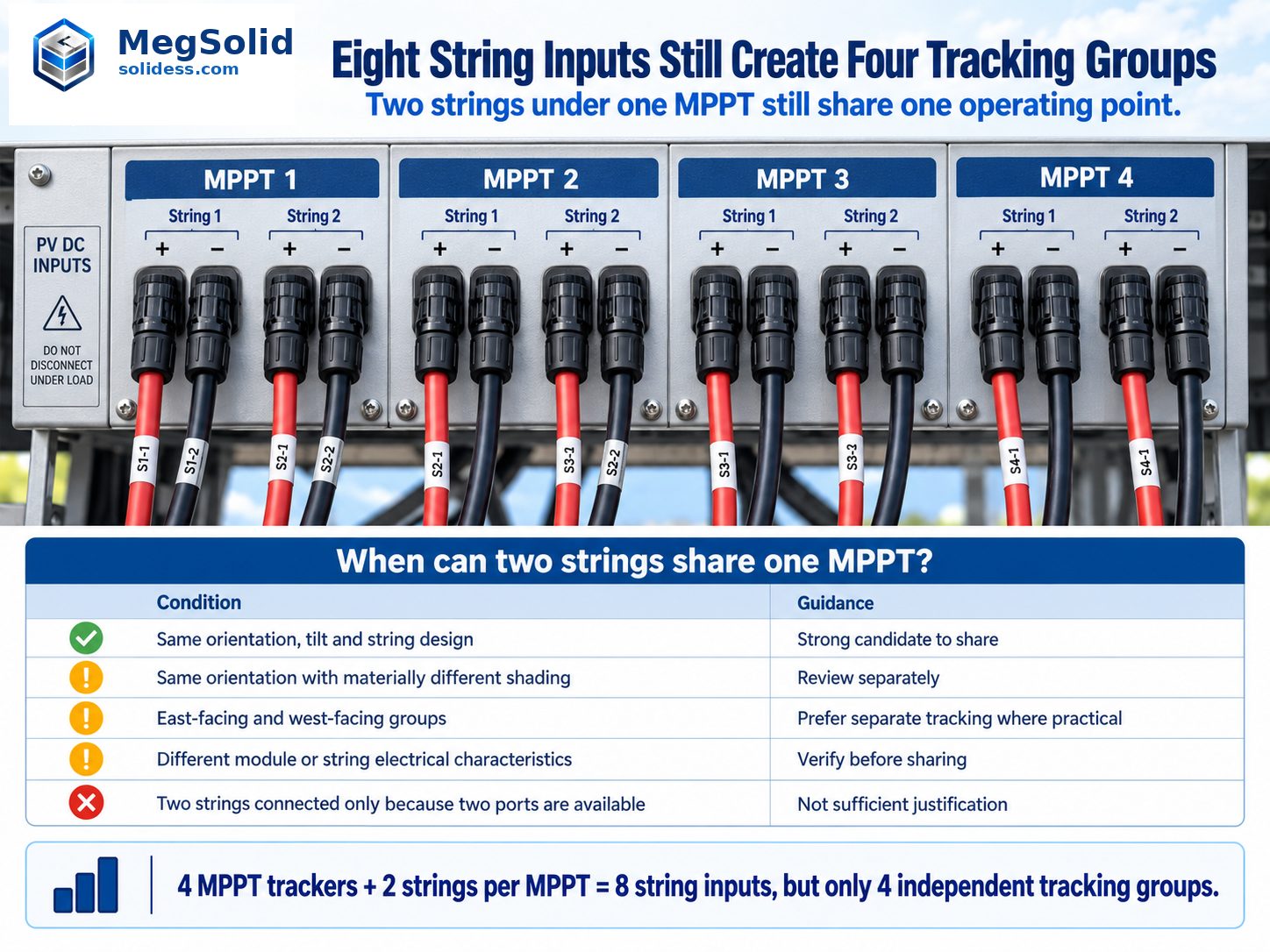
Iistrings ezimbini ezidityaniswe kwi-MPPT enye aziba zizitrakha ezizimeleyo ezimbini kuba zisebenzisa indawo yokusebenza enye ekhethwe lelo jelo le-MPPT, ngoko ke ukubakho kweepoti zeestrings ezimbini asisizathu saneleyo sokudibanisa iindawo ezimbini zophahla.
Iintambo zilungele ngakumbi ukwabelana nge-MPPT enye xa iimeko zazo zombane nezokusebenza zifana. Ukuhluka kwezinto ezifana nendlela ezijonge ngayo, ithunzi, ulungelelwaniso lweemodyuli okanye iprofayile yokukhanya kwelanga kwenza ukudibanisa okunjalo kube nzima ukukuthethelela.
| Imeko yeqela le-PV | Isigqibo sokuqala se-MPPT |
|---|---|
| Ulwakhiwo olufanayo, ukuthambeka kunye noyilo lomtya | Umgqatswa oqinileyo wokwabelana |
| Ukwalungelelana okufanayo kunye nokufipha okwahluke kakhulu. | Phonononga ngokwahlukeneyo |
| Amaqela ajonge empuma nawajonge entshona | Khetha ukulandelela ngokwahlukeneyo apho kunokwenzeka khona. |
| Iimpawu zombane ezahlukeneyo zemodyuli okanye zomtya | Qinisekisa phambi kokwabelana |
| Imicu emibini idityaniswe nje kuba iipoti ezimbini zikhona. | Asonelanga isizathu |
Iintambo ezijonge empuma nezijonge entshona azithintelwa ngokuzenzekelayo ekwabelaneni ngetracker kuyo yonke idizayini, kodwa iimeko zazo ezilungileyo zokusebenza zinokwahluka ngokuhamba kosuku, ngoko ke ukuzigcina kwi-MPPT ezahlukeneyo kunika i-inverter inkululeko yokulandela iqela ngalinye ngokuzimeleyo xa ulwakhiwo luvumela.
Iitracker ezine zenza amaqela amane azimeleyo okusebenza; iingeno ezisibhozo zomtya ongokwenyama zonyusa kuphela umthamo wokudibanisa ngaphakathi kwala maqela.
Imilo yophahla ingenza i-MPPT ibale umqobo wokuqala.
Iinqaba zorhwebo zinokwahlulwa zibe ngamaqela amane eendawo ze-PV ezisebenzisekayo, nokuba isixa-mpenda se-kWp sisahleli ngaphakathi komda ophezulu opapashiweyo we-inverter.
Olunye ucwangciso olusebenzisekayo lunokuba:
- MPPT 1 → uphahla oluphambili olujonge empuma
- MPPT 2 → uphahla oluphambili olujonge entshona
- MPPT 3 → isandiso esijonge emazantsi
- MPPT 4 → isigqubuthelo esinika umthunzi emva kwemini
Le nkcazelo yomlinganiselo nje. Isiqwenga esinye sophahla asisoloko silingana ne-MPPT enye, kwaye uphahla olukhulu lunokufuna iitracker ezingaphezulu kwesinye ngenxa yomthunzi, umsinga okanye imida yoyilo lwezityholo. Umgaqo obalulekileyo kukuba itracker nganye kufuneka ifumane izityholo ze-PV ezinokwabelana ngokufanelekileyo ngendawo enye yokusebenza.
Kwenzeka Ntoni Xa Uphahla Ludinga Amaqela Angaphezu Kwamane
Uthintelo luyacaca ngakumbi xa isiza sineqela le-PV elineentsingiselo ezintlanu okanye ezintandathu ezahluke ngokuphathekayo. Ukuthenga i-inverter enkulu ngokwe-kW akusombululi loo nto ngokuzenzekelayo kuba amandla e-AC ongezelelweyo akadali ii-trackers ezizimeleyo ezongezelelweyo, ngoko i-EPC isenokufuneka idibanise kuphela amaqela ahambelanayo, iphinde icinge ngoyilo lwe-string, itshintshe ulwakhiwo lwesigqubuthelo, yahlule iprojekthi kwii-inverters ezingaphezulu kwesinye okanye ikhethe enye i-architecture yokufaka i-PV.
Ukudityaniswa Kwegcini Akususi Ukuqinisekiswa kwe-MPPT
Iiprojekthi zelanga zorhwebo ezikwaquka ukugcinwa zisadinga ukugcina lo mthetho wecala le-DC xa zisenza isigqibo. Isakhiwo sebhetri yelanga esidityaniswe nge-AC okanye nge-DC, kuba itopoloji yokudibanisa ayisusi imfuneko yokuba i-array ye-PV ingene kwii-inputs ze-inverter ngokombane.
Send the planned PV kWp per roof zone, orientation, shading differences and preliminary string layout; MegSolid can return a preliminary four-MPPT allocation and indicate whether R30KH3, R40KH3 or R50KH3 is the stronger fit before the project locks the inverter power class.
Equal kWp Can Hide Different Operating Conditions
Two roof sections can each carry 15 kWp and still present very different electrical conditions if one receives clean midday irradiance while the other is crossed by an HVAC shadow in the afternoon, so equal installed capacity should not be treated as proof that the strings belong on the same tracker.
Parapets, HVAC equipment, vents, neighboring buildings, canopies, roof pitch, azimuth and seasonal shade all create different operating conditions on commercial roofs. These conditions change the irradiance profile seen by the modules and can create different maximum-power points even when the module count is similar.
Tracking Flexibility Has Limits
Four independent MPPT channels give the R-series more freedom to separate those groups where it matters. The trackers do not remove shade, and they do not guarantee a fixed energy gain over a two-MPPT inverter. The benefit exists only when the roof contains operating groups that should not share one tracking point.
commercial solar inverter selection should not stop at AC kW because roof geometry and PV operating groups can separate products with similar output ratings.
Total PV Power Can Pass While One MPPT Current Fails
R30KH3, R40KH3 and R50KH3 each publish 40 A maximum input current per MPPT, 60 A short-circuit current per MPPT, four trackers and two strings per tracker.
That creates a second pass/fail test after total PV power has been checked.
Proposals can stay below the R50KH3 maximum PV power of 75 kW and still fail if too much current is concentrated on one MPPT, especially when higher-current modules or parallel strings are used. The screening sequence is:
total PV power passes → roof groups are allocated → each MPPT current is checked → string allocation is accepted or revised
Eight available string connections do not bypass the 40 A per-MPPT operating-current limit because each pair of ports still belongs to one tracker.
The issue is large enough to affect purchasing. If the inverter is ordered first and the MPPT current problem appears after rooftop cable routes and string allocations have already been fixed, the site may need to reassign strings, change cable routes or add another inverter, which is exactly the type of redesign that a pre-purchase MPPT check is meant to avoid.
String Voltage Can Reject an Otherwise Valid Roof Map
Four available trackers do not make every string length valid. Each proposed string still has to stay inside the inverter’s voltage window.
Check the Voltage Window After the Roof Groups Are Assigned
The current R-series product data gives:
- MPPT voltage range: 150–850 V
- PV start voltage: 180 V
- rated PV input voltage: 600 V
These values mean the designer still has to check expected Vmpp, cold-weather Voc, hot-weather Vmpp, modules per string and module temperature coefficients before approving the roof-zone allocation. One roof group can fit the four-MPPT map and still fail the voltage check, while another can fit the voltage window but fail the per-MPPT current limit.
Final string design should be checked against the approved project voltage limits, while the published 150–850 V MPPT operating range, 180 V start voltage and 600 V rated PV input remain the key product values for the first-stage fit screen.
MPPT count determines how many groups can be tracked independently; voltage and current determine whether those groups are electrically valid.
More MPPTs Do Not Remove Other Electrical Limits
Four trackers add flexibility, but PV power, string voltage, per-MPPT current and module compatibility still have to pass on their own.
Extra MPPT channels cannot correct:
- an undersized AC power class;
- PV power beyond the selected model envelope;
- invalid string voltage;
- excessive current on one tracker;
- incompatible module or string electrical characteristics;
- severe shading that should have been addressed in the roof layout.
Four MPPTs do not guarantee more energy than two MPPTs on every roof. Uniform arrays may have only one or two meaningful operating groups. In that case, unused trackers add little project value and the decision can be dominated by AC power, battery duty, price or system architecture instead.
The advantage becomes stronger on sites with east/west roof planes, multiple buildings, canopies plus main roofs, recurring shading differences or staged rooftop expansion where another independent PV group may be added later.
Once the PV architecture fits electrically, PV charging priority determines when solar surplus should charge the battery, while Ingqiqo yezinto eziphambili ye-BESS EMS coordinates storage with other operating objectives; neither control layer can repair an unsuitable MPPT/string arrangement underneath it.
Choose R30, R40 or R50 After the MPPT Map Passes
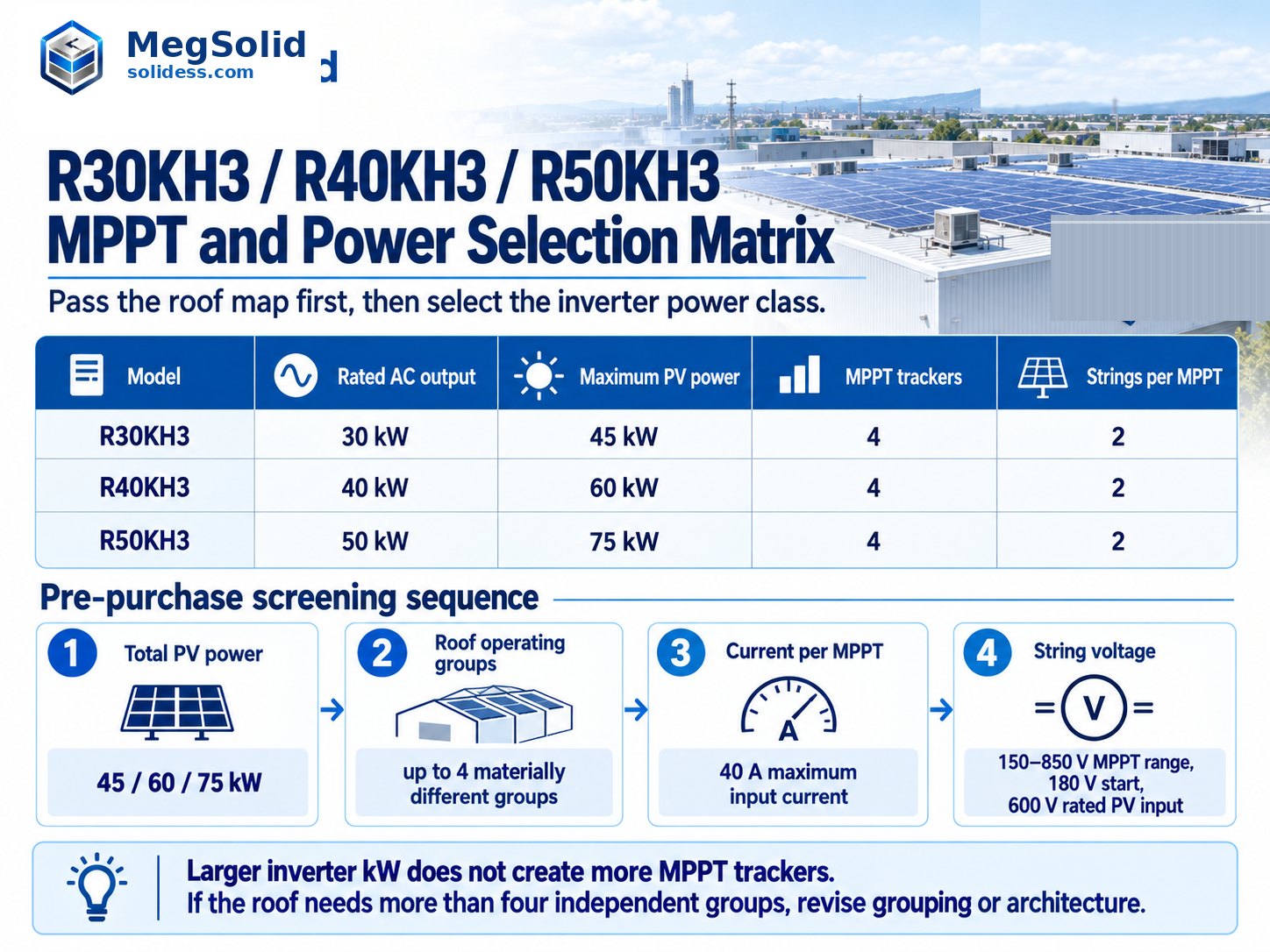
Model selection gets simpler once the roof has been reduced to electrically workable PV groups. R30KH3, R40KH3 and R50KH3 then differ mainly in power envelope around the same four-MPPT architecture.
| Preliminary project result | Indlela yemveliso |
|---|---|
| PV ≤45 kW and required AC output fits 30 kW | R30KH3 |
| PV ≤60 kW and required AC output fits 40 kW | R40KH3 |
| PV ≤75 kW and required AC output fits 50 kW | R50KH3 |
| More than four materially different PV groups | Revise grouping or inverter architecture |
| One MPPT exceeds its current envelope | Reallocate strings before approval |
| Proposed string falls outside the valid voltage window | Change string length or configuration |
The first three rows are only the handoff from MPPT fit to power-class selection; load profile, backup duty, battery power and grid connection still affect the final model.
R30KH3, R40KH3 and R50KH3 publish rated AC outputs of 30 / 40 / 50 kW and maximum PV powers of 45 / 60 / 75 kW, so the product path should be selected only after the roof map, per-MPPT current and string-voltage checks have passed.
The wider Uyilo lwenkqubo yokugcina amandla ebhetri ye-C&I must then coordinate inverter power, battery energy, connection limits and operating mode.
Backup also remains a separate architecture because inverter-level switching performance does not by itself prove that the entire site will remain energized during an outage; protected loads, isolation and transfer arrangements still determine whether a grid-tied battery system can operate as backup.
Four MPPTs Add Value Only When the Roof Needs Four Trackers
The strongest case for four MPPTs is a roof where materially different PV groups would otherwise be forced onto the same tracking point.
R30KH3, R40KH3 and R50KH3 become strong candidates when the project has several meaningful roof orientations, separated building sections, recurring shading differences, distinct canopy and roof arrays or multiple electrically compatible string pairs that benefit from independent tracking.
Sites with one uniform roof plane and consistent strings may gain little from all four trackers. Map the roof before paying for extra MPPT flexibility. Where the site genuinely needs four independent groups, the R-series offers a clear product path: four MPPT trackers stay constant while the buyer selects 30, 40 or 50 kW AC output and 45, 60 or 75 kW maximum PV power to match the site duty.
Battery Integration Is a Separate Check
Battery integration should then be checked separately because the R-series lists a 150–800 V lithium-ion battery range, two battery inputs and dual 80 A maximum battery current. Mixed-supplier systems still need compatible BMS communications and operating limits, so the PCS and battery integration boundary becomes relevant only after the PV-side architecture has passed.
Send the planned PV kW, required AC output, module/string electrical data and roof-zone allocation; MegSolid can screen whether the four MPPT groups fit cleanly and which R-series power class should move into detailed design.
Imibuzo Ebuzwa Rhoqo
What does 4 MPPT mean on a commercial solar inverter?
It means the inverter has four independent maximum-power-point tracking channels, allowing up to four PV operating groups to be tracked independently when the electrical design supports that allocation.
Does 4 MPPT mean the inverter can optimize eight roof zones independently?
No. R30KH3, R40KH3 and R50KH3 provide two string inputs per MPPT, but the two strings under one tracker share the same MPPT operating point, so eight string inputs still create only four independent tracking groups.
Should east- and west-facing strings use separate MPPTs?
Often yes when their irradiance profiles and operating points differ materially, but the final decision should follow the actual module, string, voltage, current and shading conditions instead of a blanket rule based only on orientation.
Can a 50 kW inverter accept 75 kW of PV?
R50KH3 publishes 50 kW rated AC output and 75 kW maximum PV power. The array still has to pass the per-MPPT current, voltage, string and project-design limits before that PV capacity is approved.
What is the maximum input current per MPPT on R30KH3, R40KH3 and R50KH3?
The published maximum input current is 40 A per MPPT, with 60 A short-circuit current per MPPT, so each tracker has to be checked independently after the total PV power is screened.
What is the MPPT voltage range of the R30KH3, R40KH3 and R50KH3?
The published MPPT operating range is 150–850 V, with 180 V start voltage and 600 V rated PV input voltage. Final string design still needs to satisfy the approved project voltage limits across the expected temperature range.
Can more MPPTs fix partial shading?
More independent trackers can help separate PV groups with different operating conditions, but they do not remove the physical shade itself or guarantee a fixed energy gain. Roof layout and shading treatment still matter.
When is a 4 MPPT inverter unnecessary?
Uniform commercial roofs with one or two consistent PV operating groups may gain little from all four trackers, so AC power, PV capacity, battery duty and price may become more important than MPPT count.
How should R30KH3, R40KH3 and R50KH3 be selected after the MPPT layout passes?
R30KH3 fits projects within its 30 kW AC / 45 kW PV envelope, R40KH3 within 40 kW / 60 kW, and R50KH3 within 50 kW / 75 kW, subject to load, battery, grid and project-specific electrical checks.
Can two strings with different module types share one MPPT?
They should not be assumed compatible. Different electrical characteristics can create an unsuitable shared operating point, so the module and string data should be checked before assigning them to the same tracker.
Is a 4 MPPT inverter useful for warehouse rooftops?
It can be particularly useful where warehouse roofs contain east/west sections, canopies, extensions or recurring shading zones that benefit from independent tracking groups.
Is a 4 MPPT inverter useful for supermarkets and retail sites?
Yes, especially where the site combines the main roof, carport PV, canopies or multiple building sections with different orientations or shading patterns, provided the string voltage and current limits also pass.
Is a 4 MPPT inverter suitable for industrial sites with future rooftop expansion?
It can be useful where an unused tracker remains available for a future electrically distinct PV group, but the expansion still has to fit the inverter’s total PV power, MPPT current, voltage and AC power limits.
