
An ESSA0100B-0215 is a sensible first screen when the required battery-charging duty stays within 100 kW and the day’s surplus energy fits the validated SOC headroom. If a plant repeatedly produces 120 kW more than the facility uses, the cabinet can still charge at 100 kW, but the remaining 20 kW needs a defined destination: permitted export, PV curtailment or an approved flexible load. That decision belongs in the design, not in the first week of commissioning.

Consider the same plant at 11:30 a.m. Rooftop PV is producing 95 kW more than the site load, but overnight recovery left the battery close to its upper SOC. By 1:00 p.m. the battery is full and the plant controller is curtailing PV. Afternoon peak shaving then uses part of the stored energy, while the protected reserve locks another part. At 5:30 p.m. too little usable energy remains for the full evening target. Nothing failed; the schedule treated midday capture, afternoon dispatch and evening demand as separate jobs even though they share the same battery.
MegSolid ESSA0100B-0215 gives this duty a 100 kW PCS, 215.04 kWh of nominal LFP energy and an integrated EMS. Its practical advantage is that the battery limits, PCS command and daily schedule sit in one storage-control platform. PV charging priority decides when to leave room, when to accept solar and when to release that energy. Coincident PV and load data still have to prove the power and energy fit before the cabinet is awarded.
Define solar surplus at the PCC
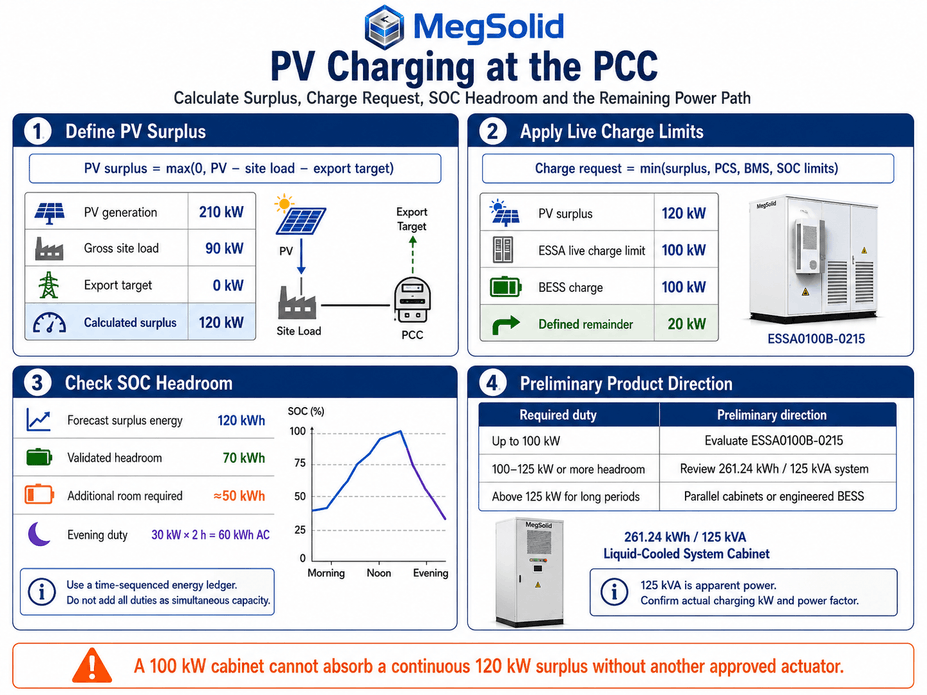
The PV inverter may report 180 kW, but that is not the battery’s charging opportunity. If the facility is using 85 kW at the same moment, only 95 kW remains before the export rule is applied. Site load, the chosen export target and the live battery limit have to sit in one power balance.
For an AC-coupled plant, count site load without BESS charging and write down the sign convention:
PV surplus requiring BESS action = max(0, PV generation − site load − export target)
The export target is the operating value used by the EMS or plant controller. It is zero on a zero-export site and can be positive when the owner intentionally sells power. The contractual export limit remains the outer boundary, but it does not decide whether a permitted kilowatt-hour should be sold or stored. That commercial choice needs a signed operating target.
Charge request in the same interval:
PV charge request = min(PV surplus, PCS charge limit, live BMS charge limit, SOC-dependent charge limit)
PCC feedback trims the request so measured export stays on target. If the meter becomes stale, a CT is reversed or a tie breaker changes the control boundary, the EMS must enter the approved fallback. Holding the last valid charge command can turn a data fault into an export violation.
CT placement, fail-safe and who owns curtailment: PCC zero-export control page.
Follow one solar day from morning to evening
The worked example is a factory with a zero-export target and one 100 kW cabinet. All values are AC power at the site boundary.
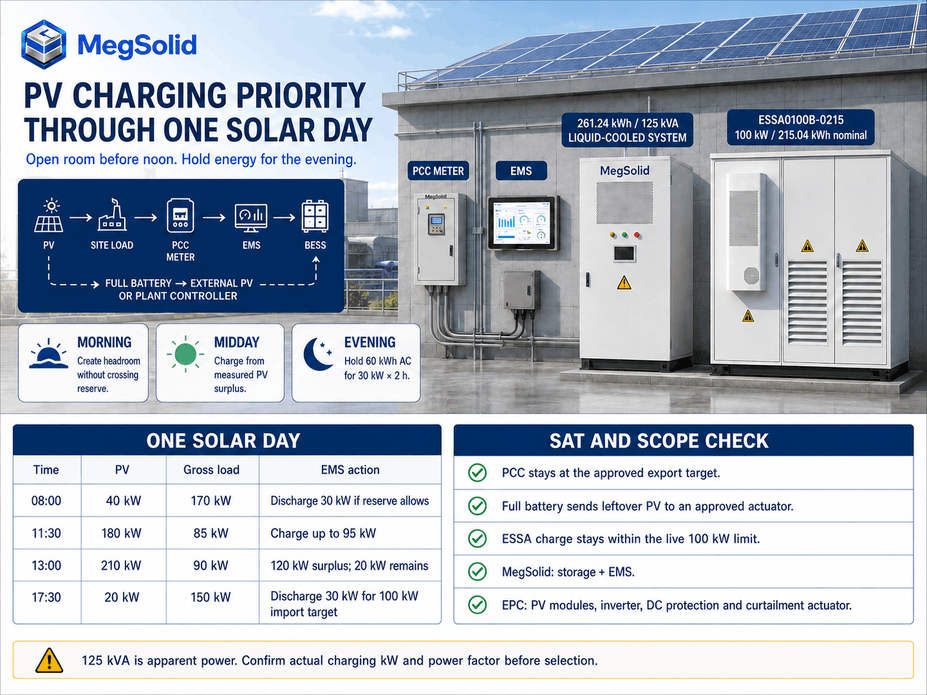
| Time | PV | Gross facility load, excluding BESS | Immediate EMS decision |
|---|---|---|---|
| 08:00 | 40 kW | 170 kW | Discharge 30 kW to hold a 100 kW import target, if reserve allows |
| 11:30 | 180 kW | 85 kW | Up to 95 kW is available for charging |
| 13:00 | 210 kW | 90 kW | 120 kW surplus; a 100 kW charge limit leaves 20 kW for curtailment or another approved actuator |
| 17:30 | 20 kW | 150 kW | Discharge 30 kW to hold a 100 kW import target, if reserve and SOC allow |
The table has to be read in both kW and kWh. At 1:00 p.m. the cabinet may still have unused energy space, yet its 100 kW charge-power ceiling leaves 20 kW unabsorbed. At 5:30 p.m. the reverse problem can appear: 30 kW of discharge power is available, but the stored energy may not last through the full evening block.
Put a value on the 20 kW the battery cannot accept
If the 20 kW residual lasts for two hours on 250 operating days, the annual energy exposed to export or curtailment is:
20 kW × 2 h/day × 250 days = 10,000 kWh/year
Apply the site’s verified energy value rather than a generic marketing tariff:
Annual exposure = 10,000 kWh/year × verified site value of curtailed or exported kWh
On a zero-export plant, that energy is lost through the inverter limit. Where export is allowed, compare the export credit with the value of holding the same energy for the evening peak.
Do not buy another power stage until this line is filled with site data. A small annual exposure may not justify a larger PCS. A recurring 80 kW residual lasting four hours, especially when the site later pays an evening demand charge, can change the decision quickly.
SOC headroom is an energy budget
Charge power answers how fast the battery can absorb solar. SOC headroom answers how long it can keep doing so.
Keep dispatch and headroom on one energy boundary:
Available charging headroom = energy at upper SOC limit − energy at current SOC
Suppose the noon forecast contains 120 kWh of PV energy above site load and the export target, while the battery has only 70 kWh of validated headroom on the same energy boundary. About 50 kWh of additional room is needed before the solar crest, plus the agreed allowance for forecast error and conversion losses.
Morning peak shaving, a lighter overnight grid charge, or a flexible midday load can open that room. Protected reserve stays closed when the forecast may miss.
Charging efficiency and auxiliaries must be aligned before battery-side headroom is compared with an AC-bus PV forecast. Otherwise, two different energy boundaries are being subtracted as if they were the same.
Four inputs for a preliminary PV charging table
A useful preliminary screen needs:
- 1. 15-minute or finer PV generation and gross site-load data
- 2. contractual export limit, chosen export target and PCC meter location
- 3. protected reserve, present SOC window and upper charging limit
- 4. evening peak target, required discharge duration and next recovery deadline
The resulting table should show midday SOC headroom, maximum charging kW, expected captured PV kWh, residual curtailment or export risk, and a preliminary product route. Without coincident PV and load data, the result can only be a range; it cannot lock the EMS settings or the cabinet selection.
Set the morning SOC corridor from the later jobs
A fixed morning SOC target is easy to configure and often wastes part of the battery. Use a corridor instead: a lower boundary that protects reserve and planned discharge, and an upper boundary that still leaves room for the expected PV.
In the factory case the EMS may have to hold:
- 60 kWh for the evening demand window
- 40 kWh for the active backup requirement
- room for 120 kWh of forecast midday surplus
Do not simply add 60 + 40 + 120 and call the result a battery size. The three duties occur at different times, and midday solar captured in the 120 kWh window may later supply the 60 kWh evening duty. Build a time-sequenced energy ledger instead. Before the solar crest, the cabinet must protect the 40 kWh reserve while leaving the planned charging room. After the solar window, it must still hold the 60 kWh evening duty above the protected reserve. If either moment exceeds validated usable energy, the plant needs a higher export target, earlier morning discharge, more curtailment, a smaller evening target or more storage energy. Changing the mode name cannot create missing kWh.
A weekday day-shift plant can often open most charging room before noon. A night-shift plant may still be discharging into production when the PV window begins. A supermarket keeps compressors running after sunset, so a full battery at noon helps only if the EMS prevents that energy from being spent too early. The shift pattern, export rule and measured curves write the schedule; the country field on the project sheet does not.
When reserve, PCC limits, peak shaving and PV charging arrive together: BESS EMS priority logic. Protected lower edge: BESS SOC reserve strategy.
Carry enough solar into the evening
At 5:30 p.m. in the example, gross site load is 150 kW and PV has fallen to 20 kW. Holding a 100 kW import target requires 30 kW of battery discharge. This result is valid only because the table defines 150 kW as gross facility load rather than net load after PV.
If the table uses gross facility load:
PCC import before BESS = 150 kW − 20 kW = 130 kW
Required BESS discharge = 130 kW − 100 kW = 30 kW
Two hours at that rate requires 60 kWh of planned AC discharge before reserve, loss and auxiliary treatment. Mixing gross load with net demand, or subtracting PV twice, understates the energy that must be available at 5:30 p.m.
Mid-afternoon peak shaving, backup reserve and tariff dispatch draw from the same ledger. The cabinet has to arrive at 5:30 p.m. with that 60 kWh still available under the signed rules.
A full battery needs another actuator
Once the upper SOC limit or the live BMS charge limit ends absorption, the remaining PV surplus still has to go somewhere.
1:00 p.m. in the example: surplus 120 kW, cabinet charge 100 kW. The leftover 20 kW follows the site rule:
- export, if the contract and operating plan allow it
- curtail the PV inverter through a compatible plant controller
- send the power to an approved flexible load
MegSolid’s cabinet has no PV-curtailment output of its own. The project therefore needs a compatible PV or plant controller that accepts the power-limit command, a named owner for that interface, and an agreed response when communications are lost.
Scope split stays public. MegSolid supplies the storage and control platform. PV modules, inverters, array design, DC protection and local solar installation stay with the EPC or the solar contractor.
Keep grid charging separate from PV charging
Grid charging still has a job when the next reserve deadline arrives before the solar window. Spare import capacity sets the cap:
Grid-charge allowance = max(0, PCC recharge ceiling − site import before BESS charging)
Reserve 40 kWh short, two hours on the clock: the schedule needs at least 20 kW average before losses. PCC headroom of 12 kW means the deadline is already at risk. Quiet high-rate grid charging would print a new peak.
PCC loop that caps this recharge: battery peak-shaving control article.
Forecasts adjust the plan; local measurements run the plant
Cloud forecasts help size the room to open before noon. Keep them off the fast export loop.
If PV comes in below forecast, protect evening and reserve energy before using capacity for optional dispatch. If PV comes in high, open extra headroom only while enough time and permitted discharge power remain. Reversing between charge and discharge on every forecast update adds cycling while often making little difference at the PCC.
Write a data-quality floor, an update interval, a forecast margin and a local fallback schedule. When the forecast feed drops, local PCC and battery limits keep running on live measurements.
What ESSA0100B-0215 brings to the site
The MegSolid ESSA0100B-0215 outdoor C&I BESS combines a 100 kW PCS, 215.04 kWh of nominal LFP energy, intelligent air cooling, an IP54 enclosure, a built-in isolation transformer and integrated EMS in one cabinet. RS485 and TCP/IP support the grid, load, PV and storage signals used by the site controller.
The 100 kW rating sets the charge and discharge power class; it does not promise that every 100 kW solar interval can be absorbed at every SOC and temperature. The 215.04 kWh nominal rating starts the energy review, but captured solar still depends on the approved SOC window, validated usable-energy boundary, live BMS limits, temperature and the shape of the surplus curve.
Model checks: ESSA0100B-0215 selection page. Other power and duration classes: MegSolid C&I storage range.
Choose the first product route from surplus kW and kWh
| Measured solar-storage duty | Preliminary route | Confirmation before award |
|---|---|---|
| Surplus up to 100 kW and energy fits validated SOC headroom | ESSA0100B-0215, 100 kW / 215.04 kWh | Coincident PV/load simulation, usable energy and reserve |
| Surplus approaches 100–125 kW or needs more energy headroom | 261.24 kWh / 125 kVA liquid-cooled LFP system | Actual charging kW, power factor, SOC window and thermal duty |
| Surplus exceeds 125 kW for long periods | Parallel cabinets or a larger engineered BESS | Shared PCC controller, pooled charge limit and curtailment interface |
Treat 125 kVA as apparent power until configuration and power factor produce a real charge-kW figure.
Integrated storage control or a split package?
| Supply route | What must be coordinated | Warning sign before purchase |
|---|---|---|
| Integrated ESSA storage platform | BMS charge limit, PCS command, SOC and EMS schedule | PV curtailment actuator and PCC meter omitted from project scope |
| Battery + separate PCS + third-party EMS | Voltage window, protocols, sign convention, time sync and source-priority logic | PV, PCS and battery vendors each expect another party to own the full-battery event |
| Trader-assembled solar-storage package | One party supplies the energy balance, command map, logs and SAT criteria | Quote combines PV kWp and battery kWh without a coincident 15-minute model |
A split plant can operate well when one integrator owns the loop. Reject a package that leaves three questions unanswered: who cuts PV when the battery is full, who owns the export target, and which synchronized trend proves that the command reached the correct device.
Commission the difficult moments
A smooth PV-charging hour is only the warm-up. SAT still has to reach the charge-power limit, the upper SOC limit and the export fallback.
Log PCC power, gross site load, PV power, BESS power, SOC, live BMS limits, export target, EMS command, PV curtailment command, controller state, timestamp and data quality. Replay a PV ramp, a sudden load step, a full battery, loss of the PV meter, loss of the curtailment command, and the handoff into evening discharge.
The cabinet passes the stated duty only when the measured charge stays within its live limit, the PCC remains on target and every residual kilowatt follows the approved export, curtailment or flexible-load path. If the site requires one cabinet to absorb the full 120 kW surplus with no export and no curtailment, ESSA0100B-0215 fails that power-duty requirement regardless of how much energy space remains.
Channels: BESS SCADA point list. AC acceptance: BESS power-quality test plan.
PV charging priority should match the solar curve
The schedule should show available room before the solar crest and usable stored energy before the evening duty. When PV output is cut, the synchronized trend should identify the cause: upper SOC, the 100 kW charge ceiling, a live BMS limit or a failed external actuator.
FAQ
What is PV charging priority?
It is the EMS rule that allocates charge power and SOC headroom to available solar while protecting reserve, PCC limits and later discharge duties.
Should PV serve site load before charging the battery?
Follow the signed operating objective. Many self-consumption plants serve coincident load first and charge from leftover surplus. Write the export target on the page. Leave nothing assumed.
What is the difference between an export target and an export limit?
The export limit is the contractual maximum. The export target is the operating number the EMS or plant controller uses inside that maximum.
How much SOC headroom is needed?
Take forecast surplus energy over the charging window, then apply agreed efficiency, uncertainty and the upper-SOC boundary. Check charge kW on a second line. Spare energy space can still sit behind a charge-power limit.
Why can PV be curtailed below 100% SOC?
Live BMS or PCS charge power can fall with temperature, voltage, alarms or SOC-dependent tapering. Energy room can remain after charge power is already gone.
Should the battery discharge in the morning to create headroom?
Yes when reserve and morning demand stay protected and extra solar capture pays for the added cycles.
How much evening energy should be retained?
Integrate planned BESS discharge kW across the evening window. Apply usable-energy, loss, auxiliary and reserve treatment on one boundary.
Can grid charging and PV charging use the same limit?
They share PCS and BMS limits. Grid charging also spends PCC import margin. PV-surplus charging tracks the selected export target.
Does PV charging override backup reserve?
Charging raises SOC. Morning discharge used to open headroom still stops at the protected reserve floor. Later dispatch uses only the energy the reserve policy releases.
What happens when the PV forecast is lost?
The EMS falls back to the approved local schedule. Local PCC, BMS and PCS limits keep running on valid measurements.
Can ESSA0100B-0215 control the PV inverter directly?
Only with a compatible PV or plant controller, mapped communications and a named control owner. Solar-generation hardware stays outside BESS product scope.
Does MegSolid supply the rooftop PV system?
No. MegSolid supplies the storage and control platform. PV modules, inverters, string design, DC protection and local solar installation stay with the project or EPC.
Can one 100 kW cabinet absorb a continuous 120 kW surplus?
No. At least 20 kW remains for permitted export, curtailment or another actuator while the cabinet’s live charge limit is 100 kW.
When should the 261.24 kWh / 125 kVA system be reviewed?
Review it when the ESSA screen runs out of charge-power or energy headroom. Confirm actual charging kW, usable AC energy and required power factor before selection.
What should a buyer send for a preliminary PV charging table?
Coincident PV and gross-load data, export rules, the SOC and reserve window, evening discharge duty and recovery deadline.
What proves PV charging performance?
One synchronized trend: PCC power, gross load, PV output, BESS power, SOC, live limits, export target, EMS and curtailment commands, controller states and data quality.