
A 261.24kWh liquid-cooled C&I BESS must be specified by power as well as energy. The MegSolid Energon 261 provides 125kVA at 400V or 480V, a 676–936V DC window, IP54 protection and parallel operation of up to ten units.
An RFQ should state the load profile, discharge duration, operating mode, site conditions and acceptance tests. Require each supplier to provide the cooling, fire-protection, control and warranty evidence needed for technical and commercial comparison.
Define the C&I BESS Duty Before Requesting a Quote
Qala ngomthwalo nengxaki yegridi, hayi ngobukhulu bekhabhathi obukhethwayo. I-261kWh ayixeleli i-EPC ukuba ingaba inkqubo kufuneka inciphise incopho ye-100kW kangangeeyure ezimbini, ixhase umthwalo woshishino we-125kVA, ifunxe amandla elanga agqithisileyo, iphephe ukuthumela ngaphandle, ihambe nexesha lokunqamka kombane okanye idibane nejeneretha. Indlela nganye yokusetyenziswa itshintsha izilawuli, izixhobo zokutshintshela, ukhuseleko kunye nemiqathango yokwamkelwa.
- Nika idatha yemithwalo yexesha elingange-15 yemizuzu ubuncinane; amaxesha amafutshane angcono apho ukunyuka okukhulu kwemfuno kubalulekile.
- Chaza indlela yokusebenza ekujoliswe kuyo: ukunciphisa ubuninzi, ukuzisebenzisa ilanga, ukuxhasa, ukutshintsha ixesha lokusetyenziswa, impendulo yomthamo okanye umdibaniso ochaziweyo.
- Chonga indawo yokudibanisa, ivoltheji eqhelekileyo, ifrikhwensi, isilinganiselo setransfoma, inqanaba elifumanekayo lesiphene kunye nolungiselelo lokugandisa.
- Chaza umthwalo obalulekileyo we-kW okanye i-kVA, ixesha elifunekayo kunye nokuphazamiseka kokutshintshela okuvumelekileyo kwiinkqubo zokuxhasa.
- Chaza iimeko zokungqongileyo, ukuphakama, ukufuma, ukugqwala, uthuli, isikhukula kunye nemiqobo yokufikelela kwindawo yokwenene.
- Dwelisa amaxwebhu novavanyo ekufuneka anikezelwe phambi kokuthunyelwa kunye nokwamkelwa kokugqibela.
MegSolid 261.24kWh C&I BESS Specifications
Ucwangciso olupapashiweyo lukaMegSolid yi-Hybrid Solid-State Ugcino-amandla lwezoRhwebo nezoShishino inokugcina i-261.24kWh. Ucwangciso lwebhetri yi-1P260S isebenzisa iiseli ze-Hybrid Solid-State LFP 314Ah. Uluhlu lwe-voltage ye-DC luphakathi kwe-676–936Vdc, kunye ne-voltage eqhelekileyo eyi-832Vdc. Amandla e-AC aqikelelweyo yi-125kVA kwi-480V okanye i-400V ±15%, 50/60Hz.
| Into eqinisekisiweyo | Ixabiso elipapashiweyo | Isizathu sokuba kubaluleke kumthengi |
|---|---|---|
| Amandla alinganisiweyo | 261.24kWh | Indawo yokuqala yokubala umthwalo nexesha |
| Ucwangciso lwebhetri | 1P260S; I-Hybrid Solid-State LFP 314Ah | Ichaza uyilo lwezixhobo zombane oluza kuphononongwa |
| I-voltage ye-DC | 676–936Vdc; 832Vdc esiqhelekileyo | Kufuneka kuhambelane noyilo lokuguqula amandla nokukhusela. |
| Amandla ombane we-AC amiselweyo | 125kVA | Imisela isalathiso samandla abonakalayo aqhubekayo |
| Ujongano lwe-AC | 480V okanye 400V ±15%; 50/60Hz | Kufuneka kuhambelane nendawo kunye netransformer. |
| Ukusebenza kakuhle okuphezulu kwenkqubo | 90% | Sebenzisa imida kunye neemeko zovavanyo ezifanayo xa uthelekisa iibhidi. |
| Isingxobo | IP54; 1300 × 1350 × 2200mm, ±5mm | Iphazamisa ukukhethwa kwendawo, ufikelelo, iziseko kunye nokuchanabeka kokusingqongileyo |
| Ukusebenza ngokunxuseneyo | Ukuya kutsho kwii-yunithi ezili-10 | Ixhasa ucwangciso lwemilinganiselo yomthamo oluyimodyuli |
| Ukhuselo lomlilo | INovec, isixhobo sokufumanisa esinezivamvo ezininzi kunye nokucinezela okusekelwe emanzini | Kufuneka idityaniswe nesicwangciso sezimo ezingxamisekileyo nesomlilo sasiza. |
La ngamaqiniso aqinisekisiweyo emveliso, hayi isiqinisekiso esipheleleyo seprojekthi. Umthombo okhoyo awupapashi ubomi bemijikelo, ixesha lewaranti, ubunzima bekhabhathi, uluhlu lobushushu bokusebenza, ubunzulu bokukhupha, ukusebenza kakuhle kuhambo olubuyayo okanye uluhlu lwezatifikethi ezithile zemodeli. Isicelo se-RFQ esifanelekileyo kufuneka sicele ezo zinto njengeemvume ezilawulwayo zababoneleli endaweni yokuzalisa izikhewu ngokuqikelela.
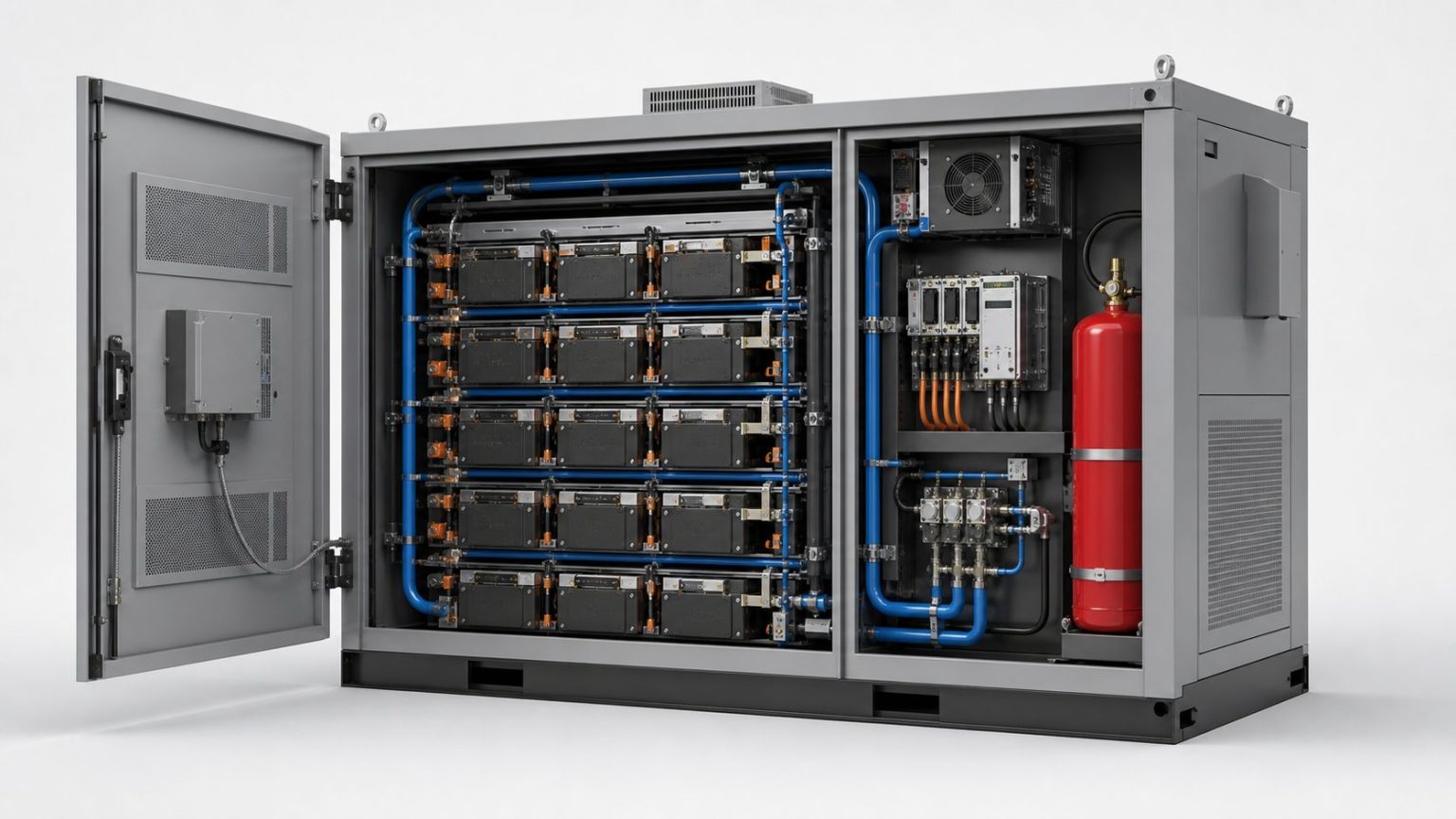
Qala ngeProfayile yoMthwalo, hayi nge-261kWh ekhombisiweyo.
Kuvavanyo lokuqala, amandla ngumthwalo uphindwe lixesha lenkxaso. Umthwalo we-100kW weeyure ezimbini uqala kufutshane ne-200kWh phambi kokuba kusetyenziswe ilahleko, ugcino olusebenzayo, isabelo sokuguga kunye nemiqathango yendawo. Olo balo lulula luncedo, kodwa ayisiyiyo idizayini yokugqibela. Amandla asebenzisekayo kwindawo efunekayo kwinkqubo kufuneka aqinisekiswe phantsi kweemeko ezibekiweyo ngumthengisi.
Amanani Amane Athintela Uninzi Lweempazamo Zobungakanani
- Umphakamo wamandla okwenyani kwi-kW kunye namandla abonakalayo kwi-kVA, kuquka iimfuno zokuqalisa imoto okanye ezingamaxesha amfutshane.
- Required discharge duration under the defined load profile, not an average-load estimate.
- Energy available at the buyer’s chosen measurement boundary after applicable conversion losses.
- Recharge window and available charging power from the grid, PV system or generator.
If backup is part of the scope, divide loads into life-safety, production-critical and deferrable tiers. Do not size storage to the facility’s monthly electricity bill. Request the interval data, mark the loads that must remain energised and state which loads can be shed automatically. This produces a more accurate quotation and often avoids buying unnecessary battery capacity.
Check the DC Window Against the Project Architecture
The verified 676–936Vdc range and 832Vdc nominal value must be checked against the power-conversion system, disconnects, fuses, busbars, insulation coordination and measurement equipment. Ask the bidder to submit a single-line diagram showing normal current paths, isolation points, protection boundaries and communications. A compatible nominal voltage is not enough; the complete operating window must remain inside every connected component’s permitted range.
The 1P260S architecture is also relevant to service strategy. Procurement should ask how a fault is isolated, how module or rack maintenance affects availability, and which measurements are visible at cell, module, string and system level. Those answers matter more than a glossy dashboard screenshot because they determine how quickly an EPC can diagnose abnormal behaviour.
Verify the AC Interface and Operating Modes
MegSolid publishes a rated AC power of 125kVA and an interface of 480V or 400V ±15% at 50/60Hz. Your RFQ should still state whether the project evaluates real power, reactive power or both. The proposed operating point must respect the equipment’s apparent-power limit, especially if the system is expected to provide power-factor correction while charging or discharging.
- Required import and export limits at the point of connection.
- Active- and reactive-power control priorities.
- Ramp-rate, dispatch interval and response-time requirements.
- Grid-following, backup and generator-coordination expectations.
- Black-start or seamless-transfer requirements, if any, as separately verified options.
- Communication protocols, signals, historian data and remote-access boundaries.
Do not assume the cabinet provides a particular transfer time, black-start function or generator-control sequence unless the supplier confirms it for the quoted configuration. These features depend on the complete system architecture, not the battery energy rating alone.
Treat Liquid Cooling as a Controlled Subsystem
MegSolid describes intelligent liquid cooling and self-evolving algorithms designed to keep temperature difference within ±5°C. That is valuable because temperature uniformity supports consistent operation across the battery assembly. However, a buyer should evaluate the cooling system as an engineered subsystem with pumps, piping, sensors, controls, leak management and maintenance requirements.
- Request the temperature measurement points and the conditions under which the ±5°C figure is demonstrated.
- Ask for coolant specifications, inspection intervals, alarm thresholds and leak-detection logic.
- Review pump redundancy, safe shutdown behaviour and the response to loss of cooling.
- Confirm heat rejection, clearances and any site-side ventilation or spacing requirements.
- Include cooling alarms, sensor plausibility checks and abnormal-temperature tests in FAT or SAT.
A lower cabinet price can be misleading if cooling maintenance is unclear or if the EPC must later add unplanned heat-rejection equipment. Normalize the scope before comparing commercial offers. For the wider selection logic, use this liquid-cooled versus air-cooled BESS comparison before fixing the cooling architecture.
Do Not Reduce Fire Safety to One Line on a Datasheet
The published system description lists Novec, a multi-sensor detector and water-based suppression. That identifies important protection elements, but it does not replace a project fire strategy. The RFQ should request the detection sequence, alarm thresholds, shutdown interlocks, isolation logic, ventilation response, external notification, emergency-stop philosophy and post-event inspection procedure.
Ask for a cause-and-effect matrix that shows what happens after each detector or system alarm. The EPC, fire engineer and authority having jurisdiction can then evaluate separation distances, access, signage, water supply, emergency response and any building-specific measures. This is stronger due diligence than accepting a statement that the cabinet “has fire suppression.”
Use an RFQ Compliance Matrix That Separates Facts From Evidence
| RFQ line item | MegSolid published data | Supplier submission required |
|---|---|---|
| Amandla alinganisiweyo | 261.24kWh | State test boundary and operating conditions |
| Amandla ombane we-AC amiselweyo | 125kVA | Provide active/reactive capability curve |
| Voltage and frequency | 480V okanye 400V ±15%; 50/60Hz | Confirm selected project interface |
| DC range | 676–936Vdc; 832Vdc esiqhelekileyo | Submit coordinated single-line diagram |
| Ukusebenza kakuhle | 90% maximum system efficiency | Define test method, load point and system boundary |
| Ukubandisa | Intelligent liquid cooling; temperature difference within ±5°C | Provide cooling design, alarms and maintenance plan |
| Isingxobo | IP54; 1300 × 1350 × 2200mm, ±5mm | Confirm weight, lifting plan, clearances and foundation loads |
| Parallel expansion | Ukuya kutsho kwii-yunithi ezili-10 | Provide control, protection and communication architecture |
| Ukhuselo lomlilo | INovec, isixhobo sokufumanisa esinezivamvo ezininzi kunye nokucinezela okusekelwe emanzini | Provide cause-and-effect matrix and project fire integration |
| Lifetime and warranty | Not stated in the supplied product data | Provide warranted terms, exclusions and evidence |
| Imida yokusingqongileyo | Not stated in the supplied product data | Provide temperature, altitude, humidity and corrosion limits |
| Compliance | No model-specific list stated in the supplied product data | Provide applicable certificates and test reports for the quoted model |
This matrix makes bid review faster because every bidder must either confirm, clarify or mark a deviation. It also prevents a sales brochure from being treated as a binding project specification.
Normalize Commercial Bids Before Comparing Price
Compare the total delivered and commissioned scope, not a price per nominal kWh. Two quotations can show the same headline capacity while allocating switchgear, transformers, EMS, metering, communications, civil work, fire integration, freight, commissioning, spares and training very differently.
- Use one agreed delivery boundary and Incoterm.
- State whether the transformer, AC panel, protection relays and revenue meter are included.
- Compare usable performance at the same duty and measurement point.
- Require a complete exclusions and deviations schedule.
- Compare warranty remedies and response obligations, not only warranty duration.
- Price required spares, planned maintenance, remote support and software access.
- Separate optional functions from the base compliant offer.
The published 90% maximum system efficiency is useful only when every bidder declares the same boundary and conditions. Ask whether auxiliary cooling and control loads are included, and at which power level the result applies. Never substitute that number for a project-specific annual energy model.
Make FAT and SAT Part of the Purchase Order
Factory acceptance testing and site acceptance testing turn requirements into evidence. Agree the procedures, instruments, tolerances, data format, witness points and retest rules before manufacturing is complete. A pass/fail checklist added after delivery has little commercial leverage.
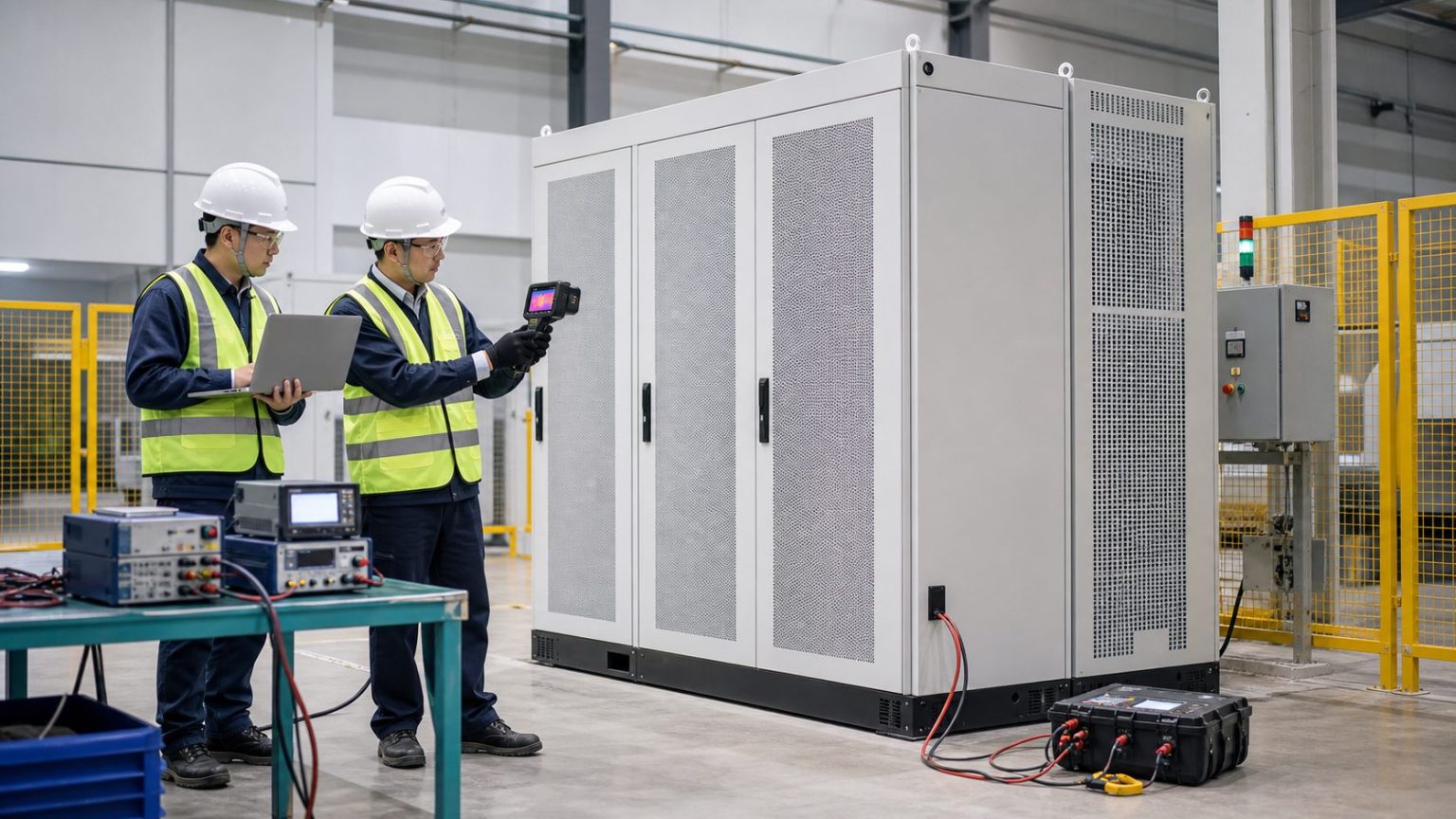
Recommended FAT Checks
- Nameplate, configuration, dimensions and document revision verification.
- Insulation, protective-earth continuity and wiring inspection under the approved procedure.
- BMS, PCS, EMS and meter communication checks.
- Alarm, interlock, emergency-stop and safe-shutdown sequence tests.
- Charge and discharge operation at agreed points within the test facility’s limits.
- Cooling operation, sensor validation and abnormal-temperature response.
- Data logging, time synchronization, user permissions and remote-access controls.
- Review of certificates, test reports, manuals, spares and packing records.
Recommended SAT Checks
- Installation, clearances, foundations, cable terminations and earthing inspection.
- Protection settings and point-of-connection coordination.
- Dispatch, import/export limit and site-control tests.
- PV or generator coordination where included in the approved scope.
- Alarm routing, emergency response and operator training.
- Performance demonstration using the agreed site measurement boundary.
- Handover of as-built drawings, backups, credentials and maintenance records.
Test values must come from the approved project documents. This article intentionally does not invent acceptance tolerances, transfer times, ramp rates or overload capability.
When a 261kWh Cabinet Is a Practical Shortlist
- The required duty fits the verified 261.24kWh energy and 125kVA power envelope after project allowances.
- A modular outdoor cabinet is preferable to a larger containerized installation.
- The site interface can be engineered around 480V or 400V ±15% at 50/60Hz.
- The 676–936Vdc operating range is compatible with the proposed system architecture.
- The site can accommodate the IP54 enclosure and its 1300 × 1350 × 2200mm dimensions with required clearances.
- The expansion plan benefits from parallel operation of up to 10 units.
Parallel capability can support phased growth, but ten cabinets should not be treated as ten independent appliances. The common controls, protection, communications, transformer loading, cable ratings, fault contribution and operational dispatch all need a coordinated design. If the project is approaching multi-cabinet scale, compare the deployment trade-offs in modular cabinets versus containerized ESS.
Why Shortlist MegSolid’s Hybrid Solid-State Design
For buyers who prioritize thermal-risk management, modular deployment and a clear AC/DC interface, MegSolid’s 261.24kWh Hybrid Solid-State system deserves consideration. The published combination of Hybrid Solid-State LFP 314Ah cells, intelligent liquid cooling, AI early warning, multi-sensor detection and layered suppression creates a credible starting architecture for C&I evaluation.
That recommendation is not a substitute for engineering review. It is an invitation to compare evidence. Ask MegSolid to map the quoted configuration against your load profile, site single-line diagram, control philosophy, environmental conditions, required standards and acceptance plan. The strongest proposal is the one that closes those interfaces clearly.
Standards and Documentation: Ask for Evidence, Not Logos
Industrial buyers commonly reference IEC 62619 for safety requirements and tests for secondary lithium cells and batteries used in industrial applications. In markets using North American frameworks, UL 9540 and UL 9540A address system certification and thermal-runaway fire-propagation testing, while NFPA 855 addresses stationary energy-storage installation requirements.
The applicable rules depend on the country, authority having jurisdiction, building and application. Do not assume the 261.24kWh model carries a specific certificate because a standard is mentioned in an RFQ. Require the supplier to identify the exact tested model, report number, scope, limitations and any differences between the tested and offered configuration.
What to Send for a Useful MegSolid Quotation
A useful quotation begins with a concise technical data pack. Sending the items below lets the engineering team test whether one 261.24kWh cabinet is appropriate, whether parallel units are needed, or whether a different architecture will produce a better result.
- Site location and indoor/outdoor installation preference.
- At least one representative month of interval load data, plus seasonal peaks.
- Critical-load list, required backup duration and acceptable interruption.
- Existing and planned PV, generator and transformer ratings.
- Single-line diagram and point-of-connection details.
- Operating modes, tariffs, export constraints and dispatch priorities.
- Environmental conditions and available footprint.
- Required standards, utility rules, fire requirements and submission format.
- Target delivery date, commissioning scope and commercial delivery boundary.
Final Recommendation
Do not buy a 261kWh liquid-cooled energy storage system from a capacity label. Buy a verified duty, a coordinated interface and an acceptance plan. MegSolid’s 261.24kWh Hybrid Solid-State system offers a defined 125kVA AC rating, published DC window, intelligent liquid cooling, modular parallel capability and layered detection and suppression features. Your RFQ should connect those verified facts to the site’s real load, controls, fire strategy and commercial boundaries. That is how an EPC turns a product shortlist into a lower-risk project decision.
Imibuzo Ebuzwa Rhoqo
Yintoni inkqubo yokugcina amandla e-261kWh epholisiweyo ngokutshizwa?
Yinkqubo yokugcina ibhetri yorhwebo enomlinganiselo wamandla angange-261kWh kunye nesiphelo solawulo lobushushu olululwelo. Inani lamandla lodwa alichazi ixesha elinokusetyenziswa, amandla e-AC, indlela yokusebenza okanye ukufaneleka kweprojekthi, ngoko ke ezi zinto kufuneka ziqinisekiswe kwi-RFQ.
Zeziphi iireyithingi zombane eziqinisekisiweyo zesistim ye-MegSolid engu-261.24kWh?
Iinkcukacha ezipapashiweyo zibonisa amandla alinganisiweyo angama-261.24kWh, ukumiselo kwe-1P260S Hybrid Solid-State LFP 314Ah, 676–936Vdc enenani eliqhelekileyo lika-832Vdc, kunye namandla e-AC aqikelelwe kwi-125kVA kwi-480V okanye 400V ±15%, 50/60Hz.
Ingaba ikhabhinethi yeMegSolid 261.24kWh ingasebenza ngokunxuseneyo?
IMegSolid ithi iiyunithi ezifikelela kwe-10 zingasebenza ngokunxuseneyo. I-EPC isafuneka ilungelelanise ulawulo olufanayo, ukhuseleko, unxibelelwano, iitransformer, iikhebula kunye nesicwangciso sokuthunyelwa kwendawo.
Zeziphi iingxelo ezifanele zicelwe yi-EPC phambi kokuba ku-odolwe?
Cela i-datasheet evunyiweyo, umzobo womgca omnye, ifilosofi yokhuseleko, amaxwebhu okupholisa kunye neempembelelo zomlilo, izatifikethi ezisebenzayo kunye neengxelo zovavanyo, imiqathango ye-waranti, iinkqubo ze-FAT/SAT, incwadana yofakelo, isicwangciso-kulungiswa, imiqathango yokufikelela kwi-software kunye neshedyuli epheleleyo yokuphambuka.
Ingaba ikhabhathi ye-261kWh ilungele amandla okuxhasa?
Isenokwenzeka, kodwa ukufaneleka kuxhomekeke kwimithwalo ebalulekileyo ye-kW ne-kVA, ixesha elifunekayo, iimfuno ze-motor okanye ezingxamisekileyo, uyilo lothutho, ugcino lokusebenza, iilahleko kunye nomthombo wokutshaja kwakhona. Ngenisa iprofayile yemithwalo kunye neshedyuli yemithwalo ebalulekileyo phambi kokuba ukhethe inani leekhabhathi.