
A 261.24kWh liquid-cooled C&I BESS must be specified by power as well as energy. The MegSolid Energon 261 provides 125kVA at 400V or 480V, a 676–936V DC window, IP54 protection and parallel operation of up to ten units.
An RFQ should state the load profile, discharge duration, operating mode, site conditions and acceptance tests. Require each supplier to provide the cooling, fire-protection, control and warranty evidence needed for technical and commercial comparison.
Define the C&I BESS Duty Before Requesting a Quote
Start with the load and grid problem, not a preferred cabinet size. A 261kWh nameplate does not tell an EPC whether the system must shave a 100kW peak for two hours, support a 125kVA industrial load, absorb surplus solar, avoid export, ride through an outage or coordinate with a generator. Each use case changes the controls, switchgear, protection and acceptance criteria.
- Provide at least 15-minute load data; shorter intervals are better where demand spikes are important.
- State the target operating mode: peak shaving, solar self-consumption, backup, time-of-use shifting, demand response or a defined combination.
- Identify the point of connection, nominal voltage, frequency, transformer rating, available fault level and grounding arrangement.
- Define the critical-load kW or kVA, required duration and allowable transfer interruption for backup applications.
- Declare ambient, altitude, humidity, corrosion, dust, flood and access constraints for the actual site.
- List the documents and tests that must be supplied before shipment and before final acceptance.
MegSolid 261.24kWh C&I BESS Specifications
MegSolid’s published configuration is a Hybrid Solid-State Commercial and Industrial Energy Storage rated at 261.24kWh. The battery arrangement is 1P260S using Hybrid Solid-State LFP 314Ah cells. The DC voltage range is 676–936Vdc, with a nominal voltage of 832Vdc. The rated AC power is 125kVA at 480V or 400V ±15%, 50/60Hz.
| Verified item | Published value | Why it matters to the buyer |
|---|---|---|
| Rated energy | 261.24kWh | Starting point for duty and duration calculations |
| Battery configuration | 1P260S; Hybrid Solid-State LFP 314Ah | Defines the electrical architecture to be reviewed |
| DC voltage | 676–936Vdc; 832Vdc nominal | Must match the power-conversion and protection design |
| Rated AC power | 125kVA | Sets the continuous apparent-power reference |
| AC interface | 480V or 400V ±15%; 50/60Hz | Must align with the site and transformer |
| Maximum system efficiency | 90% | Use the same boundary and test conditions when comparing bids |
| Enclosure | IP54; 1300 × 1350 × 2200mm, ±5mm | Affects siting, access, foundations and environmental exposure |
| Parallel operation | Up to 10 units | Supports modular capacity planning |
| Fire protection | Novec, multi-sensor detector and water-based suppression | Must be integrated with site emergency and fire strategy |
These are verified product facts, not a complete project guarantee. The available source does not publish the cycle life, warranty term, cabinet weight, operating-temperature range, depth of discharge, round-trip efficiency or a model-specific certification list. A responsible RFQ should request those items as controlled supplier documents rather than filling the gaps with assumptions.
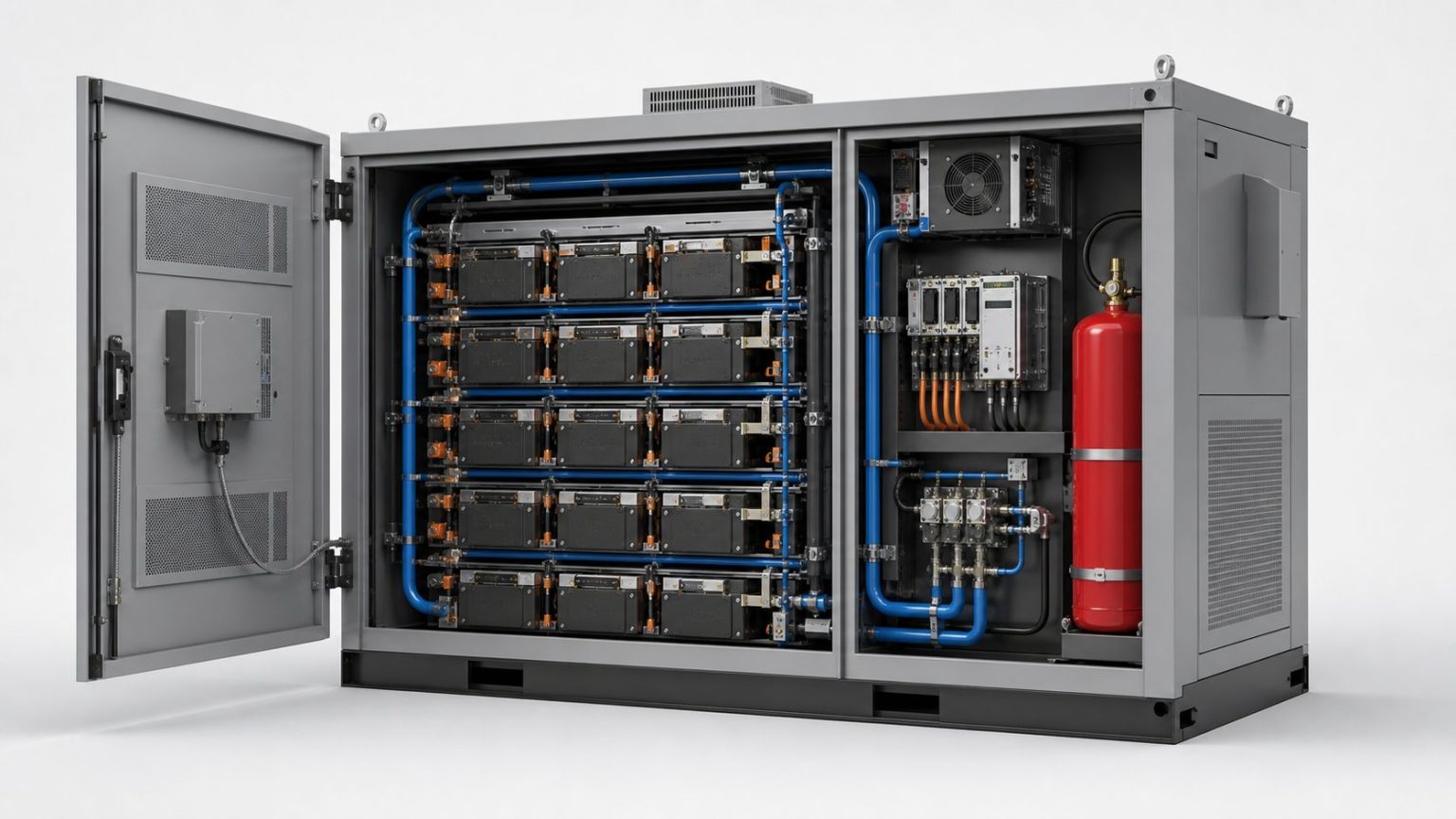
Start With the Load Profile, Not the 261kWh Nameplate
For an initial screening, energy is the load multiplied by the support duration. A 100kW duty for two hours begins near 200kWh before losses, operating reserve, ageing allowance and site constraints are applied. That simple calculation is useful, but it is not a final design. The usable energy at the required point in the system must be confirmed under the supplier’s stated conditions.
Four Numbers That Prevent Most Sizing Errors
- Peak real power in kW and apparent power in kVA, including motor-starting or transient demands.
- Required discharge duration under the defined load profile, not an average-load estimate.
- Energy available at the buyer’s chosen measurement boundary after applicable conversion losses.
- Recharge window and available charging power from the grid, PV system or generator.
If backup is part of the scope, divide loads into life-safety, production-critical and deferrable tiers. Do not size storage to the facility’s monthly electricity bill. Request the interval data, mark the loads that must remain energised and state which loads can be shed automatically. This produces a more accurate quotation and often avoids buying unnecessary battery capacity.
Check the DC Window Against the Project Architecture
The verified 676–936Vdc range and 832Vdc nominal value must be checked against the power-conversion system, disconnects, fuses, busbars, insulation coordination and measurement equipment. Ask the bidder to submit a single-line diagram showing normal current paths, isolation points, protection boundaries and communications. A compatible nominal voltage is not enough; the complete operating window must remain inside every connected component’s permitted range.
The 1P260S architecture is also relevant to service strategy. Procurement should ask how a fault is isolated, how module or rack maintenance affects availability, and which measurements are visible at cell, module, string and system level. Those answers matter more than a glossy dashboard screenshot because they determine how quickly an EPC can diagnose abnormal behaviour.
Verify the AC Interface and Operating Modes
MegSolid publishes a rated AC power of 125kVA and an interface of 480V or 400V ±15% at 50/60Hz. Your RFQ should still state whether the project evaluates real power, reactive power or both. The proposed operating point must respect the equipment’s apparent-power limit, especially if the system is expected to provide power-factor correction while charging or discharging.
- Required import and export limits at the point of connection.
- Active- and reactive-power control priorities.
- Ramp-rate, dispatch interval and response-time requirements.
- Grid-following, backup and generator-coordination expectations.
- Black-start or seamless-transfer requirements, if any, as separately verified options.
- Communication protocols, signals, historian data and remote-access boundaries.
Do not assume the cabinet provides a particular transfer time, black-start function or generator-control sequence unless the supplier confirms it for the quoted configuration. These features depend on the complete system architecture, not the battery energy rating alone.
Treat Liquid Cooling as a Controlled Subsystem
MegSolid describes intelligent liquid cooling and self-evolving algorithms designed to keep temperature difference within ±5°C. That is valuable because temperature uniformity supports consistent operation across the battery assembly. However, a buyer should evaluate the cooling system as an engineered subsystem with pumps, piping, sensors, controls, leak management and maintenance requirements.
- Request the temperature measurement points and the conditions under which the ±5°C figure is demonstrated.
- Ask for coolant specifications, inspection intervals, alarm thresholds and leak-detection logic.
- Review pump redundancy, safe shutdown behaviour and the response to loss of cooling.
- Confirm heat rejection, clearances and any site-side ventilation or spacing requirements.
- Include cooling alarms, sensor plausibility checks and abnormal-temperature tests in FAT or SAT.
A lower cabinet price can be misleading if cooling maintenance is unclear or if the EPC must later add unplanned heat-rejection equipment. Normalize the scope before comparing commercial offers. For the wider selection logic, use this liquid-cooled versus air-cooled BESS comparison before fixing the cooling architecture.
Do Not Reduce Fire Safety to One Line on a Datasheet
The published system description lists Novec, a multi-sensor detector and water-based suppression. That identifies important protection elements, but it does not replace a project fire strategy. The RFQ should request the detection sequence, alarm thresholds, shutdown interlocks, isolation logic, ventilation response, external notification, emergency-stop philosophy and post-event inspection procedure.
Ask for a cause-and-effect matrix that shows what happens after each detector or system alarm. The EPC, fire engineer and authority having jurisdiction can then evaluate separation distances, access, signage, water supply, emergency response and any building-specific measures. This is stronger due diligence than accepting a statement that the cabinet “has fire suppression.”
Use an RFQ Compliance Matrix That Separates Facts From Evidence
| RFQ line item | MegSolid published data | Supplier submission required |
|---|---|---|
| Rated energy | 261.24kWh | State test boundary and operating conditions |
| Rated AC power | 125kVA | Provide active/reactive capability curve |
| Voltage and frequency | 480V or 400V ±15%; 50/60Hz | Confirm selected project interface |
| DC range | 676–936Vdc; 832Vdc nominal | Submit coordinated single-line diagram |
| Efficiency | 90% maximum system efficiency | Define test method, load point and system boundary |
| Cooling | Intelligent liquid cooling; temperature difference within ±5°C | Provide cooling design, alarms and maintenance plan |
| Enclosure | IP54; 1300 × 1350 × 2200mm, ±5mm | Confirm weight, lifting plan, clearances and foundation loads |
| Parallel expansion | Up to 10 units | Provide control, protection and communication architecture |
| Fire protection | Novec, multi-sensor detector and water-based suppression | Provide cause-and-effect matrix and project fire integration |
| Lifetime and warranty | Not stated in the supplied product data | Provide warranted terms, exclusions and evidence |
| Environmental limits | Not stated in the supplied product data | Provide temperature, altitude, humidity and corrosion limits |
| Compliance | No model-specific list stated in the supplied product data | Provide applicable certificates and test reports for the quoted model |
This matrix makes bid review faster because every bidder must either confirm, clarify or mark a deviation. It also prevents a sales brochure from being treated as a binding project specification.
Normalize Commercial Bids Before Comparing Price
Compare the total delivered and commissioned scope, not a price per nominal kWh. Two quotations can show the same headline capacity while allocating switchgear, transformers, EMS, metering, communications, civil work, fire integration, freight, commissioning, spares and training very differently.
- Use one agreed delivery boundary and Incoterm.
- State whether the transformer, AC panel, protection relays and revenue meter are included.
- Compare usable performance at the same duty and measurement point.
- Require a complete exclusions and deviations schedule.
- Compare warranty remedies and response obligations, not only warranty duration.
- Price required spares, planned maintenance, remote support and software access.
- Separate optional functions from the base compliant offer.
The published 90% maximum system efficiency is useful only when every bidder declares the same boundary and conditions. Ask whether auxiliary cooling and control loads are included, and at which power level the result applies. Never substitute that number for a project-specific annual energy model.
Make FAT and SAT Part of the Purchase Order
Factory acceptance testing and site acceptance testing turn requirements into evidence. Agree the procedures, instruments, tolerances, data format, witness points and retest rules before manufacturing is complete. A pass/fail checklist added after delivery has little commercial leverage.
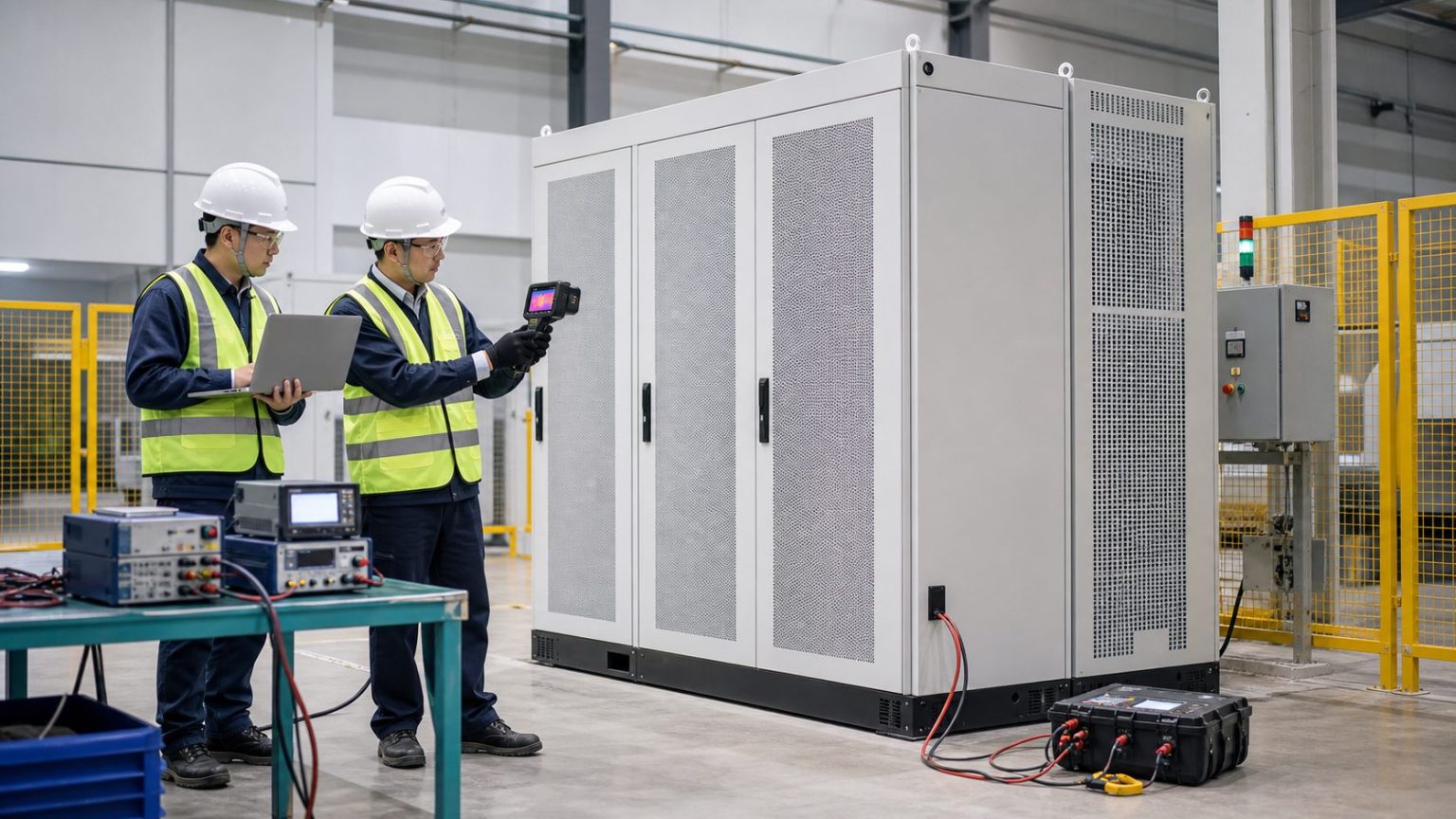
Recommended FAT Checks
- Nameplate, configuration, dimensions and document revision verification.
- Insulation, protective-earth continuity and wiring inspection under the approved procedure.
- BMS, PCS, EMS and meter communication checks.
- Alarm, interlock, emergency-stop and safe-shutdown sequence tests.
- Charge and discharge operation at agreed points within the test facility’s limits.
- Cooling operation, sensor validation and abnormal-temperature response.
- Data logging, time synchronization, user permissions and remote-access controls.
- Review of certificates, test reports, manuals, spares and packing records.
Recommended SAT Checks
- Installation, clearances, foundations, cable terminations and earthing inspection.
- Protection settings and point-of-connection coordination.
- Dispatch, import/export limit and site-control tests.
- PV or generator coordination where included in the approved scope.
- Alarm routing, emergency response and operator training.
- Performance demonstration using the agreed site measurement boundary.
- Handover of as-built drawings, backups, credentials and maintenance records.
Test values must come from the approved project documents. This article intentionally does not invent acceptance tolerances, transfer times, ramp rates or overload capability.
When a 261kWh Cabinet Is a Practical Shortlist
- The required duty fits the verified 261.24kWh energy and 125kVA power envelope after project allowances.
- A modular outdoor cabinet is preferable to a larger containerized installation.
- The site interface can be engineered around 480V or 400V ±15% at 50/60Hz.
- The 676–936Vdc operating range is compatible with the proposed system architecture.
- The site can accommodate the IP54 enclosure and its 1300 × 1350 × 2200mm dimensions with required clearances.
- The expansion plan benefits from parallel operation of up to 10 units.
Parallel capability can support phased growth, but ten cabinets should not be treated as ten independent appliances. The common controls, protection, communications, transformer loading, cable ratings, fault contribution and operational dispatch all need a coordinated design. If the project is approaching multi-cabinet scale, compare the deployment trade-offs in modular cabinets versus containerized ESS.
Why Shortlist MegSolid’s Hybrid Solid-State Design
For buyers who prioritize thermal-risk management, modular deployment and a clear AC/DC interface, MegSolid’s 261.24kWh Hybrid Solid-State system deserves consideration. The published combination of Hybrid Solid-State LFP 314Ah cells, intelligent liquid cooling, AI early warning, multi-sensor detection and layered suppression creates a credible starting architecture for C&I evaluation.
That recommendation is not a substitute for engineering review. It is an invitation to compare evidence. Ask MegSolid to map the quoted configuration against your load profile, site single-line diagram, control philosophy, environmental conditions, required standards and acceptance plan. The strongest proposal is the one that closes those interfaces clearly.
Standards and Documentation: Ask for Evidence, Not Logos
Industrial buyers commonly reference IEC 62619 for safety requirements and tests for secondary lithium cells and batteries used in industrial applications. In markets using North American frameworks, UL 9540 and UL 9540A address system certification and thermal-runaway fire-propagation testing, while NFPA 855 addresses stationary energy-storage installation requirements.
The applicable rules depend on the country, authority having jurisdiction, building and application. Do not assume the 261.24kWh model carries a specific certificate because a standard is mentioned in an RFQ. Require the supplier to identify the exact tested model, report number, scope, limitations and any differences between the tested and offered configuration.
What to Send for a Useful MegSolid Quotation
A useful quotation begins with a concise technical data pack. Sending the items below lets the engineering team test whether one 261.24kWh cabinet is appropriate, whether parallel units are needed, or whether a different architecture will produce a better result.
- Site location and indoor/outdoor installation preference.
- At least one representative month of interval load data, plus seasonal peaks.
- Critical-load list, required backup duration and acceptable interruption.
- Existing and planned PV, generator and transformer ratings.
- Single-line diagram and point-of-connection details.
- Operating modes, tariffs, export constraints and dispatch priorities.
- Environmental conditions and available footprint.
- Required standards, utility rules, fire requirements and submission format.
- Target delivery date, commissioning scope and commercial delivery boundary.
Final Recommendation
Do not buy a 261kWh liquid-cooled energy storage system from a capacity label. Buy a verified duty, a coordinated interface and an acceptance plan. MegSolid’s 261.24kWh Hybrid Solid-State system offers a defined 125kVA AC rating, published DC window, intelligent liquid cooling, modular parallel capability and layered detection and suppression features. Your RFQ should connect those verified facts to the site’s real load, controls, fire strategy and commercial boundaries. That is how an EPC turns a product shortlist into a lower-risk project decision.
FAQ
What is a 261kWh liquid-cooled energy storage system?
It is a commercial battery storage system with roughly 261kWh of rated energy and a liquid thermal-management circuit. The energy number alone does not define usable duration, AC power, operating mode or project suitability, so these must be confirmed in the RFQ.
What are the verified electrical ratings of MegSolid’s 261.24kWh system?
The published data states 261.24kWh rated energy, a 1P260S Hybrid Solid-State LFP 314Ah configuration, 676–936Vdc with 832Vdc nominal, and 125kVA rated AC power at 480V or 400V ±15%, 50/60Hz.
Can the MegSolid 261.24kWh cabinet operate in parallel?
MegSolid states that up to 10 units can operate in parallel. The EPC must still coordinate common controls, protection, communications, transformers, cables and the site dispatch strategy.
Which documents should an EPC request before ordering?
Request the approved datasheet, single-line diagram, protection philosophy, cooling and fire cause-and-effect documents, applicable certificates and test reports, warranty terms, FAT/SAT procedures, installation manual, maintenance plan, software-access terms and a complete deviations schedule.
Is a 261kWh cabinet suitable for backup power?
It may be, but suitability depends on the critical-load kW and kVA, required duration, motor or transient demands, transfer architecture, operating reserve, losses and recharge source. Submit a load profile and critical-load schedule before selecting the cabinet quantity.