 Gaan na inhoud
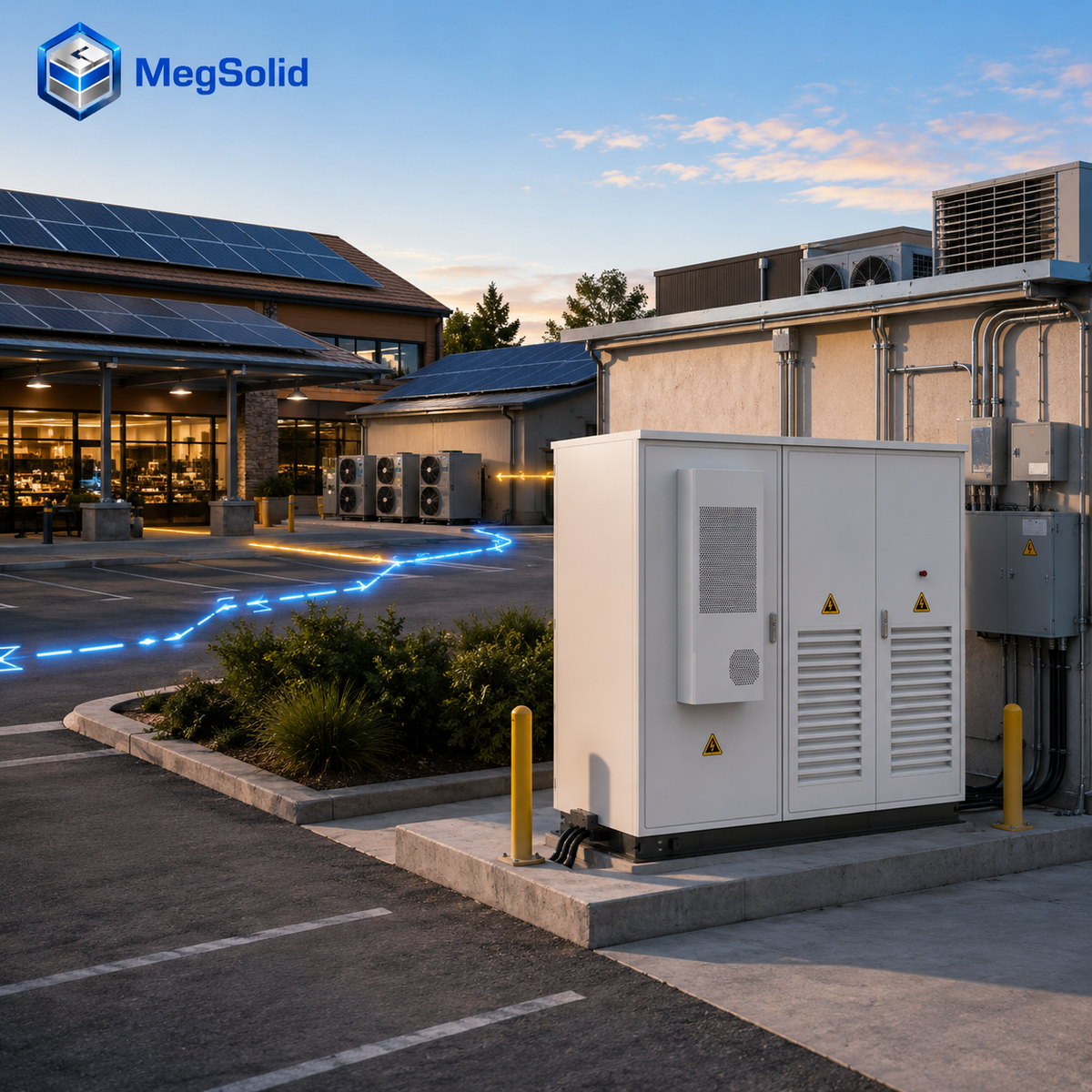
Compact 30 kW / 50 kWh systems fit sites with short demand peaks and a limited group of supported loads. The same capacity becomes restrictive when evening operation runs longer, refrigeration continues overnight, the backup scope grows, or recurring midday PV surplus needs a wider storage window. Those conditions shift the project toward a larger outdoor commercial battery storage system.
The decision comes from the load event, not from the size of the building or its monthly electricity bill. The C&I BESS-ontwerpproses establishes the duty, and the C&I BESS power-to-energy ratio guide separates the required kW from the required operating hours. When both move beyond the compact range, the 100 kW / 215 kWh buite BESS-keusehandleiding becomes the next relevant product screen.
Begin With the Load Event, Not the Daily Electricity Bill
Daily consumption hides the two details that set cabinet size: how much load arrives at the same time and how long the battery must carry it. Two businesses can each use 300 kWh per day while presenting completely different storage duties. One may have a short lunchtime demand peak; the other may hold refrigeration, lighting and checkout loads for hours after solar production declines.
A compact small commercial battery storage system remains a credible fit when the site can isolate a modest group of loads, the peak event is brief, and the usable solar surplus is limited. In that situation, a 30 kW PCS can cover the simultaneous demand and roughly 50–65 kWh can cover the intended window with the required reserve applied.
The same cabinet begins to lose fit when the load curve shows an extended evening plateau, continuous overnight equipment or several loads starting together. Those patterns reveal the sizing problem more clearly than the monthly bill because they show the actual power ceiling and energy window the battery must meet.
The First Mismatch Appears in Either kW or Hours
A 30 kW battery storage system can deliver up to its approved AC power limit at a given moment. Adding battery modules behind the same conversion stage extends duration, but the PCS still sets the simultaneous load that can be served. A 36 kW event, for example, already sits outside a 30 kW discharge ceiling even when plenty of stored energy remains.
A 50 kWh battery storage system faces a different constraint. With a steady 30 kW supported load, nameplate division gives about 1.67 hours. At 20 kW, the same calculation gives 2.5 hours; at 10 kW, it gives 5 hours.
Nameplate duration = battery energy ÷ supported load
| Battery-supported load | Theoretical duration from 50 kWh |
|---|---|
| 10 kW | 5.0 h |
| 20 kW | 2.5 h |
| 30 kW | 1.67 h |
These are screening results. Final runtime uses the warranted usable-energy boundary, operating SOC window, reserve, conversion losses, auxiliaries and the measured load profile. The value of the simple division is speed: it shows whether a project is already too close to the edge to remain in the compact class.
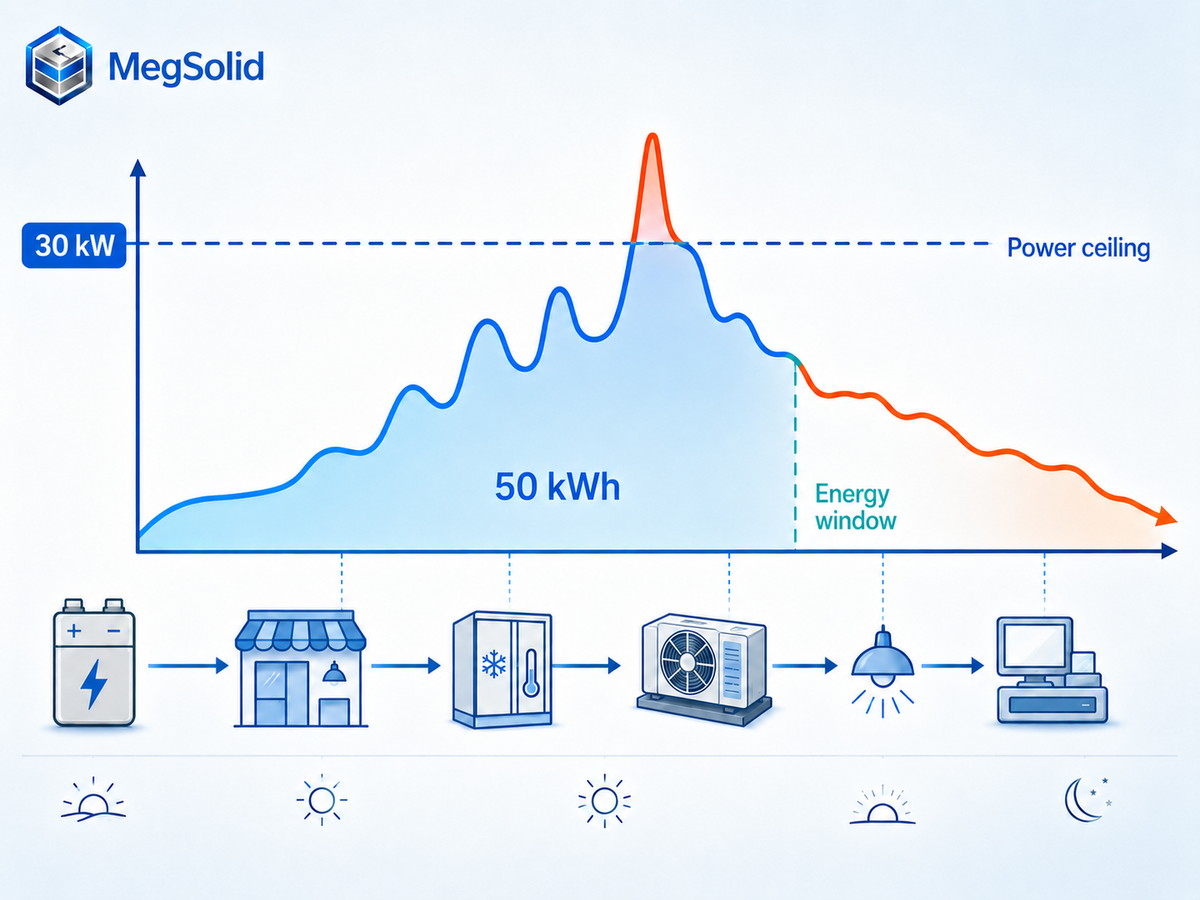
The power and duration calculation can then be completed through the C&I BESS power-to-energy ratio guide using the site's actual event instead of a generic daily-cycle assumption.
How a Small Site Outgrows Compact Storage
The change usually appears in operations before it appears in a procurement specification. Trading hours extend, refrigeration is added, more circuits become operationally important, or daytime solar production begins exceeding the load for longer periods. Each change alters the load event the battery has to cover.
Evening Trade and Refrigeration Stretch the Energy Window
Retail, hospitality and office loads often continue after PV output falls. A short peak may still fit within 50 kWh, while a stable evening plateau can consume the available energy well before closing time. Cold rooms, display refrigeration, telecom equipment and IT loads create the same issue overnight: their kW may look modest, but persistence turns them into a larger kWh requirement.
This is where interval data changes the conversation. A three-hour 18 kW block carries a different storage requirement from a ten-minute 30 kW peak, even though the lower-power event looks less demanding on a single meter reading.
Solar Shifting Changes When Surplus and Later Demand Overlap
A larger PV array alone says little about battery size. The relevant input is recurring solar surplus during the hours when the battery can charge, matched against consumption after solar production declines. A larger cabinet earns its place when both sides of that pattern are visible in timestamped data.
The charging window and SOC allocation belong in the C&I BESS PV charging priority guide. Existing PV sites should also settle the conversion route through the AC-coupled vs DC-coupled storage guide before assigning value to recovered solar energy.
A wider protected-load scope raises power and reserve together. Lighting, communications and point-of-sale equipment may fit comfortably inside a compact backup scope. Adding refrigeration, pumps, HVAC or production equipment changes both the highest simultaneous demand and the energy that must remain available during an outage.
The protected-load schedule should state which circuits run, which can be shed, and how long the reserve must last. That schedule produces a usable operating boundary for the battery instead of treating every connected load as equally critical.
ESSA0100B-0215 Changes Both Sides of the Load Event
MegSolid ESSA0100B-0215 enters the discussion when the measured duty sits outside the compact 30 kW / 50–65 kWh class. Its 100 kW rated AC output raises the controlled-load ceiling, while 215.04 kWh of nominal battery energy opens a longer storage window.
| ESSA0100B-0215 field | Project meaning |
|---|---|
| 100 kW rated AC | Higher simultaneous controlled-load capability |
| 215,04 kWh nominale energie | More energy for longer events, solar shifting or reserve |
| 400 V class | Commercial low-voltage integration basis |
| IP54 enclosure | Outdoor cabinet deployment basis |
| Intelligente lugafkoeling | Integrated cabinet thermal management |
| Built-in isolation transformer | Fewer external transformer interfaces in applicable designs |
The cabinet is relevant when higher power and a larger energy window arrive together. A site that only needs 18 kW for a short peak still has a compact duty. A site carrying a larger evening block, repeated demand peaks or a broader group of protected loads should test the 100 kW / 215.04 kWh class.
Peak Control and Later-Hour Solar Use Share the Same Energy
ESSA0100B-0215 can support a larger peak-shaving event and retain more daytime PV energy for later loads. Both services draw from the same battery, so the operating schedule must show when each service takes priority and how much SOC remains available.
PCC dispatch belongs in the battery peak-shaving control guide. The control target, meter location and response sequence determine how the 100 kW power capability is used at the site boundary.
Reserve Becomes an EMS Allocation Decision
More battery energy creates room for a protected-load reserve alongside daily commercial operation. Integrated EMS control can allocate SOC among peak shaving, solar shifting and the reserved window according to the released operating logic.
The reserve remains tied to the protected-load schedule and usable-energy boundary. Whole-site backup and selected-load backup are different duties, and the BESS EMS prioriteitslogika-gids shows how competing objectives are ordered before commissioning.
Electrical fit still depends on the existing switchboard, protection, cabling and connection boundary. The 400 V BESS-aansluitingsgids carries that check into the site design.
At this stage, the contact decision is whether the measured event has crossed both the compact power and energy limits. Sharing the interval load profile, peak kW, target operating window, PV surplus and protected-load schedule allows the ESSA0100B-0215 class to be screened against one defined duty.
Two 215 kWh Cabinets Can Serve Different Jobs
Battery energy is only one part of the product architecture. Current market configurations make the distinction visible: KSTAR BluePulse pairs approximately 215.04 kWh with 30–50 kW, while MegSolid ESSA0100B-0215 pairs 215.04 kWh with 100 kW rated AC power.
| Example architecture | Load-duty implication |
|---|---|
| 30 kW + ~215 kWh | Long energy window behind a lower power ceiling |
| 50 kW + ~215 kWh | Intermediate simultaneous-load capability |
| 100 kW + 215.04 kWh | Higher power available across the same nominal-energy class |
A 30 kW / 215 kWh system may suit a long, moderate load. A 100 kW / 215.04 kWh system can address a heavier event, although sustained full-power operation uses the stored energy more quickly. The comparison has to keep rated power, usable energy, event duration and control duty on the same line.
This distinction also prevents a common sizing shortcut. Increasing kWh behind a 30 kW PCS extends time; it leaves the 30 kW load ceiling in place. Raising PCS power changes the event the system can follow, while the battery-energy window determines how long that response remains available.
The compact cabinet remains the better fit for a site with a stable supported load well below 30 kW, short repeatable peaks, limited evening consumption and a narrow protected-load scope. A modest PV surplus also favors this class when most solar production is already consumed directly.
In this operating range, extra cabinet capacity may sit unused for much of the year. The project gains more from a clean definition of the event, an appropriate engineering margin and a control strategy that repeatedly uses the available storage.
The decision should stay with the smallest product class that covers the measured duty, reserve and growth allowance. That approach keeps product selection tied to operating evidence instead of treating every future possibility as installed capacity required on day one.
Beyond ESSA: Liquid-Cooled Cabinets and MWh-Scale Storage
ESSA0100B-0215 has its own working range. A project seeking a higher-energy cabinet, a different thermal architecture or MWh-scale expansion should move to the next suitable platform instead of stretching one 215.04 kWh unit across a duty it was not selected to serve.
Energon 261 provides 261.24 kWh nominal energy and 125 kVA rated AC capacity, using liquid cooling and 314Ah LFP cells. The 125 kVA figure is an apparent-power rating; the corresponding kW capability follows the applicable power factor and operating boundary.
Cabinet-to-cabinet comparison is covered in the 215 kWh vs 261 kWh BESS selection guide. Projects moving toward multi-unit or MWh-scale duty can continue into the containerized energy storage architecture.
The transition between products is an architecture decision as much as a capacity decision. Cooling, apparent power, site voltage, expansion strategy, installation interfaces and the intended operating profile all enter before a model is released.
Close the Selection With the Load Curve
A synchronized record shows when demand occurs, how high it rises, how long the event lasts, and what energy is available for charging. It turns a general request for “more battery” into a defined commercial duty.

Start with the interval load profile and mark the event the BESS is expected to change. Record the highest simultaneous kW inside that event, then calculate the energy that must be shifted or reserved across its full duration. Overlay timestamped PV surplus where solar charging is part of the case.
Protected loads need their own schedule because outage duty may overlap with daily peak or solar objectives. The final input is the required operating duration after the usable-energy boundary and reserve have been applied. Together, these measurements show whether 50–65 kWh remains workable, whether ESSA0100B-0215 deserves evaluation, or whether the project has already moved into another product class.
The screen should produce a range, not a false single-point answer. Show load growth, seasonal variation and control margin beside the base duty, then record why the selected class covers that range. The same record should state which change in power, duration, reserve or site interface would reopen the selection.
Keeping the load event beside the selected class gives engineering and procurement one basis for the decision. The downloadable guide carries those site inputs into the MegSolid product review without repeating the sizing exercise in a separate document.
VGV
Is 50 kWh enough for a small business?
Fifty kilowatt-hours can suit a modest supported load and a short operating window. Interval demand, peak kW, PV surplus, reserve and protected-load duration show whether the project remains inside the 50–65 kWh class.
How long can a 50 kWh battery support a 30 kW load?
Nameplate division gives about 1.67 hours: 50 kWh ÷ 30 kW. The project runtime is then adjusted for usable energy, SOC reserve, conversion losses, auxiliaries and the measured load profile.
Should a 30 kW battery storage system be sized from daily electricity consumption?
Use daily kWh as background information. Peak power sets the PCS requirement, while the energy that must be shifted or reserved across the target event sets the battery-energy requirement.
What usually pushes small commercial battery storage beyond 50–65 kWh?
Extended evening demand, overnight refrigeration, recurring PV surplus and a wider protected-load scope commonly enlarge the required energy window. Simultaneous equipment operation can raise the power requirement at the same time.
Does a larger commercial PV system automatically need a larger battery?
Battery capacity follows usable midday surplus and later site demand. Timestamped PV and load data reveal how much solar energy can be stored and consumed after the charging window closes.
When should ESSA0100B-0215 be evaluated?
ESSA0100B-0215 becomes relevant when the defined load event exceeds the compact 30 kW / 50–65 kWh class in both simultaneous power and required energy.
What changes when moving from 30 kW / 50 kWh to 100 kW / 215.04 kWh?
The larger class raises the AC power ceiling and opens a substantially larger nominal-energy window. It can address heavier or longer C&I duties when the site data supports that move.
Can ESSA0100B-0215 support both peak shaving and solar energy shifting?
Both objectives can be included in the EMS strategy. The released priority logic sets their operating windows, SOC allocation and protected-load reserve.
Can ESSA0100B-0215 provide backup power?
ESSA0100B-0215 can support selected loads whose combined power and required duration fit within the validated system boundary. The backup schedule and usable-energy reserve define the supported scope.
Why can two 215 kWh commercial BESS products have very different kW ratings?
Battery kWh describes stored energy, while the PCS rating sets the AC power ceiling. Similar nominal energy can sit behind different converters and serve different load events.
What site data is needed before selecting outdoor commercial battery storage?
Use the interval load profile, peak kW, target event duration, required shifted energy, timestamped PV surplus and protected-load schedule. These inputs place the project in an appropriate product class.
When should a project evaluate Energon 261 instead of ESSA0100B-0215?
Energon 261 enters the screen when the project calls for the 261.24 kWh / 125 kVA class and a liquid-cooled cabinet architecture. Electrical interface and operating duty complete the selection.
When should a commercial site move to containerized energy storage?
Containerized ESS becomes more relevant as the project reaches MWh-scale capacity, requires larger multi-unit expansion or moves beyond the practical boundary of a single outdoor cabinet.
