

Polish factories with surplus midday PV and evening production can use MegSolid's ESSK1000B-2150 to build a 5 MW, 10 MWh nameplate-class installation. Five units supply 5 MW rated power and 10.752 MWh rated energy. Two 5000INTL containers provide 5.4 MW / 10.0318 MWh rated. For a contract specifying AC energy at the factory meter, the equipment count increases; the site BESS design must also account for the connection limit.
- Existing site output: measure simultaneous PV generation, factory load, and actual solar surplus.
- Bedryfsplig: set the maximum discharge MW and the AC MWh needed at the factory meter.
- Equipment route: use ESSC's 1 MW increments for a 5 MW nameplate-class duty; evaluate 5000INTL's 2.7 MW / 5.0159 MWh, 690 V blocks when the connection and delivery requirement favour the larger unit.
Polish Industrial Projects Show the Storage Scale
EDP announced on 28 January 2026 that its Group PBI project in Poland's Świętokrzyskie region will pair 5.7 MWp of PV with 10 MWh of battery storage on a former mining site. EDP expects approximately 6 GWh of solar generation per year. The amount available to charge storage depends on simultaneous site use.
Solas Capital announced on 18 June 2026 financing for three behind-the-meter batteries at Polish automotive manufacturing facilities, together rated 25 MW / 50 MWh. The projects target on-site consumption, peak reduction, and flexibility services.
These Polish projects show the scale at which MegSolid’s two container platforms enter a factory design: ESSC adds 1 MW / 2.1504 MWh per unit, while 5000INTL adds 2.7 MW / 5.0159 MWh. Connection power and the evening shift’s usable-energy demand determine the unit count.
MegSolid ESSC Gives a 1 MW Expansion Step for a 5 MW Factory Duty
Five ESSC1000B-2150 systems provide 5 × 1 MW = 5 MW of rated AC power and 5 × 2.1504 MWh = 10.752 MWh of rated battery energy. MegSolid recommends this five-unit arrangement for a factory requiring up to 5 MW of discharge and planning capacity additions in 1 MW steps. Confirm the AC collection voltage and transformer arrangement in the approved site design.
Die 10.752 MWh rating sits 0.752 MWh, or 7.52%, above a 10 MWh nameplate target. A guarantee at the plant meter must also allow for the usable SOC window, conversion and transformer losses, auxiliary consumption, and ageing.
Each ESSC1000B-2150 is a containerized industrial product with intelligent temperature-controlled air cooling, an IP54 enclosure, and 12,192 × 2,438 × 2,896 mm dimensions. Five 1 MW units need an engineered AC collection arrangement and transformer strategy; the presence of a 400 V board alone does not approve five direct connections. The existing switchboard assessment explains the current, fault-level, protection, and busbar checks that sit behind that decision.
A factory adding solar in phases could install two ESSC blocks first, providing 2 MW / 4.3008 MWh, then expand in 1 MW / 2,1504 MWh steps. EMS limits, protection, parallel operation and civil space need to accommodate the planned final installation.
Count the Blocks Against the Contracted AC Energy
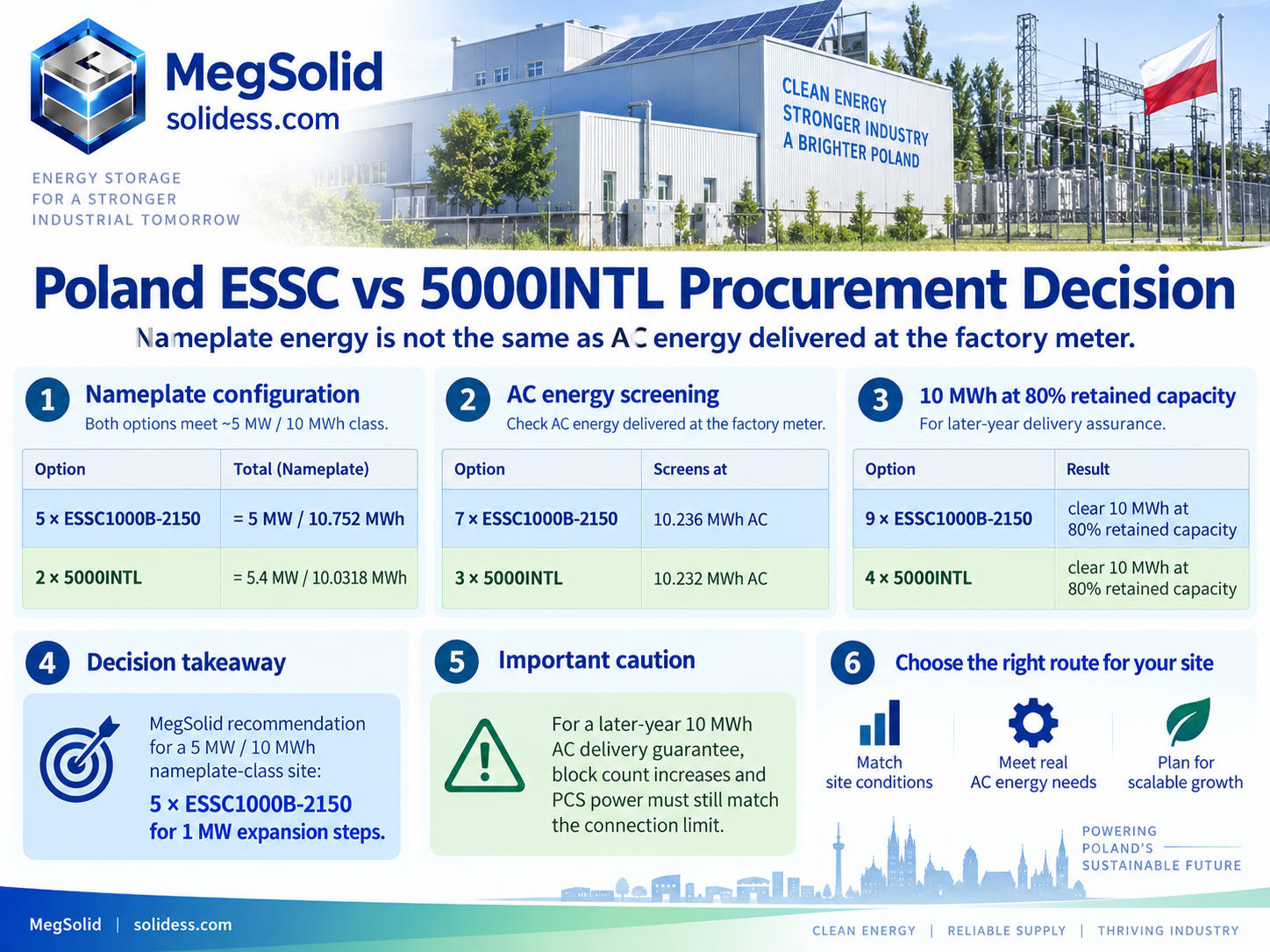
The number of blocks changes when the purchase requirement moves from 10 MWh of rated battery energy to 10 MWh delivered at the factory meter:
| MegSolid configuration | Geurateerde wisselstroomkrag | Gegradueerde batterye-energie | Energy above 10 MWh nameplate | AC design consideration |
|---|---|---|---|---|
| 5 × ESSC1000B-2150 | 5 MW | 10.752 MWh | 0.752 MWh | Confirm collection voltage in design |
| 2 × 5000INTL | 5.4 MW | 10.0318 MWh | 0.0318 MWh | 690 V per unit |
| 7 × ESSC1000B-2150 | 7 MW | 15.0528 MWh | 5.0528 MWh | Confirm collection voltage in design |
| 3 × 5000INTL | 8.1 MW | 15.0477 MWh | 5.0477 MWh | 690 V per unit |
Two 5000INTL containers exceed 10 MWh on the nameplate by only 31.8 kWh. That 31.8 kWh margin is too small to absorb SOC restrictions, conversion losses or auxiliaries under a 10 MWh AC delivery guarantee. The contracted year, usable SOC range, discharge-path factor and auxiliary load therefore determine the required block count.
Using an 80% operating SOC window and an 85% AC-delivery factor, the minimum nominal energy for 10 MWh delivered is 10 ÷ (0.80 × 0.85) = 14.706 MWh before ageing or auxiliaries outside the stated factor. Seven ESSC units screen at 10.236 MWh AC at the beginning of service; three 5000INTL units screen at 10.232 MWh AC. With an 80% retained-capacity factor in the contract year, the screen rises to nine ESSC units or four 5000INTL units. Their installed PCS power exceeds a 5 MW dispatch requirement, so the owner must assess the connection and the value of a different power-to-energy configuration.
IEC 62933-2-1 covers unit parameters and testing methods for electrical energy storage systems. Specify the metering point, discharge power, starting and ending SOC, temperature, auxiliaries, test duration, and contractual year. The BESS-fabrieksaanvaardingstoets and site test should use the same measurement boundary as the purchase contract.
Existing PV Must Actually Have Energy to Charge the Battery
EDP expects about 6 GWh of annual PV generation at its Group PBI project, equivalent to 16.44 MWh per calendar day as an annual average. The daily chargeable surplus is lower on days when the site uses more PV as it is generated, and winter output differs from the annual average. Interval data, or an approved grid-charging route, sets the charging schedule.
In each metering interval, use max(PV output (kW) − concurrent site load (kW), 0) × interval duration (h) to obtain solar-surplus energy in kWh. If the meters already report kWh per interval, subtract those energy readings directly, without multiplying by hours again. Sum the intervals that fall inside the charging window. Compare that daily surplus with the energy the selected MegSolid blocks can accept under the approved charge-power ceiling and operating SOC window. The AC-coupled or DC-coupled connection then determines which PV and battery converters share the site control boundary.
Five ESSC blocks serve a factory that needs up to 5 MW late in the day and can recharge for its intended discharge. At only 3 MWh of solar surplus on ordinary workdays, the larger battery capacity needs a measured peak-reduction duty or permitted grid charging to be put to use.
Factory Peaks Set the PCS MW; Solar Shifting Sets the MWh
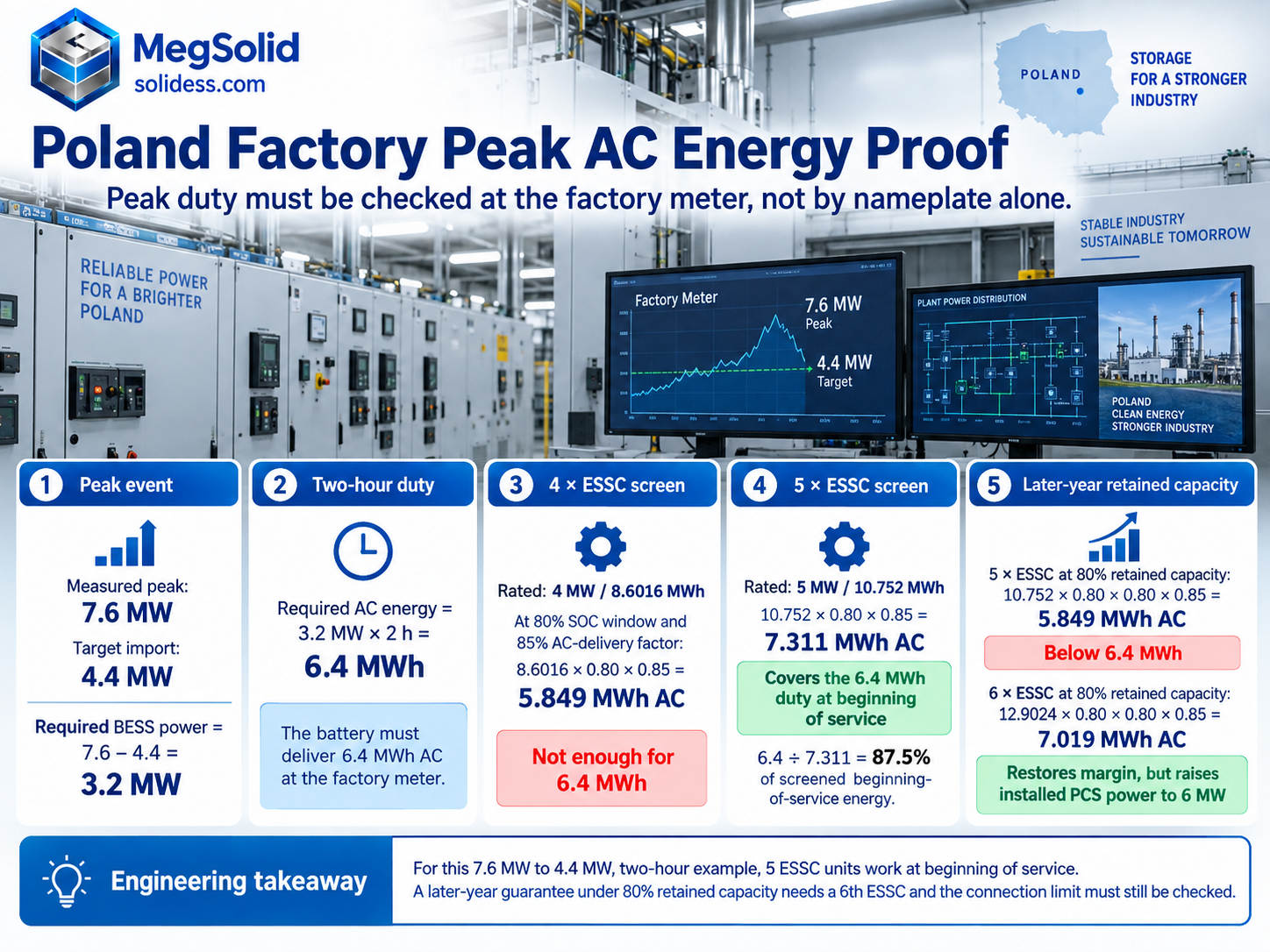
For peak shaving, PCS power must cover the measured load above the import ceiling: required BESS kW = site kW − target import kW. Battery energy must then sustain that correction for the actual event duration. The control point at the PCC matters because a battery that reaches its own setpoint can still leave a chargeable peak at the factory meter.
Consider a site that reaches 7.6 MW for two hours while its chosen import target is 4.4 MW. The battery must supply 3.2 MW and at least 6.4 MWh AC during that event. Four ESSC blocks provide 4 MW / 8.6016 MWh rated; applying an 80% SOC window and an 85% AC-delivery factor gives 5.849 MWh, short of the required 6.4 MWh even before ageing. Five ESSC blocks raise that screened AC energy to 7.311 MWh and give 5 MW of rated power. The 6.4 MWh duty consumes 87.5% of that screened beginning-of-service energy; the contractual delivery year and site auxiliaries determine the final guarantee.
At the beginning of service, the fifth ESSC fills the energy gap in a 1 MW increment. At 80% retained capacity later in the contract, five blocks screen at only 5.849 MWh for the same 6.4 MWh duty. A sixth ESSC raises screened energy to 7.019 MWh, but also raises installed PCS power to 6 MW. The connection limit must accommodate the selected arrangement.
5000INTL Fits a 690 V Collection Design
The 5000INTL combines 2.7 MW rated AC power and 5.0159 MWh rated energy in one liquid-cooled, IP55, 690 V container. Two systems deliver 5.4 MW / 10.0318 MWh rated; three deliver 8.1 MW / 15.0477 MWh rated. Each container has six 450 kW conversion blocks and a roughly 6 m length. Its 690 V output changes the collection and layout design compared with five or seven ESSC units.
MegSolid recommends 5000internasionaal where a 690 V to medium-voltage collection design is available and the site benefits from fewer, larger units. Three containers screen at 10.232 MWh AC at beginning of service under the 80% SOC / 85% delivery factors above; they cannot support a 10 MWh guarantee after material ageing on that basis. Four containers screen at 10.915 MWh AC with 80% retained capacity, before site auxiliaries, but bring 10.8 MW rated PCS power. A 5 MW discharge requirement therefore needs a defined connection limit and power-to-energy design if four containers are installed.
Five ESSC1000B-2150 units remain MegSolid's recommendation for a 10 MWh nameplate-class installation requiring no more than 5 MW of discharge and phased 1 MW expansion. The 690 V versus 400 V AC-current comparison helps assess the available collection options; the ESSC unit interface and the Polish factory's SLD must determine the actual scheme.
EMS Dispatch Must Protect Both Solar Value and the Grid Agreement
The EMS allocates energy between midday PV charging, peak shaving and the evening shift. It must respond to changing production and PV output rather than relying on a fixed discharge time. The SOC and dispatch priority must set the order of operations at the actual site meter.
The approved import and export envelope sets the first control limit. Charging five ESSC blocks at their combined rated power while factory load is high could create a new import peak; discharging during high PV output could exceed the export agreement. The EMS then protects the SOC needed for the contracted evening duty. Additional operating opportunities can use energy above that floor.
In Poland, the distribution network operator and the site connection conditions determine permitted import, export, metering and protection settings. The battery's rated PCS power is an equipment fact, not permission to import or export that full power at the connection. MegSolid's BESS, external site meters, solar inverters, transformer, protection, and local controller must be tested together under the approved operating sequence.
Verify the Installed System at the Factory Connection
The ESSC series has IP54 protection and intelligent air cooling. The 5000INTL operates at 690 V AC, with IP55 protection and smart liquid cooling. Verify the existing MV transformer, fire layout and grid agreement for the selected unit count. The equipment dimensions and access envelope affect whether the units can be installed, serviced, and expanded at a built-up industrial site.
IEC 62933-5-2:2025 addresses safety requirements for grid-integrated electrochemical storage as a complete system over its life cycle. On this project, that means checking interactions among battery, PCS, cooling, detection, protection, and emergency isolation in the actual installation. A standard reference is a design and acceptance basis; model-specific conformity evidence and Polish site approvals must match the equipment supplied.
The purchase specification needs the ordered MegSolid model and unit count tied to the AC meter used for the energy guarantee. A witnessed factory test checks the ordered hardware and control sequences; a site acceptance test checks the installed meter, transformer, solar interface, protection, and EMS at the factory connection. Commissioning then measures the agreed discharge power and AC energy at the factory meter.
MegSolid's Recommendation for the 5 MW Factory
For a 5 MW, 10 MWh nameplate-class industrial project that can use 1 MW expansion steps, MegSolid recommends five ESSC1000B-2150 blocks. They supply 5 MW / 10.752 MWh rated; for the 3.2 MW, two-hour peak example, the fifth unit raises screened beginning-of-service energy to 7.311 MWh, above the required 6.4 MWh AC. A later guarantee at 80% retained capacity requires a sixth unit under the stated SOC and delivery factors.
A 10 MWh AC delivery guarantee in a later contract year leads to a larger block count. Nine ESSC units or four 5000INTL containers clear the arithmetic screen under the stated 80% SOC, 85% delivery and 80% retained-capacity factors, before auxiliaries outside that factor. They also install 9 MW or 10.8 MW of PCS, respectively. For a site needing only 5 MW of discharge, MegSolid can engineer the battery-to-PCS balance around the signed meter boundary, PV surplus, load profile and connection limit.
VGV
Which MegSolid product fits a Polish factory targeting about 10 MWh of installed storage?
Five ESSC1000B-2150 blocks provide 5 MW and 10.752 MWh rated energy, with 1 MW increments for a staged industrial installation.
Can two MegSolid 5000INTL containers guarantee 10 MWh at the factory meter?
No. They total 10.0318 MWh rated battery energy; usable SOC, conversion losses, auxiliaries, and ageing reduce AC energy at the meter.
How many MegSolid blocks start a 10 MWh delivered-energy calculation?
At an 80% SOC window and an 85% AC-delivery factor, seven ESSC blocks or three 5000INTL units each screen just above 10.2 MWh AC at the beginning of service. With 80% retained capacity, nine ESSC or four 5000INTL units clear 10 MWh before site auxiliaries; installed PCS power must also be justified.
Does a 5.7 MWp solar plant need a 5.7 MW BESS?
No. PV nameplate power, actual charging surplus, the factory's peak-reduction MW, and the evening energy window are separate quantities.
What determines the power rating for factory peak shaving?
The difference between measured factory demand and the chosen import target sets required BESS kW. The duration of that difference sets delivered kWh.
How does a Polish factory calculate solar energy available to charge a BESS?
Subtract simultaneous facility demand from PV generation in each metering interval, count only positive surplus, and sum the available kWh across the charging window.
Can five ESSC blocks connect directly to an existing 400 V board?
Five units represent 5 MW of rated output; the equipment connection voltage must be verified in the ordered electrical drawings. The site engineer must design the AC collection, transformer, switchgear, protection, and current path.
When is the 690 V 5000INTL route preferable?
It is a strong candidate when a multi-megawatt site benefits from fewer high-energy containers and has an engineered 690 V to MV route. Power limits and delivered-energy requirements still determine unit count.
Does either configuration automatically provide backup during a grid outage?
No. Backup requires a designed islanding, switching, protection, control, and reserve-SOC arrangement in addition to battery power and energy.
Which performance measure belongs in the battery purchase agreement?
Specify delivered AC MWh at a named meter and power level, with SOC, test temperature, auxiliaries, losses, and guaranteed year defined. Nominal container capacity is a different measure.
Are there public examples of large Polish industrial solar and storage projects?
EDP announced 5.7 MWp of solar with 10 MWh of storage for Group PBI in January 2026. The project is in Poland’s Świętokrzyskie region.
Is there evidence of behind-the-meter BESS for Polish factories?
Solas Capital described three batteries at automotive manufacturing facilities with a combined 25 MW / 50 MWh in June 2026.
Is MegSolid's ESSC1000B-2150 an industrial container or a small outdoor cabinet?
It is a 1 MW / 2.1504 MWh containerized system with intelligent temperature-controlled air cooling and IP54 protection.