

توصي شركة MegSolid بالتعامل مع قائمة نقاط نظام BESS SCADA باعتبارها أحد مخرجات الواجهة التعاقدية، وليس كملف تصدير للسجلات يُطلب تقديمه أثناء مرحلة التشغيل التجريبي. فإذا لم تحدد طلبات عرض الأسعار (RFQ) القياسات والحالات والإنذارات والأوامر والبيانات الوصفية المطلوبة، فقد يتلقى المقاول (EPC) مئات العلامات، لكنه يظل يفتقر إلى الإشارات القليلة اللازمة لتشغيل المحطة وتشخيص أعطالها وقبولها.
والحل المباشر هو اعتماد قائمة أحادية النقطة قبل اختبار FAT تربط كل علامة بجهازها المصدر، والمعنى الهندسي، ونوع البيانات، والوحدات، والتحجيم، وعلامة الجودة، وقاعدة التحديث، وأذونات الوصول، ومعالجة الإنذارات، واختبار القبول. ويمنح هذا النهج مهندس SCADA واجهة قابلة للتطوير، كما يوفر لقسم المشتريات التزامًا قابلًا للقياس من جانب المورد.
الإجابة المباشرة: اجعل قائمة النقاط بمثابة عقد واجهة
إن قائمة نقاط SCADA المفيدة لنظام تخزين الطاقة بالبطاريات (BESS) هي أكثر من مجرد قائمة بعناوين Modbus. فهي تحدد ما يمكن للمشغل رؤيته، وما يمكن لنظام إدارة الطاقة (EMS) أن يأمر به، وما يظل خاضعًا لسلطة الحماية التي يتمتع بها نظام إدارة المبنى (BMS) أو نظام التحكم في الطاقة (PCS)، وما هي الأدلة التي تثبت أن كل واجهة تعمل بشكل سليم. إن دليل بنية الاتصالات بين نظام إدارة البطارية (BMS) ونظام إدارة الطاقة (EMS) تشرح طبقات النظام؛ وتُعالج هذه الصفحة مسألة الشراء المنفصلة المتعلقة بما يجب تسليمه بالضبط بين هذه الطبقات.
- 📊 القياسات: الطاقة النشطة والطاقة التفاعلية، والجهد، والتيار، والتردد، والطاقة، ومستوى شحن البطارية (SOC)، وحالة البطارية (SOH)، ودرجات الحرارة، وحدود تشغيل المعدات.
- 🔘 الدول: موضع القاطع، ووضع التشغيل، وحالة التوافر، وحالة الشحن/التفريغ، والحالة المحلية/البعيدة، وحالة سلامة الاتصالات.
- 🚨 أجهزة الإنذار: أحداث BMS وPCS وإدارة الحرارة ونظام الحريق والعدادات ووحدات التحكم والشبكة، مع تحديد درجة الخطورة والطوابع الزمنية.
- 🎛️ الأوامر: فقط الوظائف القابلة للكتابة المعتمدة، مع فحوصات النطاق، والصلاحيات، والتشابكات، وردود الفعل على الأوامر.
- 🧭 السياق: المصدر، والعنوان، والوحدات، والمقياس، وقواعد الإشارات، والجودة، ومعدل التحديث، ونطاق التثبيت، والملكية، ومرجع FAT.
تعكس بنية المخرجات هذه الممارسات الفعلية في مجال شراء المرافق العامة. إن نطاق نظام إدارة طاقة تخزين الطاقة (BESS EMS) لشركة Xcel Energy تتطلب قوائم نقاط أنظمة إدارة الطوارئ (EMS) ومراكز التحكم في الطوارئ الإقليمية (RTAC)، ورسومات الاتصالات، وخطط الاختبار القبول النهائي (FAT) والتشغيل. والدرس المستفاد في مجال المشتريات بسيط: قائمة النقاط يجب أن تكون جزءًا من حزمة التصميم، وليس ضمن قائمة المهام النهائية للتشغيل.
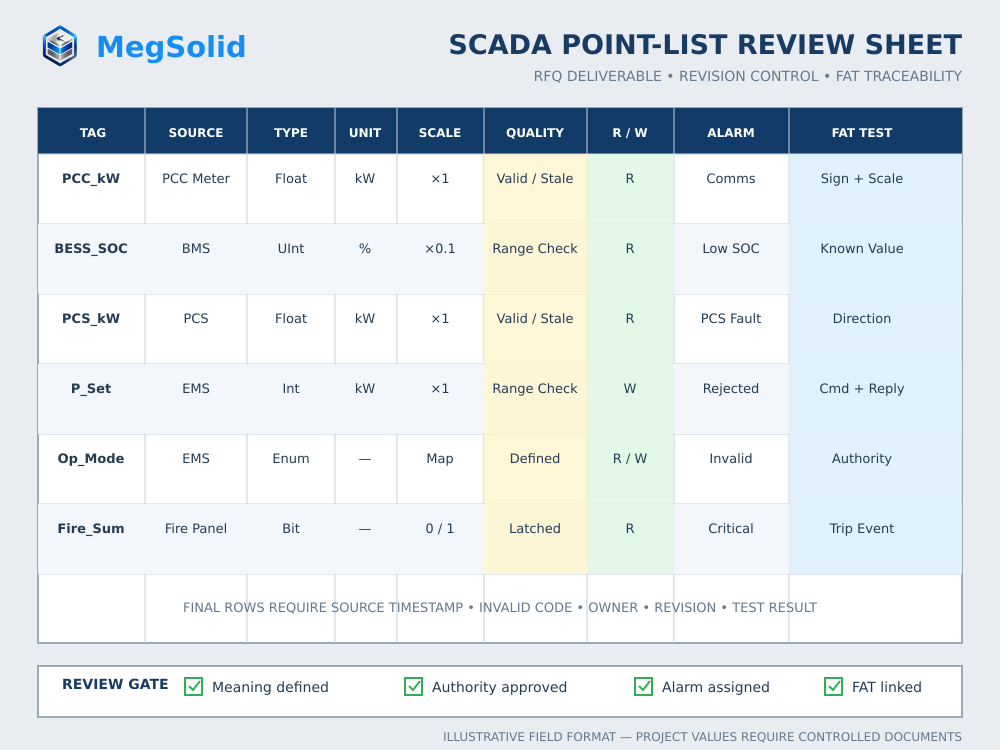
ابدأ بمجموعات «Six Point»، لا بتصدير سجل عشوائي
يجب تنظيم مجموعة النقاط الدنيا وفقًا للقرار الذي تدعمه كل مجموعة بيانات. قد تكشف خريطة السجلات الأولية عن آلاف القيم، لكنها لا تُعلم نظام التحكم في الأداء (EPC) بالنقاط التي ينبغي أن تظهر على واجهة المستخدم (HMI) الخاصة بالمشغل، أو في سجل البيانات التاريخية، أو في تقرير الأداء، أو في حلقة التحكم. استخدم المجموعات التالية كأساس لطلب عرض الأسعار (RFQ)، ثم أضف متطلبات الشبكة والتعرفة والمشترين الخاصة بالمشروع.
| مجموعة النقاط | أمثلة بسيطة | تم تأييد القرار |
|---|---|---|
| PCC وقياس الاستهلاك في الموقع | الاستيراد/التصدير بالكيلوواط، والكيلوفار، والجهد، والتيار، والتردد، ومعامل القدرة، والكيلوواط/ساعة المستوردة/المصدرة، وجودة العداد | التحقق من تبادل الشبكة، وحدود التسوية، واستجابة نظام إدارة الطاقة (EMS) |
| ملخص عن محطة BESS | القدرة المتاحة للشحن/التفريغ، والقدرة الفعلية، ونسبة الشحن (SOC)، وحالة الصحة (SOH)، ووضع التشغيل، ومدى التوافر، وعدادات الطاقة الإجمالية | تعرف على ما يمكن أن يقدمه المصنع حالياً ولماذا قد يكون ذلك محدوداً |
| واجهة PCS و AC | الجهد والتيار المتردد والمستمر، كيلوواط، كيلوفار، التردد، معامل القدرة، حالة التشغيل، حالة العطل، نقطة الضبط والتغذية الراجعة | التحقق من استجابة التحويل وحالة التشغيل الكهربائية |
| البطارية ونظام إدارة البطارية (BMS) | حالة النظام (SOC)، حالة الصحة (SOH)، الجهد/التيار المستمر، حدود الشحن/التفريغ، القيم القصوى لدرجة الحرارة، حالة العزل، والإنذارات النشطة | الالتزام بحدود البطارية وتشخيص انخفاض السعة |
| المعدات المساعدة والسلامة | حالة التبريد، ودرجة حرارة الخزانة، وملخص لوحة الإنذار بالحريق، وحالة الدخان/الغاز (حيثما تتوفر)، والإيقاف في حالات الطوارئ، وحالة الإمداد المساعد | تحديد الظروف التي قد تؤدي إلى خفض قدرة النظام أو توقفه |
| وحدة التحكم والشبكة | وضع EMS، الهدف، مصدر الأوامر، الحالة المحلية/البعيدة، اتصالات الجهاز، مزامنة الوقت، علامة البيانات القديمة، وحالة وحدة التحكم | أثبت أي وحدة تحكم هي المسؤولة، وما إذا كانت المدخلات الواردة إليها صحيحة |
لا تقم بنسخ كل نقطة على مستوى الخلية إلى نظام SCADA الخاص بالموقع دون وجود حالة استخدام محددة. احتفظ بملخص على مستوى المشغل للتشغيل العادي، وحدد مسارًا تشخيصيًّا منفصلاً لفحص الوحدة أو الخلية عندما تدعم المعدات ذلك. الـ نماذج تخزين الطاقة من SunSpec توضيح كيف يمكن ترتيب تفاصيل «bank» و«string» و«module» في طبقات بدلاً من تجميعها في قائمة واحدة غير منظمة.
تزويد كل علامة SCADA بالبيانات الوصفية اللازمة لاستخدامها
يُعتبر اسم العلامة مثل «Battery_Power» غامضًا إلى أن يتم تحديد حدوده وقواعد الإشارة الخاصة به. فهل يتم قياسه عند ناقل التيار المستمر (DC bus)، أم عند أطراف التيار المتردد (AC) لوحدة توليد الطاقة (PCS)، أم عند لوحة الجهد المنخفض (LV board)، أم عند وحدة التحكم في الطاقة (PCC)؟ وهل تعني القيمة الموجبة الشحن أم التفريغ؟ وهل يتم قياسه أم حسابه أم أنه ناتج عن أمر؟ يجب الإجابة عن هذه الأسئلة في نفس الصف من قائمة النقاط المعتمدة.
بالنسبة للمشاريع التي تخضع لقيود التصدير، يجب أن تدعم قائمة نقاط SCADA متطلبات العدادات والأوامر والحالة وفترة الانتظار والإنذارات المحددة في إطار عمل التحكم في خدمات البريد السريع (EMS) الذي لا يسمح بالتصدير.
| حقل إلزامي | لماذا هذا مهم | Example decision |
|---|---|---|
| Unique tag and source device | Prevents duplicate names and identifies the data owner | PCC meter kW is not the same as PCS kW |
| Address, protocol and data type | Lets the integrator build and test the mapping | Holding register, input register, bit, float or integer |
| Units, scale and sign | Prevents factor-of-ten and reversed-direction errors | kW versus W; positive discharge versus positive charge |
| Range and invalid value | Supports validation and rejects corrupt data | Approved engineering range and unavailable-data code |
| Update, deadband and timestamp | Aligns control, HMI and historian performance | Event-driven or periodic update with source timestamp |
| Read/write authority | Stops monitoring points from becoming uncontrolled commands | Read only, operator write or EMS-controlled |
| Alarm priority and latching | Makes alarms actionable instead of noisy | Warning, trip, emergency; self-clearing or manual reset |
| FAT/SAT reference | Connects the data row to objective acceptance evidence | Test step, expected result and recorded trend |
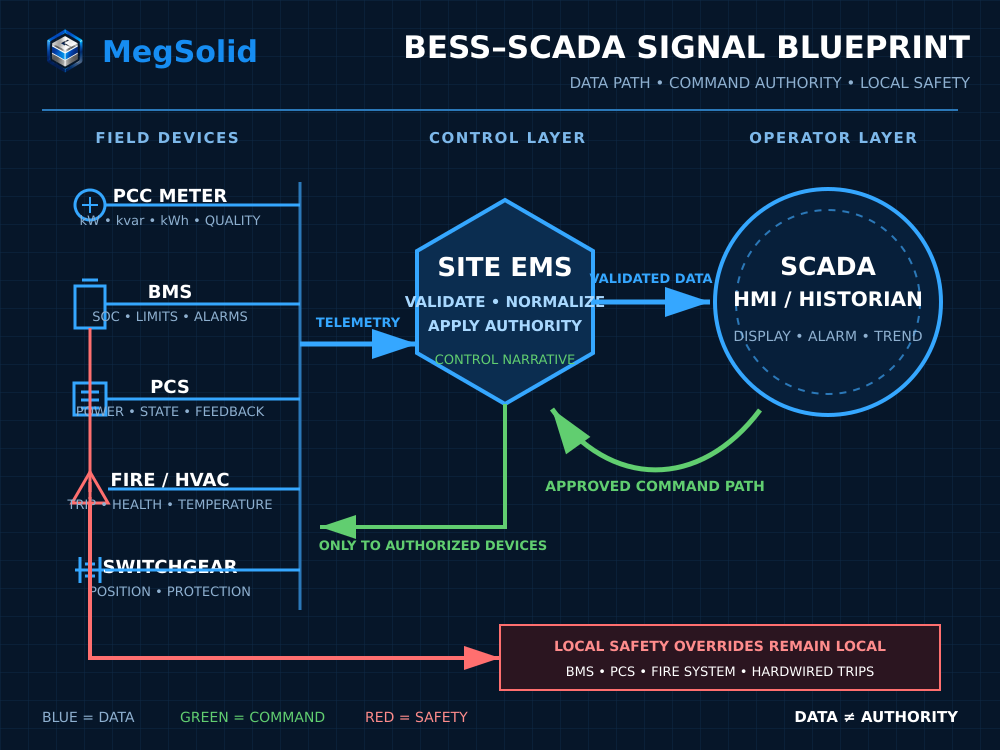
Separate Monitoring, Commands and Safety Authority
The SCADA point list must show which values are informational, which commands may be written, and which protective decisions remain local to the BMS, PCS, fire system or hardwired circuit. A writable tag is not automatically permission to control it. The control narrative, interlock matrix and user-access design must agree with the point list.
- 👁️ Monitor: Values used for HMI display, historian records, reporting and diagnostics.
- ✍️ Command: Approved setpoints and mode requests with defined ranges, source priority and feedback.
- 🛡️ Protect: Local BMS, PCS, relay, fire-system or hardwired actions that are not delegated to ordinary SCADA control.
- 🔐 Authorize: Role-based access, local/remote selection and command-source indication.
- ✅ Confirm: Requested value, accepted value, actual response and rejection reason when a command is blocked.
Do not assume that one protocol makes equipment interoperable. Modbus can standardize transport, while the project still needs an agreed data model, scaling, control authority and exception behavior. Before selecting equipment, use MegSolid’s دليل شراء أنظمة تخزين الطاقة التجارية و BESS supplier qualification checklist to keep interface documentation inside the quotation comparison.
Apply the Checklist to MegSolid Product Interfaces
MegSolid publishes model-specific communications interfaces that can be used to establish the RFQ boundary. They are not a substitute for the ordered register map, firmware revision and integration test. The buyer should request those controlled documents for the exact model and project configuration.
| MegSolid family | Published interfaces | RFQ action |
|---|---|---|
| ESSA outdoor C&I series | RS485 and TCP-IP; integrated EMS; touch LCD and cloud platform; simultaneous access to load, battery, grid, diesel generator and PV | Request the ordered EMS point list, source-device map, writable commands, alarm list and FAT procedure |
| MEGA0030TS–MEGA0500TS قطع | BMS via RS485/CAN; EMS via RS485/TCP-IP | Define the PCS/BMS/EMS ownership boundary and confirm the model-level register map |
| PMA080–PMA0125 modular PCS | RS485, CAN and Ethernet; BMS and EMS interfaces | Confirm protocol assignment, gateway scope and transformer/system integration responsibilities |
| محول هجين من طراز R30KH3–R50KH3 | Meter RS485; BMS RS485/CAN; EMS RS485 | Map meter, battery and site-controller data separately and approve command authority |
For a 30–100 kW, 55.296–215.04 kWh outdoor C&I application, review the MegSolid ESSA outdoor energy storage platform together with the 100 kW / 215 kWh BESS selection guide. For larger PCS boundaries, compare the MEGA TS PCS with isolation transformer و مجموعة PCS المعيارية من PMA.
The ESSA platform can be configured with solid-state battery cells for project-specific requirements, but this option must be confirmed in the quotation, signed datasheet and BOM. When supported by model-level test evidence, a verified hybrid solid-state configuration may be evaluated for improved thermal stability or reduction of specific risks; it does not eliminate thermal runaway and must not reduce the required temperature, BMS-limit, fire-detection, shutdown and communications monitoring. See the MegSolid solid-state energy storage options و solid-state battery thermal-runaway verification guide for the correct system-level safety boundary.
Design Alarm and Event Data for Action, Not Volume
An alarm list that forwards every device event at the same priority will overwhelm operators and hide the event that matters. The RFQ should require an alarm philosophy that assigns severity, cause, operator action, latching, acknowledgement, reset authority and suppression rules. Each high-priority alarm should also identify the associated operating state and any automatic response.
- 🔴 Trip or emergency: Immediate loss of operation or a condition requiring urgent site response.
- 🟠 Major alarm: Derating, unavailable equipment or a fault that threatens the required service.
- 🟡 Warning: Deviation requiring inspection before it becomes a trip or performance loss.
- 🔵 Advisory: State change, maintenance notice or operator information that does not require an alarm response.
- ⏱️ Sequence evidence: Source timestamp, first-out indication, clear time, acknowledgement and reset record.
Trend requirements must be equally explicit. Specify which points need source timestamps, event-resolution records, short-term high-resolution capture and long-term historian storage. The AES Indiana SCADA requirements provide a useful procurement example by calling for point name, address, description, span, units, offset and data type rather than accepting an unlabeled register dump.
Make FAT and SAT Prove the Complete Data Chain
Point-list approval does not prove integration. FAT should stimulate or simulate the source value, verify the EMS mapping and show the correct SCADA result. SAT should repeat critical tests through the installed network, final meters, user permissions and site control hierarchy. Use the دليل اختبار القبول في المصنع لنظام BESS to connect the point-list rows to witnessed evidence.
| Acceptance test | Required proof | Common failure caught |
|---|---|---|
| Address and identity | Source device, register and SCADA tag match the approved list | Wrong device instance or duplicate tag |
| Scaling and sign | Known injected value appears with correct units and direction | ×10 scaling error or reversed charging sign |
| Quality and stale data | Lost communication changes quality, raises the approved alarm and blocks invalid control use | Frozen value shown as healthy |
| Command and feedback | Authorized request is range-checked, acknowledged and compared with actual response | Command accepted on screen but ignored by equipment |
| Alarm sequence | Timestamp, priority, first-out, acknowledgement, clear and reset behave as specified | Alarm flood or missing initiating event |
| Historian retrieval | Trend and event records can be exported for the agreed test window | Data visible live but unavailable for acceptance evidence |
| Authority and access | Local/remote state and user role allow only approved writes | Conflicting controllers or excessive user permissions |
Put These SCADA Deliverables into the EPC RFQ
The quotation should identify not only the communication port, but also every engineering document and integration activity included in the price. This prevents the battery supplier, PCS supplier, EMS integrator and site-SCADA contractor from assigning the same missing interface to one another after equipment arrives.
- 📄 Approved point list: Native Excel format plus controlled PDF revision.
- 🗺️ Architecture package: SLD, network diagram, IP plan, device map and gateway scope.
- 🔢 Register documentation: Protocol, address, data type, scaling, units, invalid codes and writable ranges.
- 🚨 Alarm deliverables: Alarm list, priority, cause, response, latching, reset and notification responsibility.
- 🎛️ Control deliverables: Control narrative, command hierarchy, interlocks, local/remote logic and feedback.
- 🧪 Acceptance package: FAT/SAT procedures, simulators, trend files, exception log, punch list and retest responsibility.
- 🔐 Operations package: User roles, remote-access boundary, backups, change control, historian export and training.
- 🧩 Revision control: Firmware, register-map version, final as-built point list and future change notification.
To receive the editable MegSolid BESS SCADA Point-List Template, email [email protected]. Include the project country, SLD, required BESS power and energy, selected or proposed model, PCC voltage, SCADA/PLC platform, preferred protocol, existing meter and site-controller details, required operating modes, alarm philosophy, FAT/SAT scope and delivery schedule. MegSolid can then review the interface boundary before the quotation becomes a commissioning problem.
الأسئلة الشائعة
What should a BESS SCADA point list contain?
It should contain measurements, states, alarms and approved commands, with the source device, address, data type, units, scale, sign convention, range, quality rule, update method, access authority, alarm treatment and FAT/SAT reference for every point.
Who should supply the BESS SCADA point list?
Each equipment supplier should provide its controlled register map and alarms. The EMS or SCADA integrator should consolidate those sources into one site-level point list, while the EPC or owner approves naming, authority, historian and acceptance requirements.
How many SCADA tags does a C&I BESS need?
There is no universal number. The required count depends on system size, number of devices, reporting level, diagnostic depth, operating modes and contractual obligations. Define required decisions first, then select the points that support them.
Which BESS points should be writable from SCADA?
Only commands approved in the control narrative should be writable. Each requires a valid range, user authority, source priority, interlocks, acknowledgement, actual-response feedback and defined behavior when the request is rejected or communications fail.
Should site SCADA receive cell-level battery data?
Not always. Normal operations may need bank or string summaries, while cell-level data may be reserved for diagnostics. Specify the operator view, historian need and service access separately to avoid unnecessary tag volume.
What is the difference between a register map and a SCADA point list?
A register map describes data exposed by a device. A SCADA point list selects the project-required points and adds engineering meaning, naming, permissions, alarm behavior, update rules, ownership and acceptance criteria.
How should BESS alarms be prioritized?
Classify alarms by operational consequence and required action, then define latching, acknowledgement, reset and suppression. Trip or emergency events, major derating, warnings and advisories should not share one undifferentiated priority.
Which SCADA documents should be approved before BESS FAT?
Approve the point list, device and network architecture, register maps, alarm list, control narrative, command hierarchy, time-synchronization method, historian requirements, user roles and FAT procedure before witnessed testing begins.
How should an EPC test BESS point mapping?
Inject or simulate a known source value, trace it through the gateway or EMS, verify the SCADA tag, units, scale, sign, quality and timestamp, then record the result against the approved point-list row.
Which MegSolid systems publish communications interfaces for integration?
The ESSA series publishes RS485 and TCP-IP; MEGA TS publishes BMS RS485/CAN and EMS RS485/TCP-IP; PMA publishes RS485, CAN and Ethernet; R30KH3–R50KH3 publishes separate meter, BMS and EMS interfaces. Request the exact model register map before design.
ما هي قائمة نقاط SCADA الخاصة بنظام تخزين الطاقة بالبطاريات (BESS)؟
قائمة نقاط نظام SCADA لنظام تخزين الطاقة بالبطاريات (BESS) هي الجدول المعتمد لقياسات تخزين الطاقة بالبطاريات، والحالات، والإنذارات، والأوامر التي يتم تبادلها بين المعدات الميدانية، ونظام إدارة الطاقة (EMS)، ونظام SCADA الخاص بالموقع، بما في ذلك البيانات الوصفية اللازمة لتفسير واختبار كل نقطة.
كيف يقوم نظام إدارة الطاقة (EMS) الخاص بنظام تخزين الطاقة بالبطاريات (BESS) بإرسال البيانات إلى نظام SCADA؟
يقوم نظام إدارة الطاقة (EMS) بجمع البيانات المعتمدة من العدادات ونظام إدارة البطاريات (BMS) ونظام التحكم في الطاقة (PCS) والأنظمة المساعدة، ويطبق نموذج بيانات المشروع، وينقل القيم والحالات والإنذارات المحددة عبر البروتوكول الصناعي المتفق عليه. ولا تُرسَل الأوامر إلا عبر مسار الصلاحيات المعتمد.
ما الذي يجب على المشتري أن يرسله إلى MegSolid للحصول على عرض لتكامل نظام SCADA؟
يرجى إرسال البيانات التالية: SLD، وقيم BESS بالكيلوواط (kW) والكيلوواط/ساعة (kWh)، والطراز المقترح، والجهد الكهربائي لـ PCC، ومنصة SCADA أو PLC، والبروتوكول المفضل، وتفاصيل العداد ووحدة التحكم، وأنماط التشغيل، والنقاط المطلوبة، ومنهجية الإنذار، ونطاق اختبار القبول الميداني (FAT) واختبار القبول لدى العميل (SAT)، وجدول التسليم.