 الانتقال إلى المحتوى
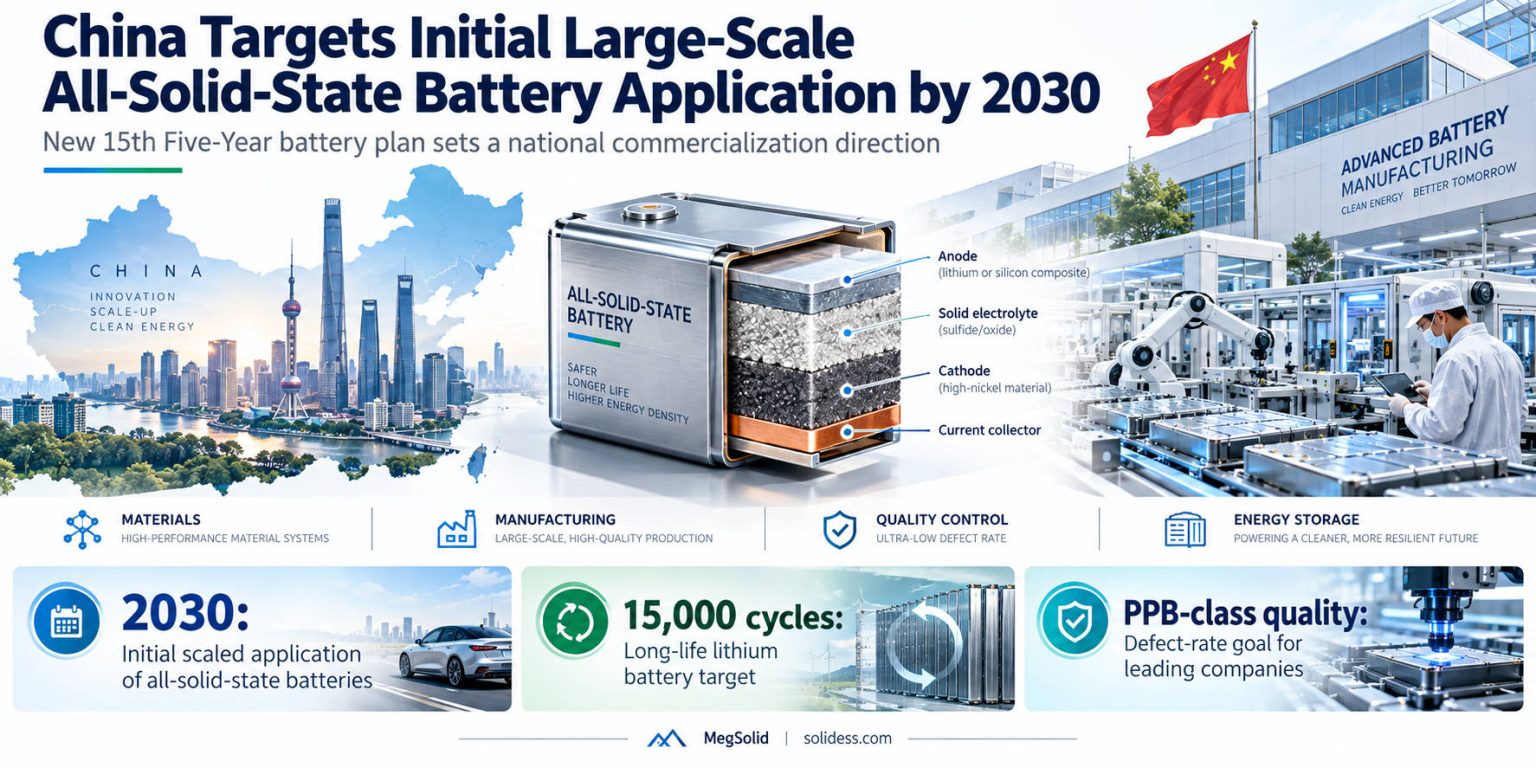
China has moved all-solid-state batteries from an industry forecast into an explicit national industrial-policy target.
On September 28, 2026, China’s Ministry of Industry and Information Technology and six other departments publicly released the New Battery Industry Development Plan for the 15th Five-Year Plan, a document formally dated September 14.
The headline target is explicit:
By 2030, all-solid-state batteries should initially achieve scaled application.
That sentence should not be misread as:
“China expects mature, low-cost, mass-market all-solid-state batteries everywhere by 2030.”
The plan is broader than a simple 2030 commercialization headline.
It combines a national commercialization target for all-solid-state batteries with aggressive goals for long-life lithium batteries, manufacturing quality, advanced materials, solid electrolytes and production equipment.
The energy-storage policy signal is:
solid-state technology is no longer being treated only as a laboratory research direction. China is now building the materials, manufacturing and quality infrastructure required to move it toward industrial deployment.
Separate the 2030 All-Solid-State Target From the Wider Battery Plan
The 2030 targets cover the wider “new battery” industry, not only all-solid-state batteries.
The distinction matters because the targets apply to different parts of the battery industry.
Separate the 2030 Targets by Industry Function
The plan sets out several high-level objectives:
| 2030 Target | What It Means |
|---|---|
| All-solid-state batteries | Initial scaled application |
| Long-life lithium batteries | Cycle life reaches 15,000 cycles |
| Leading battery companies | Product defect rates reach PPB-class levels |
| Advanced materials | New progress in electrodes, electrolytes and high-end auxiliary materials |
| التطبيق | Expansion into power, grid, industrial parks, data centers and multiple electrification sectors |
الـ 15,000-cycle target is not a statement that every all-solid-state battery must reach 15,000 cycles.
It is a separate target for long-life lithium batteries.
The PPB target needs the same careful reading.
It represents a push toward parts-per-billion-class manufacturing quality among leading companies—not a claim that today's solid-state production lines have already achieved that defect level.
Read the Targets as Both Outcomes and Industrialization Tasks
The policy describes where the industry needs to go و what technologies must be industrialized to get there.
MegSolid's existing solid-state battery technology hub tracks many of the same engineering barriers now appearing in national policy, including interface stability, cycle life, manufacturing pressure and commercialization.
The Manufacturing Roadmap Matters as Much as the 2030 Target
The most important part of the plan is not one sentence about 2030.
It is the manufacturing roadmap underneath it.
Track the Engineering Problems Named in the Roadmap
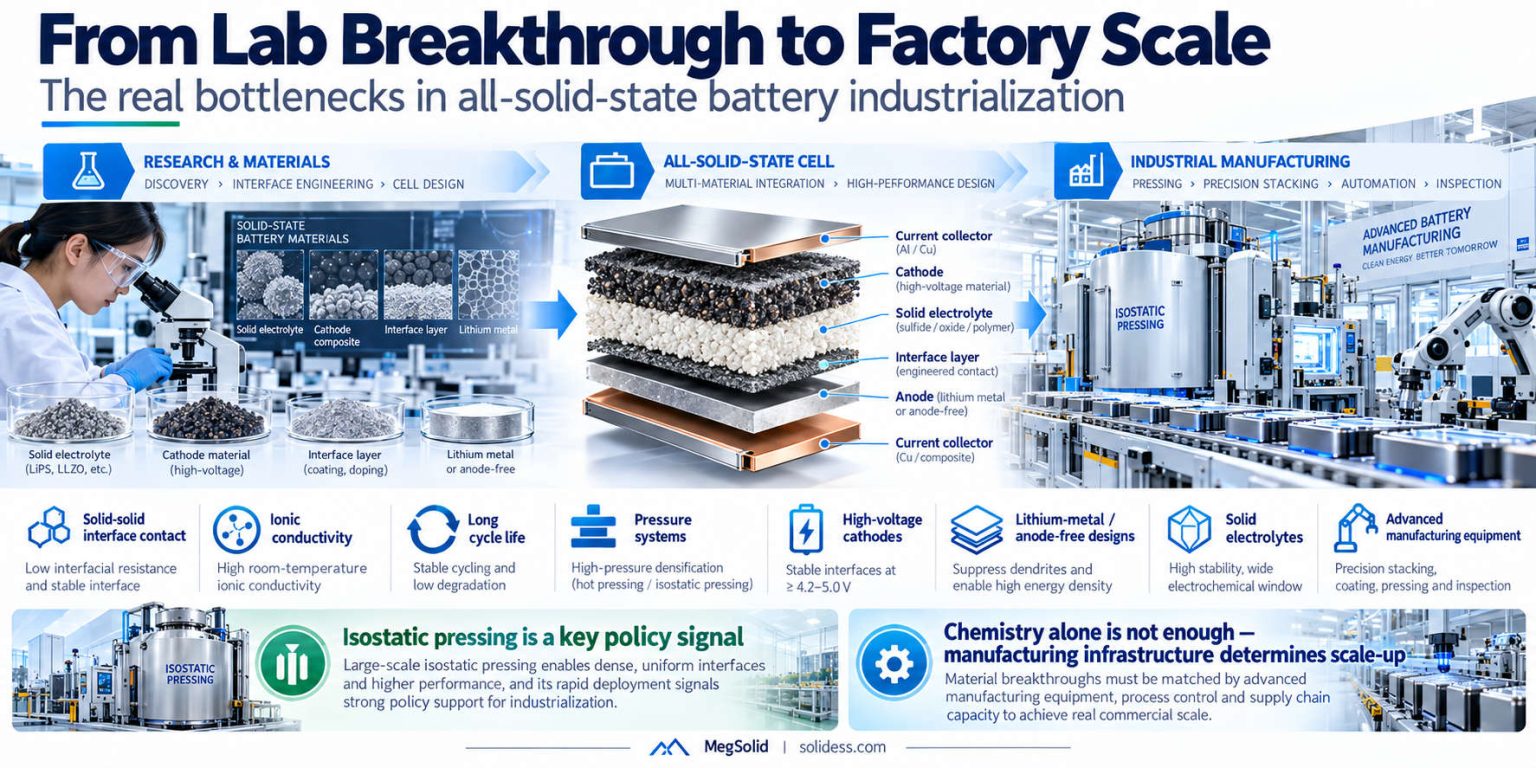
China is explicitly targeting breakthroughs in:
- solid-solid interface contact
- high ionic conductivity
- long cycle life
- engineered pressure systems
- high-voltage, high-specific-capacity cathodes
- lithium-metal-based anodes
- anode-free architectures
- high-performance solid electrolytes
- advanced battery manufacturing equipment
That list maps directly to major unresolved all-solid-state battery engineering problems.
Interface engineering remains one of the most important manufacturing issues.
Liquid electrolytes naturally wet electrode surfaces.
Solid electrolytes do not provide the same wetting behavior.
Repeated charge and discharge can make mechanical expansion, contraction and imperfect contact increase interfacial resistance and accelerate degradation.
That is why solid-solid interface degradation remains one of the decisive barriers between impressive laboratory cells and durable commercial batteries.
The policy does not suggest that the technical problems have disappeared.
It is telling the industry which problems must now be solved at manufacturing scale.
Isostatic Pressing Shows Where Manufacturing Investment Must Expand
One manufacturing detail deserves specific attention:
the plan explicitly includes isostatic-pressure battery manufacturing technology and equipment.
Pressure matters because it is one of the defining engineering challenges of many solid-state cell architectures.
Solid electrolytes need intimate physical contact across interfaces.
Maintaining that contact during manufacturing—and sometimes during operation—can require pressure-control strategies that conventional liquid-electrolyte battery production lines were never designed to provide.
China's plan supports more than “better chemistry.”
It supports the machines required to manufacture that chemistry.
Follow the Manufacturing Equipment That Must Scale
The manufacturing roadmap can drive investment into:
- precision stacking
- dry-electrode processes
- hot pressing
- isostatic pressing
- advanced inspection
- automation
- solid-electrolyte production
- manufacturing software
The road from a successful laboratory pouch cell to mass production is difficult because manufacturing must reproduce those conditions consistently at scale.
MegSolid's analysis of solid-state battery mass-production constraints reaches the same engineering conclusion: manufacturing pressure, interface control and production-line economics can be as important as nominal cell chemistry.
2027 Demonstration and 2030 Scale-Up Are Not the Same Policy Statement
A second timeline point needs careful separation.
The widely repeated timeline:
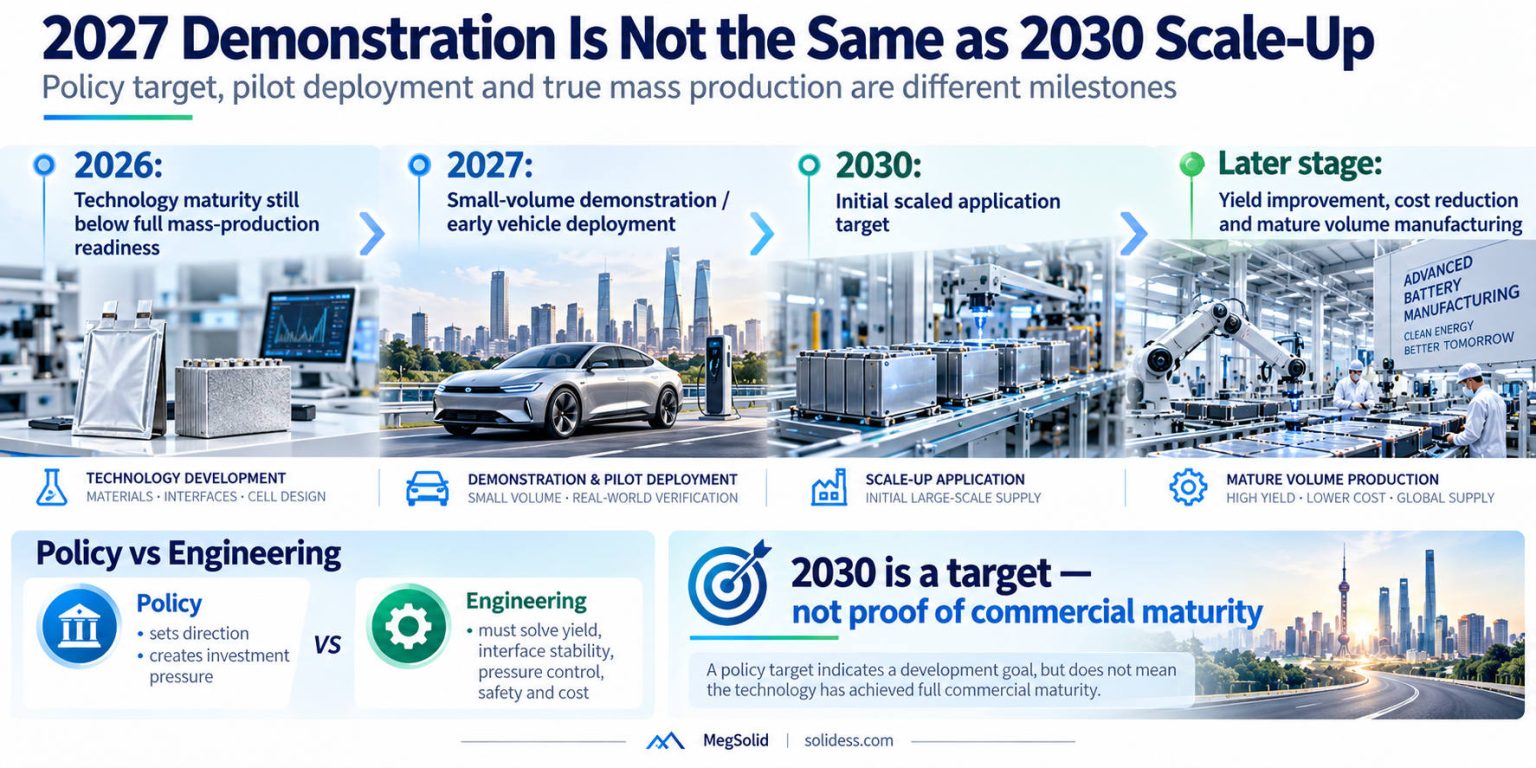
2027 demonstration or small-volume vehicle deployment → 2030 scale-up
is consistent with industry expectations, but the “2027” milestone is not the core 2030 target written into the new seven-department plan.
China EV100 has separately reported an industry view that all-solid-state batteries could enter small-volume vehicle deployment around 2026–2027, with broader scale conditions emerging around 2030.
The 2027 date is useful as an industry milestone.
It does not make it a guaranteed national commercialization deadline.
Battery commercialization rarely moves in a straight line.
Keep the Commercialization Sequence in Order
laboratory validation → pilot line → small-volume production → application demonstration → yield improvement → cost reduction → scaled production
Skipping those stages in a press release does not remove them in a factory.
CATL's Caution Shows the Gap Between Policy Targets and Engineering Readiness
The most revealing contrast comes from CATL Chairman Robin Zeng.
In June 2026, he described current solid-state battery technology maturity at roughly 4 on a 1-to-9 scale, with 9 representing technology ready for true mass production.
CATL's stated direction was still:
- small-volume production around 2027;
- another three to five years before genuine volume manufacturing.
The CATL timeline does not necessarily contradict the government plan.
It is the difference between industrial policy و engineering readiness.
Separate the Policy Target From Engineering Readiness
- Policy target: China wants the ecosystem capable of initial scaled all-solid-state application by 2030.
- Engineering-readiness view: the technology is still several major engineering steps away from mature mass production.
Both statements can coexist because they describe different levels of readiness.
The gap between target and readiness helps explain why the policy emphasizes manufacturing development.
Governments set the direction.
Factories still have to solve yield, pressure control, solid-electrolyte manufacturing, lithium-metal stability, interface degradation, safety validation and cost.
Battery technology does not become commercially mature because a target date appears in a planning document.
The target creates pressure. Engineering determines whether the industry can meet it.
The Policy Also Matters for Stationary Energy Storage
Most solid-state battery headlines focus on passenger cars.
The new plan is broader.
Include Stationary Storage in the Policy Impact
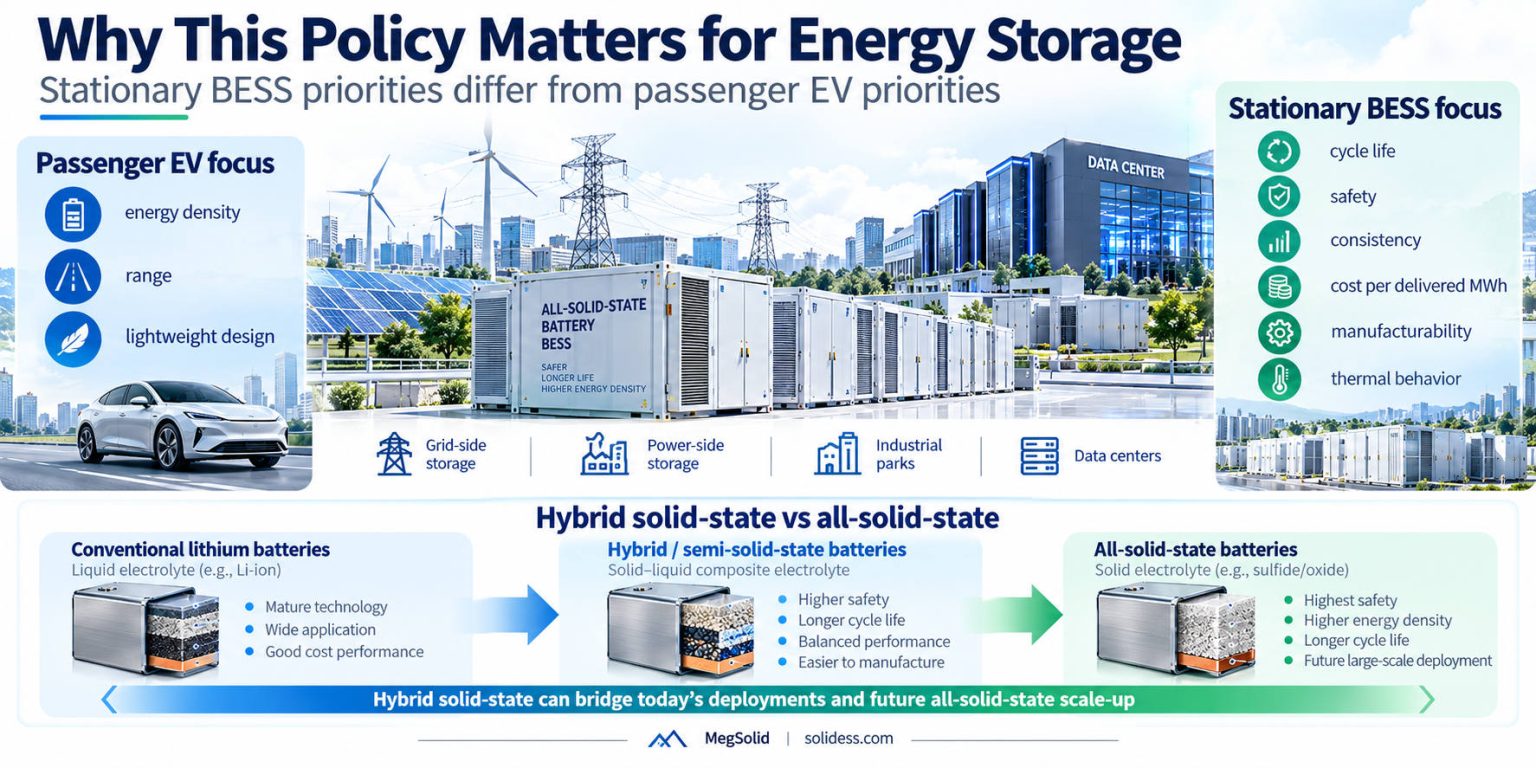
The plan explicitly points to new-battery applications across:
- power-side energy storage
- grid-side energy storage
- industrial parks
- data centers
That matters for BESS developers.
Energy storage has very different priorities from premium electric vehicles.
Vehicles may prioritize extreme gravimetric energy density.
Stationary BESS often places more weight on:
- cycle life
- السلامة
- consistency
- degradation
- cost per delivered MWh
- manufacturability
- السلوك الحراري
That is why the 15,000-cycle target may ultimately be just as important for the stationary storage market as the headline all-solid-state target.
MegSolid's guide to evaluating solid-state BESS beyond cycle life makes this procurement distinction clear: headline chemistry alone does not determine project economics.
Cells still have to survive real C&I and grid operating conditions.
Keep Hybrid Solid-State and All-Solid-State Batteries Distinct
The policy also makes one market distinction increasingly important.
Hybrid or semi-solid-state batteries are not the same as all-solid-state batteries.
MegSolid currently develops and deploys hybrid solid-state battery systems.
إنها 314Ah hybrid solid-state battery technology represents a commercial engineering route that combines solid-state concepts with a system designed for current energy-storage deployment.
That should not be relabeled “all-solid-state” simply because national policy now emphasizes all-solid-state technology.
The two occupy different points on the commercialization curve.
Hybrid systems can act as a bridge between conventional liquid-electrolyte lithium batteries and future all-solid-state architectures.
The new Chinese policy does not erase that bridge.
It may make it more important.
The industry still needs commercially manufacturable technologies while all-solid-state materials and production equipment mature.
MegSolid's hybrid solid-state C&I battery engineering should be evaluated on its own documented cell and system performance—not on policy targets written for the future all-solid-state industry.
The 15,000-Cycle Target Raises Lifecycle Expectations for Storage
The 15,000-cycle objective deserves its own attention.
Commercial storage has already moved beyond a simple “how many kWh?” competition.
Evaluate Storage on Lifetime Performance, Not Capacity Alone
Projects increasingly compete on:
- degradation
- usable throughput
- augmentation requirement
- downtime
- replacement cost
- lifetime delivered energy
The 15,000-cycle national industrial target signals higher long-duration asset expectations.
That does not mean buyers should start demanding “15,000 cycles” on every 2026 quotation.
Require the Test Conditions Behind Cycle-Life Claims
Suppliers will face increasing pressure to prove:
- test conditions
- DoD
- temperature
- C-rate
- capacity retention
- end-of-life criterion
Cycle-life claims without those conditions remain incomplete.
The broader transition is already visible in the next-generation energy storage competition: capacity alone is no longer enough.
PPB-Class Quality Pushes the Industry Toward Manufacturing Consistency
Solid-state battery discussions usually focus on energy density.
The PPB target points to something less glamorous and more important:
manufacturing consistency.
Battery manufacturing at million-cell scale cannot depend on laboratory-level selection and manual quality control.
Treat Manufacturing Consistency as a System Requirement
It needs:
- stable materials
- repeatable interfaces
- automated inspection
- traceability
- process control
- extremely low defect escape rates
Large energy storage systems make even very low cell-level defect probability important once thousands or tens of thousands of cells are installed in one project.
At this point, the policy emphasis shifts from chemistry to industrial capability.
Commercial success will depend on more than an impressive laboratory sample.
They will be the companies that can reproduce performance at scale.
MegSolid's C&I solid-state energy storage analysis already treats manufacturing reliability and system integration as part of the technology decision rather than secondary details.
Watch the Evidence That Shows Whether the 2030 Target Is Advancing
The September 28 release is a major signal.
It is not the end of the commercialization debate.
The next evidence will come from execution.
Track the Evidence That Shows Execution
Watch for:
- pilot-line yield improvements
- solid-electrolyte manufacturing capacity
- lithium-metal and anode-free validation
- isostatic-pressure equipment orders
- large-format cell cycle data
- pack-level safety testing
- real production cost
- stationary-storage demonstration projects
Use the Commercialization Question That Matters
Do not stop at “Will China develop all-solid-state batteries?” That direction now sits inside national industrial policy. Ask instead: How quickly can laboratory performance be converted into repeatable, safe and economically manufacturable cells?
Treat 2030 as a Policy Target, Not Proof of Commercial Maturity
China's new battery plan changes the conversation.
All-solid-state batteries now have an explicit 2030 industrialization objective inside a seven-department national plan.
Long-life lithium batteries have a 15,000-cycle target.
Leading manufacturers are being pushed toward PPB-class quality control.
Materials, equipment and production technology are being developed around the same roadmap.
The combined targets create a strong industrial-policy signal.
The engineering gap still remains.
Keep the Commercialization Milestones Separate
2027 small-volume demonstration, 2030 initial scaled application and mature mass-market production are three different milestones. They should not be treated as the same thing.
Energy-storage investors, EPCs and buyers should not wait for a single date when every battery becomes all-solid-state.
They should track which technologies already deliver verified safety, cycle life and manufacturing consistency, and which all-solid-state breakthroughs are moving from laboratory claims into industrial evidence.
China has now put 2030 on the policy calendar.
The next four years will decide whether manufacturing can catch up with the ambition.
الأسئلة الشائعة
What exactly does China's 2030 all-solid-state battery target say?
The plan targets initial scaled application of all-solid-state batteries by 2030. It does not say the technology will already be fully mature, low-cost or universally deployed by that date.
Does the 15,000-cycle target apply specifically to all-solid-state batteries?
No. The article separates the targets: the 15,000-cycle objective applies to long-life lithium batteries, while all-solid-state batteries have the separate target of initial scaled application by 2030.
What does PPB-class quality mean in the policy context?
It refers to a manufacturing-quality target for leading battery companies, pushing product defect rates toward parts-per-billion-class levels. It is not proof that today's solid-state production lines already operate at that level.
Why is the manufacturing roadmap as important as the 2030 target?
Because industrialization depends on solving interface contact, ionic conductivity, cycle life, pressure management, advanced cathodes, lithium-metal or anode-free designs, solid electrolytes and manufacturing equipment at factory scale.
Why does isostatic pressing matter for all-solid-state battery manufacturing?
Many solid-state architectures require intimate and uniform contact across solid interfaces. Isostatic-pressure equipment is one route for creating dense, repeatable interfaces and shows that scale-up requires new manufacturing infrastructure, not only better chemistry.
Is the 2027 demonstration milestone part of the same government target as the 2030 scale-up objective?
No. The article treats 2027 small-volume demonstration or early vehicle deployment as a separate industry milestone, while 2030 is the explicit policy target for initial scaled application in the new seven-department plan.
Does a 2030 policy target prove that all-solid-state batteries will be commercially mature by 2030?
No. A policy target sets industrial direction and investment pressure, but factories still have to solve yield, pressure control, interface degradation, safety validation, lithium-metal stability and cost.
Why does the policy matter for stationary BESS and not only electric vehicles?
The plan includes power-side storage, grid-side storage, industrial parks and data centers. Stationary storage also values cycle life, safety, consistency, degradation, cost per delivered MWh, manufacturability and thermal behavior.
What is the difference between hybrid solid-state and all-solid-state batteries?
Hybrid or semi-solid-state batteries use a mixed solid-liquid electrolyte approach, while all-solid-state batteries rely on solid electrolyte architectures. They occupy different points on the commercialization curve.
Does China's new all-solid-state policy make hybrid solid-state storage obsolete?
No. The article argues that hybrid solid-state systems can bridge current commercial deployment and future all-solid-state scale-up while materials, interfaces and manufacturing equipment continue to mature.
How should storage buyers evaluate long cycle-life claims after the 15,000-cycle policy target?
Buyers should ask for the test conditions behind the claim, including depth of discharge, temperature, C-rate, capacity retention and end-of-life criterion instead of comparing cycle numbers without context.
Why is manufacturing consistency especially important for large BESS projects?
Large energy-storage systems contain thousands or tens of thousands of cells, so even a very low cell-level defect probability can matter at system scale. Stable materials, repeatable interfaces, inspection, traceability and process control become system-level requirements.
What evidence should investors and buyers watch to judge progress toward the 2030 target?
Track pilot-line yield, solid-electrolyte manufacturing capacity, lithium-metal and anode-free validation, isostatic-pressure equipment deployment, large-format cycle data, pack-level safety testing, real production cost and stationary-storage demonstration projects.
