 الانتقال إلى المحتوى
For a 400 V MegSolid C&I BESS project, the owner’s electrical engineer and EPC commissioning lead need one answer before commercial operation: which result belongs to FAT, which belongs to SAT and which still requires a separate performance run. A FAT PASS clears the identified model, bill of materials and software build for shipment; a SAT PASS clears the installed meters, CTs, protection, communications and control sequence at site; a performance PASS accepts only the contracted kW, kVA or usable AC kWh measured at the agreed boundary. If one PASS is allowed to stand in for all three, a reversed PCC CT, wrong meter scaling, firmware mismatch or unverified energy shortfall can leave the test file and enter commercial operation.

The Three Acceptance Gates
FAT, SAT and performance acceptance cover different physical boundaries. Read an acceptance file by asking where the equipment was, what was connected and which decision the signature supported.
| Acceptance gate | Where it happens | Question answered | What the PASS supports | What remains open |
|---|---|---|---|---|
| Factory acceptance test | Manufacturer or integration facility | Was the ordered configuration assembled, identified and functionally checked before shipment? | Release of the tested configuration for shipment, subject to the contract | Site wiring, PCC metering, local protection and delivered AC performance |
| Site acceptance test | Installed project site | Do the actual meters, CTs, breakers, protection, communications and control interfaces work together? | Functional release of the installed interfaces | Contracted kW, kVA or usable AC kWh unless the procedure includes a separate measured run |
| Performance acceptance | Agreed AC delivery point | Does the installed system deliver the contracted duty under the stated conditions? | Acceptance of the measured power, energy or power-quality result | Functions or interfaces that were not exercised during that run |
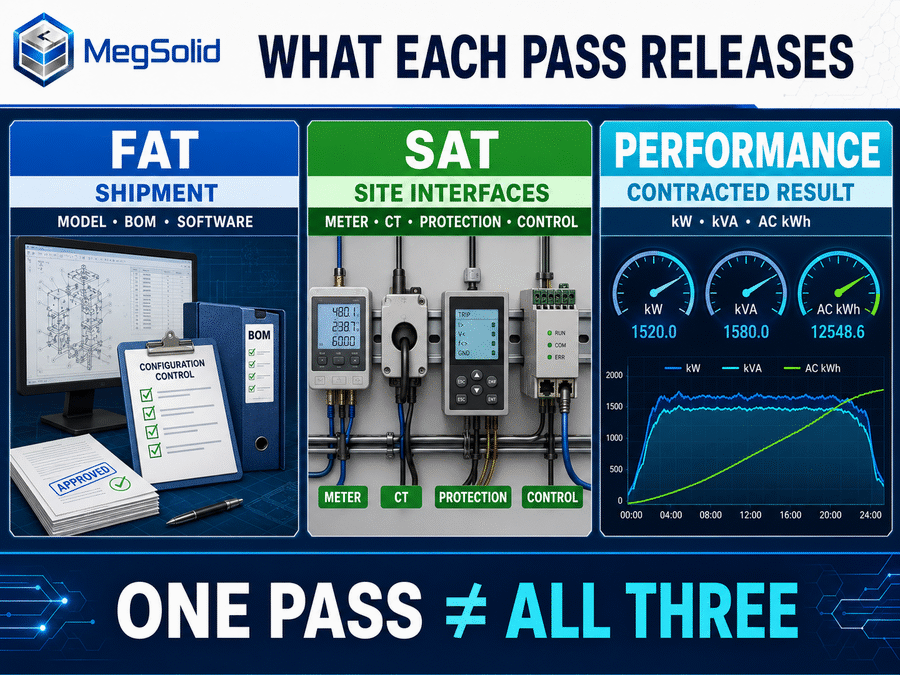
The contract decides whether a PASS also triggers shipment, payment, warranty commencement or final acceptance. The test report still has to state its technical boundary. PCC CT direction belongs in SAT, and an emergency trip belongs in functional SAT, even when the factory or capacity report says PASS.
From Factory Floor to Commercial Operation
Each handoff should leave one record for the next team:
FAT → shipment → installation → energization → SAT → performance acceptance → handover
The factory record travels with the identified model, serial numbers and software build. The site team adds the actual switchboard, transformer, CTs, meter, communications network and protection settings. Performance acceptance then uses those stable interfaces to measure the contracted result at the named AC boundary.
An EMS update after FAT gets its own revision entry and a repeat run of every function it changes. A replacement PCC meter adds its serial number, ratio, polarity, sign convention and time source to the SAT record. Factory results for unaffected functions remain tied to the configuration that was tested.
When the cabinet, site wiring and measured energy are merged into one PASS, the next reviewer cannot tell which part was released or which change occurred after the witness left.
Factory Release: What FAT Proves and What Remains Open
A FAT pass proves that the identified equipment matched the agreed factory scope when it was tested. A useful record starts with identity: model, serial numbers, battery configuration and bill of materials. It then names the approved hardware and software revisions used for the run, records how the available factory functions responded and links every open deviation to a retest or disposition.
A cell, module, rack, cabinet, transformer and protection panel do not share one test method. Grenergy described the Oasis de Atacama Phase I FAT across cell, module, frame and system levels. For a West African C&I project, Spenomatic reported witnessing a 10 MWh BESS FAT at the equipment factory. Each announcement names the tested level and witness scope. “The BESS passed” omits both.
For an integrated C&I cabinet, the factory can exercise internal battery-to-PCS limits, EMS commands, thermal-management response, alarms and communications available within the supplied boundary. The factory cannot reproduce the final CT orientation, site transformer behavior, switchboard fault duty or local network path merely by simulating their signals.
Model/BOM reconciliation, firmware control, witness evidence and retest rules belong in the controlled factory procedure. FAT clears an identified factory configuration. The installed plant waits for SAT.
Site Release: What SAT Proves at the PCC
SAT begins where factory simulation ends. The installed switchboard, transformer, CTs, meter, breaker wiring, protection relays and site network now determine what the controller sees and how the BESS responds.
At a 400 V factory switchboard, a commissioning engineer commands discharge and sees PCC import rise. The first check is the installed measurement chain. A reversed CT or inverted sign convention makes a correct cabinet response look wrong to the EMS, which then increases the wrong command. The fault belongs to SAT.
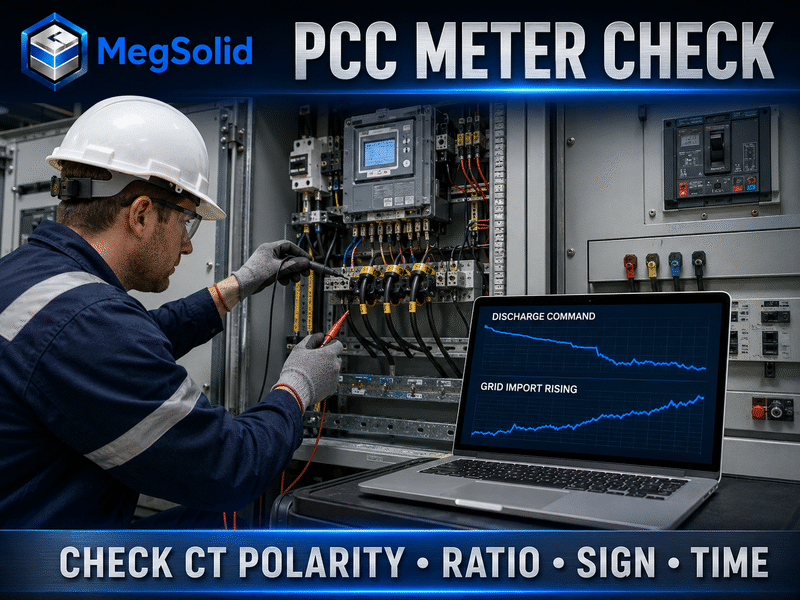
The site record needs to establish four interface groups:
- the controller is reading the correct phase, direction, ratio and timestamp from the approved PCC meter;
- breakers, protection and upstream interlocks produce the intended permission or trip;
- PLC, SCADA and EMS points carry the correct units, status and command ownership;
- a failed or stale control signal produces the approved alarm, fallback action and recovery.
الـ BESS zero-export control framework explains the meter-sign and safe-state questions behind that loop. For projects connecting at an existing board, the 400 V BESS switchboard guide separates cabinet scope from bus rating, fault duty, breaker selection and site protection.
The Cape Town Market project shows the site boundary at a larger scale. The City of Cape Town announced commissioning of a 3 MWh battery and demand-management system at Epping after more than 3,000 solar panels had been installed. Refrigeration, PV, standby generation, PLC logic and demand control only meet as an operating system at the project site. The public announcement confirms the commissioning stage; it does not publish a signed SAT procedure or prove a particular meter-boundary result.
CT polarity, meter scaling, phase mapping, loss-of-signal behavior and synchronized trends need their own controlled site procedure. SAT releases the installed interfaces, not the battery’s nameplate energy.
Performance Release: Nominal kWh vs Usable AC kWh
Performance acceptance starts after the installed control and measurement chain is stable. Its job is to prove the contracted duty, not to repeat every functional SAT step.
| Value | What it describes | Why it cannot replace the other values |
|---|---|---|
| Nominal battery kWh | The product’s defined battery energy | It does not state the usable SOC window, AC conversion losses or auxiliary treatment |
| Usable AC kWh | Energy delivered through the agreed AC measurement point under the stated conditions | It applies only to the named boundary, SOC endpoints, temperature and test method |
| Rated kW or kVA | The converter’s published power capability | Available project power still depends on temperature, altitude, power factor, P-Q duty and active system limits |
For an AC energy run, the result comes from time-aligned active power measured at the agreed point:
Measured usable AC energy = Σ(AC power at the agreed delivery point × sample interval)
The report names the start and end SOC, power setpoint, temperature basis, auxiliary treatment and meter location. A system can complete the run without an alarm and still miss the contracted energy because the SOC endpoints, measurement boundary or active power limit do not match the agreement. The BESS capacity-test failure analysis covers those failure mechanisms in detail.
Power, energy and power quality may require separate runs. A capacity test integrates energy over time; it does not establish harmonic performance, dynamic P-Q response or a closed-loop controller’s recovery behavior. The commercial BESS power-quality test covers the analyzer setup and operating boundary, while the بنية اتصالات أنظمة إدارة البطارية (BMS) وأنظمة إدارة الطاقة (EMS) separates local protection authority from supervisory commands.
IEC 62933-3-1:2025 addresses EES functions, design, operation, test items and performance assessment. The project’s signed procedure and controlled product data still define the actual pass value and measurement boundary.
Keep nominal and accepted energy in different contract fields. Nominal kWh belongs to the product definition; accepted usable AC kWh belongs to a measured test with a named boundary and operating condition.
How MegSolid Product Scope Fits the Three Gates
MegSolid’s integrated C&I architecture ties the battery, PCS, BMS, EMS, thermal management, communications and included protection functions to one controlled product configuration. The FAT record can therefore use one internal model/BOM/software baseline. Site cables, switchgear, transformer, protection coordination and PCC measurement remain project interfaces and are released through SAT and performance acceptance.
| MegSolid model | Published configuration | Factory boundary | Project and site boundary |
|---|---|---|---|
| ESSA0100B-0215 | 100 kW rated AC power, 215.04 kWh nominal energy, 400 V, LFP, intelligent air cooling, IP54, RS485 and TCP/IP | Internal BMS-to-PCS limits, EMS commands, fan control, alarms, emergency stop and communication mapping | Usable AC energy, project temperature and power factor, PCC control, site transfer behavior and local protection |
| Energon 261.24 | 125 kVA rated output, 261.24 kWh nominal energy, 400 V or 480 V, 314 Ah LFP, liquid cooling, IP54, RS485, LAN and 4G | BMS limits, EMS functions, pump and cooling control, coolant alarms, remote communications and safety interlocks | Project kW at the required power factor, usable AC energy, temperature or altitude derating, transformer and PCC behavior |
Keep Energon’s rating in kVA until the project power factor and P-Q duty are fixed. The controlled offer and acceptance schedule set the usable AC energy and project conditions; nominal kWh remains a product definition.
A 400 V Peak-Shaving Example Across All Three Gates
A factory shortlists one ESSA cabinet for an 80 kW peak-shaving duty. Its published rated-power screen is only the starting point; project temperature, power factor, available discharge power and any compressor starting duty remain open until the design and acceptance basis address them.
| المرحلة | What the project checks | تم تأييد القرار |
|---|---|---|
| FAT | Delivered model and serial number, approved software build, charge/discharge command response, internal alarms and thermal controls | Ship the identified configuration |
| SAT | 400 V phase sequence, breaker interlocks, PCC CT polarity, meter scaling, SCADA mapping and loss-of-meter response | Release the installed interfaces for the approved operating modes |
| Performance acceptance | Agreed peak-shaving kW and usable AC energy at the named meter boundary, with the test conditions recorded | Accept the measured duty |
| Handover | Accepted product identity, software baseline and signed records | Preserve the accepted configuration for operation and service |
The preliminary screen covers the steady 80 kW duty only. Compressor starts and staged backup loads bring starting current, starter type, permitted voltage dip and available overload capability into a separate calculation or test. Accepted usable AC kWh still comes from the performance run.
If the PCS trend and PCC meter disagree on direction or energy, the result stays open until the CT ratio, sign convention and timestamps are reconciled. A screenshot showing a charge or discharge command cannot close that mismatch.
Handover: One Model, One Software Version, One Signed Test Set
The final product record can stay simple: one delivered model and serial-number schedule + one approved BMS, PCS and EMS software-version schedule + one signed FAT, SAT and performance-test set.
Those three references let the operator match the cabinet in front of them to the configuration and results accepted at handover. Site EPC documents continue to cover cables, switchgear, protection coordination, civil works and local approvals. Six months later, the service team should not need to rebuild that connection from email threads or unlabeled screenshots.
الأسئلة الشائعة
1. What is the difference between BESS FAT and SAT?
FAT verifies the identified factory configuration before shipment. SAT verifies the installed plant interfaces after delivery and installation. The two records connect through the model, serial numbers and approved software revision, but they do not share the same physical boundary.
2. Can a BESS be accepted on FAT alone?
No. FAT can support shipment release, but it cannot verify final CT orientation, meter scaling, switchboard wiring, protection coordination or site communication paths. Contracted power or usable AC energy also needs its named performance result.
3. What does each BESS acceptance PASS release?
A FAT PASS releases the tested configuration for shipment. A SAT PASS releases the installed functional interfaces. A performance PASS accepts only the measured kW, kVA, kWh or power-quality duty covered by that procedure. Contract language determines any payment or warranty consequence.
4. Does a passed FAT prove usable battery energy?
Not by itself. A usable-energy result needs an agreed SOC window, AC measurement point, power setpoint, temperature basis, auxiliary treatment and calculation method. A functional FAT pass proves the tested functions, not automatically the site-delivered AC kWh.
5. Where should usable kWh be measured, at the PCC or PCS?
Either boundary can be used if the contract names it. PCS-terminal measurement describes converter output; PCC measurement includes the agreed equipment and losses between the PCS and the connection point. The procedure and final comparison must use the same boundary.
6. Why are nominal kWh and usable AC kWh different?
Nominal kWh comes from the battery product definition. Usable AC kWh comes from a measured delivery boundary and includes the permitted SOC window, conversion losses, auxiliary consumption, temperature basis and active BMS limits.
7. When should BESS performance acceptance take place?
Run it after safe energization and functional SAT, once defects that could affect the measurement have been corrected. Power, energy and power-quality checks may occur in separate witnessed runs.
8. Should the BESS transformer have a separate FAT?
Yes, when the project supply and contract require it. Transformer ratio, vector group, impedance, losses, insulation and accessories follow a transformer procedure. Its report should be cross-referenced from the project-wide acceptance index.
9. Who signs FAT, SAT and performance acceptance?
The contract names the authority for each release. A factory witness may sign FAT, the site commissioning or electrical lead may sign functional SAT, and the owner or independent engineer may retain final performance acceptance. One signature should not silently replace the others.
10. What happens if firmware changes after FAT?
Record the reason, new revision and affected functions. Repeat the tests influenced by that change and link the retest to the original result. Unaffected factory checks can remain valid for the configuration they covered.
11. Is BESS commissioning the same as SAT?
No. Commissioning is the wider process covering installation checks, energization, start-up, functional tests, performance runs, training and handover. SAT is one formal acceptance stage within that programme.
12. Can SAT pass while the BESS capacity test fails?
Yes. The installed metering, protection and controls can work correctly while the measured usable AC energy misses the contractual result. That is why functional SAT and performance acceptance remain separate records.
13. What should the owner receive at BESS handover?
At minimum, the owner needs the delivered model and serial-number schedule, the approved software-version schedule and the signed FAT, SAT and performance-test set. Site records add the as-built electrical and protection documents required by the project.
