
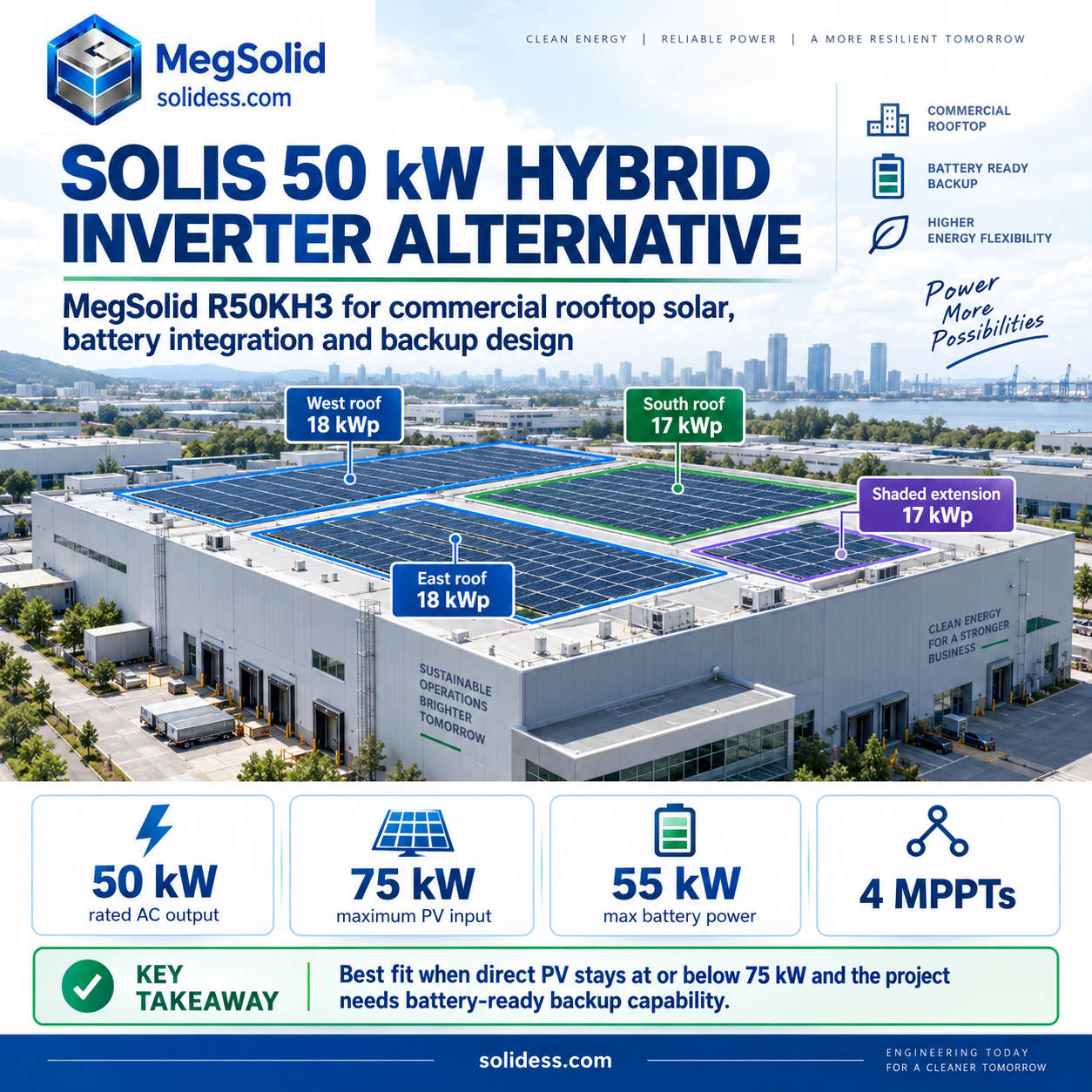
Commercial sites needing a Solis 50kW hybrid inverter alternative can use the MegSolid R50KH3 for 50 kW AC output with up to 75 kW of PV. Four MPPTs accommodate different roof sections, while 55 kW maximum battery power and unbalanced-load capability support the storage and backup design.
- New 50 kW DC-coupled solar-storage project: R50KH3 combines PV, battery and backup control in one IP65 hybrid inverter.
- Uneven three-phase or critical loads: R50KH3 provides 100% unbalanced-load output and backup switching below 10 ms.
- Complete 50 kW / 100 kWh-class BESS: the ESSA0050B-0100 adds 100.352 kWh of storage, an isolation transformer, an outdoor cabinet and fire suppression.
R50KH3 Is the MegSolid Replacement for a 50 kW Hybrid Inverter
R50KH3 combines PV conversion, high-voltage battery charging and backup supply for the same 50 kW commercial application as the Solis S6-EH3P50K-H. The PV array, battery and AC feeder must stay within the MegSolid ratings below.
| متطلبات الموقع | R50KH3 published value | Benefit to the project |
|---|---|---|
| Commercial AC output | 50 kW rated | Matches the target inverter class without moving to a larger PCS |
| Rooftop PV input | 75 kW maximum | Supports PV input equal to 150% of rated AC power |
| Battery charge/discharge | 55 kW maximum | Provides a 55 kW maximum battery-side rating; conversion losses and operating limits still determine AC output |
| Roof segmentation | 4 MPPTs | Separates four orientations, tilts or shading conditions |
| High-voltage battery | 150–800 فولت | Creates a defined battery-voltage design window |
| Three-phase loads | 100% unbalanced output | Supports uneven phase demand within the approved phase limits |
| Critical-load transfer | Below 10 ms | Reduces the interruption seen by a correctly designed backup board |
| Outdoor installation | IP65 | Protects the inverter enclosure against dust and water ingress at the stated rating |
For sites approaching 50 كيلوواط, ، الـ 30–50 kW MegSolid inverter comparison compares the R50 with the smaller models in the same range.
Four MPPTs for a 70 kWp Commercial Roof
Commercial roofs lose design flexibility when strings with different orientations or shading are forced onto the same tracker. R50KH3 accepts up to 75 kW of PV and divides the array across four MPPT channels, each published with 40 A maximum input current.
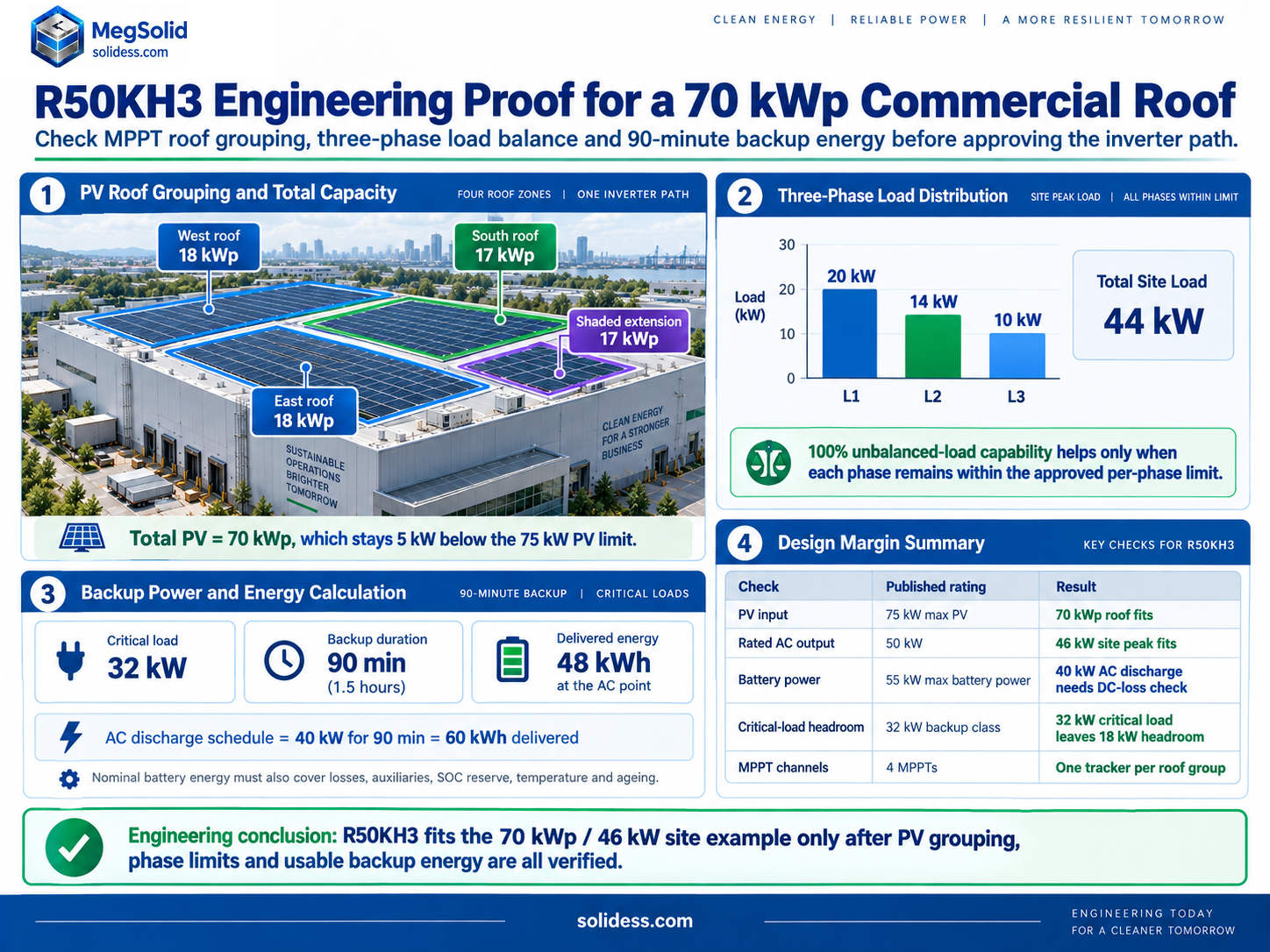
On a 70 kWp factory roof, separate trackers can serve 18 kWp facing east, 18 kWp west, 17 kWp south and 17 kWp on a partially shaded extension. The array stays 5 kW below the R50KH3 published PV input ceiling. Each group has independent maximum-power tracking, subject to its string-voltage and current limits.
Solis also publishes four MPPTs. For this 70 kWp roof, R50KH3 adds a published 55 kW battery power limit and a 150–800 V high-voltage battery window to its four roof trackers. The R50 four-MPPT roof design connects these limits to practical string allocation.
R50KH3 Supports Uneven Three-Phase Loads
Factory and commercial backup boards rarely divide power equally across L1, L2 and L3. Refrigeration, lighting, offices and single-phase process equipment can leave one phase heavily loaded even when total demand remains below 50 kW.
R50KH3 publishes 100% unbalanced-load output. For a 44 kW interval with 20 kW on L1, 14 kW on L2 and 10 kW on L3, the highest-to-lowest phase spread is 10 kW. The 20 kW phase must fall within the approved per-phase output capability, even though total demand is below 50 kW.
The unbalanced-output capability supports this load distribution only with each phase inside its operating limit. The signed design must confirm allowed phase current, neutral rating, cable sizing and protective-device settings.
The 55 kW Battery Port Preserves Power for Charging and Backup
Supplying 50 kW AC from the battery requires additional DC power for conversion losses. R50KH3 publishes 55 kW maximum battery charge and discharge power alongside 50 kW rated AC output. The difference between those ratings does not guarantee 50 kW AC at every battery voltage: conversion losses, current limits and operating conditions still apply.
The 150–800 V battery window supports MegSolid hybrid solid-state and standard lithium-ion paths. Compatibility also depends on charge and discharge current, BMS protocol and firmware, along with the contactor sequence and fault handling. The MegSolid battery-technology comparison compares the battery options for the complete system.
Sub-10 ms Transfer for the Critical-Load Board
R50KH3’s published backup switching time is below 10 ms, giving the EPC a transfer-time specification for the separated critical-load board. The design must account for load ride-through, isolation, earthing, protection and battery reserve.
Supplying 32 kW for 90 minutes requires 48 kWh before conversion losses, auxiliary demand, reserve SOC, temperature effects and ageing are added. The inverter covers the 32 kW power requirement with 18 kW of rated-AC headroom, while the matched battery must cover the delivered-energy requirement.
The integrated transfer function must work with the connected equipment’s interruption tolerance. Motor starting, transformer inrush and simultaneous loads also need to stay within the inverter’s backup capability.
ESSA0050B-0100 Is the MegSolid Answer When the Project Needs a Complete BESS
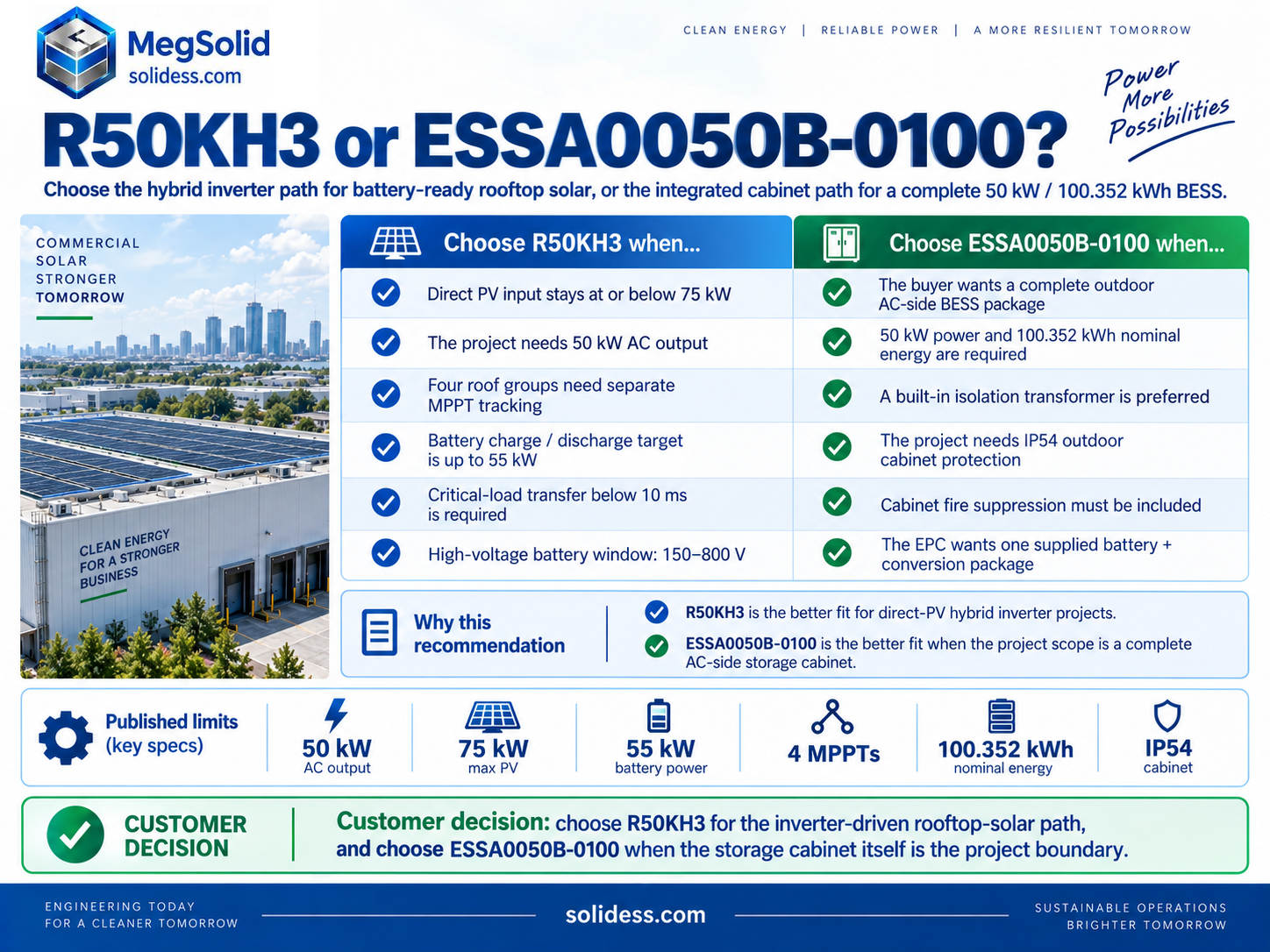
For a complete outdoor 50 kW storage system, MegSolid recommends ESSA0050B-0100. The cabinet includes the battery, AC conversion, isolation transformer and fire suppression in one equipment package.
| ESSA0050B-0100 item | القيمة المنشورة | Customer result |
|---|---|---|
| القدرة الكهربائية المقننة التي تعمل بالتيار المتردد | 50 كيلوواط | Matches the same commercial power class as the inverter search |
| الطاقة الاسمية | 100.352 كيلوواط/ساعة | Provides a two-hour-class nameplate ratio at rated power |
| جهد البطارية | 358.4 V nominal; 319.2–397.6 V | Fixes the internal battery operating range inside the supplied cabinet |
| واجهة التيار المتردد | 400 V; 320–460 V; 3W+N+PE | Fits common low-voltage commercial distribution designs |
| جودة الطاقة | On-grid THDi below 3% | Establishes a measurable current-distortion boundary |
| Isolation | محول عزل مدمج | Removes a separately sourced transformer from the BESS equipment package |
| Environmental protection | IP54 | Provides a defined outdoor-cabinet ingress rating |
| Fire suppression | Aerosol or NOVEC 1230 | Includes cabinet-level fire suppression in the supplied system boundary |
| Mechanical boundary | 1,770 × 1,510 × 2,270 mm; 2,400 kg | Gives the EPC fixed foundation, access and lifting inputs |
MegSolid supplies the cabinet’s internal battery, conversion and isolation interfaces as one package. PV connection still needs a site-specific design because ESSA0050B-0100 is an AC-side storage cabinet, separate from the R50KH3 hybrid inverter.
الـ 30 kW / 50 kWh cabinet comparison shows why a smaller cabinet fails when the site needs the full 50 kW power class or a longer energy window.
الـ 50 kW / 100 kWh BESS specification guide covers delivered-energy and acceptance boundaries. Use this to specify the battery and acceptance tests alongside the selected equipment.
The 70 kWp Factory Gains Measurable R50KH3 Design Margin
For a factory with four roof zones totalling 70 kWp, a 46 kW site peak and a 32 kW critical-load board, evaluate R50KH3 against a 40 kW AC discharge schedule lasting 90 minutes.
| متطلبات الموقع | R50KH3 rating | Design check |
|---|---|---|
| 70 kWp PV array | 75 kW maximum PV input | 5 kW remains below the published PV ceiling |
| 46 kW site peak | 50 kW rated AC output | 4 kW remains below the rated output boundary |
| 40 kW AC discharge command | 55 kW maximum battery power | Allow for DC-to-AC losses before calculating battery-side headroom |
| Four roof zones | 4 MPPTs | Every roof group receives a separate tracker |
| Uneven three-phase loads | 100% unbalanced output | Confirm the load on each phase against its approved output limit |
| 32 kW critical load | 50 kW rated backup output class | 18 kW remains between the critical load and rated inverter power |
الـ 40 kW AC discharge lasting 90 minutes requires 60 kWh at the AC delivery point. Size nominal battery energy to cover this duty after conversion losses, auxiliaries, SOC reserve, temperature and ageing allowances. The battery must also sustain the corresponding DC power throughout its operating voltage range.
R50KH3 meets the stated PV and total AC power requirements; the final configuration also depends on current limits, individual phase loads and battery compatibility.
ESSA0050B-0100 supplies the same project with an AC-side storage package rated at 50 kW and 100.352 kWh nominal energy. Its built-in transformer and fire suppression reduce the equipment the buyer must procure separately. Meeting the 60 kWh duty requires sufficient usable AC energy at the agreed SOC, temperature and life condition.
Model-Level Safety Evidence
Hybrid inverter and connected battery
IEC 62109-1 covers general hazards in photovoltaic power-conversion equipment, including electric shock, energy, fire and mechanical hazards. IEC 62109-2 adds inverter-specific requirements for grid-interactive, stand-alone and multiple-mode equipment.
The R50KH3 approval file must connect the exact ordered model, voltage, operating mode and configuration to the evidence required in the destination market. Inverter certification does not automatically cover a third-party battery, transfer device or assembled cabinet.
Complete cabinet evidence
The complete BESS requires system-level evidence. IEC 62933-5-2:2025 addresses safety requirements for grid-integrated electrochemical energy-storage systems and the hazards created by subsystem interaction. For ESSA0050B-0100, that evidence needs to cover the supplied cabinet and the interaction of its subsystems.
Check the test-report scope against the ordered model, standard edition and supplied configuration before relying on a certification claim.
R50KH3 and Solis: Where the Ratings Differ
The Solis S6-EH3P50K-H and MegSolid R50KH3 both occupy the 50 kW hybrid-inverter class. Compare the exact models against the required PV input, battery interface and backup duty.
| حالة المشروع | MegSolid recommendation | Reason |
|---|---|---|
| New PV array at or below 75 kW | R50KH3 | 50 kW AC, 75 kW PV, four MPPTs and 55 kW battery power form one matched platform |
| Uneven commercial phases | R50KH3 | 100% unbalanced-load output addresses the measured phase condition |
| Separated critical-load board | R50KH3 | Backup switching is published below 10 ms |
| Complete outdoor 50 kW / 100 kWh-class system | ESSA0050B-0100 | Battery, conversion, isolation, cabinet and fire suppression are included |
| Direct PV input above 75 kW | Different architecture required | The R50KH3 PV ceiling must not be exceeded |
Solis publishes four MPPTs, PV input up to 100 kW, two battery connections, 140 A maximum battery charging current, 160% off-grid overload for two seconds and transfer below 10 ms on its [official S6-EH3P product page](https://www.solisinverters.com/de/energy_storage_inverters16/S6-EH3P%2829%2C9-50%29K-H_de.html). Solis offers a higher published PV ceiling in this comparison. For arrays within 75 kW, R50KH3 remains the MegSolid recommendation where its battery interface, phase limits and backup functions meet the project requirements.
R50KH3 is not recommended for 76–100 kW of direct PV input. Existing-PV projects can move to a separate AC-coupled PCS and battery architecture without discarding a serviceable solar inverter.
MegSolid Extends the Project Beyond the 50 kW Class
Above the R50KH3’s 50 kW inverter duty or beyond the battery’s usable discharge window, the project moves to a larger MegSolid system. Multiple small inverters also require the AC infrastructure to support their combined output.
- ESSA0100B-0215: 100 kW / 215.04 kWh for a larger cabinet-level duty.
- Energon 261: 261.24 kWh / 125 kVA liquid-cooled system for a longer energy window within its kVA limit.
- MEGA TS PCS: separate AC-coupled conversion when existing PV remains in service.
الـ 215.04 kWh and 261.24 kWh comparison establishes the next capacity step. The MegSolid PCS architecture guide covers designs using a separate converter.
الأسئلة الشائعة
What is the MegSolid alternative to the Solis S6-EH3P50K-H?
MegSolid R50KH3 is the recommended direct alternative for a 50 kW commercial hybrid-inverter project. It provides 50 kW AC output, up to 75 kW PV input, four MPPTs, 55 kW maximum battery power and a 150–800 V battery window.
Why is R50KH3 recommended for a 50 kW commercial site?
Its published limits match the common design boundary: 50 kW AC, 75 kW PV, 55 kW battery power, four MPPTs, 100% unbalanced output and backup switching below 10 ms.
Can R50KH3 connect a 100 kWp PV array?
No. R50KH3 has a 75 kW maximum PV input. Direct PV input above that limit requires a different MegSolid architecture or a larger approved system.
How many roof orientations can R50KH3 control?
Four MPPTs can separate four electrically different roof groups when string voltage and current remain within the signed design limits.
What battery power does R50KH3 provide?
R50KH3 publishes 55 kW maximum battery charge and discharge power. The matched battery must also satisfy the voltage range, current, BMS protocol and firmware requirements.
Does R50KH3 support uneven three-phase loads?
Yes. R50KH3 publishes 100% unbalanced-load output, with final phase current, neutral and protection limits confirmed in the project design.
Does below-10 ms switching make a whole factory interruption-free?
No. Separated critical-load boards, isolation, coordinated protection, motor-start analysis and sufficient battery energy are still required.
What does the 70 kWp factory example prove?
The 70 kWp array and 46 kW site peak fit the stated PV and total AC ratings. A 40 kW AC discharge for 90 minutes requires 60 kWh delivered; confirm battery-side power after losses, usable energy and phase limits before approval.
When is ESSA0050B-0100 the recommended product?
ESSA0050B-0100 is the recommended MegSolid route when the project needs a complete outdoor 50 kW / 100.352 kWh BESS with an isolation transformer, IP54 cabinet and fire suppression.
Which standards apply to this purchase?
IEC 62109-1 and IEC 62109-2 address PV power-converter and inverter safety. IEC 62933-5-2:2025 addresses safety for grid-integrated electrochemical energy-storage systems at system level.
What is the main R50KH3 specification in one sentence?
R50KH3 is a 50 kW three-phase hybrid inverter with 75 kW PV input, four MPPTs, 55 kW battery power, 100% unbalanced output, 150–800 V battery compatibility and sub-10 ms backup switching.
What is the main ESSA0050B-0100 specification in one sentence?
ESSA0050B-0100 is a 50 kW / 100.352 kWh outdoor BESS with a 358.4 V nominal battery system, 400 V AC interface, built-in isolation transformer, IP54 protection and cabinet fire suppression.
What is the direct purchasing difference between Solis and R50KH3?
R50KH3 is the MegSolid recommendation when the site stays within 75 kW PV and needs its 55 kW battery, four-MPPT, unbalanced-load and backup functions; PV input above 75 kW falls outside its published boundary.