 Aller au contenu
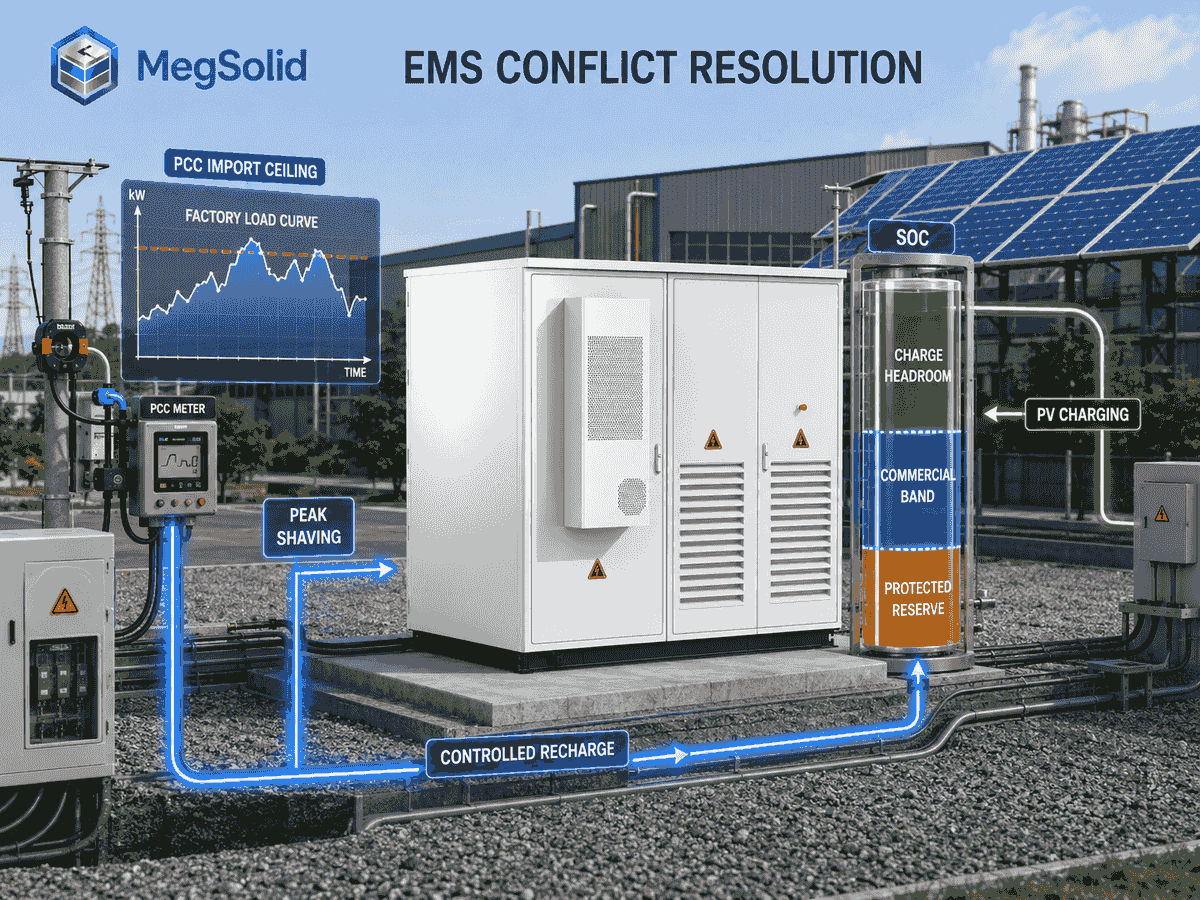
Most BESS failures are obvious: a breaker opens, an alarm appears or the PCS stops. An EMS priority failure is quieter. The battery keeps running. Peak shaving can still spend energy reserved for an outage. PV charging can still fight a demand limit. Post-event recharge can still create a second peak at the PCC.
The result depends less on how many modes sit on the HMI than on which mode is allowed to act first. MegSolid ESSA0100B-0215 combines a 100 kW PCS, 215.04 kWh nominal battery energy and integrated EMS in one outdoor C&I platform. Those functions help only after the project writes one hierarchy for safety, grid obligations, reserve, commercial dispatch and recovery.

Why several useful BESS functions can produce the wrong result
Take a factory that wants three outcomes from one battery: keep energy for a controlled shutdown, cut the afternoon demand peak, and absorb surplus PV before an evening shift.
At midday, PV charging is useful. When factory demand rises, charging should drop before peak-shaving discharge starts. If the grid fails later, the protected reserve should still be there. After the event, recharge should restore readiness without pushing grid import above the demand target.
Each command is reasonable on its own. The conflict appears when they compete for the same PCS power and battery energy. Independent mode switches do not resolve that. The EMS needs one control order that confines each commercial objective to the envelope left by higher-priority requirements.
The five-level EMS hierarchy that keeps the objectives aligned
| Priority | Control authority | Effect on lower-priority modes |
|---|---|---|
| 1 | BMS, PCS, temperature, alarm and emergency limits | Unsafe or unavailable commands are blocked |
| 2 | Breaker state, anti-islanding and contractual PCC limits | Dispatch stays inside the permitted electrical state |
| 3 | Protected-load reserve | Commercial discharge stops at the approved reserve floor |
| 4 | Peak shaving, tariff dispatch and PV self-consumption | Only the remaining power and SOC band are used |
| 5 | Controlled recharge | Recovery uses available charge headroom and PCC margin |
This order separates control authority from commercial preference. The owner can still rank demand reduction, tariff shifting or PV capture inside Priority 4. None of those objectives can override BMS limits, an export constraint or protected energy.
OpenEMS documents separate controllers for minimum battery level, peak shaving and PV self-consumption, then uses a scheduler for execution order. One higher-priority controller narrows the setpoints available to the next. See the OpenEMS Edge architecture et scheduler and controller concepts.
Where measurements, permissions and commands originate: Architecture de communication entre le BMS et l'EMS. The priority hierarchy then decides which valid request gets the available battery power.
Backup reserve starts with protected-load energy
A fixed 20%, 30% or 40% SOC floor has no engineering meaning without a protected-load profile. The same SOC percentage can support very different durations as load, temperature, auxiliary demand, battery condition and the usable SOC window change.
Reserve starts with the AC energy required by the selected circuits. Safe-stop loads, restart loads and auxiliary consumption belong in the same calculation when they form part of the resilience objective.
Protected energy fraction = required protected-load AC energy ÷ warranted usable AC energy
The result is an energy allocation. It becomes an EMS setpoint only after applying that model’s SOC definition, operating window, measurement accuracy and state-of-health boundary.
Why nominal battery energy is not guaranteed AC delivery: Procédure d'essai de capacité des systèmes de stockage d'énergie par batterie (BESS) à usage commercial. DOD, throughput and end-of-life: C&I BESS warranty boundary.
Dynamic reserve avoids wasting the commercial working band
A permanent high reserve protects resilience and can leave too little energy for daily savings. A permanent low reserve releases more commercial capacity and can leave production exposed in a known risk period.
A dynamic reserve changes with a defined event: a utility outage notice, a high-value production shift, severe weather, a weak-grid period or planned generator maintenance. Each change needs an activation time, expiry condition, recovery target and audit record. Forecasts can move the schedule. They must not override BMS, PCS or PCC constraints.
NREL’s Microgrids for Energy Resilience separates grid-connected economic operation from resilience operation. The EMS control narrative should keep that same split. A daily tariff schedule should not decide whether backup energy survives.
Peak shaving succeeds or fails at the PCC meter
Peak shaving is a feedback-control problem measured at the contractual PCC, where grid import and demand compliance are judged.
Using positive values for grid import and BESS discharge, an initial feed-forward request is:
Requested BESS discharge power = max(0, net site demand before BESS − PCC import target)
Measured PCC power then closes the loop. The EMS must account for meter latency, ramp rate, deadband, load variation and the active demand-measurement window. The final command stays inside available PCS power, BMS discharge permission, temperature limits and the protected SOC floor.
When reserve is the active limitation, the HMI should show that reason. A generic “System normal” state hides the difference between healthy equipment and an unmet PCC target.
Zero export uses the same PCC measurement and a different obligation. Export envelope first, commercial peak target second: Spécification de contrôle « zéro exportation » BESS.
PV charging and grid recharge need different envelopes
PV charging uses generation that would otherwise be exported or curtailed. Grid recharge uses available import capacity to restore SOC. One unrestricted “charge” mode hides two different effects at the PCC.
The instantaneous PV charging command should contain only power quantities:
Permitted battery charging power = min(PV-surplus power, PCS charge-power limit, BMS charge-power limit, PCC charge allowance, SOC-dependent charge-power limit)
SOC headroom is an energy quantity. It sets how long the charging command can continue. Convert it over a defined control horizon before it enters a kW limit.
Grid recharge follows the remaining import margin:
Allowed grid-recharge power = max(0, PCC import ceiling − site import before BESS charging)
This limit stops reserve recovery from recreating the peak the battery just cut. A scheduled low-load window or available PV can restore SOC with less import stress. BMS charge permission, PCS limits and active alarms still set the final command. Commercial context for that recovery: C&I peak-shaving ROI page.
What the EMS should do when operating modes collide
| Simultaneous condition | Winning control | Observable result |
|---|---|---|
| Peak shaving reaches the reserve floor | Protected-load reserve | Commercial discharge stops and the limitation is logged |
| Grid recharge reaches the import ceiling | PCC import limit | Recharge is reduced to the remaining margin |
| Battery becomes full while export is restricted | Approved PV or load-control fallback | The alternative actuator responds |
| Zero-export and peak shaving request different setpoints | PCC export constraint | The commercial request is clipped |
| Grid status or PCC data becomes invalid | Electrical-state or fail-safe logic | Grid-connected dispatch exits or enters the approved fallback |
Generator operation adds another constraint. Reverse-power protection and minimum generator loading sit above commercial battery dispatch. Generator envelope and control boundary: BESS and diesel-generator control page.
Stale data also needs a defined response. Holding the last valid setpoint can be unsafe because load or breaker state may have changed. A timeout, alarm, local fallback and controlled recovery sequence make the failure visible and testable.
Why the ESSA0100B-0215 platform fits this control problem
Cabinet architecture with battery, PCS, isolation transformer and EMS in one boundary: MegSolid ESSA outdoor C&I platform. Priority control crosses every one of those interfaces.
Integrated EMS reduces control handoffs
ESSA publishes access to grid, PV, storage, load and generator information. One EMS can evaluate those sources in a single operating cycle. Project-specific meter mapping and actuator logic remain necessary. The control foundation is already part of the platform.
Rated power and nominal energy serve different decisions
ESSA0100B-0215 is rated at 100 kW AC with 215.04 kWh nominal battery energy. The 100 kW rating is the cabinet’s dispatch power class. The 215.04 kWh figure is the starting energy value for reserve and duration analysis. Keep those roles separate. A nominal two-hour ratio is not a backup guarantee.
Built-in electrical and outdoor integration simplify the equipment boundary
The published platform includes a built-in isolation transformer, IP54 enclosure and intelligent air cooling. That gives a defined outdoor cabinet and electrical interface for C&I sites. External switchgear, ATS design, PCC metering, PV controls and generator protection stay in project engineering. They are not implied by an “all-in-one” label.
Standard communications support commissioning evidence
RS485 and TCP/IP let the cabinet exchange measurements, limits, commands and alarms with project meters and SCADA. Their value is the trend from EMS target to BESS response to PCC result.
Wider power, duration and site-interface decision: Page de sélection ESSA0100B-0215. Other classes: MegSolid C&I energy-storage portfolio.
Commissioning should prove priority during overlapping modes
Separate tests prove that backup, peak shaving and PV charging can run. Controlled overlap tests prove which function receives priority.
A complete FAT and SAT sequence should include:
- discharge to the commercial SOC floor while a PCC peak remains active
- a controlled load increase below and above the peak target
- PV surplus with charge headroom and again at the battery charge limit
- an approved simulated or witnessed grid-loss transition
- grid restoration with SOC below the recovery target
- stale PCC data, communications loss and controller restart
- a schedule boundary and time-synchronization failure for dynamic reserve
The synchronized trend should connect PCC power, site load, PV, BESS AC power, SOC, available charge and discharge limits, EMS target, issued command, actual response, breaker state, mode, alarms and data quality. Without that chain, a pass result can show the final power value without proving the hierarchy produced it.
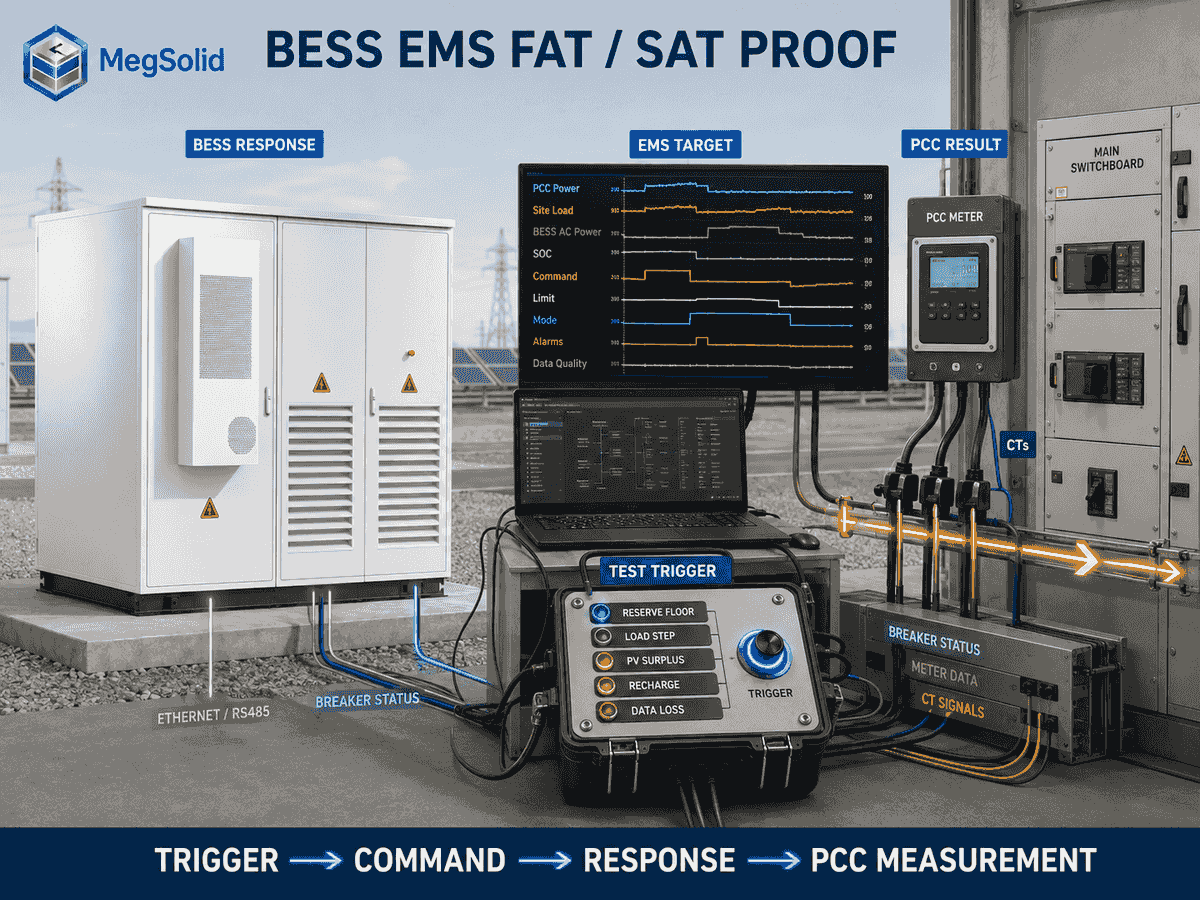
Minimum trend channels: BESS SCADA point-list article. Factory boundary: Guide des essais de réception en usine BESS. AC performance: BESS power-quality acceptance.
A strong EMS hierarchy increases useful BESS operating value
Backup reserve, peak shaving and PV charging can share one battery when power, energy and control authority are allocated in the open.
The hierarchy works when commercial dispatch uses the battery hard inside its approved band, mandatory PCC limits stay protected, reserve survives until a valid release event, and recharge restores readiness without a rebound peak. The operator can see which limit is active. The acceptance record can show why the BESS responded as it did.
For ESSA0100B-0215 projects that need a model-specific EMS priority matrix, contact MegSolid for a technical configuration review.
FAQ
Which function should have the highest priority in a C&I BESS EMS?
Safety, BMS and PCS limits come first. Electrical topology and PCC obligations follow. The EMS then protects the specified backup reserve before using the remaining battery envelope for peak shaving, PV charging or tariff shifting.
How should a factory set BESS reserve SOC?
Calculate the protected-load AC energy, safe-stop or restart energy, auxiliaries and contingency. Compare that requirement with warranted usable AC energy under the specified operating conditions, then convert it into the model-specific SOC threshold.
Is one fixed reserve SOC suitable for every operating day?
A fixed value fits sites with a stable resilience requirement. Sites with scheduled outages, production shifts or changing weather risk can use a time-varying reserve with signed triggers, expiry rules and change logs.
What happens when peak shaving reaches the backup reserve?
Peak-shaving discharge stops at the configured commercial floor. The EMS keeps the protected reserve available and records reserve limitation as the reason the PCC target can no longer be maintained.
Should PV charge the battery before serving the load?
The control narrative should measure the full site boundary and apply the contractual power-flow objective. Battery charging uses available PV after respecting site load, PCC limits, BMS and PCS limits, SOC headroom and the planned later discharge window.
How does an EMS prevent a rebound peak?
It limits grid recharge to the remaining margin below the contractual PCC ceiling. The controller can also schedule recharge for lower-load periods or use PV while recording SOC recovery and site demand.
La politique de contrôle zéro des exportations prime-t-elle sur l'écrêtement des pics de consommation ?
The contractual PCC export constraint defines the permitted operating envelope. Peak shaving operates inside that envelope and uses the remaining battery power and energy after mandatory limits are applied.
What should the BESS do when EMS communication fails?
The project must define a timeout, alarm, local fallback and recovery sequence. The controller should reject stale measurements and avoid maintaining a command that no longer matches the current load or topology.
Can ESSA0100B-0215 perform backup, peak shaving and PV charging?
ESSA0100B-0215 provides a 100 kW / 215.04 kWh platform with integrated EMS and published grid, PV, battery, load and generator interfaces. The ordered project still needs a priority matrix, usable-energy calculation, external switching design and acceptance tests.
Which logs prove that EMS priority works?
Record synchronized PCC power, site load, PV power, BESS AC power, SOC, available limits, EMS target, command, response, breaker state, operating mode, alarm, data quality and user changes.
Can one commercial BESS provide backup and reduce demand charges?
Yes, when its kW, usable energy and reserve policy support both obligations. The EMS protects the specified reserve and gives peak shaving access only to the remaining commercial working band.
What should an EPC include in a BESS EMS priority specification?
Include the mode list, priority matrix, SOC bands, PCC targets, trigger sources, command limits, failure responses, user permissions, trend channels and FAT/SAT pass criteria.
What information gives a supplier enough data to design EMS dispatch?
Provide interval load and PV data, critical-load duration, tariff and demand rules, import/export limits, generator and ATS states, SLD, meter location, required modes and handover tests.
Qu'est-ce que la logique de priorité du système EMS de BESS ?
La logique de priorité du système EMS de BESS est la hiérarchie pondérée qui répartit la puissance et l'énergie disponibles de la batterie entre les limites de sécurité, les contraintes PCC, la réserve de secours, l'écrêtement des pics, la recharge photovoltaïque, la gestion tarifaire et la recharge.
Comment calcule-t-on la réserve de secours du BESS ?
Calculez l'énergie CA requise par les charges protégées pendant la durée spécifiée, ajoutez-y l'énergie convenue pour l'arrêt de sécurité, le redémarrage, les fonctions auxiliaires et les imprévus, puis comparez ce résultat à l'énergie CA utilisable garantie et à la définition du SOC spécifique au modèle.
De quoi MegSolid a-t-il besoin pour bénéficier d'un examen prioritaire du système de gestion de l'énergie (EMS) pour un système de stockage d'énergie par batterie (BESS) ?
MegSolid a besoin de la courbe de charge, du tableau des charges critiques, de la durée de l'alimentation de secours, des plages tarifaires et de demande, du profil photovoltaïque, des contraintes liées au point de raccordement au réseau (PCC), des informations relatives au générateur ou au commutateur ATS, du SLD, de l'étendue des communications et des justificatifs requis pour les tests FAT/SAT.
