 Yiya kumxholo
Protected load within 100 kW, and the reserve still inside the tested usable-energy window: MegSolid ESSA0100B-0215 stays on the shortlist. Duty exceeds the 100 kW ESSA screen, or the energy window looks tight: review the 261.24 kWh / 125 kVA Energon cabinet and confirm usable kW at the required power factor. Lock neither cabinet until the staged load, generator/ATS sequence, usable AC kWh and recovery deadline are available.
Those four inputs become a preliminary SOC band and a product route. They also catch a quiet site failure: the HMI reads 45% SOC, peak shaving has already spent the protected energy, and the line never reaches a safe stop.
If protected power, reserve energy or starting duty sits outside the cabinet’s validated envelope, raising the SOC percentage will not close it. You need more kW, more kWh, or another unit.
Start with the outage job, not a round SOC number
“Keep 30% in reserve” is a keyboard setting. It does not describe the outage.
A food plant may keep refrigeration controls and circulation pumps, finish the batch already on the line, then drop to safety and monitoring. A warehouse holding fire controls, access systems and emergency lighting has another curve. Copying 30% across both sites is guesswork.
Write the outage in stages:
- circuits that stay live the moment the grid drops
- loads that stop after a controlled shutdown
- whether a generator must start and synchronize
- whether the battery must carry a later restart
- how much BESS auxiliary load sits inside the agreed measurement boundary
Auxiliaries trip people up. If contracted usable energy is already net of cabinet auxiliaries, adding them again double-counts the same kWh. Pick one energy boundary on the single-line and keep the capacity test on that boundary.
A worked reserve calculation for a food-processing site
Illustrative sequence only:
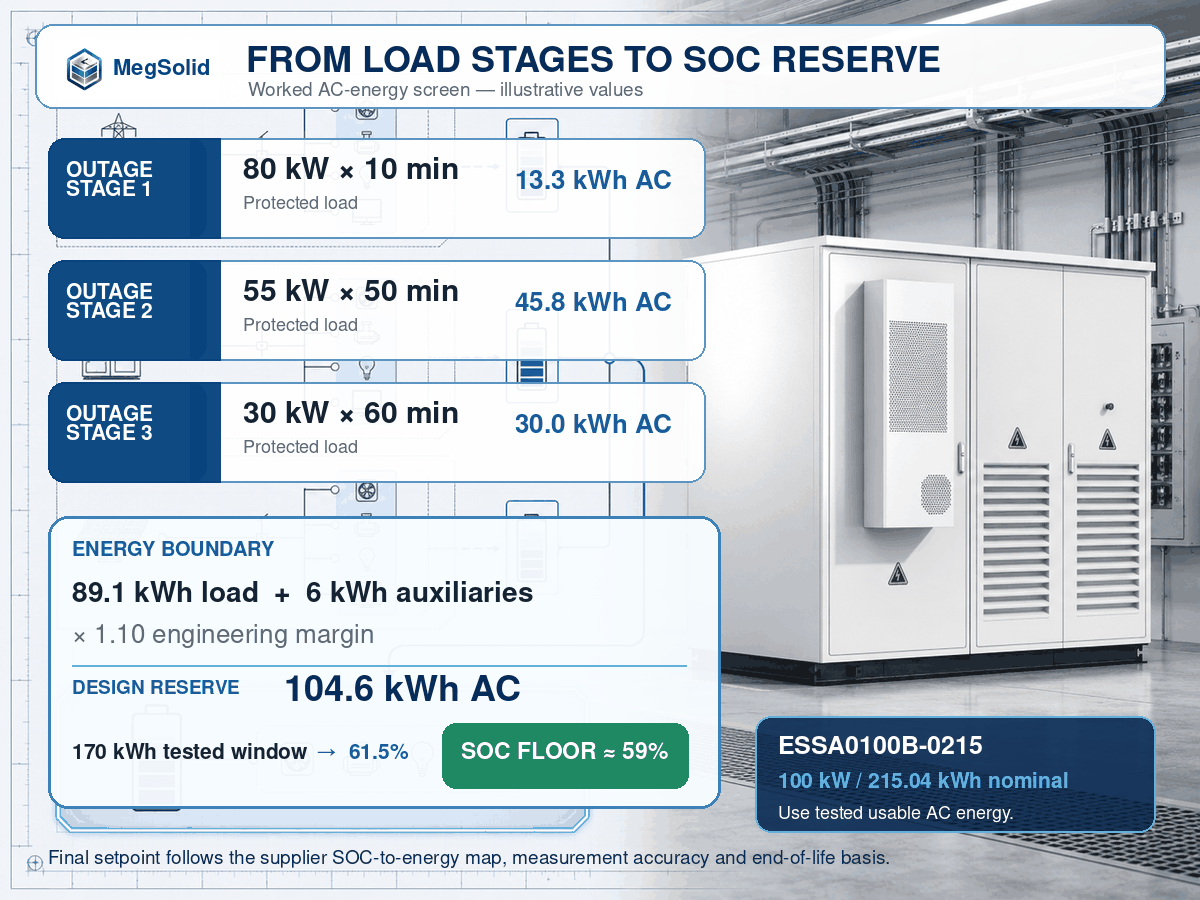
| Outage stage | AC load | Time | Required AC energy |
|---|---|---|---|
| Finish the active process and stabilize refrigeration | Amashumi asibhozo kwii-kilowatt | 10 min | 13.3 kWh |
| Complete the controlled shutdown | 55 kW | 50 min | 45.8 kWh |
| Hold safety, controls and cold-room circulation | 30 kW | 60 min | 30.0 kWh |
Load duty: 89.1 kWh AC. Add 6 kWh of event auxiliaries that sit outside the agreed measurement boundary, then a 10% engineering margin:
Design reserve energy = (89.1 kWh + 6 kWh) × 1.10 = 104.6 kWh AC
Use your own load schedule, shutdown sequence and margin. A monthly electricity bill will not give you either. It never shows which circuits survive or when they shed.
What a wrong reserve setting costs on site
Let peak shaving spend 70 kWh that operations thought was reserved. The 104.6 kWh example reserve falls to 34.6 kWh before the outage starts.
At 50 kW protected load that leftover covers about 42 minutes. The original reserve covered a little over two hours. You just lost about 1.4 hours of protected runtime.
Finance can price that hour with site numbers:
Event exposure = lost protected runtime × site contribution margin per hour + batch scrap + restart or cleaning cost
Leave the currency blank until production, finance and quality put in verified stop-hour contribution, work-in-process and restart cost. The engineering result does not wait for that meeting: 70 kWh spent on the wrong job removes 1.4 hours from a 50 kW critical load. In a supermarket or cold store the same hole is lost refrigeration time and a product-temperature excursion.
Map required kWh into the usable SOC window
ESSA0100B-0215 publishes 215.04 kWh nominal battery energy. Treat it as a product reference. It is not 215.04 kWh sitting on the plant AC bus. Conversion loss, approved SOC window, temperature, battery condition and auxiliary treatment all move delivered energy.
Use contracted or acceptance-tested usable AC energy:
Protected fraction of usable window = design reserve energy ÷ validated usable AC energy
Example with test data: acceptance verifies 170 kWh AC between 90% and 10% BMS SOC. The 104.6 kWh reserve uses 61.5% of that tested window.
A linear first pass would put the commercial discharge floor near 59% SOC:
10% + (61.5% × 80 percentage points) ≈ 59% SOC
Keep 59% as a screening number. Final setpoint follows the supplier SOC-to-energy map, measurement accuracy and end-of-life basis. BMS SOC is an estimate. Usable energy is not a straight line across every condition.
How to prove energy at an agreed AC boundary: commercial BESS capacity-test procedure. Throughput, DOD and retained capacity: C&I BESS warranty terms.
Send four inputs and receive a preliminary reserve table
MegSolid engineering can screen reserve before detailed engineering from:
- 1. staged outage load in kW × minutes
- 2. diesel-generator status and ATS sequence
- 3. measured usable AC kWh, or nominal energy marked pending capacity test
- 4. recovery deadline and available PCC charging margin
The review should return a preliminary SOC band, the open assumptions, and a first product route. No capacity test yet means the band stays preliminary. Do not freeze it as the EMS setpoint.
Check kW as carefully as kWh
Stored kWh will not carry the first seconds if the PCS cannot.
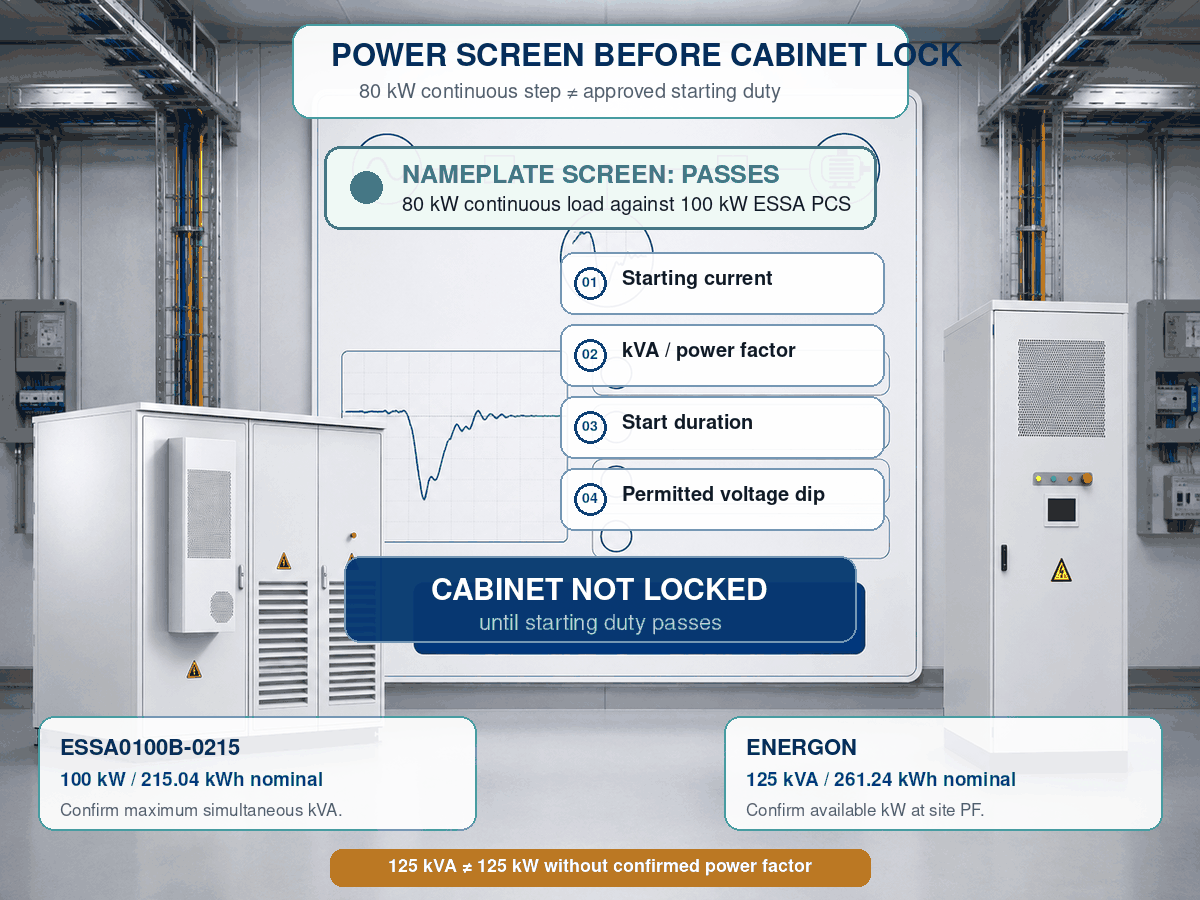
In the example the first protected step is 80 kW. Against a 100 kW PCS that only clears the continuous nameplate screen. It does not lock ESSA. Confirm compressor starting current, start duration, measured kVA or power factor, permitted voltage dip and PCS transient capability before anyone treats the cabinet as selected.
The leftover 20 kW on the nameplate can vanish on a compressor restart, on reactive power, in temperature derating, or when the BMS cuts available discharge. Pass the power check only when the full starting event stays inside approved PCS, BMS and voltage-dip limits.
Two passes, every time:
- Energy check: validated AC kWh covers the complete outage sequence
- Power check: live PCS and BMS limits cover the highest simultaneous kW and kVA
Motor loads also need starting method, starting current, acceptable voltage dip and shed order. The 100 kW rating does not prove black start, transfer performance or motor-start capability.
Dynamic reserve works when the trigger is specific
The same reserve all day is lazy. Parking 105 kWh through a quiet weekend wastes working capacity. Dropping the floor ahead of a known weak-grid window wastes the backup.
A weekday rule can hold 105 kWh through production, drop after the safe-stop load ends, and restore before the next shift. A utility outage notice, weather alert or generator service window can raise the target for a defined period.
Write activation time, expiry time, recovery deadline and a log. “Use the forecast” will fail commissioning. A commissioning-ready rule looks like this:
Raise the reserve target to 105 kWh at 05:00 on production days. Complete recovery by 06:30. Keep the target active until the protected production shift ends at 18:00.
Forecasts may move the commercial band inside approved limits. They do not release protected energy without a written rule. How reserve sits with PCC limits, peak shaving, PV charging and recovery: BESS EMS priority logic.
Recovery time belongs in the reserve calculation
Battery used 70 kWh in the outage. Next shift is 3.5 hours away. Minimum average recovery power, before charging losses:
70 kWh ÷ 3.5 h = 20 kW
If the PCC has only 15 kW of spare import in that window, the grid alone will miss the deadline. Wait for PV, start recovery earlier, or raise an alarm that backup readiness will be late. Charging at 20 kW in silence will break the import target.
Reserve control meets battery peak-shaving control right here. The battery has to recover. Recovery must not print the next demand peak.
Where ESSA0100B-0215 fits
The MegSolid ESSA0100B-0215 ikhabhathi yangaphandle puts a 100 kW PCS, 215.04 kWh nominal LFP energy, intelligent air cooling, IP54 enclosure, built-in isolation transformer and integrated EMS in one cabinet. RS485 and TCP/IP carry limits, commands, measurements and alarms.
That boundary makes reserve logic easier to follow from BMS permission to PCS response. Site work stays on the EPC: ATS or switching, PCC meter, protected-load board, external switchgear, cables and generator interface.
Model power and interface checks: ESSA0100B-0215 selection page. Duty outside this cabinet: MegSolid C&I energy-storage range.
Use the reserve duty to choose the first product route
| Measured duty | Preliminary route | Item that still needs confirmation |
|---|---|---|
| Protected load up to 100 kW and reserve fits the validated ESSA energy window | ESSA0100B-0215, 100 kW / 215.04 kWh | Usable AC kWh, transfer design and maximum kVA |
| Duty exceeds the 100 kW ESSA screen or needs more energy headroom | 261.24 kWh / 125 kVA liquid-cooled LFP system | Available kW at required power factor, usable AC energy and thermal duty |
| Protected load exceeds 125 kW or duration exceeds cabinet-scale energy | Parallel cabinets or an engineered containerized route | Pooled PCS power, redundancy, switchgear and site controller |
Screening path only. 125 kVA is apparent power. Confirm power factor and the offered configuration before anyone writes 125 kW.
Integrated cabinet, engineered split system or trader bundle?
| Supply route | What can make it work | Warning sign before purchase |
|---|---|---|
| Integrated ESSA cabinet | Battery, PCS, isolation transformer and EMS share a defined product boundary | External ATS, PCC meter and protected-load board still missing from project scope |
| Engineered battery + PCS + third-party EMS | One integrator signs voltage match, BMS protocol, SOC definition, meter map and system FAT | Each supplier guarantees only its own component |
| Trader-assembled cabinet package | Same usable-AC test, control narrative, logs and warranty owner as an integrator | Quote shows nominal kWh and a generic EMS screenshot, nobody owns backup performance |
If a bidder cannot name usable AC energy, SOC definition, meter boundary and control owner, do not approve the package as backup. A cheaper cabinet does not replace those four answers.
Prove the reserve with one continuous trend
Commissioning should replay the moment commercial dispatch hits the protected floor. The trend should tell the story without a verbal tour.
Record PCC power, protected-load power, BESS AC power, SOC, available charge and discharge power, reserve target, active limitation, breaker state and data quality. Then run:
- discharge toward the reserve floor while peak shaving is active
- the highest protected-load step
- trigger and expiry of a dynamic reserve schedule
- stale PCC data or a lost communications link
- grid restore and recharge inside the PCC ceiling
- recovery-deadline alarm when charging power cannot meet the clock
Wider signal set: Uluhlu lweendawo ze-BESS SCADA. Factory versus site evidence: BESS FAT guide.
Make the BESS SOC reserve strategy easy to defend
A defensible reserve traces to a load schedule, an AC energy test and a recovery deadline. If operations ask why the floor is 59% and not 30%, the answer fits on one sheet.
Size the reserve in kWh first. Daily dispatch then takes whatever remains. Backup readiness stays measurable as the load and the battery age.
Imibuzo Ebuzwa Rhoqo
What is a BESS SOC reserve strategy?
It is the rule that protects a calculated amount of usable battery energy for a defined outage duty while commercial modes use only the energy above that floor.
Is 20% SOC enough for backup power?
The percentage alone cannot answer that question. Compare the required protected-load AC energy with validated usable AC energy, then check the maximum kW and kVA duty.
How is the reserve energy calculated?
Add the AC energy for every protected-load stage, any separately measured auxiliary or restart energy, and the agreed engineering margin. Keep every value on the same measurement boundary.
Should reserve use nominal or usable AC energy?
Use contracted or acceptance-tested usable AC energy. Nominal battery energy can support an early screen only when it is clearly marked as an assumption pending the capacity test.
How does a factory choose 59% instead of 40% SOC?
Convert the protected AC kWh into a fraction of the validated SOC window, then apply the manufacturer's SOC-to-energy mapping and accuracy allowance. The percentage comes after the energy calculation.
Should battery aging change the reserve floor?
Yes. The same protected-load duty consumes a larger share of the usable SOC window as validated capacity falls. Review the floor after capacity testing and whenever the resilience duty changes.
Can reserve SOC change during the day?
Yes. Use scheduled or event-based targets with clear activation, expiry, recovery and logging rules. Commercial dispatch may use only the energy above the active floor.
Should BESS auxiliaries be added to the load calculation?
Add them only when they sit outside the usable-energy measurement boundary. If the AC capacity test already includes those auxiliaries, adding them again would double count the loss.
How do a diesel generator and ATS change the reserve?
They define how long the BESS must bridge the outage, which loads transfer, how many generator-start attempts are supported and whether the battery must carry a restart or safe-stop sequence.
Why must reserve sizing check both kW and kWh?
kWh determines runtime. kW and kVA determine whether the PCS can carry the largest simultaneous load, motor start or reactive-power duty at that moment.
Does ESSA0100B-0215 guarantee two hours at 100 kW?
No. Its 215.04 kWh value is nominal battery energy. Actual AC duration depends on the approved SOC window, conversion loss, auxiliaries, operating limits, reserve and site conditions.
When is ESSA0100B-0215 the first product route?
It is a reasonable starting route when protected power stays within 100 kW and the calculated reserve fits the project's validated usable-energy window.
When should the 261.24 kWh / 125 kVA system be reviewed?
Review it when the duty needs more power or energy headroom than the ESSA screen provides. Confirm usable AC kWh and available kW at the required power factor before selection.
Is a split battery, PCS and EMS system unsuitable for backup?
It can work when one integrator owns voltage matching, controls, SOC definition, protection, system testing and warranty coordination. The risk appears when those duties are divided without one accountable system owner.
What should a buyer send for a preliminary SOC table?
Send the staged protected-load profile, generator and ATS sequence, usable AC energy basis, recovery deadline and PCC charging margin.
What should appear in the commissioning record?
Capture the protected-load profile, BESS power, SOC, live BMS limits, reserve target, active control reason, PCC power, breaker state, timestamps and data quality in one synchronized trend.
