
Charge protégée inférieure à 100 kW, et la réserve restant dans la plage d'énergie utilisable testée : le MegSolid ESSA0100B-0215 reste sur la liste des candidats présélectionnés. Si la charge dépasse le seuil de 100 kW de l’ESSA ou si la plage d’énergie disponible semble trop étroite : examinez l’armoire Energon de 261,24 kWh / 125 kVA et vérifiez la puissance utilisable (en kW) au facteur de puissance requis. Ne retenez aucune des deux armoires tant que la charge échelonnée, la séquence générateur/ATS, le nombre de kWh CA utilisables et le délai de récupération ne sont pas disponibles.
Ces quatre données donnent lieu à une plage SOC préliminaire et à un itinéraire de production. Elles permettent également de détecter une défaillance silencieuse du site : l'IHM affiche « 45% SOC », le système de lissage des pics a déjà consommé l'énergie protégée, et la ligne n'atteint jamais un arrêt de sécurité.
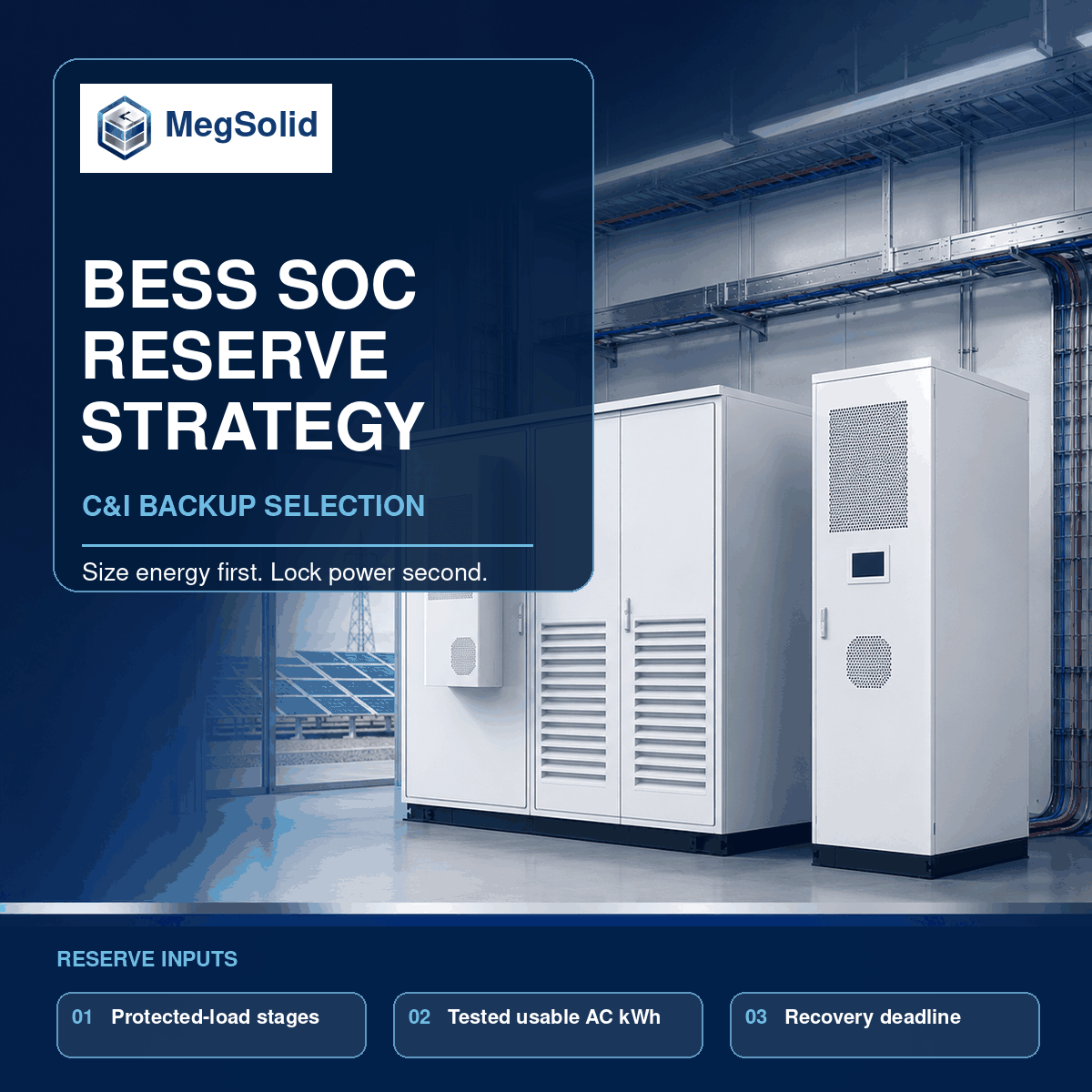
Si la puissance protégée, l'énergie de réserve ou la puissance de démarrage dépassent les limites validées de l'armoire, augmenter le pourcentage de SOC ne suffira pas à combler cet écart. Vous aurez besoin de plus de kW, de plus de kWh ou d'une autre unité.
Commencez par la tâche liée à la panne, et non par un chiffre arrondi du SOC
“ Garder 30% en réserve ” est un paramètre du clavier. Cela ne décrit pas la panne.
Une usine agroalimentaire peut maintenir en service les systèmes de régulation de la réfrigération et les pompes de circulation, terminer la production du lot déjà en cours, puis passer en mode de sécurité et de surveillance. Un entrepôt abritant des systèmes de lutte contre l'incendie, des systèmes de contrôle d'accès et un éclairage de secours présente une autre configuration. Reproduire le modèle 30% sur les deux sites relève de la conjecture.
Décrivez la panne par étapes :
- circuits qui restent sous tension dès que le réseau tombe en panne
- charges qui s'arrêtent après un arrêt contrôlé
- si un générateur doit démarrer et se synchroniser
- si la batterie doit supporter un redémarrage ultérieur
- quelle part de la charge auxiliaire du BESS se trouve à l'intérieur des limites de mesure convenues
Les équipements auxiliaires prêtent à confusion. Si l'énergie utilisable contractuelle est déjà nette des équipements auxiliaires du tableau, les ajouter à nouveau revient à compter deux fois le même kWh. Choisissez une limite d'énergie sur le schéma unifilaire et effectuez le test de capacité à cette limite.
Exemple de calcul des réserves pour un site de transformation alimentaire
Séquence à titre d'exemple uniquement :
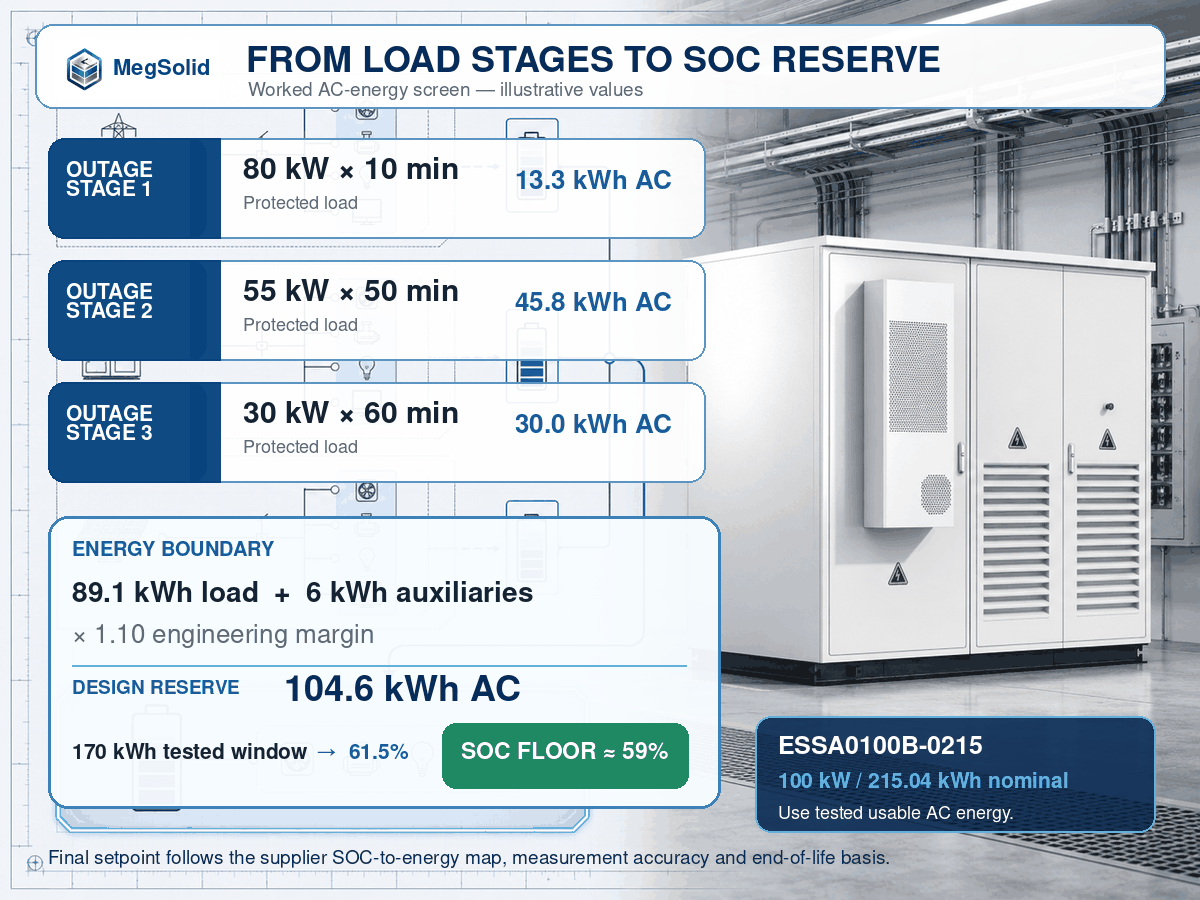
| Phase de coupure | Charge CA | Heure | Énergie électrique CA requise |
|---|---|---|---|
| Mettre fin au processus en cours et stabiliser la réfrigération | 80 kW | 10 min | 13,3 kWh |
| Effectuer l'arrêt contrôlé | 55 kW | 50 min | 45,8 kWh |
| Sécurité des cuves de stockage, des commandes et de la circulation dans les chambres froides | 30 kW | 60 min | 30,0 kWh |
Charge utile : 89,1 kWh CA. Ajouter 6 kWh correspondant aux équipements auxiliaires événementiels situés en dehors des limites de mesure convenues, puis une marge technique de 10% :
Réserve d'énergie nominale = (89,1 kWh + 6 kWh) × 1,10 = 104,6 kWh CA
Utilisez votre propre programme de charge, votre propre séquence d'arrêt et votre propre marge. Une facture d'électricité mensuelle ne vous fournira aucune de ces informations. Elle n'indique jamais quels circuits restent sous tension ni à quel moment ils sont coupés.
Ce qu'un mauvais réglage de la réserve coûte sur le chantier
Supposons que le système de lissage des pointes consomme 70 kWh que le service d'exploitation pensait réservés. La réserve de 104,6 kWh mentionnée dans l'exemple tombe à 34,6 kWh avant le début de la coupure.
Avec une charge protégée de 50 kW, cette réserve restante permet d'assurer environ 42 minutes d'autonomie. La réserve initiale couvrait un peu plus de deux heures. Vous venez de perdre environ 1,4 heure d'autonomie protégée.
Le service financier peut chiffrer cette heure à l'aide des chiffres relatifs au site :
Coût de l'incident = temps d'exécution perdu × marge contributive horaire du site + rebuts de lot + coût de redémarrage ou de nettoyage
Ne renseignez pas le champ « devise » tant que les services de production, des finances et de la qualité n’ont pas saisi les données vérifiées concernant les heures d’arrêt, les encours de fabrication et les coûts de redémarrage. Le résultat technique n’attend pas cette réunion : 70 kWh consommés sur une tâche erronée réduisent de 1,4 heure une charge critique de 50 kW. Dans un supermarché ou un entrepôt frigorifique, ce même écart se traduit par une perte de temps de réfrigération et un écart de température des produits.
Convertir les kWh requis en plage de SOC utilisable
La référence ESSA0100B-0215 indique une énergie nominale de la batterie de 215,04 kWh. Considérez cette valeur comme une référence produit. Il ne s'agit pas d'une quantité de 215,04 kWh disponible sur le bus CA de la centrale. Les pertes de conversion, la plage d'état de charge (SOC) autorisée, la température, l'état de la batterie et les traitements auxiliaires ont tous une incidence sur l'énergie fournie.
Utiliser l'énergie électrique alternative (CA) contractuelle ou dont la conformité a été vérifiée :
Fraction protégée de la fenêtre utilisable = énergie de réserve prévue ÷ énergie de climatisation utilisable validée
Exemple avec des données de test : le contrôle de réception vérifie 170 kWh en courant alternatif entre les valeurs SOC du BMS 90% et 10%. La réserve de 104,6 kWh occupe 61,5% de cette plage testée.
Un premier passage linéaire fixerait le seuil minimal de rejet commercial à environ 591 TP5T SOC :
101 TP5T + (61,51 TP5T × 80 points de pourcentage) ≈ 591 TP5T SOC
Conserver 59% comme valeur de référence. Le point de consigne final est déterminé en fonction de la courbe SOC-énergie fournie par le fournisseur, de la précision des mesures et de la fin de vie de la batterie. Le SOC indiqué par le BMS est une estimation. L’énergie utilisable ne suit pas une courbe linéaire dans toutes les conditions.
Comment démontrer l'énergie à une frontière AC convenue : Procédure d'essai de capacité des systèmes de stockage d'énergie par batterie (BESS) à usage commercial. Débit, DOD et capacité résiduelle : Conditions de garantie du système BESS C&I.
Envoyer quatre données et recevoir un tableau de réserve préliminaire
MegSolid Engineering peut évaluer les réserves avant la phase d'ingénierie détaillée à partir des éléments suivants :
- 1. charge de coupure programmée en kW × minutes
- 2. État du groupe électrogène diesel et séquence de l'ATS
- 3. kWh d'électricité alternative (CA) mesurés et utilisables, ou énergie nominale indiquée test de capacité en cours
- 4. délai de recouvrement et marge de facturation PCC disponible
L'analyse doit fournir une fourchette SOC préliminaire, les hypothèses en cours d'examen et un premier parcours de production. L'absence de test de capacité à ce stade signifie que cette fourchette reste préliminaire. Ne la considérez pas comme la valeur de référence pour le système EMS.
Vérifiez les kW avec autant de soin que les kWh
Les kWh stockés ne prendront pas en compte les premières secondes si le PCS n'est pas en mesure de le faire.
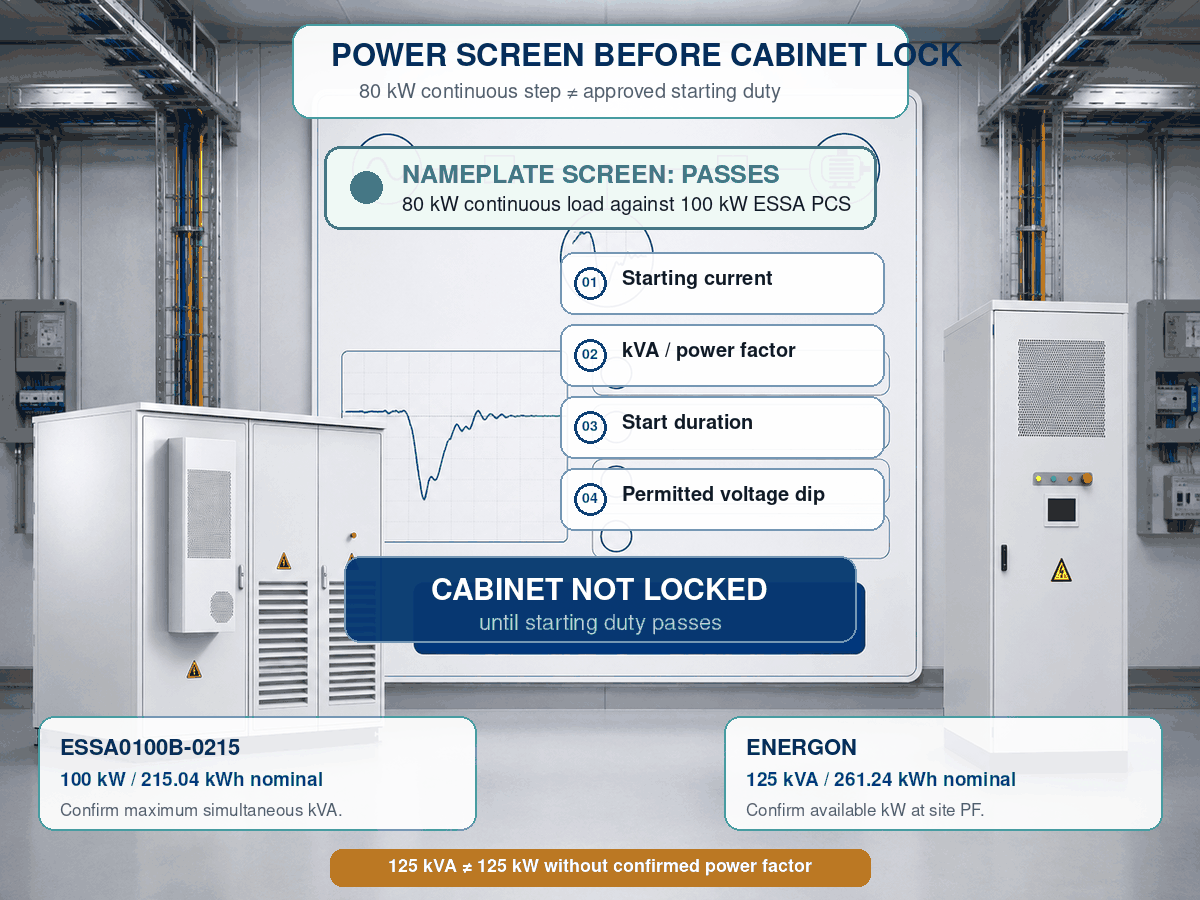
Dans l'exemple, le premier seuil de protection est de 80 kW. Avec un PCS de 100 kW, cela ne suffit qu'à passer le filtre de plaque signalétique en régime continu. Cela ne déclenche pas l'ESSA. Vérifiez le courant de démarrage du compresseur, la durée de démarrage, la valeur mesurée en kVA ou le facteur de puissance, la chute de tension admissible et la capacité transitoire du PCS avant de considérer que l'armoire a été sélectionnée.
Les 20 kW restants indiqués sur la plaque signalétique peuvent disparaître lors du redémarrage d'un compresseur, en raison de la puissance réactive, d'un déclassement thermique ou lorsque le BMS réduit le débit disponible. Ne validez le contrôle de puissance que si l'ensemble du processus de démarrage reste dans les limites approuvées pour le PCS, le BMS et les chutes de tension.
Deux passes, à chaque fois :
- Bilan énergétique : Les kWh CA validés couvrent l'ensemble de la séquence de coupure de courant
- Vérification de la puissance : Les limites en temps réel du PCS et du BMS couvrent les valeurs maximales simultanées en kW et en kVA
Les charges des moteurs doivent également tenir compte de la méthode de démarrage, du courant de démarrage, de la chute de tension admissible et de l'ordre de coupure. La puissance nominale de 100 kW ne garantit pas le démarrage à froid, les performances de transfert ni la capacité de démarrage des moteurs.
La réserve dynamique fonctionne lorsque le déclencheur est spécifique
Garder la même réserve toute la journée, c'est de la paresse. Stocker 105 kWh pendant un week-end calme revient à gaspiller de la capacité de production. Abaisser le seuil avant une période de faiblesse connue du réseau revient à gaspiller la réserve.
Une règle applicable en semaine permet de stocker 105 kWh pendant la production, de réduire cette quantité une fois la charge d'arrêt de sécurité terminée, puis de rétablir le niveau avant le début de la prochaine équipe. Un avis de coupure de courant, une alerte météo ou une fenêtre d'intervention sur le générateur peuvent augmenter l'objectif pendant une période définie.
Indiquez la durée d'activation, la date d'expiration, le délai de récupération et un journal. L'option “ Utiliser les prévisions ” entraînera l'échec de la mise en service. Une règle prête pour la mise en service se présente comme suit :
Augmenter l'objectif de réserve à 105 kWh à 5 h les jours de production. Achever la récupération avant 6 h 30. Maintenir cet objectif en vigueur jusqu'à la fin de l'équipe de production protégée, à 18 h.
Les prévisions peuvent faire varier la bande commerciale dans les limites autorisées. Elles ne libèrent pas l'énergie protégée sans une règle écrite. Comment la réserve s'articule-t-elle avec les limites du PCC, l'écrêtement des pics, la recharge photovoltaïque et la récupération : Logique de priorité du système EMS de BESS.
Le temps de récupération doit être pris en compte dans le calcul de la réserve
La batterie a consommé 70 kWh pendant la coupure de courant. La prochaine équipe prendra le relais dans 3,5 heures. Puissance de récupération moyenne minimale, avant pertes de charge :
70 kWh ÷ 3,5 h = 20 kW
Si le PCC ne dispose que de 15 kW d’importation disponible pendant cette plage horaire, le réseau à lui seul ne respectera pas le délai. Il faudra attendre l’alimentation photovoltaïque, lancer la remise en service plus tôt ou signaler que la mise en service de la solution de secours sera retardée. Une recharge silencieuse à 20 kW entraînera le non-respect de l’objectif d’importation.
Réunion du comité de contrôle des réserves contrôle de l'écrêtement de la demande par batterie Juste ici. La batterie doit se recharger. La recharge ne doit pas entraîner un nouveau pic de consommation.
Où s'intègre le modèle ESSA0100B-0215 ?
Le MegSolid Armoire d'extérieur ESSA0100B-0215 Réunit dans une seule armoire un système de conversion de puissance (PCS) de 100 kW, une capacité nominale de 215,04 kWh en batterie LFP, un système de refroidissement par air intelligent, un boîtier IP54, un transformateur d'isolement intégré et un système de gestion énergétique (EMS) intégré. Les protocoles RS485 et TCP/IP assurent la transmission des limites, des commandes, des mesures et des alarmes.
Cette délimitation permet de mieux suivre le raisonnement de la réserve, depuis l'autorisation du BMS jusqu'à la réponse du PCS. Les travaux sur site restent du ressort de l'EPC : ATS ou commutation, compteur PCC, tableau de charges protégées, appareillage de commutation externe, câbles et interface du générateur.
Vérifications de la puissance et de l'interface du modèle : Page de sélection ESSA0100B-0215. Fonctions exercées en dehors de ce gouvernement : Gamme de systèmes de stockage d'énergie MegSolid C&I.
Utilisez la fonction « réserve » pour choisir le premier parcours de livraison
| Droit mesuré | Itinéraire préliminaire | Élément nécessitant encore une confirmation |
|---|---|---|
| La charge protégée, d'une puissance maximale de 100 kW, et la réserve correspondent à la fenêtre énergétique validée par l'ESSA | ESSA0100B-0215, 100 kW / 215,04 kWh | kWh CA utilisables, conception du transfert et kVA maximal |
| La charge dépasse le seuil de 100 kW fixé par l'ESSA ou nécessite une marge énergétique supplémentaire | Système LFP refroidi par liquide de 261,24 kWh / 125 kVA | Puissance disponible en kW au facteur de puissance requis, énergie CA utilisable et charge thermique |
| La charge protégée dépasse 125 kW ou la durée dépasse la consommation énergétique à l'échelle de l'armoire | Armoires parallèles ou parcours modulaire en conteneurs | Alimentation PCS mutualisée, redondance, appareillage de commutation et contrôleur de site |
À titre indicatif uniquement. Les 125 kVA correspondent à la puissance apparente. Vérifiez le facteur de puissance et la configuration proposée avant que quelqu’un n’écrive 125 kW.
Armoire intégrée, système split sur mesure ou pack commercial ?
| Voie d'approvisionnement | Qu'est-ce qui peut permettre d'y parvenir ? | Avertissement avant l'achat |
|---|---|---|
| Armoire ESSA intégrée | La batterie, le PCS, le transformateur d'isolement et l'EMS relèvent tous d'une même catégorie de produit bien définie | L'ATS externe, le compteur PCC et le tableau de charge protégée ne font toujours pas partie du périmètre du projet |
| Batterie sur mesure + PCS + système de gestion de batterie (EMS) tiers | Un intégrateur valide la correspondance de tension, le protocole BMS, la définition du SOC, la carte des compteurs et le test d'acceptation en usine (FAT) du système | Chaque fournisseur ne garantit que son propre composant. |
| Ensemble d'armoires à monter soi-même | Même test de fonctionnement du climatiseur, même rapport de contrôle, mêmes registres et même titulaire de la garantie qu'un intégrateur | La citation indique une valeur nominale en kWh et présente une capture d'écran générique du système de gestion de l'énergie (EMS) ; personne ne peut garantir les performances de l'alimentation de secours. |
Si un soumissionnaire n'est pas en mesure de préciser la puissance CA utilisable, la définition du SOC, les limites de comptage et le propriétaire du système de contrôle, ne validez pas l'offre en tant que solution de secours. Un coffret moins cher ne remplace pas ces quatre éléments.
Justifier la réserve à l'aide d'une tendance continue
La mise en service doit reproduire le moment où la production commerciale atteint le seuil de protection. La courbe de tendance doit parler d'elle-même, sans explication verbale.
Enregistrez la puissance du PCC, la puissance de la charge protégée, la puissance CA du BESS, le SOC, les puissances de charge et de décharge disponibles, l’objectif de réserve, la limitation active, l’état du disjoncteur et la qualité des données. Ensuite, exécutez :
- décharge vers le seuil de réserve lorsque la fonction de lissage des pics est active
- le palier de charge protégée le plus élevé
- déclenchement et expiration d'un calendrier de réserve dynamique
- des données PCC obsolètes ou une perte de liaison de communication
- Restauration et recharge du réseau à l’intérieur du plafond du PCC
- Alarme de délai de récupération lorsque la puissance de charge ne suffit pas à alimenter l’horloge
Ensemble de signaux plus large : Liste des points SCADA BESS. Preuves provenant de l'usine par opposition à celles provenant du chantier : Guide BESS FAT.
Faire en sorte que la stratégie de réserve SOC de BESS soit facile à défendre
Une réserve justifiable repose sur un programme de charge, un test de puissance CA et un délai de rétablissement. Si les services opérationnels demandent pourquoi le seuil est fixé à 59% et non à 30%, la réponse tient sur une seule feuille.
Commencez par déterminer la capacité de réserve en kWh. La gestion quotidienne de la charge utilise ensuite ce qui reste. L'état de préparation de la réserve reste mesurable au fur et à mesure que la charge évolue et que la batterie vieillit.
FAQ
Qu'est-ce qu'une stratégie de réserve SOC pour un système de stockage d'énergie par batterie (BESS) ?
Cette règle permet de préserver une quantité déterminée d'énergie utilisable de la batterie pour une durée de fonctionnement en cas de coupure définie, tandis que les modes commerciaux n'utilisent que l'énergie supérieure à ce seuil minimal.
Le SOC de 20% est-il suffisant pour une alimentation de secours ?
Ce pourcentage ne suffit pas à lui seul à répondre à cette question. Comparez l'énergie CA nécessaire pour alimenter la charge protégée à l'énergie CA utilisable validée, puis vérifiez la puissance maximale en kW et en kVA.
Comment calcule-t-on l'énergie de réserve ?
Ajoutez l'énergie CA pour chaque niveau de charge protégée, toute énergie auxiliaire ou de redémarrage mesurée séparément, ainsi que la marge technique convenue. Veillez à ce que toutes les valeurs se situent dans la même plage de mesure.
Faut-il utiliser l'énergie AC nominale ou l'énergie AC utilisable pour la réserve ?
Utilisez l'énergie CA contractuelle ou dont la conformité a été testée. L'énergie nominale de la batterie ne peut servir de base à une première évaluation que si elle est clairement indiquée comme une hypothèse en attendant le test de capacité.
Pourquoi une usine choisit-elle le SOC 59% plutôt que le 40% ?
Convertissez les kWh CA protégés en une fraction de la plage SOC validée, puis appliquez la correspondance SOC/énergie fournie par le constructeur ainsi que la marge de tolérance. Le pourcentage est obtenu après le calcul de l'énergie.
Le vieillissement de la batterie devrait-il modifier le seuil minimal de réserve ?
Oui. Cette même charge protégée occupe une part plus importante de la fenêtre SOC utilisable à mesure que la capacité validée diminue. Vérifiez la valeur minimale après les tests de capacité et chaque fois que la charge de résilience change.
La charge du SOC peut-elle varier au cours de la journée ?
Oui. Utilisez des cibles programmées ou liées à des événements, assorties de règles claires en matière d'activation, d'expiration, de rétablissement et de journalisation. La distribution commerciale ne peut utiliser que l'énergie dépassant le seuil minimal actif.
Faut-il inclure les équipements auxiliaires du système BESS dans le calcul de la charge ?
Ne les ajoutez que s'ils se trouvent en dehors des limites de mesure de l'énergie utilisable. Si le test de capacité du climatiseur inclut déjà ces équipements auxiliaires, les ajouter à nouveau reviendrait à comptabiliser deux fois la perte.
En quoi un groupe électrogène diesel et un ATS modifient-ils la réserve ?
Ils définissent la durée pendant laquelle le système de stockage par batterie (BESS) doit pallier la panne, quelles charges sont transférées, le nombre de tentatives de démarrage du générateur autorisées et si la batterie doit prendre en charge une séquence de redémarrage ou d'arrêt de sécurité.
Pourquoi faut-il vérifier à la fois la puissance (kW) et la consommation (kWh) lors du dimensionnement de la réserve ?
Le kWh détermine l'autonomie. Le kW et le kVA déterminent si le PCS est capable de supporter la charge simultanée la plus importante, le démarrage d'un moteur ou la puissance réactive à ce moment-là.
Le modèle ESSA0100B-0215 garantit-il deux heures à 100 kW ?
Non. Sa valeur de 215,04 kWh correspond à l'énergie nominale de la batterie. La durée réelle de fonctionnement en courant alternatif dépend de la plage de SOC autorisée, des pertes de conversion, des équipements auxiliaires, des limites de fonctionnement, de la réserve et des conditions du site.
À quelle date le produit ESSA0100B-0215 a-t-il été lancé pour la première fois ?
Il s'agit d'une approche de départ raisonnable lorsque la puissance protégée reste inférieure à 100 kW et que la réserve calculée correspond à la fourchette d'énergie utilisable validée pour le projet.
À quel moment faut-il procéder à la révision du système de 261,24 kWh / 125 kVA ?
Vérifiez ces données lorsque l'application nécessite une puissance ou une réserve d'énergie supérieure à celle fournie par le tableau ESSA. Vérifiez le nombre de kWh CA utilisables et la puissance disponible en kW au facteur de puissance requis avant de faire votre choix.
Un système composé d'une batterie en mode split, d'un PCS et d'un EMS est-il inadapté à une alimentation de secours ?
Cela peut fonctionner lorsqu'un seul intégrateur est responsable de l'adaptation de tension, des commandes, de la définition du SOC, de la protection, des tests du système et de la coordination de la garantie. Le risque apparaît lorsque ces responsabilités sont réparties sans qu'il y ait un seul responsable du système.
Quels éléments un acheteur doit-il fournir pour établir un tableau SOC préliminaire ?
Envoyez le profil de charge protégé par étapes, la séquence du générateur et du commutateur ATS, la base d'énergie CA utilisable, le délai de rétablissement et la marge de charge du point de couplage (PCC).
Que doit figurer dans le procès-verbal de mise en service ?
Enregistrez le profil de charge protégée, la puissance du BESS, le niveau de charge (SOC), les limites en temps réel du BMS, l'objectif de réserve, le motif de contrôle actif, la puissance de couplage en phase (PCC), l'état du disjoncteur, les horodatages et la qualité des données dans un seul graphique de tendance synchronisé.