 Yiya kumxholo
Umthwalo okhuselweyo ongaphakathi kwi-100 kW, kwaye isipaji sisahleli kwifestile yamandla asetyenzisiweyo avavanyiweyo: i-MegSolid ESSA0100B-0215 ihlala kuluhlu olufutshane. Umthwalo wokusebenza ugqitha i-100 kW yescreen se-ESSA, okanye i-window yamandla ibonakala imxinwa: khangela ikhabhathi ye-Energon eyi-261.24 kWh / 125 kVA kwaye uqinisekise i-kW esetyenziswayo kwi-power factor efunekayo. Musa ukuvala nayiphi na ikhabhathi de umthwalo owenziwe ngokwamanqanaba, ulandelelwano lwe-generator/ATS, i-AC kWh esetyenziswayo kunye nomhla wokugqibela wokubuyisela zifumaneke.
Ezo zinto zine zingenayo ziba liqela le-SOC lokuqala kunye nendlela yemveliso. Zikwabamba nasekusileleni kwendawo okungaxeliyo: i-HMI ifunda i-SOC engu-45%, ukunciphisa incopho sele kusetyenziswe amandla akhuselweyo, kwaye umgca awufikeleli kwinqam leyo ikhuselekileyo.
Ukuba amandla akhuselekileyo, amandla agciniweyo okanye umthwalo wokuqalisa ukusebenza angaphandle kwemida eqinisekisiweyo yekhabhathi, ukunyusa ipesenti ye-SOC akuyi kuyivala loo mthwalo. Udinga i-kW ezingaphezulu, i-kWh ezingaphezulu, okanye enye iyunithi.
Qala ngomsebenzi wokunqamka, hayi inani elingumyinge we-SOC.
“Gcina i-30% kwindawo yokugcina” sisicwangciso sekhibhodi. Ayichazi ukuphazamiseka.
Umzi-mveliso wokutya unokugcina ulawulo lokupholisa neempompo zokujikeleza, ugqibezele isiqingatha esele sikhona kumgca, uze emva koko utshintshele kukhuseleko nokubeka iliso. Indawo yokugcina impahla enezilawuli zomlilo, iinkqubo zokungena nezibane zikaxakeka inendlela yayo eyahlukileyo. Ukukopa i-30% kwiindawo zombini kukuqikelela nje.
Bhala ukuphazamiseka ngokwamanqanaba:
- Iisekethi ezihlala zinogunyathiselwano xa umbane uphuma.
- iilayidi eziyeka emva kokucinywa okulawulwayo
- Nokuba ijeneretha kufuneka iqalise kwaye ilungelelanise.
- Ingaba ibhetri kufuneka ikwazi ukuqalisa kwakhona kamva
- ukuba ingakanani umthwalo oncedisayo we-BESS ohleli ngaphakathi kwemida yokulinganisa evunyelweneyo
Izixhobo zokuncedisa zidida abantu. Ukuba amandla asetyenzisiweyo asele ehlanganisiwe nezixhobo zokuncedisa zekhabhathi, ukuzongeza kwakhona kubala i-kWh enye kabini. Khetha umda wamandla omnye kumzila-mnye kwaye ugcine uvavanyo lwamandla kuloo mda.
Ubalo olusebenzayo lwendawo egciniweyo kwisiza sokuqhuba ukutya
Ngokulandelelanayo nje kuphela:
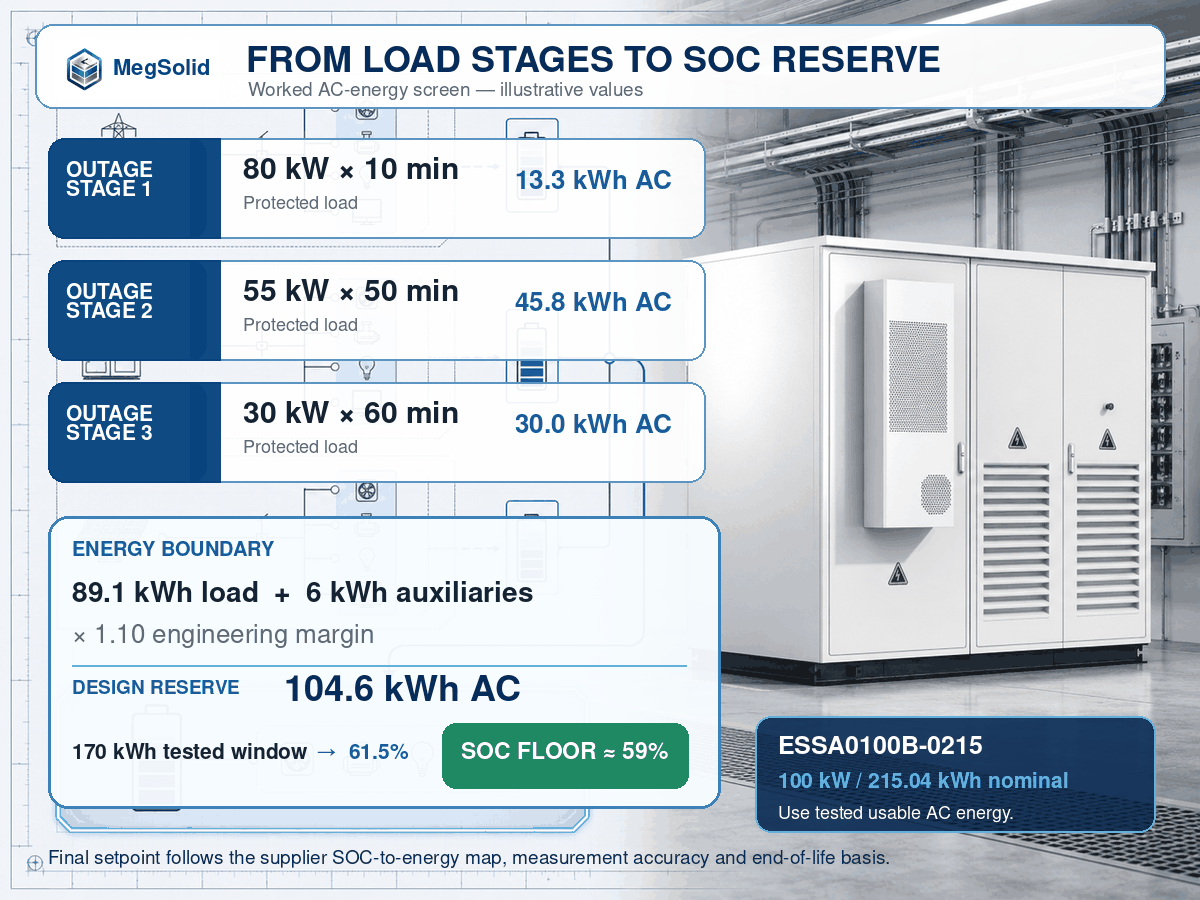
| Isigaba sokuphazamiseka | Umthwalo we-AC | Ixesha | Amandla e-AC afunekayo |
|---|---|---|---|
| Gqibezela inkqubo eqhubekayo uze uzinzise ukupholisa. | Amashumi asibhozo kwii-kilowatt | Iminithi eli-10 | 13.3 kWh |
| Gqibezela ukuvalwa okulawulwayo | 55 kW | Imizuzu engama-50 | 45.8 kWh |
| Bamba ukhuseleko, izilawuli kunye nokujikeleza komoya kwigumbi elibandayo | 30 kW | Imizuzu engamashumi amathandathu | 30.0 kWh |
Umthwalo womsebenzi: 89.1 kWh AC. Yongeza i-6 kWh yezixhobo zexhelo zomsitho ezingaphandle komda wokulinganisa ovunyelweneyo, emva koko umda wobunjineli we-10%:
Ugcino lwamandla olucetyiweyo = (89.1 kWh + 6 kWh) × 1.10 = 104.6 kWh AC
Sebenzisa ishedyuli yakho yokulayisha, ulandelelwano lokucima kunye nemarji. Isityala sombane senyanga asizukukunika nanye kwezi zinto. Asoze ibonise ukuba zeziphi iisekethe ezisaphilayo okanye zikhupha nini.
Into eyenzekayo xa usethingi yeresaybhini ingalunganga kwindawo yomsebenzi
Mkela i-peak shaving isebenzise i-70 kWh eyayicingelwa ngabasebenzi ukuba igciniwe. Isipaji somzekelo se-104.6 kWh sehlela kwi-34.6 kWh phambi kokuba ukuvalwa kuqale.
Kumthwalo okhuselweyo we-50 kW, loo masalela anele imizuzu emalunga nama-42. Isipaji sokuqala besinele iiyure ezingaphezulwana kwezimbini. Usandul' ukulahlekelwa yimizuzu emalunga ne-1.4 yexesha lokusebenza elikhuselweyo.
Ulawulo lwezemali lunokubeka ixabiso lelo xesha ngamanani eendawo:
Ukuvezwa kwesiganeko = ixesha elilahlekileyo lokusebenza elikhuselweyo × umnxeba wegalelo lasiza ngeyure + inkunkuma yebhetshi + iindleko zokuqalisa ngokutsha okanye zokucoca
Yiyeke le mali ingagcwaliswanga de imveliso, imali kunye nomgangatho bafake igalelo eliqinisekisiweyo lexesha lokumisa, umsebenzi oqhubekayo kunye neendleko zokuqalisa kwakhona. Isiphumo sobunjineli asilindelanga lolo hlangano: i-70 kWh echithwe kumsebenzi ongachanekanga isusa iiyure eziyi-1.4 kumthwalo obalulekileyo we-50 kW. Kwisuphamakethi okanye kwigumbi elikhenkcezayo, le xesha ilahlekileyo iyilahlekelwa lixesha lokukhenkcezisa kunye nokuphuma kwemveliso kwqondo lobushushu elifanelekileyo.
Faka i-kWh efunekayo kwi-window ye-SOC esetyenziswayo.
I-ESSA0100B-0215 ipapasha amandla ebhetri aqikelelwa kwi-215.04 kWh. Yithathe njengereferensi yemveliso. Ayikho i-215.04 kWh ehamba kwi-AC bus yombane wasemkhenikheni. Ukulahleka kuguqulo, i-SOC window evunyiweyo, ubushushu, imeko yebhetri kunye nonyango oluncedisayo zonke ziyayitshintsha imvuzo yamandla.
Sebenzisa amandla e-AC asayiniweyo okanye avavanywe ukwamkelwa nasebenzisekayo:
Isabelo esikhuselweyo sefestile esisebenzisekayo = amandla agciniweyo oyilo ÷ amandla e-AC asebenzisekayo aqinisekisiweyo
Umzekelo ngedatha yovavanyo: ukwamkelwa kuqinisekisa i-170 kWh ye-AC phakathi kwe-90% ne-10% BMS SOC. Isipaji esiyi-104.6 kWh sisebenzisa i-61.5% yale festile yovavanyo.
Iphasi yokuqala elandelelanayo ibiya kubeka umgangatho wokukhutshwa kwezorhwebo kufutshane ne-59% SOC:
10% + (61.5% × 80 amaphuzu epesenti) ≈ 59% SOC
Gcina i-59% njengenombolo yokuhluza. Isetophoyinti yokugqibela ilandela imephu yomthengisi ye-SOC ukuya kwimandla, ukuchaneka komlinganiselo kunye nesiseko sokuphela kobomi. I-SOC ye-BMS luqikelelo. Amandla asetyenziswayo akahambi ngomgca othe tye kuzo zonke iimeko.
Indlela yokungqina amandla kumda we-AC ovunyelwene ngawo: Inkqubo yovavanyo lomthamo we-BESS yorhwebo. Umthamo wokuhambisa, i-DOD kunye nomthamo ogciniweyo: Imiqathango ye-waranti ye-C&I BESS.
Thumela iingeno ezine kwaye ufumane itheyibhile yokugcina yokuqala.
Ubunjineli beMegSolid bunokwenza uhlolo lwesigcini phambi kobunjineli obuneenkcukacha ukusuka kwi:
- 1. Umthwalo wokuphazamiseka okucwangcisiweyo kwi-kW × imizuzu
- 2. imeko yejenereyitha yedizili kunye nolandelelwano lwe-ATS
- 3. measured usable AC kWh, or nominal energy marked pending capacity test
- 4. recovery deadline and available PCC charging margin
The review should return a preliminary SOC band, the open assumptions, and a first product route. No capacity test yet means the band stays preliminary. Do not freeze it as the EMS setpoint.
Check kW as carefully as kWh
Stored kWh will not carry the first seconds if the PCS cannot.
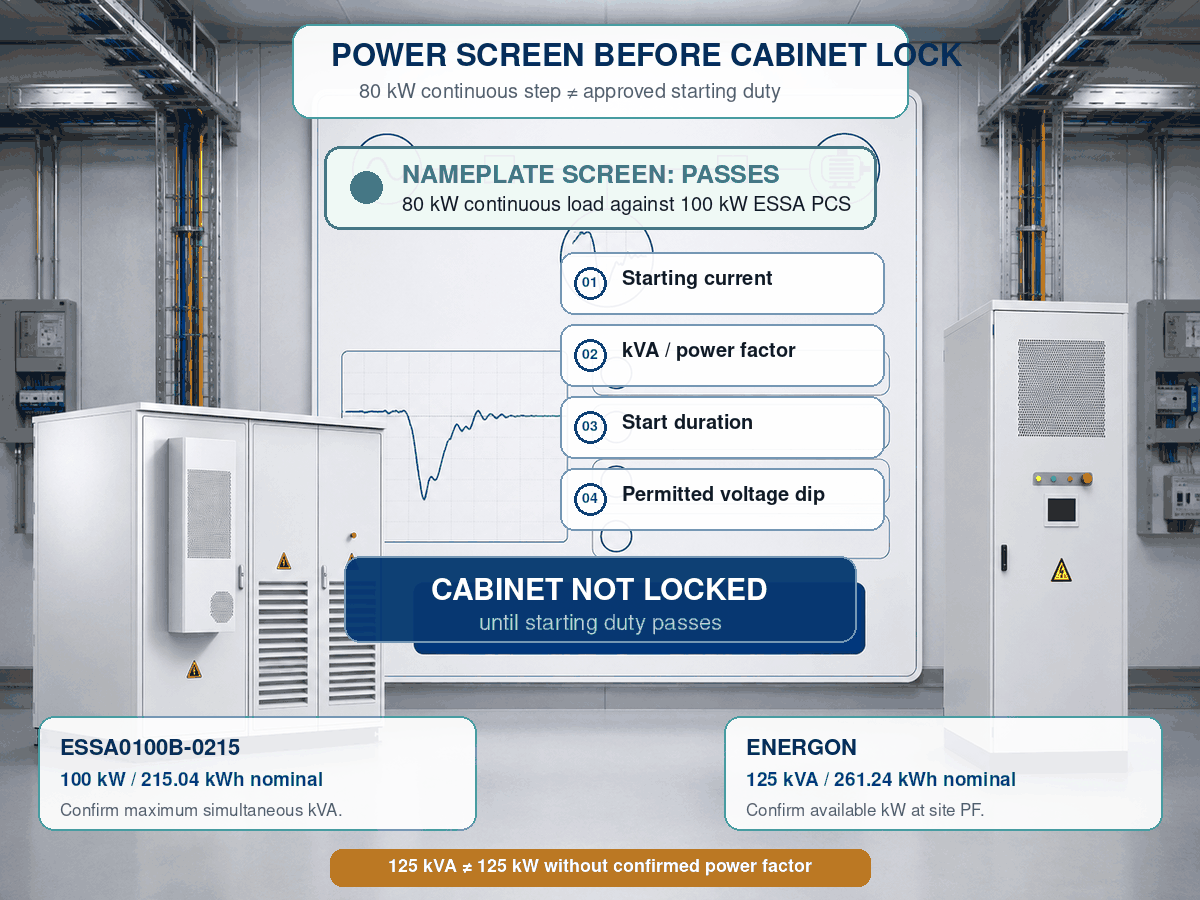
In the example the first protected step is 80 kW. Against a 100 kW PCS that only clears the continuous nameplate screen. It does not lock ESSA. Confirm compressor starting current, start duration, measured kVA or power factor, permitted voltage dip and PCS transient capability before anyone treats the cabinet as selected.
The leftover 20 kW on the nameplate can vanish on a compressor restart, on reactive power, in temperature derating, or when the BMS cuts available discharge. Pass the power check only when the full starting event stays inside approved PCS, BMS and voltage-dip limits.
Two passes, every time:
- Energy check: validated AC kWh covers the complete outage sequence
- Power check: live PCS and BMS limits cover the highest simultaneous kW and kVA
Motor loads also need starting method, starting current, acceptable voltage dip and shed order. The 100 kW rating does not prove black start, transfer performance or motor-start capability.
Dynamic reserve works when the trigger is specific
The same reserve all day is lazy. Parking 105 kWh through a quiet weekend wastes working capacity. Dropping the floor ahead of a known weak-grid window wastes the backup.
A weekday rule can hold 105 kWh through production, drop after the safe-stop load ends, and restore before the next shift. A utility outage notice, weather alert or generator service window can raise the target for a defined period.
Write activation time, expiry time, recovery deadline and a log. “Use the forecast” will fail commissioning. A commissioning-ready rule looks like this:
Raise the reserve target to 105 kWh at 05:00 on production days. Complete recovery by 06:30. Keep the target active until the protected production shift ends at 18:00.
Forecasts may move the commercial band inside approved limits. They do not release protected energy without a written rule. How reserve sits with PCC limits, peak shaving, PV charging and recovery: Ingqiqo yezinto eziphambili ye-BESS EMS.
Recovery time belongs in the reserve calculation
Battery used 70 kWh in the outage. Next shift is 3.5 hours away. Minimum average recovery power, before charging losses:
70 kWh ÷ 3.5 h = 20 kW
If the PCC has only 15 kW of spare import in that window, the grid alone will miss the deadline. Wait for PV, start recovery earlier, or raise an alarm that backup readiness will be late. Charging at 20 kW in silence will break the import target.
Reserve control meets battery peak-shaving control right here. The battery has to recover. Recovery must not print the next demand peak.
Where ESSA0100B-0215 fits
I-MegSolid ESSA0100B-0215 ikhabhathi yangaphandle puts a 100 kW PCS, 215.04 kWh nominal LFP energy, intelligent air cooling, IP54 enclosure, built-in isolation transformer and integrated EMS in one cabinet. RS485 and TCP/IP carry limits, commands, measurements and alarms.
That boundary makes reserve logic easier to follow from BMS permission to PCS response. Site work stays on the EPC: ATS or switching, PCC meter, protected-load board, external switchgear, cables and generator interface.
Model power and interface checks: Ikhasi lokukhetha i-ESSA0100B-0215. Duty outside this cabinet: MegSolid C&I energy-storage range.
Use the reserve duty to choose the first product route
| Measured duty | Indlela yokuqala | Item that still needs confirmation |
|---|---|---|
| Protected load up to 100 kW and reserve fits the validated ESSA energy window | ESSA0100B-0215, 100 kW / 215.04 kWh | Usable AC kWh, transfer design and maximum kVA |
| Duty exceeds the 100 kW ESSA screen or needs more energy headroom | 261.24 kWh / 125 kVA inkqubo ye-LFP epholisiweyo ngamanzi | Available kW at required power factor, usable AC energy and thermal duty |
| Protected load exceeds 125 kW or duration exceeds cabinet-scale energy | Parallel cabinets or an engineered containerized route | Pooled PCS power, redundancy, switchgear and site controller |
Screening path only. 125 kVA is apparent power. Confirm power factor and the offered configuration before anyone writes 125 kW.
Integrated cabinet, engineered split system or trader bundle?
| Indlela yezibonelelo | What can make it work | Isilumkiso phambi kokuthenga |
|---|---|---|
| Ikhabhathi ye-ESSA edityanisiweyo | Battery, PCS, isolation transformer and EMS share a defined product boundary | External ATS, PCC meter and protected-load board still missing from project scope |
| Engineered battery + PCS + third-party EMS | One integrator signs voltage match, BMS protocol, SOC definition, meter map and system FAT | Each supplier guarantees only its own component |
| Trader-assembled cabinet package | Same usable-AC test, control narrative, logs and warranty owner as an integrator | Quote shows nominal kWh and a generic EMS screenshot, nobody owns backup performance |
If a bidder cannot name usable AC energy, SOC definition, meter boundary and control owner, do not approve the package as backup. A cheaper cabinet does not replace those four answers.
Prove the reserve with one continuous trend
Commissioning should replay the moment commercial dispatch hits the protected floor. The trend should tell the story without a verbal tour.
Record PCC power, protected-load power, BESS AC power, SOC, available charge and discharge power, reserve target, active limitation, breaker state and data quality. Then run:
- discharge toward the reserve floor while peak shaving is active
- the highest protected-load step
- trigger and expiry of a dynamic reserve schedule
- stale PCC data or a lost communications link
- grid restore and recharge inside the PCC ceiling
- recovery-deadline alarm when charging power cannot meet the clock
Wider signal set: Uluhlu lweendawo ze-BESS SCADA. Factory versus site evidence: Isikhokelo seBESS FAT.
Make the BESS SOC reserve strategy easy to defend
A defensible reserve traces to a load schedule, an AC energy test and a recovery deadline. If operations ask why the floor is 59% and not 30%, the answer fits on one sheet.
Size the reserve in kWh first. Daily dispatch then takes whatever remains. Backup readiness stays measurable as the load and the battery age.
Imibuzo Ebuzwa Rhoqo
What is a BESS SOC reserve strategy?
It is the rule that protects a calculated amount of usable battery energy for a defined outage duty while commercial modes use only the energy above that floor.
Is 20% SOC enough for backup power?
The percentage alone cannot answer that question. Compare the required protected-load AC energy with validated usable AC energy, then check the maximum kW and kVA duty.
How is the reserve energy calculated?
Add the AC energy for every protected-load stage, any separately measured auxiliary or restart energy, and the agreed engineering margin. Keep every value on the same measurement boundary.
Should reserve use nominal or usable AC energy?
Use contracted or acceptance-tested usable AC energy. Nominal battery energy can support an early screen only when it is clearly marked as an assumption pending the capacity test.
How does a factory choose 59% instead of 40% SOC?
Convert the protected AC kWh into a fraction of the validated SOC window, then apply the manufacturer's SOC-to-energy mapping and accuracy allowance. The percentage comes after the energy calculation.
Should battery aging change the reserve floor?
Yes. The same protected-load duty consumes a larger share of the usable SOC window as validated capacity falls. Review the floor after capacity testing and whenever the resilience duty changes.
Can reserve SOC change during the day?
Yes. Use scheduled or event-based targets with clear activation, expiry, recovery and logging rules. Commercial dispatch may use only the energy above the active floor.
Should BESS auxiliaries be added to the load calculation?
Add them only when they sit outside the usable-energy measurement boundary. If the AC capacity test already includes those auxiliaries, adding them again would double count the loss.
How do a diesel generator and ATS change the reserve?
They define how long the BESS must bridge the outage, which loads transfer, how many generator-start attempts are supported and whether the battery must carry a restart or safe-stop sequence.
Why must reserve sizing check both kW and kWh?
kWh determines runtime. kW and kVA determine whether the PCS can carry the largest simultaneous load, motor start or reactive-power duty at that moment.
Does ESSA0100B-0215 guarantee two hours at 100 kW?
No. Its 215.04 kWh value is nominal battery energy. Actual AC duration depends on the approved SOC window, conversion loss, auxiliaries, operating limits, reserve and site conditions.
I-ESSA0100B-0215 ikuphi njengendlela yokuqala yemveliso?
It is a reasonable starting route when protected power stays within 100 kW and the calculated reserve fits the project's validated usable-energy window.
Ixesha elifanelekileyo lokuphononongwa kwenkqubo ye-261.24 kWh / 125 kVA liyintoni?
Review it when the duty needs more power or energy headroom than the ESSA screen provides. Confirm usable AC kWh and available kW at the required power factor before selection.
Ingaba inkqubo ye-split battery, PCS kunye ne-EMS ayifanelekanga njengomthombo wamandla oncedo?
Iyokusebenza xa umdibanisi omnye enoxanduva lokulungelelanisa ivoltheji, ulawulo, inkcazelo ye-SOC, ukhuseleko, uvavanyo lwenkqubo kunye nokulungelelanisa iwaranti. Ingozi ivela xa ezo ndima zohlulwe ngaphandle komnini-nkqubo omnye onoxanduva.
Umthengi kufuneka athumele ntoni ukuze afumane itheyibhile ye-SOC yokuqala?
Thumela iprofayili yomthwalo okhuselweyo elungiselelweyo, ijeneretha kunye nolandelelwano lwe-ATS, isiseko samandla e-AC asetyenzisekayo, umhla wokugqibela wokubuyisela kunye nemarji yokutshaja ye-PCC.
Yintoni ekufuneka ibe kwingxelo yokugunyazisa?
Bamba iprofayili yemthwalo ekhuselweyo, amandla e-BESS, i-SOC, imida ye-BMS ebukhoma, usukelo lwesipaji, isizathu solawulo olusebenzayo, amandla e-PCC, imeko ye-breaker, izitampu zexesha kunye nomgangatho wedatha kwintendeni enye elungelelanisiweyo.
