
Ilayibhile ye-solid-state ayonelanga ukuvumela inkqubo yokugcina amandla ebhetri: umthengi kufuneka aqinisekise ubungqina obuchanekileyo beseli, imodyuli, iraki kunye nenkqubo obusemva kwesibheno ngasinye sokuphuma kobushushu obugqithisileyo. I-MegSolid icebisa ukuba kuphathwe Ukuphuma komsindo wobushushu kwibhetri ye-solid state njengomsebenzi wokuqinisekisa ukufunyanwa kwezixhobo, kunye neBOM evunyiweyo, ubungqina bovavanyo lokusasazwa, uloyiko lokhuseleko kunye neFAT engqinisiweyo edityaniswe nezixhobo ezinikezelweyo. Le ndlela inceda umthengi ukuba akhethe uyilo olukhuselekileyo ngakumbi ngaphandle kokucinga ukuba i-chemistry yodwa ilawula yonke ingozi yofakelo.
- Yahlula amabango eekhemistri kubungqina benkqubo epheleleyo.
- Ngenisa nganye ingxelo kwimodeli ecaphulweyo, kulungiso lwe-BOM nakwimicimbi yokufakwa.
- Bona iimpendulo ze-BMS, zokufumanisa, zokucima kunye nonxibelelwano ngexesha le-FAT.
- Zisa iingqikelelo ezifanayo zokhuseleko kuyilo lwendawo, kwi-SAT nakwideniso.
Musa Ukuvuma i-BESS ngenxa yegama leKhemistri kuphela
Iiseli ze-solid-state neze-hybrid solid-state ziyaphuhliswa ukunciphisa ukuxhomekeka kwi-electrolyte elulwelo olunokutsha nokuphucula ukhuseleko lwazo lwendalo, kodwa i-BESS yorhwebo isenazo izidibaniso zombane, abahambisi, izixhobo zolawulo lwe-elektroniki, i-insulation, amacandelo okupholisa kunye namandla agciniweyo. Isishwankathelo sobuchwepheshe seMegSolid ngeebhetri ezixubekileyo ze-solid-state Ichaza imbono yomgangatho weseli; olu luhlu lokujonga lomthengi lujongana nombuzo owahlukileyo wokuba ingaba inkqubo ehambisiweyo inobungqina obaneleyo obunokulandelelwa ukuze ivunywe na.
Isigqibo sokuthengwa vavanya ikhemistri yeseli njengomnye umaleko wokhuseleko, hayi njengokuthatha indawo kwe-injiniyering yesistim. YeyoSebe lezaMandla lase-U.S. Isicwangciso Sobuchule Sokhuseleko Lwegcino Lamandla Izimiso zikhokela ukhuseleko kuphando, kwiikhowudi nakwimigangatho, kwimveliso, ekusunguleni, ekusebenzeni nasekusabeleni kwiziganeko; i-RFQ ekhuselekileyo kufuneka yenze okufanayo kuyo yonke inkqubo yobomi beprojekthi.
Ukubaleka kobushushu kweBhetri yeSolid State: Yakha iMatrix yokuTshintshela kuBungqina
Qala ngokubhala ngokutsha sonke isivakalisi sokhuseleko kwisicatshulwa ube sisibango esinokuthi siqinisekiswe. Amagama afana “ukhuselekile,” “ayitshiyo” okanye “ayinwenweli” anexabiso elincinci ekufumaneni impahla, ngaphandle kokuba umthengisi achaza into evavanyiweyo, indlela, iimeko, isiphumo, inombolo yengxelo kunye nohlaziyo lwemveliso.
| Isimangalo somthengisi | Ubungqina obucelwayo | Umbuzo wemvume |
|---|---|---|
| Ikhemistri yeeseli ekhuselekileyo | Ingxelo yokwakhiwa kwe-cell kunye nengxelo yovavanyo lokuxhatshazwa esebenzayo | Ingaba iseli elivavanyiweyo lufanayo na umenzi, imodeli, umthamo kunye nohlaziyo lwe-BOM enikezelweyo? |
| Ukuphuma elawulweni ngenxa yobushushu akusasazi. | Ingxelo yokusasazeka kwinqanaba lemodyuli, leraki okanye lesistim, kunye namalungiselelo noqwalaselo | Ingaba ulungiselelo lovavanyo luyahambelana na nesithuba, isingqobo, ukuhamba komoya kunye nemeko yotshaja kwiprojekthi? |
| Isilumkiso kwangethuba | Uluhlu lweesensa, imida ye-alam, imatrix yezizathu neziphumo ze-BMS kunye neerekhodi zeziganeko | Ingaba le nkqubo iza kuyibona na into eyandulelayo efanelekileyo ize ibangele impendulo echaziweyo? |
| Ukhuselo lomlilo oluzenzekelayo | Imizobo yokufumanisa nokucinezela, izidibanisi, ulogiki lokukhulula kunye nesicwangciso sokugcina | Ngaba uyilo lwamkelwe yingcali yomlilo yasekuhlaleni kunye negunya elilawulayo? |
| Inkqubo eqinisekisiweyo | Isatifikethi, umda, isalathiso somzekelo, isalathiso yengxelo, umniki kunye nokusebenza kwayo | Ingaba isatifikethi siyigubungela kanye inkqubo epheleleyo ethengwayo? |
Phambi kokuba uhlawule idipozithi: Faka le matrix kwishedyuli yobuchwepheshe kwaye uphawule umgca ngamnye njenge Ovuletyiweyo, Onemiqathango okanye Ovulekileyo. Le nkqubo ithintela ingxelo ekumgangatho webhukwana ukuba ingangeni ngokuzolileyo njengomgangatho wokwamkelwa kwesivumelwano ongenakulinganiswa lilo naliphi na iqela.
Funda igama lovavanyo phambi kokuba ufunde isiphumo
Amaxwebhu awohlukeneyo aphendula imibuzo eyahlukileyo. UN 38.3 ijongana novavanyo lwezothutho lweeseli neebhetri zeli-lithium; ayisosilingo esipheleleyo somlilo senkqubo emileyo. UL 9540 ijongene nendlela yokuqinisekisa inkqubo yesixhobo sokugcina amandla, ngelixa i-UL 9540A iyindlela yovavanyo esetyenziselwa ukuvavanya iimpawu zokunwenwa komlilo okubangelwa kukuphuma kobushushu obugqithisileyo.
Kwiiprojekthi ezisisigxina, kwakhona fumana ukuba loluphi uhlelo lwemigaqo yofakelo nokhuseleko oluza kuphunyezwa ngugunyazi wasekuhlaleni. NFPA 855 kwaye IEC 62933-5-2:2025 Ingazisa ngeenkcukacha zeprojekthi, kodwa i-EPC kunye nengcali yomlilo kufuneka badibanise iimfuno ezisebenzayo kwilizwe, kwindawo, kubahlali kunye nekhowudi eyamkelweyo.
- Qinisekisa ukuba into evavanyiweyo ibiyiseli, imodyuli, irakh, ikhabhathi okanye isikhongozeli esipheleleyo.
- Bhala phantsi imeko yokutshaja, indlela yokuqalisa, umgama wokwahlula, ukuhamba komoya kunye nemeko yokuvala.
- Qinisekisa ukuba iingcango, iiphaneli, imibhobho, i-HVAC kunye ne-suppression zihambelana noyilo olunikweyo.
- Cela ingxelo epheleleyo okanye isicatshulwa sobuchwepheshe esigunyazisiweyo, hayi umfanekiso wesatifikethi kuphela.
- Yimfuno ukuba i-EPC ibhale phantsi ukuba yeyiphi isiphumo esitshintsha ulwakhiwo, ukwahlulwa okanye isicwangciso sezimo ezingxamisekileyo.
Yamkela i-BOM Phambi Kokuba Wamkele Nayiphi na Ingxelo
Ingxelo ekhangeleka isemthethweni isenokungabi yeyomfuneko ukuba iyunithi yokuvelisa isebenzisa iseli eyahlukileyo, isakhelo semodyuli, ibhasibha, ifyuzi, isidibanisi, izinto zokukhusela umbane, indlela yokupholisa, isivamvo okanye ifirmware. Umthengi kufuneka enze umgangatho osisiseko olawulwayo odibanisa ikowuteshini, ulungelelwaniso jikelele, umzobo womgca omnye, uluhlu lwezinto, uhlaziyo lwesoftware kunye nobungqina bovavanyo.
Change-control rule: no safety-relevant substitution should be accepted through a purchasing email alone. Require an engineering deviation notice that states why the part changed, which hazards were reassessed, which tests remain applicable and whether a new test is required.
- Cell manufacturer, model, chemistry description, capacity and production revision
- Module and rack configuration, mechanical spacing and interconnection method
- BMS hardware, firmware version, sensor types and calibrated measurement ranges
- DC protection, contactors, fuses, isolation monitoring and emergency-stop chain
- Cooling architecture, coolant specification, pump redundancy and leak detection
- Fire detection, alarm, ventilation, suppression and external interface components
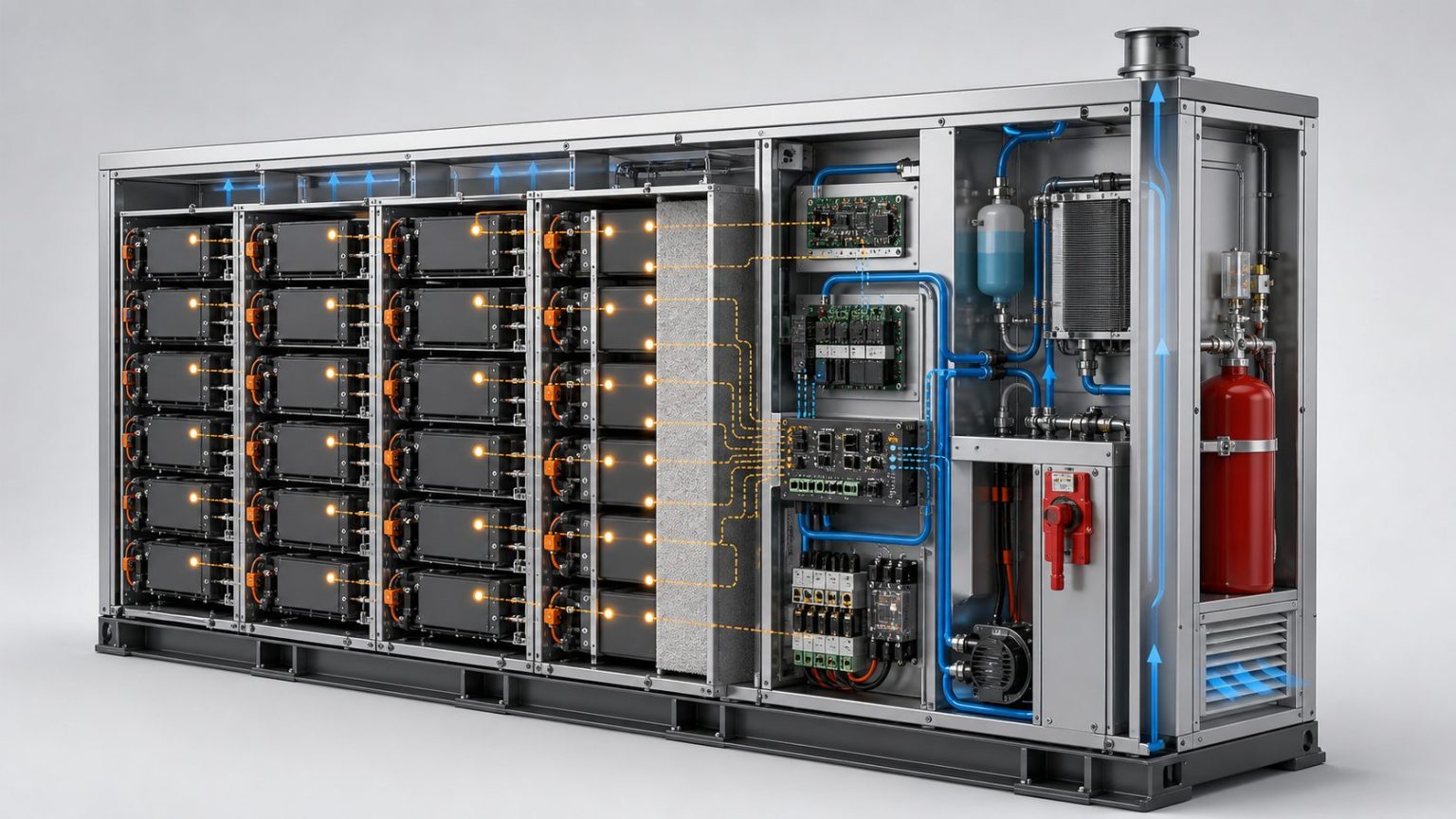
The safety-layer illustration shows why an RFQ must connect the cell, thermal path, sensing, electrical isolation, enclosure and emergency response. A buyer comparing architectures can use the solid-state energy storage system overview for selection context, then demand model-specific evidence for every layer shown in the final design.
Check Whether Heat and Gas Can Reach the Next Unit
The useful question is not merely whether one cell can enter thermal runaway under abuse. The project team needs to know what happens next: where heat, flame, particles and gases travel; whether adjacent cells or modules become involved; and how the enclosure influences pressure and exposure.
Review the result against the actual arrangement, including rack spacing, cable penetrations, cabinet-to-cabinet distance and nearby occupied areas. For larger installations, the design principles discussed in engineering a 5MWh BESS can help frame system integration, but the project's fire and explosion analysis must remain configuration-specific.
- Where are hot gases intended to discharge, and can they reach an air intake or escape route?
- What prevents a single-cell event from heating adjacent cells, modules or cabinets?
- How are smoke, temperature and relevant gas indicators detected before escalation?
- What electrical isolation occurs at alarm, trip and emergency-stop stages?
- What access, water supply, standoff distance and responder information are required?
Witness BMS Protection Logic, Not Just a Dashboard
A screen showing normal temperatures does not prove that protection will work during a fault. The BMS, PCS, EMS, HVAC and fire system must exchange the right signals, assign priorities correctly and move the equipment to a defined safe state when a sensor fails or a limit is exceeded.
| Witnessed scenario | Expected evidence | Buyer acceptance point |
|---|---|---|
| Cell-temperature warning | Live value, time-stamped alarm, affected location and operator notification | Alarm threshold and delay match the approved cause-and-effect matrix |
| Temperature trip | Charge/discharge restriction followed by the specified isolation sequence | Contactors and PCS respond without relying on a manual dashboard action |
| Sensor open/short circuit | Diagnostic alarm, degraded-mode rule and maintenance instruction | A failed sensor cannot be interpreted as a safe temperature |
| Loss of cooling flow | Flow or pressure alarm, derating/trip action and recorded event | The response protects the battery before the temperature limit is exceeded |
| Loss of communications | Fail-safe behaviour at BMS, PCS and supervisory controls | Each controller has an agreed fallback state and recovery procedure |
| Emergency stop | Defined DC/AC isolation, retained safety services and reset control | The E-stop does not disable essential detection or emergency communication |
Ask the supplier to export the event log after each injected condition and attach it to the FAT record. Buyers evaluating cabinet equipment can compare this control philosophy with the outdoor cabinet ESS range, while keeping the final acceptance limits tied to the model actually quoted.
Verify Thermal Management Under a Real Duty Profile
Cooling must be assessed against the site's ambient conditions, power profile, solar exposure, altitude, dust and maintenance plan. A steady idle display or a short factory charge is not equivalent to sustained operation at the project's maximum charge and discharge duties.
yaseMegSolid 261.24kWh hybrid solid-state ESS is listed with intelligent liquid cooling, AI early warning and an algorithm intended to control temperature difference within Malunga ne-5°C. Treat these as design features to verify during model-specific document review and testing, not as substitutes for a propagation report or a site thermal study.
- Submit the hourly or sub-hourly charge/discharge profile and maximum expected C-rate.
- State minimum, normal and maximum ambient temperature at the equipment location.
- Confirm HVAC or liquid-cooling capacity, auxiliary supply and alarm interfaces.
- Measure cell or module temperature spread during the agreed FAT duty cycle.
- Define coolant inspection, filter, pump, fan and heat-exchanger maintenance tasks.
Use FAT to Convert Design Promises into Records
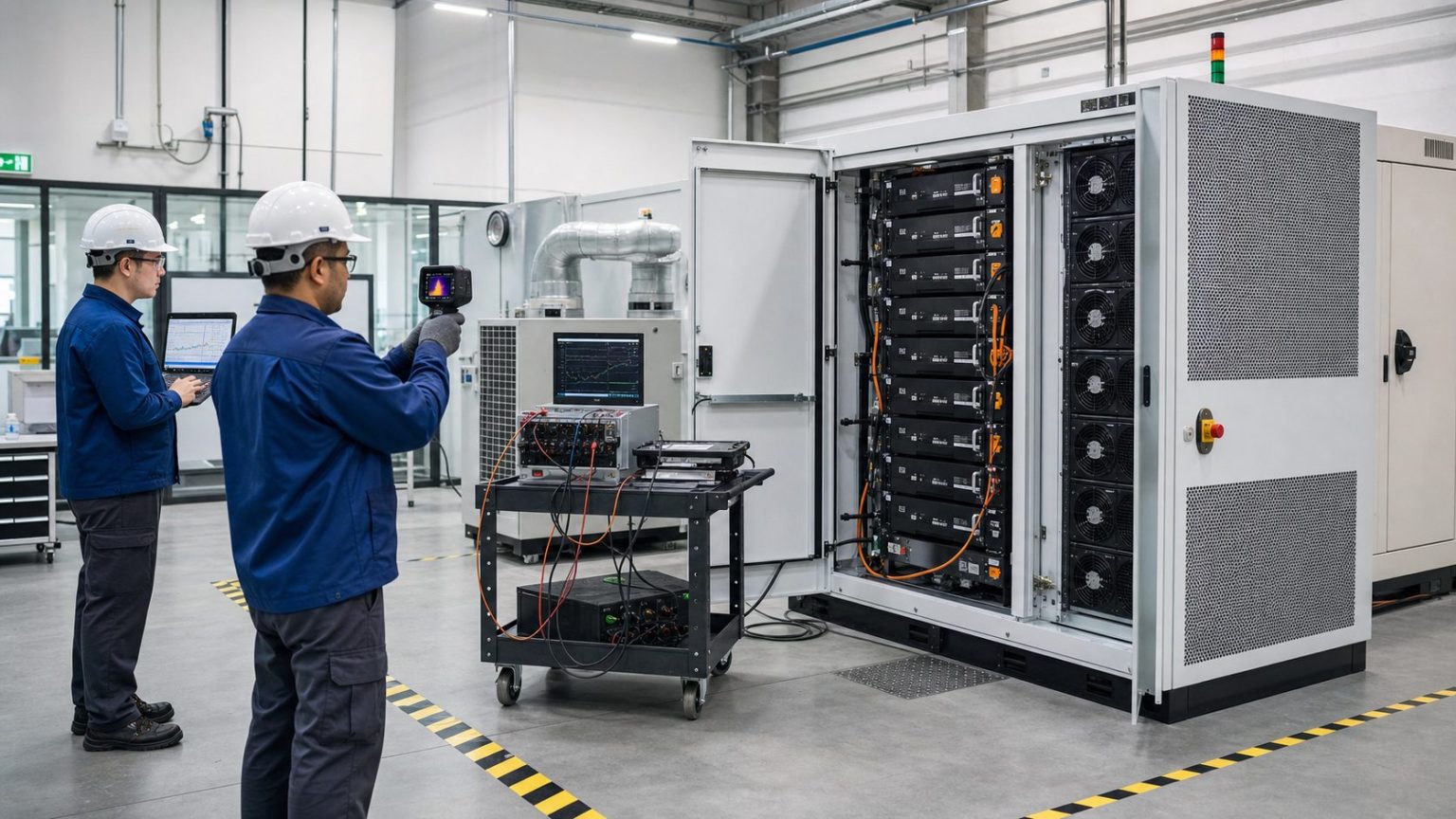
Factory acceptance testing should produce traceable evidence, not a ceremonial power-on. The buyer, EPC or independent witness should approve the protocol before travel, identify simulated inputs, define pass/fail criteria and record serial numbers plus firmware versions on the test day.
- Verify nameplates, serial numbers and the approved BOM against the purchase order.
- Inspect torque records, cable routing, insulation, earthing, enclosure seals and coolant circuits.
- Test alarm, trip, interlock and emergency-stop logic using controlled signal injection.
- Demonstrate loss of auxiliary power, communications and cooling according to the protocol.
- Verify the PCS operating limits and BMS permission chain at safe test power.
- Export event logs, photographs, calibration records, non-conformances and closure evidence.
- Reserve shipment approval until critical deviations are closed or contractually controlled.
A detailed Isikhokelo se-RFQ se-BESS epholisiweyo ngokwengcambu esiyi-261kWh can help structure the data exchange before FAT. For container-scale procurement, use the same evidence discipline when reviewing the 5000INTL containerized ESS, because a larger enclosure creates additional integration and site-interface questions.
Make SAT Reproduce the Risks of the Actual Site
Site acceptance testing confirms that factory-tested equipment still performs correctly after transport, installation and integration. The SAT must include the final protection settings, network addresses, cable terminations, auxiliary supplies, fire interfaces, emergency-stop stations and remote notifications.
South African projects: the local EPC must coordinate electrical compliance, fire design, civil layout, utility requirements and operating procedures with the relevant authorities and professionals. A buyer searching for a reliable solid-state BESS in South Africa should therefore assess the factory supplier and local integration team as one delivery chain.
- Confirm the installed model, serial numbers, firmware and protection settings match FAT records.
- Test local and remote alarms, communication loss, emergency stops and authorised reset paths.
- Verify ventilation, drainage, access control, signage, clearances and responder access.
- Check the handover pack, spare-parts list, training attendance and maintenance schedule.
- Run a documented emergency drill with the owner, operator, EPC and safety representatives.
Score Suppliers by Traceability, Not by the Strongest Adjective
A procurement scorecard keeps safety evidence comparable across quotations. It also reveals the difference between a manufacturer that can discuss cell technology and a delivery team that can close system, installation and lifecycle obligations.
| Decision area | Strong submission | Warning sign |
|---|---|---|
| Model traceability | Reports, drawings and BOM use consistent model and revision identifiers | Generic certificates with no link to the quoted product |
| Thermal-runaway evidence | Full test scope, configuration, observations and limitations are available | A marketing sentence replaces the report conditions |
| Ingqiqo yokukhusela | Approved cause-and-effect matrix is witnessed and logged during FAT | Only a normal-operation dashboard demonstration is offered |
| Change control | Safety-relevant substitutions require engineering review and buyer approval | Supplier reserves unrestricted rights to replace components |
| Local integration | Named EPC responsibilities, site interfaces and SAT criteria are documented | Factory scope ends without clear local ownership |
| Handover and lifecycle | Training, spares, maintenance, incident data and document updates are defined | Acceptance ends at delivery with no controlled handover pack |
Manufacturer lists can support initial discovery, including this guide to solid-state battery manufacturers in China, but they do not replace project due diligence. Use the Isikhokelo se-C&I sokugcinwa kwamandla kwimo engaguqukiyo to shortlist architectures, then apply the evidence scorecard to the exact offer.
Send a Complete Safety Data Pack with the RFQ
A supplier cannot design a useful safety response from battery capacity alone. Send the duty profile, site layout, ambient envelope, grid arrangement, fire strategy, communications requirements and authority constraints before requesting a firm technical offer.
- Required usable energy, AC power, overload duty and charge/discharge profile
- Single-line diagram, point of connection, earthing philosophy and available fault level
- Site coordinates, altitude, ambient conditions, dust, corrosion and flood exposure
- Equipment room or outdoor layout, separation distances and occupied-area interfaces
- Applicable standards, permitting path and authority having jurisdiction
- Fire detection, alarm, suppression, water, ventilation and responder requirements
- SCADA/EMS protocol, remote alarm destinations and cybersecurity responsibilities
- Required reports, FAT/SAT witness points, training, spares and document language
MegSolid can review this project data and help map an appropriate product architecture to the RFQ. Before contacting the team, consult the MegSolid resource centre kwaye company profile, then identify which test records and interfaces your EPC requires.
Approve the Evidence Package, Then Approve the Equipment
The practical response to solid state battery thermal runaway is neither blind trust nor automatic rejection. Approve a BESS when the safer-chemistry claim, exact BOM, applicable test evidence, protection logic, thermal design, fire interfaces and FAT/SAT records form one traceable package with clearly stated limitations.
This method keeps the decision commercial as well as technical: open evidence gaps become quotation clarifications, contractual hold points or priced risk instead of late commissioning disputes. It also lets MegSolid and the local EPC respond to a defined requirement rather than guessing what “safe solid-state battery” means for the buyer's site.
Imibuzo Ebuzwa Rhoqo
Ingaba ibhetri ye-solid-state ingaba nokuphuma elawulweni ngenxa yobushushu?
Uyilo lwe-solid-state okanye lwe-hybrid solid-state lunokunciphisa umngcipheko wokunyuka kobushushu okungalawulekiyo, kodwa abathengi akufuneki bacinge ukuba lo mngcipheko uphelile. Iziphene zombane, umonakalo womatshini, iziphene zokuvelisa, ukutshaja ngokugqithisileyo, ukufudunyezwa ngaphandle kunye nokudityaniswa kwezinye iinkqubo zisafuna uvavanyo olulungiselelwe le modeli kunye nokhuseleko olunamanqanaba.
Ingaba i-UL 9540A ingqina ukuba i-BESS ayinakutsha?
Hayi. I-UL 9540A yindlela yovavanyo esetyenziselwa ukuvavanya iimpawu zokunwenwa komlilo okubangelwa kukushisa okugqithisileyo phantsi kweemeko ezimisiweyo. Phonononga inqanaba elivavanyiweyo, ulwakhiwo, imeko yeshaji, iingqwalasela nemida, uze uzithelekise nofakelo olucetywayo.
Ingaba i-UN 38.3 yanele na ukuvumela i-BESS engashukumiyo ye-solid-state?
Hayi. I-UN 38.3 ijongene novavanyo lwezothutho lweeseli neebhetri ze-lithium. Imvume yenkqubo emileyo ikwafuna ubungqina obufanelekileyo bemveliso, yofakelo kunye neprojekthi, kubandakanywa i-logic yokhuseleko, i-fire interfaces, i-FAT/SAT kunye nokwamkelwa kwekhowudi yasekuhlaleni.
What should a thermal-runaway test report identify?
It should identify the test method, cell or system model, revision, test level, state of charge, initiation method, physical arrangement, ventilation, measurements, observations and result. The buyer must be able to map those details to the offered BOM.
Why must the BOM match the safety report?
Changes to cells, module hardware, spacing, insulation, cooling, sensors, firmware or fire components can change system behaviour. A controlled BOM and deviation process show whether existing evidence remains applicable after a substitution.
What BMS functions should be witnessed during FAT?
Witness temperature warning and trip, sensor fault detection, loss of cooling, communication failure, charge/discharge restriction, contactor isolation, emergency stop and event logging. Use approved thresholds and pass/fail criteria rather than an informal demonstration.
Does a liquid-cooled BESS eliminate thermal-runaway risk?
No. Liquid cooling can improve temperature control, but it does not eliminate every internal or external fault. Verify thermal performance, flow and leak detection, alarm logic, maintenance duties and the response to cooling loss.
Should a buyer request the full UL 9540A report?
Request enough authorised technical information to understand the tested configuration, conditions, results and limitations. A certificate image or marketing summary alone may not show whether the test is relevant to the offered installation.
What is the difference between FAT and SAT for BESS safety?
FAT verifies the manufactured equipment, protection logic and records before shipment. SAT verifies the installed system, final settings, site interfaces, emergency controls, communications and handover after transport and integration.
Who should approve the BESS fire strategy?
The project team should assign a qualified local fire professional and EPC to coordinate the manufacturer data with the site, occupancy, applicable code and authority having jurisdiction. A battery supplier's generic layout should not be treated as local approval.
What site data affects thermal safety?
Important inputs include ambient temperature, altitude, solar exposure, ventilation, enclosure arrangement, separation distances, nearby occupancies, flood and corrosion exposure, duty profile, grid conditions and emergency access.
How should suppliers be compared when safety claims differ?
Use a common claim-to-evidence matrix. Score model traceability, report relevance, propagation data, protection logic, change control, local integration, FAT/SAT and lifecycle support instead of ranking suppliers by promotional wording.
What should I send MegSolid for a model-specific review?
Send required usable energy and AC power, charge/discharge profile, single-line diagram, site conditions, layout constraints, applicable standards, fire-system interfaces, communications needs and required FAT/SAT witness points.