 Skip to content
A solid-state label is not enough to approve a battery energy storage system: the buyer must verify the exact cell, module, rack and system evidence behind every thermal-runaway claim. MegSolid recommends treating solid state battery thermal runaway as a procurement-verification task, with the approved BOM, propagation-test evidence, protection logic and witnessed FAT tied to the equipment offered. This approach helps a buyer select a safer architecture without assuming that chemistry alone controls every installation risk.
- Separate chemistry claims from complete-system evidence.
- Match every report to the quoted model, BOM revision and installation configuration.
- Witness BMS, detection, shutdown and communication responses during FAT.
- Carry the same safety assumptions into site design, SAT and handover.
Do Not Approve a BESS from the Chemistry Name Alone
Solid-state and hybrid solid-state cells are developed to reduce dependence on flammable liquid electrolyte and improve intrinsic safety, but a commercial BESS still contains electrical connections, conductors, control electronics, insulation, cooling components and stored energy. The MegSolid technical overview of hybrid solid-state batteries explains the cell-level angle; this buyer checklist addresses the different question of whether the delivered system has enough traceable evidence for approval.
Procurement decision: evaluate the cell chemistry as one safety layer, not as a substitute for system engineering. The U.S. Department of Energy's Energy Storage Safety Strategic Plan frames safety across research, codes and standards, manufacturing, commissioning, operation and incident response; a defensible RFQ should do the same across the project life cycle.
Solid State Battery Thermal Runaway: Build a Claim-to-Evidence Matrix
Start by rewriting every safety statement in the quotation as a claim that can be checked. Words such as “safe,” “non-flammable” or “no propagation” have little procurement value unless the supplier identifies the tested object, method, conditions, result, report number and product revision.
| Supplier claim | Evidence to request | Approval question |
|---|---|---|
| Safer cell chemistry | Cell construction statement and applicable abuse-test report | Is the tested cell the same manufacturer, model, capacity and revision as the offered BOM? |
| Thermal runaway does not propagate | Module-, rack- or system-level propagation report with setup and observations | Does the test arrangement match spacing, enclosure, ventilation and state of charge in the project? |
| Early warning | Sensor list, alarm thresholds, BMS cause-and-effect matrix and event records | Will the system detect the relevant precursor and trigger a defined response? |
| Automatic fire protection | Detection and suppression drawings, interfaces, release logic and maintenance plan | Is the design accepted by the local fire engineer and authority having jurisdiction? |
| Certified system | Certificate, scope, model designation, report reference, issuer and validity | Does the certificate cover the exact complete system being purchased? |
Before paying a deposit: put this matrix into the technical schedule and mark each row Approved, Conditional or Open. The process prevents a brochure-level statement from silently becoming a contractual acceptance criterion that neither party can measure.
Read the Test Name Before Reading the Result
Different documents answer different questions. UN 38.3 addresses transport testing for lithium cells and batteries; it is not a complete stationary-system fire assessment. UL 9540 addresses an energy storage system and equipment certification pathway, while UL 9540A is a test method used to evaluate thermal-runaway fire propagation characteristics.
For stationary projects, also determine which edition of the installation and safety rules the local authority will enforce. NFPA 855 and IEC 62933-5-2:2025 may inform a project specification, but the EPC and fire professional must map applicable requirements to the country, site, occupancy and adopted code.
- Confirm whether the tested object was a cell, module, rack, cabinet or complete container.
- Record test state of charge, initiation method, spacing, ventilation and enclosure condition.
- Check whether doors, panels, ducts, HVAC and suppression matched the offered design.
- Ask for the complete report or an authorised technical extract, not only a certificate image.
- Require the EPC to document which result changes the layout, separation or emergency plan.
Freeze the BOM Before You Accept Any Report
A valid-looking report can still be irrelevant if the production unit uses a different cell, module frame, busbar, fuse, connector, insulation material, coolant path, sensor or firmware. The buyer should create a controlled baseline connecting the quotation, general arrangement, single-line diagram, bill of materials, software revision and test evidence.
Change-control rule: no safety-relevant substitution should be accepted through a purchasing email alone. Require an engineering deviation notice that states why the part changed, which hazards were reassessed, which tests remain applicable and whether a new test is required.
- Cell manufacturer, model, chemistry description, capacity and production revision
- Module and rack configuration, mechanical spacing and interconnection method
- BMS hardware, firmware version, sensor types and calibrated measurement ranges
- DC protection, contactors, fuses, isolation monitoring and emergency-stop chain
- Cooling architecture, coolant specification, pump redundancy and leak detection
- Fire detection, alarm, ventilation, suppression and external interface components
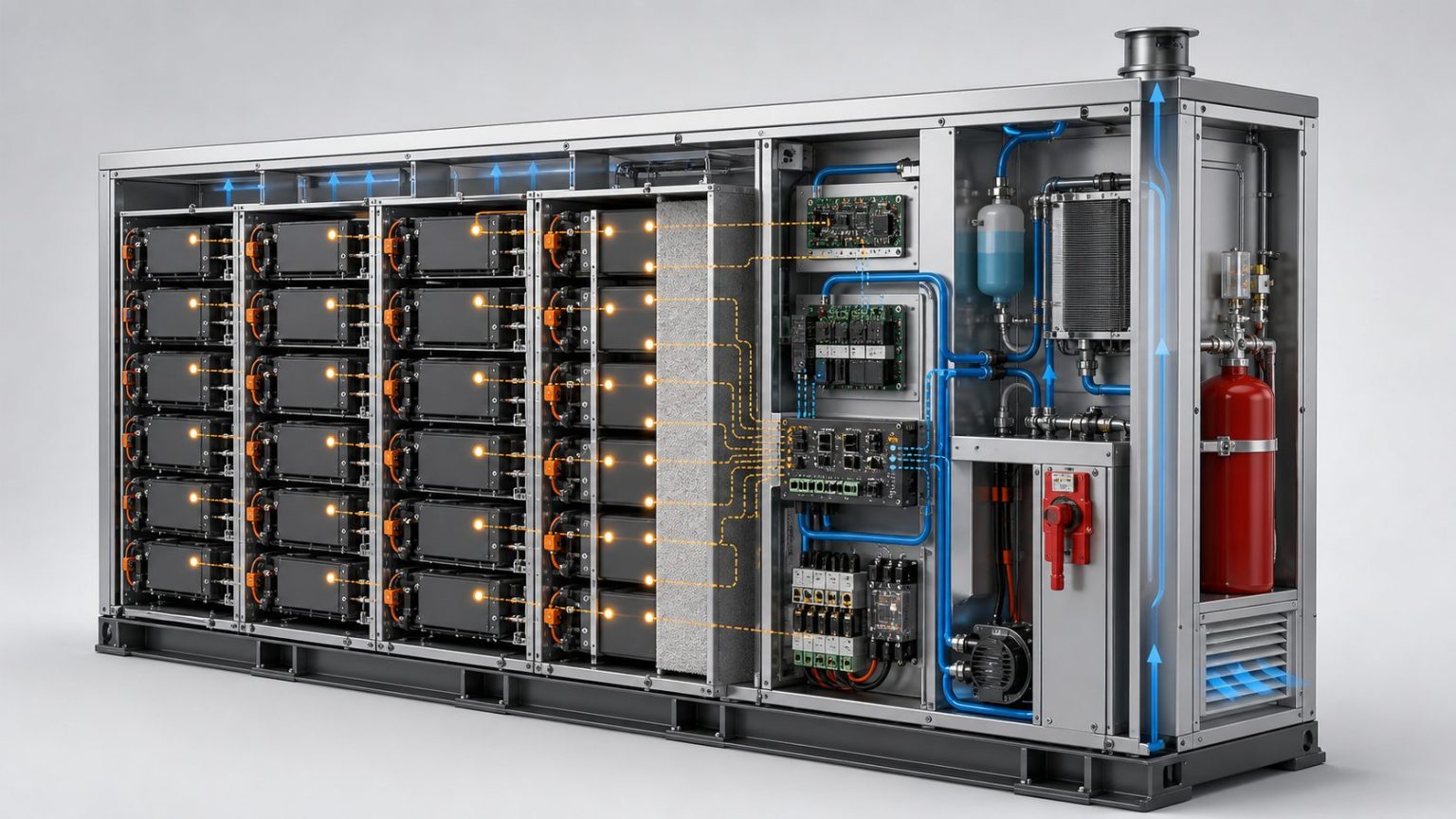
The safety-layer illustration shows why an RFQ must connect the cell, thermal path, sensing, electrical isolation, enclosure and emergency response. A buyer comparing architectures can use the solid-state energy storage system overview for selection context, then demand model-specific evidence for every layer shown in the final design.
Check Whether Heat and Gas Can Reach the Next Unit
The useful question is not merely whether one cell can enter thermal runaway under abuse. The project team needs to know what happens next: where heat, flame, particles and gases travel; whether adjacent cells or modules become involved; and how the enclosure influences pressure and exposure.
Review the result against the actual arrangement, including rack spacing, cable penetrations, cabinet-to-cabinet distance and nearby occupied areas. For larger installations, the design principles discussed in engineering a 5MWh BESS can help frame system integration, but the project's fire and explosion analysis must remain configuration-specific.
- Where are hot gases intended to discharge, and can they reach an air intake or escape route?
- What prevents a single-cell event from heating adjacent cells, modules or cabinets?
- How are smoke, temperature and relevant gas indicators detected before escalation?
- What electrical isolation occurs at alarm, trip and emergency-stop stages?
- What access, water supply, standoff distance and responder information are required?
Witness BMS Protection Logic, Not Just a Dashboard
A screen showing normal temperatures does not prove that protection will work during a fault. The BMS, PCS, EMS, HVAC and fire system must exchange the right signals, assign priorities correctly and move the equipment to a defined safe state when a sensor fails or a limit is exceeded.
| Witnessed scenario | Expected evidence | Buyer acceptance point |
|---|---|---|
| Cell-temperature warning | Live value, time-stamped alarm, affected location and operator notification | Alarm threshold and delay match the approved cause-and-effect matrix |
| Temperature trip | Charge/discharge restriction followed by the specified isolation sequence | Contactors and PCS respond without relying on a manual dashboard action |
| Sensor open/short circuit | Diagnostic alarm, degraded-mode rule and maintenance instruction | A failed sensor cannot be interpreted as a safe temperature |
| Loss of cooling flow | Flow or pressure alarm, derating/trip action and recorded event | The response protects the battery before the temperature limit is exceeded |
| Loss of communications | Fail-safe behaviour at BMS, PCS and supervisory controls | Each controller has an agreed fallback state and recovery procedure |
| Emergency stop | Defined DC/AC isolation, retained safety services and reset control | The E-stop does not disable essential detection or emergency communication |
Ask the supplier to export the event log after each injected condition and attach it to the FAT record. Buyers evaluating cabinet equipment can compare this control philosophy with the outdoor cabinet ESS range, while keeping the final acceptance limits tied to the model actually quoted.
Verify Thermal Management Under a Real Duty Profile
Cooling must be assessed against the site's ambient conditions, power profile, solar exposure, altitude, dust and maintenance plan. A steady idle display or a short factory charge is not equivalent to sustained operation at the project's maximum charge and discharge duties.
MegSolid's 261.24kWh hybrid solid-state ESS is listed with intelligent liquid cooling, AI early warning and an algorithm intended to control temperature difference within ±5°C. Treat these as design features to verify during model-specific document review and testing, not as substitutes for a propagation report or a site thermal study.
- Submit the hourly or sub-hourly charge/discharge profile and maximum expected C-rate.
- State minimum, normal and maximum ambient temperature at the equipment location.
- Confirm HVAC or liquid-cooling capacity, auxiliary supply and alarm interfaces.
- Measure cell or module temperature spread during the agreed FAT duty cycle.
- Define coolant inspection, filter, pump, fan and heat-exchanger maintenance tasks.
Use FAT to Convert Design Promises into Records
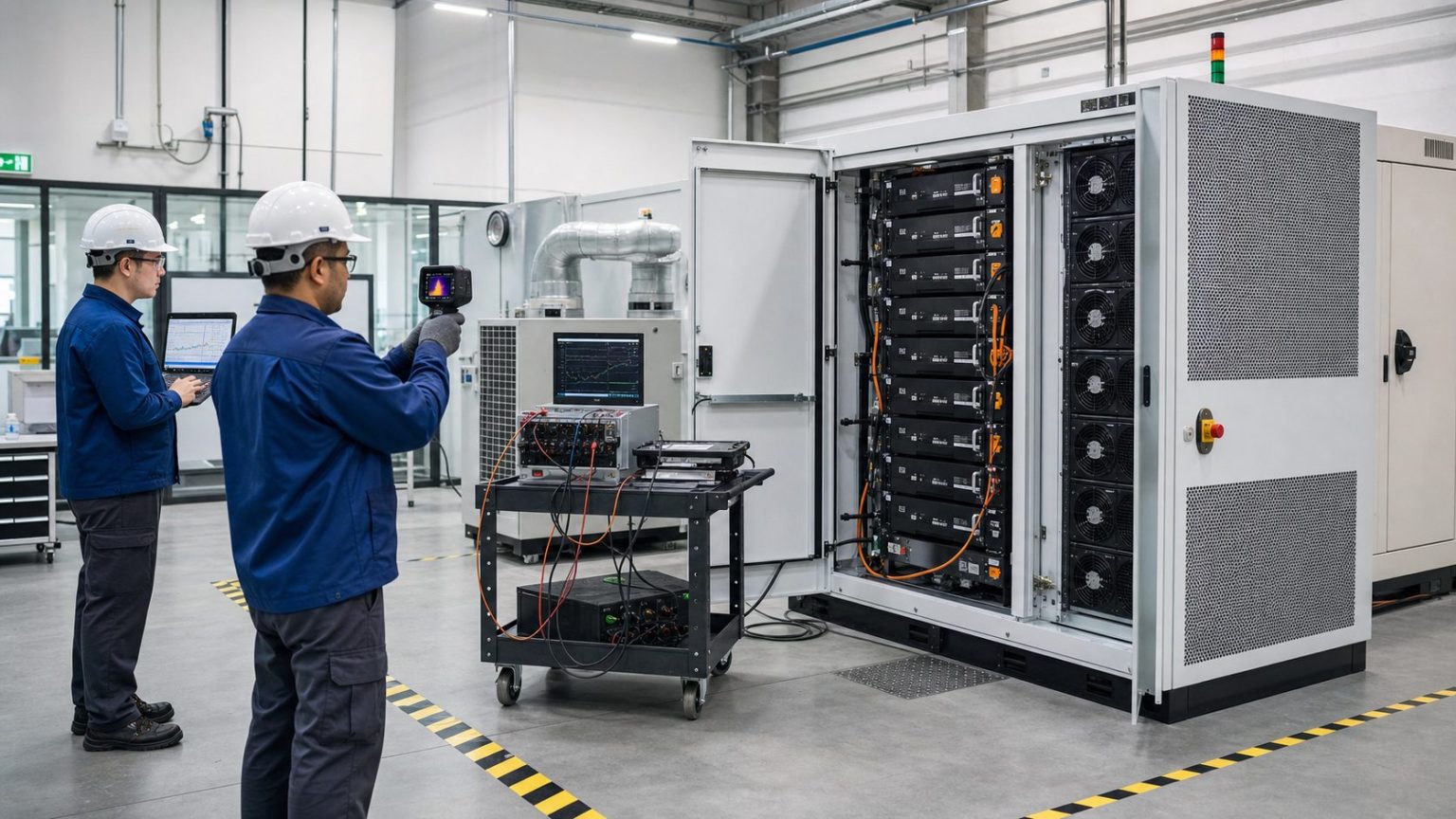
Factory acceptance testing should produce traceable evidence, not a ceremonial power-on. The buyer, EPC or independent witness should approve the protocol before travel, identify simulated inputs, define pass/fail criteria and record serial numbers plus firmware versions on the test day.
- Verify nameplates, serial numbers and the approved BOM against the purchase order.
- Inspect torque records, cable routing, insulation, earthing, enclosure seals and coolant circuits.
- Test alarm, trip, interlock and emergency-stop logic using controlled signal injection.
- Demonstrate loss of auxiliary power, communications and cooling according to the protocol.
- Verify the PCS operating limits and BMS permission chain at safe test power.
- Export event logs, photographs, calibration records, non-conformances and closure evidence.
- Reserve shipment approval until critical deviations are closed or contractually controlled.
A detailed 261kWh liquid-cooled BESS RFQ guide can help structure the data exchange before FAT. For container-scale procurement, use the same evidence discipline when reviewing the 5000INTL containerized ESS, because a larger enclosure creates additional integration and site-interface questions.
Make SAT Reproduce the Risks of the Actual Site
Site acceptance testing confirms that factory-tested equipment still performs correctly after transport, installation and integration. The SAT must include the final protection settings, network addresses, cable terminations, auxiliary supplies, fire interfaces, emergency-stop stations and remote notifications.
South African projects: the local EPC must coordinate electrical compliance, fire design, civil layout, utility requirements and operating procedures with the relevant authorities and professionals. A buyer searching for a reliable solid-state BESS in South Africa should therefore assess the factory supplier and local integration team as one delivery chain.
- Confirm the installed model, serial numbers, firmware and protection settings match FAT records.
- Test local and remote alarms, communication loss, emergency stops and authorised reset paths.
- Verify ventilation, drainage, access control, signage, clearances and responder access.
- Check the handover pack, spare-parts list, training attendance and maintenance schedule.
- Run a documented emergency drill with the owner, operator, EPC and safety representatives.
Score Suppliers by Traceability, Not by the Strongest Adjective
A procurement scorecard keeps safety evidence comparable across quotations. It also reveals the difference between a manufacturer that can discuss cell technology and a delivery team that can close system, installation and lifecycle obligations.
| Decision area | Strong submission | Warning sign |
|---|---|---|
| Model traceability | Reports, drawings and BOM use consistent model and revision identifiers | Generic certificates with no link to the quoted product |
| Thermal-runaway evidence | Full test scope, configuration, observations and limitations are available | A marketing sentence replaces the report conditions |
| Protection logic | Approved cause-and-effect matrix is witnessed and logged during FAT | Only a normal-operation dashboard demonstration is offered |
| Change control | Safety-relevant substitutions require engineering review and buyer approval | Supplier reserves unrestricted rights to replace components |
| Local integration | Named EPC responsibilities, site interfaces and SAT criteria are documented | Factory scope ends without clear local ownership |
| Handover and lifecycle | Training, spares, maintenance, incident data and document updates are defined | Acceptance ends at delivery with no controlled handover pack |
Manufacturer lists can support initial discovery, including this guide to solid-state battery manufacturers in China, but they do not replace project due diligence. Use the C&I solid-state energy storage guide to shortlist architectures, then apply the evidence scorecard to the exact offer.
Send a Complete Safety Data Pack with the RFQ
A supplier cannot design a useful safety response from battery capacity alone. Send the duty profile, site layout, ambient envelope, grid arrangement, fire strategy, communications requirements and authority constraints before requesting a firm technical offer.
- Required usable energy, AC power, overload duty and charge/discharge profile
- Single-line diagram, point of connection, earthing philosophy and available fault level
- Site coordinates, altitude, ambient conditions, dust, corrosion and flood exposure
- Equipment room or outdoor layout, separation distances and occupied-area interfaces
- Applicable standards, permitting path and authority having jurisdiction
- Fire detection, alarm, suppression, water, ventilation and responder requirements
- SCADA/EMS protocol, remote alarm destinations and cybersecurity responsibilities
- Required reports, FAT/SAT witness points, training, spares and document language
MegSolid can review this project data and help map an appropriate product architecture to the RFQ. Before contacting the team, consult the MegSolid resource centre and company profile, then identify which test records and interfaces your EPC requires.
Approve the Evidence Package, Then Approve the Equipment
The practical response to solid state battery thermal runaway is neither blind trust nor automatic rejection. Approve a BESS when the safer-chemistry claim, exact BOM, applicable test evidence, protection logic, thermal design, fire interfaces and FAT/SAT records form one traceable package with clearly stated limitations.
This method keeps the decision commercial as well as technical: open evidence gaps become quotation clarifications, contractual hold points or priced risk instead of late commissioning disputes. It also lets MegSolid and the local EPC respond to a defined requirement rather than guessing what “safe solid-state battery” means for the buyer's site.
FAQ
Can a solid-state battery experience thermal runaway?
A solid-state or hybrid solid-state design may reduce thermal-runaway risk, but buyers should not assume the risk is zero. Electrical faults, mechanical damage, manufacturing defects, overcharge, external heating and system integration still require model-specific testing and layered protection.
Does UL 9540A prove that a BESS cannot catch fire?
No. UL 9540A is a test method used to evaluate thermal-runaway fire propagation characteristics under defined conditions. Review the tested level, configuration, state of charge, observations and limitations, then compare them with the proposed installation.
Is UN 38.3 enough to approve a stationary solid-state BESS?
No. UN 38.3 addresses transport testing for lithium cells and batteries. Stationary-system approval also needs applicable product, installation and project evidence, including protection logic, fire interfaces, FAT/SAT and local code acceptance.
What should a thermal-runaway test report identify?
It should identify the test method, cell or system model, revision, test level, state of charge, initiation method, physical arrangement, ventilation, measurements, observations and result. The buyer must be able to map those details to the offered BOM.
Why must the BOM match the safety report?
Changes to cells, module hardware, spacing, insulation, cooling, sensors, firmware or fire components can change system behaviour. A controlled BOM and deviation process show whether existing evidence remains applicable after a substitution.
What BMS functions should be witnessed during FAT?
Witness temperature warning and trip, sensor fault detection, loss of cooling, communication failure, charge/discharge restriction, contactor isolation, emergency stop and event logging. Use approved thresholds and pass/fail criteria rather than an informal demonstration.
Does a liquid-cooled BESS eliminate thermal-runaway risk?
No. Liquid cooling can improve temperature control, but it does not eliminate every internal or external fault. Verify thermal performance, flow and leak detection, alarm logic, maintenance duties and the response to cooling loss.
Should a buyer request the full UL 9540A report?
Request enough authorised technical information to understand the tested configuration, conditions, results and limitations. A certificate image or marketing summary alone may not show whether the test is relevant to the offered installation.
What is the difference between FAT and SAT for BESS safety?
FAT verifies the manufactured equipment, protection logic and records before shipment. SAT verifies the installed system, final settings, site interfaces, emergency controls, communications and handover after transport and integration.
Who should approve the BESS fire strategy?
The project team should assign a qualified local fire professional and EPC to coordinate the manufacturer data with the site, occupancy, applicable code and authority having jurisdiction. A battery supplier's generic layout should not be treated as local approval.
What site data affects thermal safety?
Important inputs include ambient temperature, altitude, solar exposure, ventilation, enclosure arrangement, separation distances, nearby occupancies, flood and corrosion exposure, duty profile, grid conditions and emergency access.
How should suppliers be compared when safety claims differ?
Use a common claim-to-evidence matrix. Score model traceability, report relevance, propagation data, protection logic, change control, local integration, FAT/SAT and lifecycle support instead of ranking suppliers by promotional wording.
What should I send MegSolid for a model-specific review?
Send required usable energy and AC power, charge/discharge profile, single-line diagram, site conditions, layout constraints, applicable standards, fire-system interfaces, communications needs and required FAT/SAT witness points.
