 Skip to content
I. Engineering Trade-offs and Compromises in Solid-State Battery Technology Pathways
Sulfide vs. Oxide: The Mass-Production Constraints Behind High Ionic Conductivity
Laboratory data shows that sulfide solid-state electrolytes can achieve room-temperature ionic conductivity of 10⁻³~10⁻² S/cm — on par with liquid electrolytes and more than 10 times higher than the oxide pathway. This is the core reason the sulfide route has long been regarded as the preferred pathway for all-solid-state batteries.
But the challenges this figure faces at the mass-production end are substantial, not incremental.
Interfacial impedance is the first wall. The physical contact area of a solid-solid interface is far inferior to the "wetting" effect of a solid-liquid interface. During charge and discharge, anode materials — particularly silicon-based anodes — expand in volume by 10%~30%. A solid-state electrolyte cannot flow and fill gaps the way a liquid electrolyte can, so interfacial contact gradually degrades, impedance rises, and capacity drops directly.
Assembly pressure is the second wall. The electrochemical performance of sulfide cells depends on a continuously applied stack pressure of 5~100 MPa to maintain interfacial contact. This means cell module structures must incorporate a continuous pressurization mechanism. Conventional winding production lines cannot be directly adapted — dedicated isostatic pressing or stacking equipment is required, and the capital threshold per production line is significantly higher than the existing liquid-electrolyte route.
Chemical stability is the third wall. Sulfide materials react with moisture to generate H₂S, imposing dew-point requirements in the production environment as strict as below -40°C, which creates ongoing pressure on facility construction and operating costs. Oxide electrolytes (LLZO being the representative) offer better chemical stability, but their room-temperature conductivity is only around 10⁻⁶~10⁻⁵ S/cm, and achieving a dense structure requires high-temperature sintering above 800°C — both energy consumption and process complexity are limiting factors.
The conclusion is: neither all-solid-state pathway has resolved the core cost contradiction of mass production. The timelines announced by leading companies have been repeatedly pushed back, and this is fundamentally an engineering problem, not a capital or intent problem.
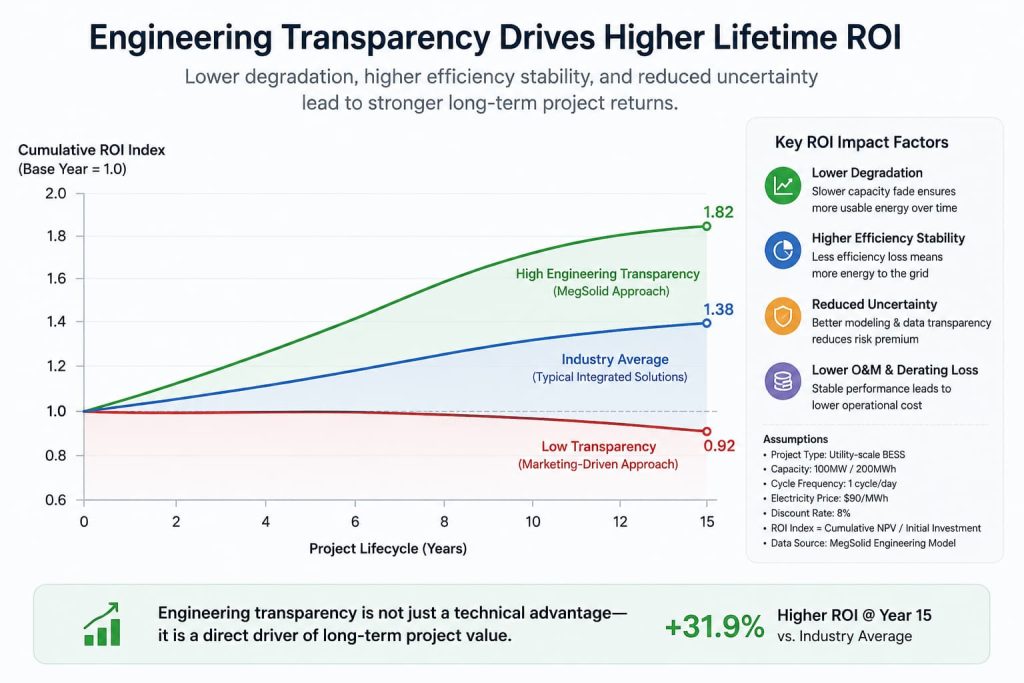
II. Global Solid-State Production Landscape and Key Player Matrix
OEMs and Traditional Battery Giants: Full Value Chain Positioning
The technology routes and timelines of the major players differ substantially and should not be conflated.
Toyota has the deepest patent portfolio in the sulfide all-solid-state route (holding more than 1,000 relevant patents as of 2024), with a target of deploying all-solid-state batteries in mass-production vehicles by 2027~2028 and an energy density target above 400 Wh/L. However, Toyota has acknowledged a remaining "100x cost gap" in manufacturing processes, and current all-solid-state samples still achieve fewer cycles than their liquid-electrolyte counterparts.
Samsung SDI pursues an anodeless architecture that theoretically eliminates the graphite anode and increases energy density by approximately 40%. Its target for mass production is 2027, but lithium dendrite suppression during actual cycling under the anodeless architecture remains an unsolved problem, and a significant gap persists between laboratory results and engineered products.
CATL's strategy is closer to the hybrid solid-state route — progressively reducing liquid electrolyte content through improvements to the electrolyte system and interface engineering, while incrementally increasing the solid-state ratio in stages without abandoning existing production line compatibility. Its mass-production timeline is relatively conservative, prioritizing technical reliability over the race to announce first.
At the cell architecture level, the combination of silicon-based anodes with solid-state electrolytes is the dominant research direction. Silicon's theoretical specific capacity (3,579 mAh/g) far exceeds that of graphite (372 mAh/g), but volume expansion is harder to manage in a solid-state system than in a liquid-electrolyte system, and the difficulty of interface design increases exponentially.
Independent Solid-State Technology Developers: Niche Market Entry Strategies
Compared to the full value chain bets placed by OEMs, independent solid-state technology developers typically choose high-premium niche markets as their starting point for commercial viability.
Miniature medical devices (such as implantable cardiac monitors and neural stimulators) have far higher demand for volumetric energy density than cost sensitivity. Solid-state micro-batteries (<1cc volume) can command a premium of 10~50 times the price of mainstream cells in this segment. Companies including Solid Power and Ilika have positioned themselves in this direction.
Wearable devices have requirements for charge/discharge rates and safety that have driven commercialization of thin-film solid-state batteries, but their individual cell capacity (typically <100 mAh) and manufacturing area constraints make it difficult to scale directly to industrial energy storage specifications (kWh and above).
This is the core paradox facing independent developers: technology validated in miniature high-premium applications typically retains less than 70% of its performance when scaled to pack level. Cell-level metrics, after series-parallel grouping, thermal management integration, and BMS matching, typically see effective energy density fall by 15%~25%, with cycle life further reduced by pack-level consistency constraints. This "scale-up discount" is a variable that must be factored into any assessment of the independent developer route.
III. MegSolid Hybrid Solid-State Solution: Breaking the Safety and Longevity Boundaries of Industrial Energy Storage
Cycle Degradation Suppression Mechanism of the Hybrid Solid-State Architecture
The longevity requirements of industrial energy storage are different from those of consumer electronics. C&I users expect battery systems to operate for 10~15 years, corresponding to 3,000~8,000 charge-discharge cycles, with capacity retention held above 80% throughout the entire period.
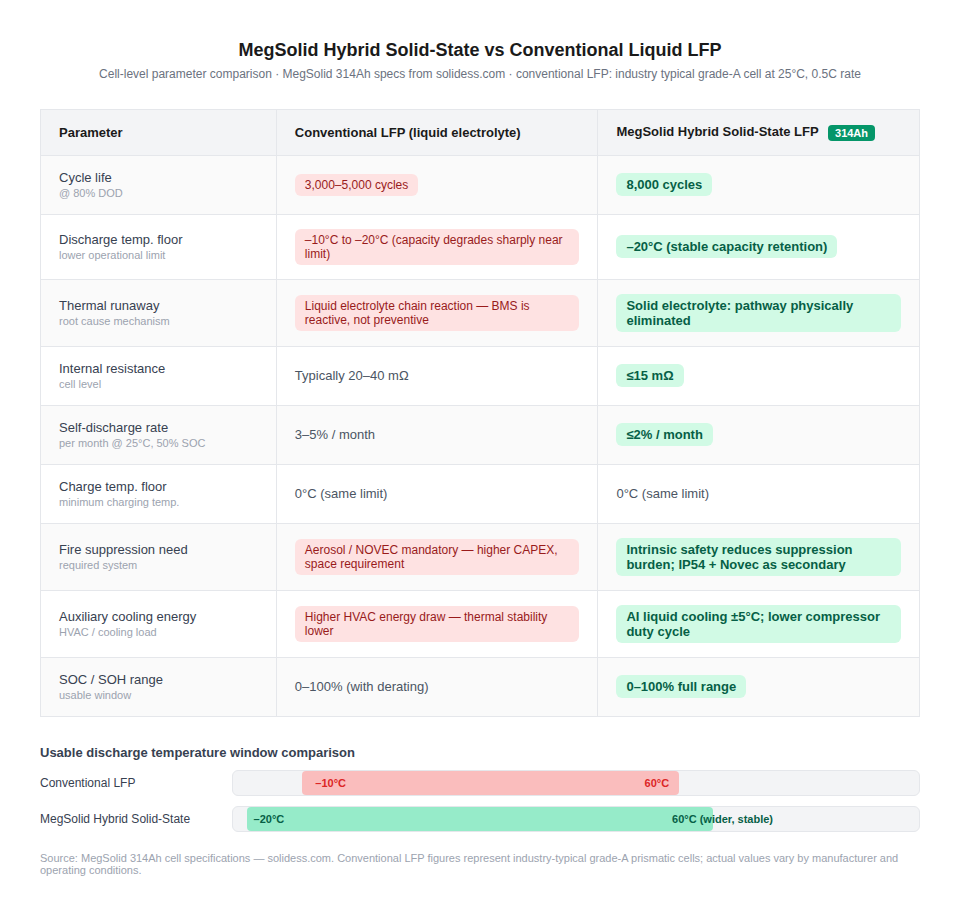
Conventional liquid LFP typically achieves 3,000~5,000 cycles at 80% DOD, which means a 10-year operating period may require 1~2 cell replacements — a hidden cost significantly higher than the initial purchase price suggests.
The MegSolid 314Ah hybrid solid-state cell has a rated cycle life of 8,000 cycles at 80% DOD. Two engineering mechanisms underpin this figure:
- Interfacial volume expansion management. The small amount of liquid component retained in the hybrid solid-state architecture acts as a "buffer layer" during charge-discharge cycling, absorbing the physical shock of anode volume expansion (particularly in silicon-containing anodes) against the solid electrolyte layer, and suppressing the periodic delamination of the solid-solid interface. This is the engineering foundation that makes 8,000 cycles achievable — not purely a function of the chemical stability of the material system.
- Precise BMS dispatch matching. The physical lifespan of a cell can only be realized in combination with precise charge-discharge control. MegSolid's C&I system (261.24 kWh) uses an AI early warning system with self-evolving algorithms to keep the temperature differential within the pack to within ±5°C. Temperature uniformity directly determines the consistency of degradation rates across individual cells, and is the critical factor determining whether pack-level lifespan can approach the single-cell nameplate value.
|
Parameter |
Conventional Liquid LFP |
MegSolid Hybrid Solid-State LFP (314Ah) |
|---|---|---|
| Cycle life (80% DOD) | 3,000~5,000 cycles | 8,000 cycles |
| Internal resistance | Typically 20~40 mΩ | ≤15 mΩ |
| Pack temperature uniformity | HVAC-dependent, typically ±10~15°C | AI liquid cooling ±5°C |
| Cell replacements within 10 years | Typically 1~2 | Theoretically 0 |
Eliminating the Liquid Liability: Intrinsic Safety and Environmental Tolerance
The chemical chain of thermal runaway is: overheating/overcharge → liquid electrolyte decomposition → flammable gas release → combustion/explosion. BMS protection logic intervenes early in this chain after it has already started — but once the chemical reaction crosses a critical threshold, software command speed cannot match the reaction rate.
The intervention point of the hybrid solid-state architecture is not the middle of the chain, but the beginning: reducing the absolute quantity of decomposable liquid solvent, so that the chemical trigger conditions for thermal runaway cannot sustain themselves energetically. This is the definition of intrinsic safety — passive protection that does not depend on sensors, BMS, or fire suppression systems.
On temperature tolerance, the comparison data is as follows:
|
Condition |
Conventional Liquid LFP |
MegSolid Hybrid Solid-State LFP |
|---|---|---|
| Low-temperature discharge cutoff | –10°C (notable capacity degradation) | –20°C (capacity remains stable) |
| Low-temperature charge cutoff | 0°C | 0°C (equivalent level) |
| High-temperature thermal runaway risk | Rises significantly with temperature | Solid electrolyte; chemical trigger threshold substantially elevated |
| HVAC auxiliary heating requirement | Heating module required in cold environments | Wider discharge temperature range reduces heating intervention frequency |
The practical engineering significance of the wide discharge temperature range (–20°C~60°C): in northern winter conditions, the heating activation temperature for energy storage enclosures can be set lower, compressor runtime decreases, and annual HVAC energy consumption falls. For a C&I system with a capacity of 261.24 kWh, HVAC energy consumption typically accounts for 3%~8% of total system energy consumption — a quantifiable cost saving over a 15-year operating period.
The fire suppression configuration of the MegSolid hybrid solid-state C&I system (261.24 kWh) is Novec + multi-sensor detector + water-based interlocking, with IP54 protection. This configuration level represents a reduced fire suppression requirement compared to conventional liquid LFP systems — which affects not only initial CAPEX, but also insurance premium rates and regulatory approval timelines.
IV. Commercial Validation: Food Processing Plant Backup Power ROI Case Analysis in Power-Deficit Markets
Downtime Risk Quantification and Power Demand Baseline
Food processing facilities in power-deficit markets — South Africa, Nigeria, Kenya, Pakistan, Indonesia, and comparable regions — face a compounded risk that facilities in stable-grid markets do not: grid outages are not exception events to plan around, they are baseline operating conditions to engineer for. The cost structure of an outage is the same regardless of geography; what changes is the frequency.
Power outage losses for a food processing facility are not a single figure — they are multiple loss chains triggering simultaneously.
Cold chain temperature zone disruption: After cold storage compressors shut down, internal temperatures rise at a rate of 3°C~5°C per hour (depending on the insulation grade of the storage structure and the thermal mass of the cargo). For frozen goods (stored at -18°C), temperatures exceeding -12°C trigger quality risk; if the outage exceeds 4 hours without backup power, batch write-off is a routine outcome, not an extreme scenario.
UHT sterilization line shutdown: Continuous sterilization equipment (such as UHT ultra-high-temperature instant sterilization lines) leaves residual material in a non-sterile state in the pipework after an uncontrolled shutdown. Before restarting, a full clean-in-place and sterilization-in-place cycle (CIP/SIP) must be completed, typically taking 2~4 hours during which there is no output.
Fresh raw material waste: Based on a mid-sized food processor handling 20 tonnes per day, with raw material inventory value of approximately USD 110,000, the write-off rate for cold chain materials during a 4-hour outage without power coverage is typically 30%~60%, representing direct losses of USD 33,000~USD 66,000 (excluding order breach penalties).
The common time threshold across these three loss chains is: outage tolerance < 10ms (for precision equipment protection), backup power duration ≥ 4 hours (for cold chain integrity). These two figures map directly to the specifications of the MegSolid R50KH3 three-phase hybrid inverter: backup switchover time <10ms, combined with the continuous discharge capability of the 261.24 kWh energy storage system.
Initial CAPEX and Lifecycle O&M Accounting
Solution A: Conventional Diesel Generator Set (500 kVA)
In markets with chronic power deficits — South Africa, Nigeria, Pakistan, Bangladesh, Indonesia, and across sub-Saharan Africa and Southeast Asia — diesel generators are typically the default backup solution. However, diesel costs in these regions are often higher than the global average due to fuel import dependency, logistics markups, and subsidy volatility. The cost structure below uses USD and reflects typical C&I project parameters in these markets.
|
Cost Item |
Value Range (Reference) |
|---|---|
| Equipment procurement (generator set + accessories) | USD 48,000~USD 70,000 |
| Annual fuel consumption (average 200h of operation per year) | USD 11,000~USD 17,000 |
| Annual scheduled maintenance (oil changes, filters, testing) | USD 2,000~USD 3,500 |
| 10-year overhaul (engine TBO) | USD 11,000~USD 21,000 (one-time) |
| Noise/emissions compliance modifications | USD 4,000~USD 11,000 (subject to local regulations) |
| Fire suppression (fuel tank area) | USD 7,000~USD 17,000 |
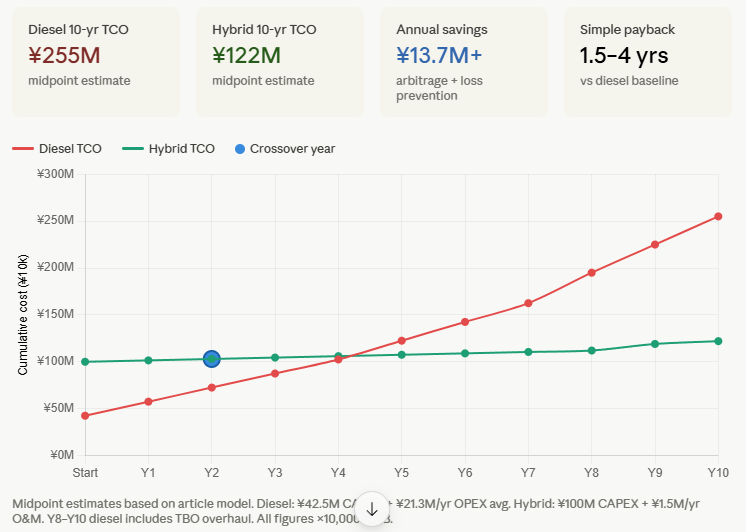
| 10-year total cost of ownership (including CAPEX) | Approx. USD 275,000~USD 430,000 |
Solution B: MegSolid Hybrid Solid-State Storage Solution
Configuration: R50KH3 three-phase hybrid inverter × 4 units + MegSolid hybrid solid-state C&I ESS (261.24 kWh) × 2 systems, covering 200 kW backup power + approximately 522 kWh of storage capacity.
|
Cost Item |
Value Range (Reference) |
|---|---|
| Equipment procurement (inverters + storage + installation) | USD 110,000~USD 165,000 |
| Annual O&M (remote monitoring + annual inspection) | USD 1,400~USD 2,800 |
| Fire suppression (IP54, Novec secondary protection) | Lower than diesel solution; no fuel tank area required |
| Footprint cost | Single 261.24 kWh system dimensions: 1300×1350×2200mm |
| Cell replacement cycle | 8,000 cycles → approx. 15~20 years, exceeding Solution A's evaluation period |
| 10-year total cost of ownership | Approx. USD 138,000~USD 200,000 |
- The figures above are engineering estimation reference ranges denominated in USD. Actual quotations will vary based on specific project configurations, installation conditions, local import duties, and prevailing electricity tariff structures in the target market.
When fire suppression retrofit costs are included in the comparison: under fire safety regulations, diesel solution fuel tank areas must have independent fire-barrier zones and automatic sprinkler systems, with compliance costs of USD 7,000~USD 17,000 and annual fire safety inspections. MegSolid's Novec system is standard equipment within the electrical enclosure, requiring no additional floor space or separate fire safety approval process.
Payback Period Modeling Based on Peak-Valley Arbitrage and Outage Loss Prevention
The financial returns from an energy storage solution come from three independent channels, each of which can be modeled separately. In power-deficit markets — South Africa, Nigeria, Kenya, Pakistan, Indonesia, the Philippines, and similar regions — Channel 3 (outage loss prevention) is typically the dominant driver, not an ancillary benefit. Grid outages in these markets are not rare events; in South Africa, for example, scheduled load-shedding (loadshedding) has reached Stage 6 in recent years, meaning up to 12+ hours of daily planned outages. In Nigeria and parts of sub-Saharan Africa, industrial facilities routinely lose grid power for 8~20 hours per day.
Channel 1: Peak-Valley Arbitrage (Peak Shaving)
C&I electricity tariffs in most power-deficit markets include time-of-use (TOU) pricing or peak demand surcharges. The effective peak-valley spread varies by country and utility, but a reference range of USD 0.08~USD 0.18/kWh is applicable across South Africa (Eskom TOU tariffs), Southeast Asian industrial zones, and parts of Latin America.
With 522 kWh of available storage, completing one full charge-discharge cycle per day (at 90% efficiency):
- Daily effective arbitrage volume: 522 kWh × 0.9 = 469.8 kWh
- Daily arbitrage revenue (at USD 0.12/kWh spread): approximately USD 56/day
- Annual arbitrage revenue: approximately USD 20,400/year
Channel 2: Demand Charge Management
C&I tariff structures in South Africa, Southeast Asia, and comparable markets typically include a maximum demand charge billed per kVA per month, at rates of approximately USD 4~USD 8/kVA·month. Discharging during peak periods can reduce the declared demand by 50~100 kVA, saving USD 2,400~USD 9,600 per year.
Channel 3: Outage Loss Prevention
In markets with chronic grid instability, this channel carries disproportionate weight. Assuming a conservative 4 significant unplanned or load-shedding outages per month (far below the actual frequency in South Africa Stage 4–6 conditions), each lasting approximately 2 hours, with a per-outage combined loss (cold chain + production line downtime + order delays) of USD 7,000~USD 21,000:
- Annual outage risk losses: USD 336,000~USD 1,008,000
- With storage coverage, losses drop to approximately USD 0 (switchover time <10ms, cold chain continuously protected)
In markets like South Africa where load-shedding is a daily operational reality, this channel alone justifies the CAPEX within the first year of deployment.
Simple payback period:
|
Incremental CAPEX (vs diesel solution) |
Annual combined returns (three channels) |
Simple payback period |
|---|---|---|
| USD 62,000~USD 97,000 | USD 358,800~USD 1,030,000/year | Well under 1 year in high-outage markets |
- Peak-valley arbitrage is a continuous revenue stream. The 8,000-cycle lifespan corresponds to approximately 15~20 years of operation. In markets where diesel fuel cost and grid unreliability are both structural, the long-term IRR advantage over diesel backup is compounded year over year.
V. Engineering Deployment Guide for Enterprise Energy Storage System Upgrades
Load Characteristic Assessment and System Expansion Redundancy Design
A site survey for an energy storage project is not a formality — the quality of the survey directly determines the accuracy of the subsequent equipment selection. The following is a standardized assessment checklist for industrial customers:
Transient power surge assessment:
- Record the startup current multiplier of the largest single motor on site (typically 5~8 times rated current, lasting 0.1~0.5s)
- Confirm the proportion of VFD variable frequency drives (VFDs can effectively suppress startup surges, which affects storage power redundancy design)
- Assess the voltage sag tolerance of precision equipment (typically within ±10%), and confirm whether UPS-grade response (<10ms) is required
High-frequency charge-discharge depth limits:
- If the system performs more than 2 charge-discharge cycles per day (e.g., peak shaving and emergency backup combined), a DOD limiting strategy must be evaluated
- The MegSolid 314Ah cell's rated cycle life is based on 80% DOD; restricting DOD to 70% in actual operation can further extend lifespan
- Confirm BMS SOC calibration accuracy (within ±1%) to avoid overcharge or over-discharge caused by misreported SOC
Grid interface protocol and storage interconnection standards:
- Confirm the local utility's THDi requirements for C&I storage grid interconnection (MegSolid outdoor cabinet system on-grid THDi < 3%, better than the 5% upper limit common in most international grid codes including South Africa's NRS 048 and IEC 61000 series)
- In markets with frequent islanding operation (off-grid or microgrid deployments common in sub-Saharan Africa and remote Southeast Asian industrial zones), confirm whether the system needs to operate in full off-grid mode and whether automatic on/off-grid switching is required (MegSolid MEGA series PCS supports automatic on/off-grid switching)
- Check whether four-quadrant operation (reactive power compensation) is required, and assess whether an isolation transformer is needed (MegSolid MEGA series PCS has a built-in isolation transformer)
- Confirm communication protocol requirements: RS485 / CAN / Modbus TCP, and whether SCADA or energy management platform integration is needed
Capacity expansion redundancy design principles:
- The MegSolid hybrid solid-state C&I system supports up to 10 units in parallel (261.24 kWh × 10 = 2,612.4 kWh), with no need to replace core equipment when expanding
- On the inverter side, the R50KH3 series supports multi-unit parallel operation with a clear expansion path
- Initial configurations should reserve 20%~30% power redundancy to accommodate demand growth from production line expansion or the addition of high-power equipment
- For projects at altitudes above 2,000m, derating factors must be confirmed in advance (MegSolid Containerized System 5000INTL rated altitude ceiling: ≤4,000m, IP55)
FAQ
Q1: Is a hybrid solid-state battery energy storage system safer than conventional LFP battery storage?
Yes. Hybrid solid-state batteries significantly reduce the amount of flammable liquid electrolyte, lowering the probability of thermal runaway at the source. MegSolid systems combine hybrid solid-state cells, AI-driven thermal management, Novec fire suppression, and multi-sensor detection to provide multiple layers of protection for commercial and industrial applications.
Q2: How long can a MegSolid hybrid solid-state battery system last in daily commercial operation?
MegSolid's 314Ah hybrid solid-state cells are rated for 8,000 cycles at 80% DOD, which can support approximately 15–20 years of operation in typical peak-shaving and backup power applications. This often eliminates the need for battery replacement during the project's economic life cycle.
Q3: Can hybrid solid-state batteries operate reliably in high-temperature environments such as Africa or the Middle East?
Yes. MegSolid hybrid solid-state battery systems are designed for harsh climates and support a wide operating temperature range of -20°C to 60°C. The reduced liquid electrolyte content improves thermal stability, making the system suitable for regions with extreme temperatures and unstable grid conditions.
Q4: What is the typical payback period for a commercial energy storage project?
Payback depends on electricity tariffs, outage frequency, and load profile. In markets with frequent power outages, such as South Africa, Nigeria, or Pakistan, many projects achieve a simple payback period of less than one year through outage loss prevention, peak-valley arbitrage, and demand charge reduction.
Q5: How much backup power capacity do I need for my factory or processing plant?
The required capacity depends on your critical loads, outage duration, and future expansion plans. MegSolid engineering teams typically conduct a load assessment to determine backup power requirements, ensuring critical equipment remains operational while optimizing project ROI.
Q6: Can MegSolid energy storage systems replace diesel generators completely?
In many applications, yes. Hybrid solid-state energy storage systems provide instant backup power with transfer times below 10ms, eliminate fuel costs, reduce maintenance requirements, and avoid emissions. For facilities experiencing frequent grid outages, energy storage often delivers a lower total cost of ownership than diesel generators.
Q7: What factors should be evaluated before selecting a commercial battery energy storage system?
Key factors include battery cycle life, safety architecture, thermal management performance, operating temperature range, expansion capability, grid compatibility, and total cost of ownership. Focusing only on battery capacity or initial price can lead to higher long-term operating costs.
Q8: Can the system be expanded as my business grows?
Yes. MegSolid commercial energy storage systems support up to 10 units in parallel, allowing capacity expansion to 2.6MWh+ without replacing existing equipment. This modular architecture helps businesses scale their energy infrastructure while protecting their initial investment.
Q9: How does MegSolid reduce battery degradation over time?
MegSolid combines hybrid solid-state cell architecture with AI-powered battery management and liquid cooling technology. The retained electrolyte buffer layer minimizes interface degradation, while temperature differences are controlled within ±5°C, helping maximize battery lifespan and system consistency.
Q10: How can I determine whether a hybrid solid-state energy storage solution is suitable for my facility?
The best approach is to perform a professional energy assessment covering load characteristics, outage frequency, electricity tariffs, backup power requirements, and future expansion plans. MegSolid can provide a customized ROI analysis and system sizing recommendation based on your facility's actual operating conditions.
