
A German EPC pays for tracing and rework when the delivered Commercial & Industrial (C&I) Battery Energy Storage Systems cannot be tied to the approved BOM. Put MegSolid ESSA0100B-0215, its PCS configuration, cell batch and software version into one supply schedule. Bring that schedule to the factory-review discussion so your team can compare equipment, documents and handover responsibility before shipment. The Energiewende opportunity still needs an order the EPC can verify.
A failed cabinet becomes harder to diagnose when its cell batch, converter firmware and released configuration cannot be traced. Give engineering a serial-to-BOM route and warranty escalation contact before purchase; that information helps isolate the affected equipment and plan support. A VDMA attribution or legal consequence needs its actual source rather than being inferred from a product label.
Treat the direct hybrid solid-state battery manufacturer relationship as a route to a defined supply package. Ask MegSolid to put the released BOM, traceability records, inspection/FAT scope, documents, spares and warranty response beside the quoted configuration. The value is faster access to the responsible product team and clearer deliverables—not automatic compliance or full formulation disclosure.
Key Takeaways
- A direct manufacturer relationship supports agreed released BOM and serial/batch evidence; define those deliverables in the quotation.
- Match the offered 768 V /1P240S cells with actual cell-level test criteria; the 51.2 V wall-module≤15mΩ listing is a different measurement.
- Quote the PCS/protection and required German connection evidence; THDi<3% alone is not complete VDE approval.
- ESSA lists ≥5, 000 cycles ; match retention/throughput obligations to the duty. IEC 62619 is a safety scope, not a universal life validation.
- Agree supplier/EPC/importer responsibilities and warranty/change control; direct sourcing does not automatically transfer liability.
Why Does Supply Chain Opacity Threaten German EPC Projects?
The German project needs clearly allocated supplier, EPC, operator and importer responsibilities. Traceability can improve diagnosis and evidence handover, whether the vendor is a manufacturer or authorized distributor. Specify the required records and response route instead of assuming every intermediary makes the equipment unverifiable.
The Liability Risks of "Black Box" BESS Procurement
A standard 215kWh outdoor cabinet contains hundreds of individual cells. If the supplier obscures the BOM, the EPC cannot verify:
- Cell origin:Identify the supplied cell model, batch and applicable report scope; do not assume every distributor suppliesB-grade cells.
- Safety scope:Identify cathode/electrolyte architecture and model/BOM-matched propagation evidence; formulation alone does not prove UL 9540A behavior.
- Batch route:Require serial/batch mapping and defect escalation regardless of sales channel; recall scope depends on the actual finding.
Navigating German Product Safety Laws (Produktsicherheitsgesetz)
Direct sourcing does not automatically transfer an EPC’s statutory or contractual responsibilities. Agree the supplied product’s applicable documents, change control, defect/warranty process and each party’s acceptance scope. The project’s legal and connection requirements need qualified, current review; the purchase contract should make the manufacturer’s deliverables enforceable.
How a Direct Manufacturer Relationship Supports BOM Traceability
A useful manufacturer offer names the supplied cells, pack, PCS, BMS/EMS version and approved substitutions, then links the released configuration to serial/batch records. Define what MegSolid will deliver and what can be witnessed at FAT. Do not assume full upstream electrolyte production or unrestricted proprietary data disclosure from the word manufacturer.
Solid Electrolyte Formulation Control
Identify the offered cathode/electrolyte architecture and the model/BOM scope of the safety reports. Where confidential material information is needed, agree the disclosure boundary and handling. Formulation data alone does not prove propagation behavior; use matched cell/module/system evidence with the project installation review. BESS thermal runaway prevention guide
Cell Batch Level Data and Internal Resistance Metrics
For the 215.04 kWh ESSA0100B-0215 offer, make the traceability package an explicit deliverable. The EPC should receive the agreed released BOM, serial/batch identifiers, configuration/firmware records and inspection/FAT outputs; confirm which data are available before treating them as standard shipment contents.
- Cell/batch identifiers:Agree the linkage from cabinet serial to released BOM and cell batch as a shipment deliverable.
- Cell grading:State the capacity/resistance criteria and measurement conditions. Do not substitute a wall-module≤15mΩ parameter for 240 individual cells.
- Inspection and FAT records:Agree the supplied configuration, cell/pack test outputs, firmware and witnessed tests; confirm actual data availability.
Why is Manufacturing Consistency Critical for 768V DC Topologies?
The electrical architecture of a C&I ESS is highly sensitive to component variance. A 768V DC bus (1P240S) requires 240 cells in series. If one cell degrades faster than the others, it becomes the weak link, dragging down the entire system's usable capacity.
I²R Losses and Cell Matching in 1P240S Configurations
Cells in a series string carry the same current. At a given current, higher resistance produces more I²R heat; capacity and resistance spread therefore matter to usable energy and temperature control. Use individual-cell measurements with stated SOC, temperature and method. The wall battery’s≤15mΩ module parameter is not an ESSA cell-matching threshold.
Automated Production Line Precision at MegSolid's Huzhou Facility
Make manufacturing consistency visible in the offer: incoming cell criteria, assembly controls, traceability, approved substitutions and witnessed release tests. ESSA0100B-0215 lists ≥5, 000 cycles, but that is not an IEC 62619 ageing validation or a 10-year project-life guarantee. Use supplied-model retention, throughput and warranty terms for daily peak-shaving economics. peak shaving ROI
Can a Direct Manufacturer Support VDE-AR-N 4110 Compliance?
German grid operators impose some of the world's strictest interconnection standards. The VDE-AR-N 4110 guideline governs the connection of generating units to the medium-voltage network, with specific focus on harmonic distortion and fault ride-through capabilities.
Custom PCS Integration at the Factory Level
Factory engineering can adapt an offered configuration when the scope and evidence are agreed. Define the PCS, transformer, protection, controller settings and required reports before release, whether the commercial route is direct or via an authorized partner. No vendor category alone guarantees the first utility acceptance.
- Transformer scope:The offered transformer provides galvanic isolation; confirm the DC injection, protection and connection requirements on the complete configuration.
- Harmonic scope:Use the listed PCS parameter and project test boundary; active filtering or THDi<3% does not by itself establish all VDE requirements.
Stuttgart Scenario: Evidence and Configuration Needed for the EPC Offer
The existing 2025 Stuttgart account describes a 1 MWh-class requirement and claimed grid-document/harmonic problems. Those private project assertions require owner-approved records before being presented as a verified deployment. For a new German EPC job, start with the actual load, connection voltage and grid operator requirements, then price a traceable configuration against them.
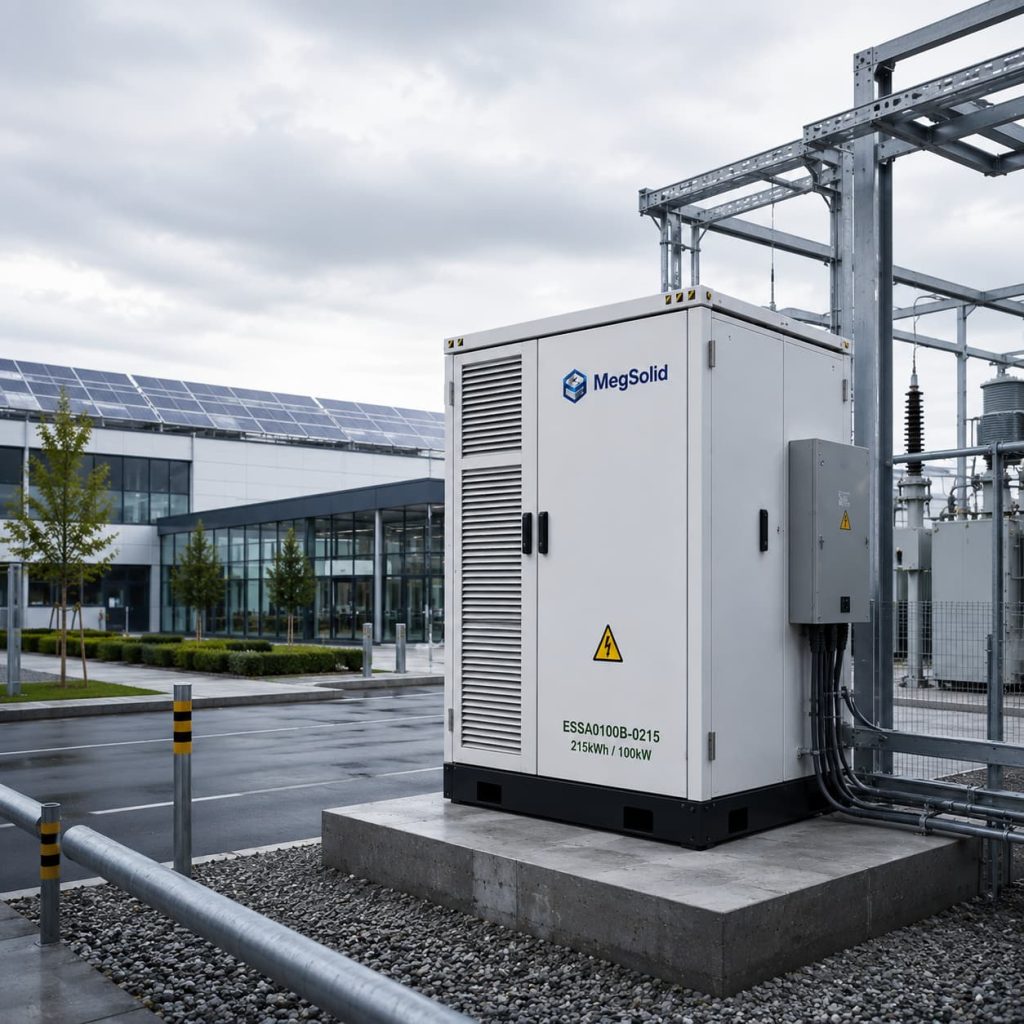
Five ESSA0100B-0215 cabinets total 500 kW rated AC and 1, 075.2 kWh nominal storage. That arithmetic gives the EPC a cabinet-block proposal to evaluate; the installed parallel scheme, transformer/protection, usable energy and commissioning scope still define the real offer.
Configuration and FAT Scope for the Offered Package
- FAT traceability:The claimed visit, certification and ≤15mΩ cell matching require actual records. Specify the offered FAT scope without borrowing wall-module impedance.
- Connection result:The claimed 2.1%THDi/first-pass Stuttgart approval needs the released configuration and operator record; it is not a universal factory guarantee.
- Thermal configuration:ESSA0100B-0215 lists air cooling. The claimed liquid cooled±5°C installation would need its own BOM and temperature map.
Commercial Results: Matched Project Records Required
- Fee result:The claimed 34% reduction needs the actual bill, tariff and meter trace for the matched period.
- Energy result:The claimed 90.2% round-trip efficiency needs AC measurement boundaries, duty and auxiliary scope; it is not proven by768 V or impedance alone.
- Support result:The claimed remote EMS recovery and zero downtime need incident/support records; define the response route in the new offer.
- Note: Results vary depending on site configuration, local tariffs, and IT load density.
Engineering Comparison: Trading Company vs. Direct MegSolid Manufacturing
EPCs must evaluate the total risk profile when sourcing BESS cabinets.
|
Engineering Feature
|
Trading Company / Distributor
|
Direct MegSolid Manufacturing
|
|---|---|---|
|
BOM Transparency
|
Agreed traceability and disclosure scope
|
Released BOM/serial-batch deliverables as written in the offer
|
|
Cell Quality Control
|
Verify the actual supplied cell and grading records
|
Offered cell test criteria; no borrowed wall-module15mΩ threshold
|
|
VDE-AR-N 4110 Support
|
Supplier/partner integration scope to be agreed
|
Quoted PCS/protection/document package; project acceptance required
|
|
Warranty Liability
|
Written warranty and escalation responsibilities
|
Written manufacturer warranty and support scope
|
|
FAT (Factory Acceptance)
|
Witness option and scope to be agreed
|
Agreed factory/remote FAT scope, schedule and records
|
|
Cycle Life Consistency
|
Matched cell/duty/retention evidence
|
ESSA lists ≥5, 000 cycles ; offered conditions/retention terms required
|
MegSolid Manufacturing Authority
Your German EPC quote should be a configuration you can release, install and support. Put the named cabinet/PCS, BOM and substitution control, FAT witness points, grid-document package, delivery dates, spares and warranty escalation on the same offer. Use OEM/ODM manufacturing to define the integration and document package against your actual duty; your EPC should receive a priceable configuration with clear project responsibilities.
References & Industry Standards
The references address different manufacturing, safety, connection and legal scopes. Determine what applies to the exact equipment and project, then identify the corresponding evidence. A list of standards does not certify every MegSolid configuration or transfer a party’s legal responsibility.
- VDMA: Battery Production Equipment and Quality Control Guidelines.
- IEC 62619: Safety requirements for secondary lithium cells and batteries in industrial applications.
- VDE-AR-N 4110: Technical Connection Rules for Generating Units Connected to the Medium-Voltage Network (Germany).
- UL 9540A : Thermal-runaway fire-propagation test method for BESS; distinct from UL 9540 equipment certification.
- Produktsicherheitsgesetz (ProdSG): German Product Safety Act.
FAQ
Q1: Why should a German EPC partner directly with a hybrid solid-state battery manufacturer?
A direct relationship can give the EPC a clearer product-team contact and agreed traceability/FAT deliverables. Request the released BOM, serial/batch mapping, documents, warranty and change-control scope with the price. It does not automatically eliminate opacity, certify the complete configuration or transfer German legal liability.
Q2: What BOM transparency does MegSolid provide to EPCs?
Agree the product’s released BOM, serial/batch identifiers, firmware/configuration versions, inspection records and FAT outputs. Confirm the availability and disclosure boundary before purchase. The published wall-pack≤15mΩ value is not an ESSA individual-cell matching result; BMS interface availability does not prove factory ageing logs are embedded.
Q3: How does MegSolid ensure cell matching for 768V DC topologies?
Use the offered cells’ measured capacity, resistance and voltage spread under stated SOC, temperature and method, alongside grading/tolerance records. Series current is common across cells. The 51.2 V module’s≤15mΩ catalogue value must not be applied as a 768 V string’s individual-cell criterion.
Q4: Can MegSolid customize the BESS to comply with German VDE-AR-N 4110 standards?
Define the project’s required PCS, transformer, protection, control settings and connection evidence with the quote. A component THDi<3% listing is not complete VDE-AR-N 4110 approval; the supplied configuration and operator’s agreed acceptance determine the scope.
Q5: What is the cycle life of MegSolid's solid-state ESS under daily peak shaving?
ESSA0100B-0215 lists ≥5, 000 cycles. Confirm the offered rate, temperature, SOC/DoD, end-of-life criterion and retention/warranty obligations before modeling daily shaving. IEC 62619 addresses industrial lithium battery safety; it does not establish a 10-year calendar life or AGC/peak-shaving ageing result.
Q6: How does manufacturing consistency affect BESS safety?
Manufacturing controls can reduce variance, but automation does not eliminate every defect. Match the offered cell/BOM and assembly records to the safety/propagation evidence. Neither material formulation nor production method proves a universally nonflammable or risk-free installation.
Q7: Can EPCs conduct Factory Acceptance Testing (FAT) at MegSolid's facility?
Put the FAT visit or remote-witness option, scope, schedule and report deliverables in the offer. Use it to confirm released BOM, configuration, protection, interfaces and agreed test records before shipment; do not assume every test or certificate is included automatically.
Q8: How does direct manufacturing reduce EPC project delays?
One responsible product team and agreed records can reduce clarification loops. Define responses, substitution approval, document release and acceptance evidence against delivery milestones. Custom PCS work needs its own scope; it does not guarantee the first operator interconnection test will pass.
Q9: What communication protocols are supported by the MegSolid BESS?
The isolatedPCS lists RS485/CAN for BMS and RS485/TCP-IP for EMS. Interfaces alone are not complete protocols or seamless SCADA integration. Agree firmware, register/point map, commands, timing, limits and fault fallback for the supplied configuration.
Q10: Does MegSolid provide OEM/ODM customization for specific EPC requirements?
Use the OEM/ODM quotation to define cabinet/branding, control, integration, environmental and document requirements. State what is standard, what is project engineering, and how the changed configuration will be accepted and supported.
Q11: What is BOM traceability in BESS manufacturing?
BOM traceability connects the released components and configuration to unit serials and production batches, with approved substitution/change records. Specify the agreed cell, PCS, BMS/EMS and inspection/FAT records. That route helps diagnosis; it does not by itself prove every certificate or avoid every recall.
Q12: Why is cell matching important in a 768V DC BESS topology?
A 1P240S topology uses 240 series cells and ESSA lists 768 V nominal DC. Higher individual resistance generates more I²R heat at the same current; capacity/resistance spread matters to usable energy. Confirm cell-level criteria and test conditions, not a ≤15mΩ value borrowed from the separate 51.2 V wallmodule.
Q13: How do BESS manufacturers comply with German VDE-AR-N 4110 standards?
Grid connection acceptance depends on the exact PCS, protection, control, transformer and project documents. Factory engineering can prepare the agreed configuration and evidence, but a built-in transformer or THDi<3% parameter does not by itself establish complete German medium-voltage compliance.
Get Your Direct Manufacturer Engineering Consultation
Send the load/PV trace, site voltage, connection requirements and project milestones. Ask MegSolid for the cabinet/PCS selection, released BOM and substitution policy, FAT/document package, delivery schedule and warranty/support boundary. Your team can then price installation and approve a defined supply—not an unbounded manufacturer promise.
Global Sales & HQ (Hong Kong):
FLAT 7, 11/F BLK C HANG WAI IND CTR, 6 KIN TAI ST, TUEN MUN, HONG KONG
- Email: [email protected]
- Phone: +852 59811073
R&D & Manufacturing Facility (Huzhou):
No. 898 Mengxi Road, South Taihu New Area, Huzhou City, Zhejiang Province, P.R.China
- Website: https://www.solidess.com/