 Skip to content
A 3kW solar system will not normally recharge a deeply discharged 16kWh battery in one Korean solar day while also supplying the home’s daytime loads.
It can still support a 16kWh battery when the home uses only part of the stored energy each night and preserves the remaining capacity for backup.
MegSolid therefore sizes the battery from daily SOC recovery, not from nominal capacity alone.
Korea’s current residential support framework lists fixed solar installations of up to 3.0kW for individual detached houses, making 3kW a practical Korean reference size. It is not a universal recommendation for every home.
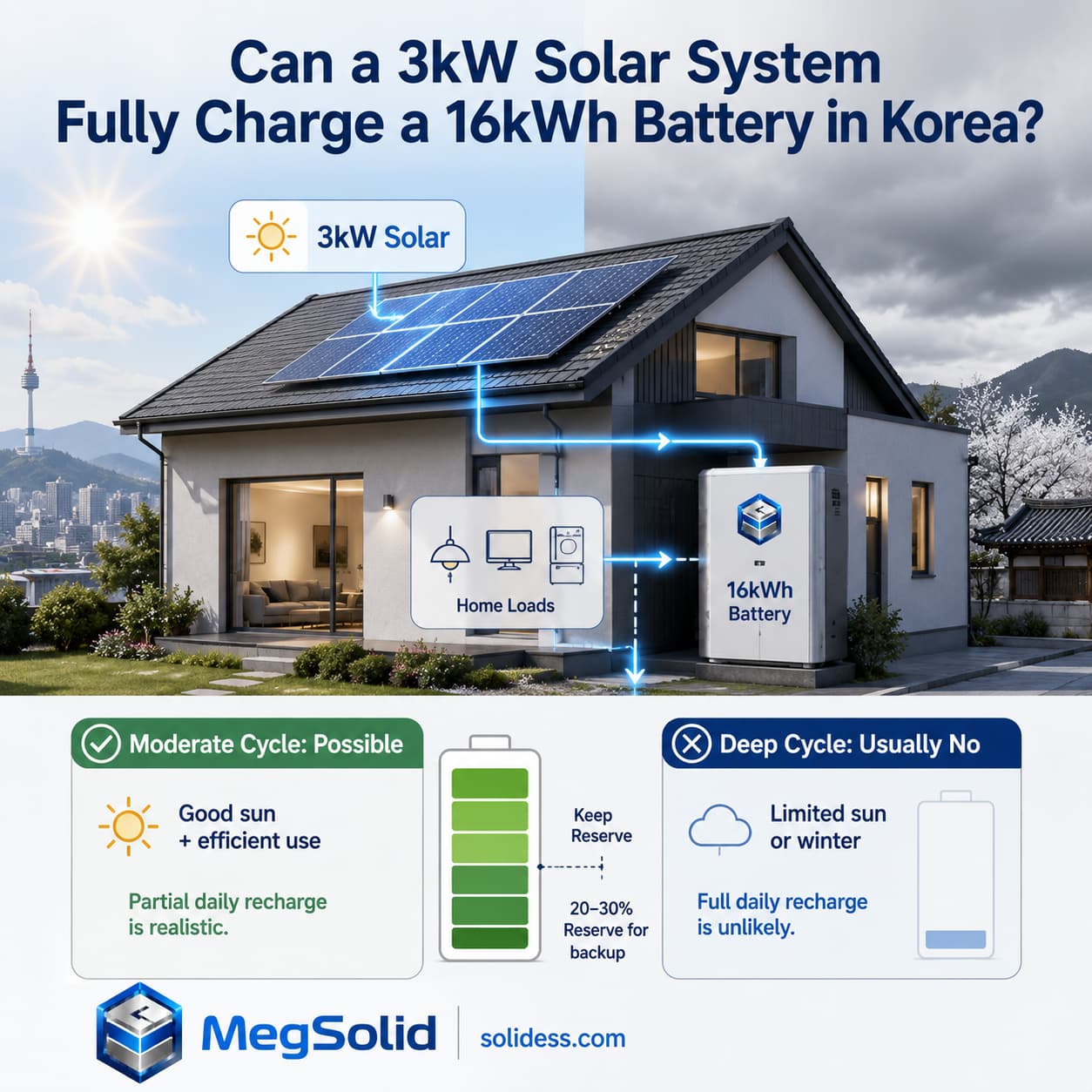
The Direct Answer
Official RECloud data shows that output from Korean building-mounted solar varies significantly by month.
Applied to an illustrative 3kW array:
| Reference month | Building solar capacity factor | Average daily generation |
|---|---|---|
| January | 10.32% | 7.43kWh |
| May | 20.60% | 14.83kWh |
| July | 13.78% | 9.92kWh |
These figures use average RPS building-installation data. They are not guaranteed production values for a specific residential roof.
A 3kW array may replace a moderate overnight discharge.
It will not normally replace an 80% discharge from a 16kWh battery.
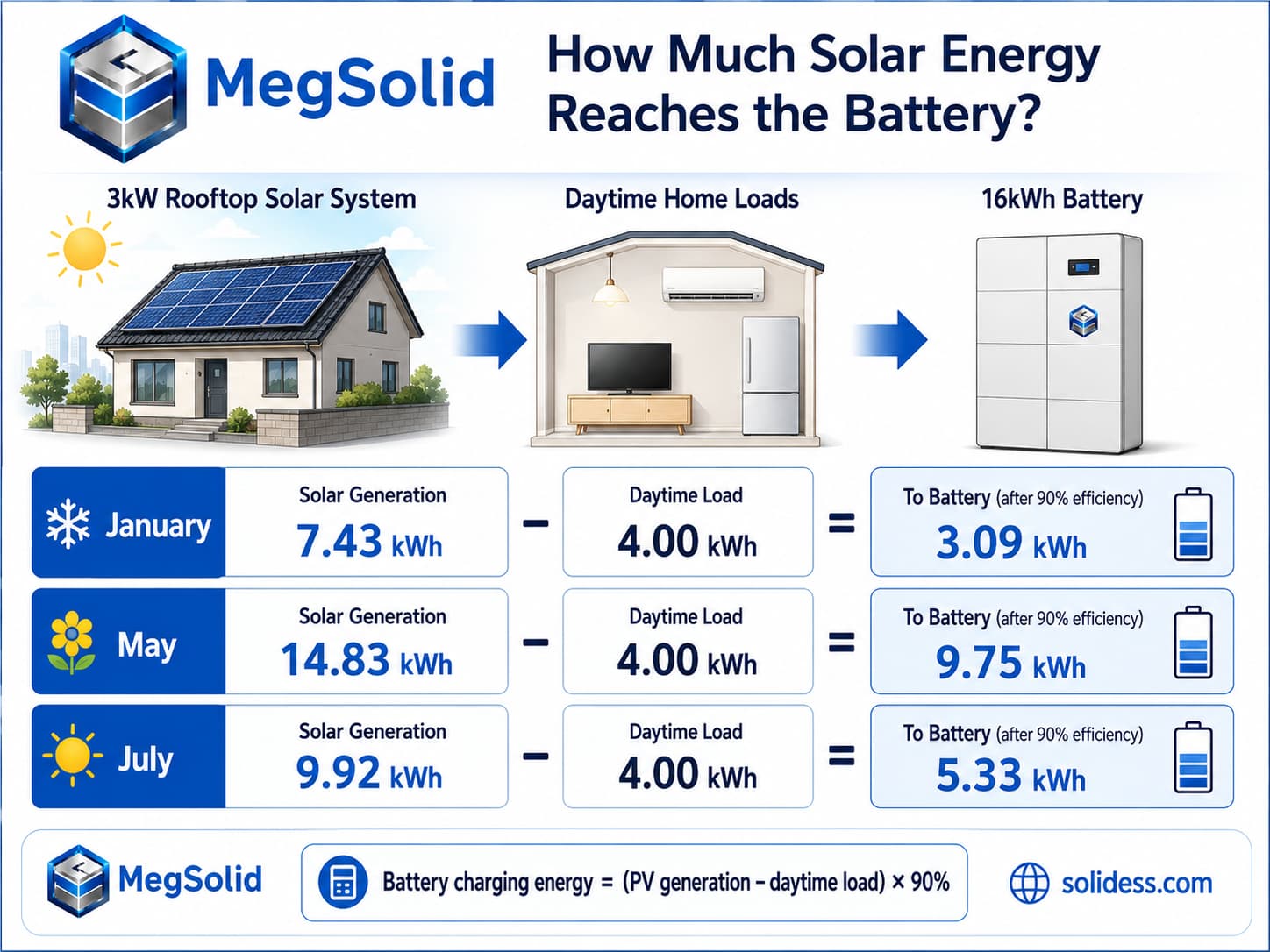
How Much Solar Energy Reaches the Battery?
Solar generation first supplies the home’s active daytime loads.
Only the remaining energy can charge the battery.
Assume:
- Daytime household load: 4kWh
- Charging-path efficiency: 90%
- No grid charging
The calculation is:
Battery charging energy = (PV generation − daytime load) × 90%
This produces approximately:
- January: 3.09kWh
- May: 9.75kWh
- July: 5.33kWh
The 90% value is an illustrative assumption, not a MegSolid efficiency guarantee.
The relevant number is solar surplus, not total solar generation.
Moderate Cycle vs. Deep Cycle
The MEG-Solid-512314FL1 16kWh battery has 16.07kWh nominal energy, 51.2V nominal voltage and 314Ah capacity. Its verified operating-voltage range is 43.2–57.6V.
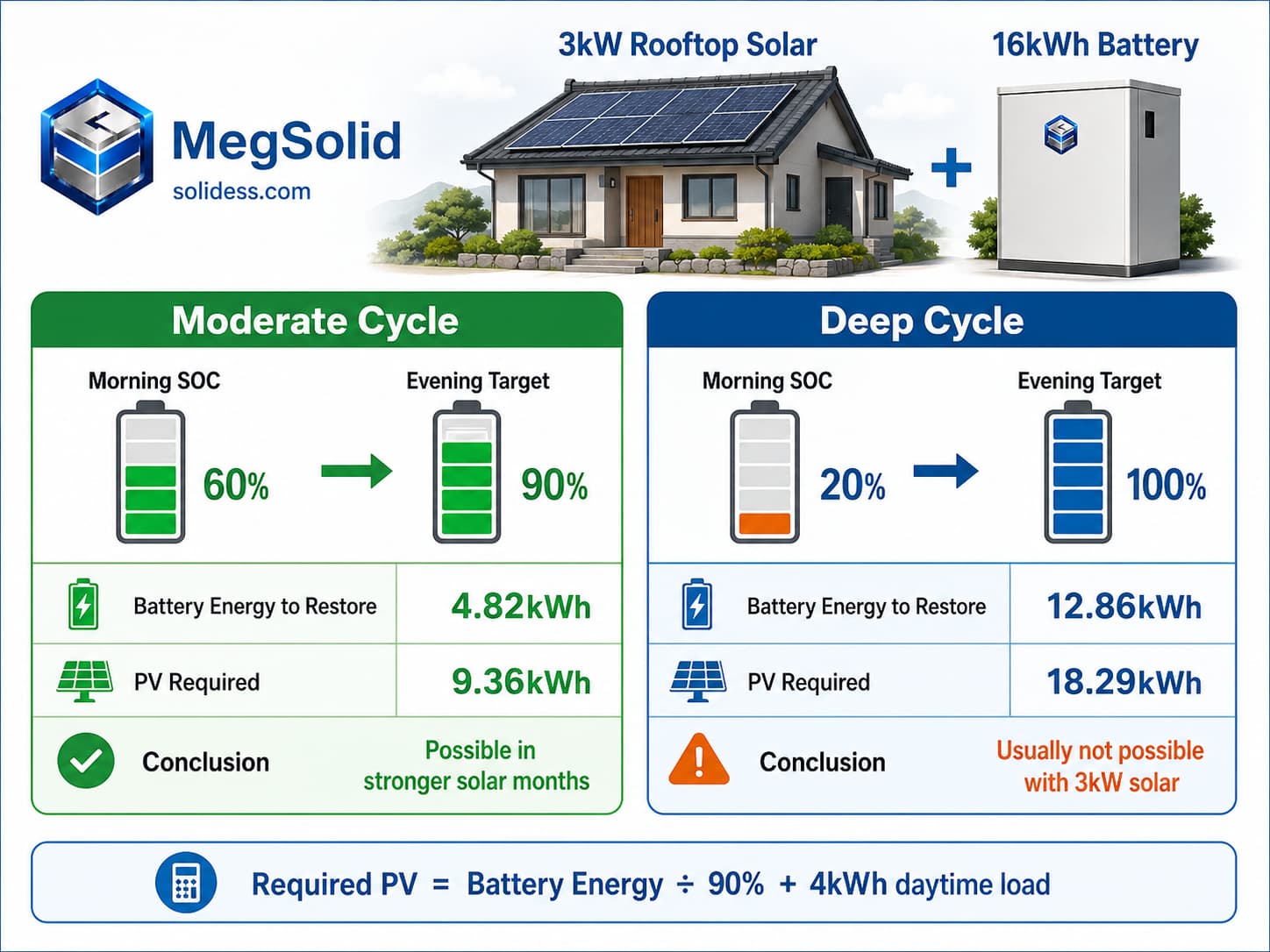
The daily requirement depends on how much SOC must be restored.
| Operating case | Morning SOC | Evening target | Battery energy to restore |
|---|---|---|---|
| Moderate cycle | 60% | 90% | 4.82kWh |
| Deep cycle | 20% | 100% | 12.86kWh |
With a 90% charging-path assumption and 4kWh of daytime demand:
Moderate cycle
4.82 ÷ 0.90 + 4 = 9.36kWh PV required
Deep cycle
12.86 ÷ 0.90 + 4 = 18.29kWh PV required
A 3kW array may achieve the moderate target during stronger production periods.
It cannot normally achieve the deep-cycle target in one day.
How Much PV Is Required for a Deep Recharge?
For the 18.29kWh deep-recharge example:
- At 3 equivalent sun hours: 6.1kW PV
- At 3.5 equivalent sun hours: 5.2kW PV
- At 4 equivalent sun hours: 4.6kW PV
This does not mean every 16kWh battery requires a 6kW solar array.
The result changes with nighttime consumption, daytime load, shading, seasonal production and backup SOC.
The solar array only needs to replace the energy used each day—not the battery’s full capacity.
When Can 3kW Solar Work With a 16kWh Battery?
The configuration can work when:
- Nighttime use remains around 4–6kWh
- Part of the battery is reserved for outages
- Grid charging supports weak solar periods
- High-consumption appliances are scheduled carefully
- The battery is not discharged to a low SOC every night
For example, a home using 5kWh overnight only needs to replace that energy plus charging losses.
The unused battery capacity remains available for backup.
Adding another battery will not solve insufficient solar production. The installer should first check the PV array, daytime load and charging limits.
Check the Inverter and BMS Limits
The battery’s maximum charging current is 200A.
At 51.2V nominal voltage, the theoretical DC boundary is:
51.2V × 200A = 10.24kW DC
This is not a guaranteed AC power rating. Actual power remains limited by the inverter, BMS, cables, temperature and SOC.
The MegSolid G2S-C single-phase inverter range provides:
- 3–6kW rated output
- 4.5–9kW maximum PV input
- 40–58V battery-input range
- CAN and RS485 communication
Its voltage range overlaps the battery’s operating range, but final compatibility still requires confirmation of charging current, firmware and BMS protocol.
The battery and inverter matching guide provides the required verification sequence.
Confirm the Korean KC 62619 Boundary
Korea lists KC 62619 Ed.2.0 as the current safety standard for industrial lithium secondary batteries.
The 2023 revision aligned the Korean requirement with IEC 62619 Ed.2.0 and expanded coverage to ESS batteries regardless of whether the application is stationary or mobile.
The verified MegSolid reference lists UL, CE and UN38.3 for the MEG-Solid-512314FL1. It does not list KC certification.
A Korean importer should confirm:
- The applicable KC route
- Whether the exact battery BOM is covered
- Korean labelling requirements
- Inverter approval responsibility
- Local testing and registration requirements
International certifications must not be presented as automatic Korean market approval.
Is the MegSolid 16kWh Battery Suitable?
The MEG-Solid-512314FL1 can be considered for Korean residential solar and backup projects when PV production, inverter compatibility and local compliance have been verified.
Its reviewed specifications include:
- 51.2V nominal voltage
- 314Ah capacity
- 16.07kWh nominal energy
- 43.2–57.6V operating range
- 200A maximum charging current
- 200A maximum continuous discharge current
- RS485, RS232 and CAN communication
- Approximately 125kg weight
- 8,000-cycle reference at 80% DOD
These are product-reference values, not project-specific performance guarantees.
The correct selection sequence is:
Daytime load → Nighttime load → Monthly PV production → SOC recovery → Inverter power → Battery capacity
A 3kW solar system will not normally refill a deeply discharged 16kWh battery in one day.
It can support partial daily cycling while preserving additional battery capacity for backup.
FAQ
Q1: Can a 3kW solar system fully charge a 16kWh battery?
Not normally after a deep discharge. The array must also supply daytime household loads.
Q2: How much can a 3kW solar system generate in Korea?
The Korean building-solar reference used here ranges from approximately 7.43kWh per day in January to 14.83kWh in May. Actual roof production will vary.
Q3: How much solar energy reaches the battery?
Subtract the daytime household load first, then apply the charging-path efficiency.
Q4: Can 3kW solar recover a 30% battery discharge?
It may. Under the stated assumptions, the system requires approximately 9.36kWh of daily PV generation.
Q5: Can it recover an 80% discharge?
Usually not. The example requires approximately 18.29kWh of daily PV generation.
Q6: How much PV is required for deep daily cycling?
Approximately 4.6–6.1kW under the assumptions used in this guide.
Q7: Should I add another battery when SOC does not recover?
No. First check solar production, daytime consumption and inverter charging limits.
Q8: What battery voltage must the inverter support?
The inverter range must cover the battery’s 43.2–57.6V operating range.
Q9: What communication protocols are available?
- CAN
- RS485
- RS232
- Optional Bluetooth and Wi-Fi
Q10: Does the verified product reference list KC certification?
No. It lists UL, CE and UN38.3. The Korean importer must confirm the applicable local route.
Q11: Is a 16kWh battery too large for a 3kW solar system in Korea?
Not necessarily. It can support partial cycling and backup reserve, but a 3kW array will not normally refill it after a deep discharge in one day.
Q12: How much solar is required for a 16kWh battery in Korea?
A deeply cycled system may require approximately 4.6–6.1kW of PV under the assumptions used in this guide.
Q13: What is the correct way to size a Korean home battery?
Calculate daytime load, nighttime load, monthly solar production, backup SOC and inverter limits before selecting battery capacity.
