Selecting a coal mine explosion proof battery manufacturer requires adherence to underground mining safety frameworks such as IEC 60079 / ATEX Directive 2014/34/EU Equipment Group I (Equipment Protection Levels Ma and Mb, ATEX categories M1 and M2, such as Ex db I Mb and Ex ia I Ma), US MSHA (30 CFR), or China MA regulations. Unlike surface and offshore gas hazardous areas—which are classified under Equipment Group II into Zone 0, Zone 1, and Zone 2—underground coal mines fall under Group I because they face the simultaneous hazards of firedamp (methane gas, CH₄) and combustible coal dust inside confined subterranean workings. Lithium battery systems intended for Group I underground mining installations (or Group II Zone 1 / Zone 2 surface facilities) require an appropriately engineered and assessed explosion-protection solution. A certified enclosure alone does not establish certification of the complete battery system. The applicable Ex protection concept and certification scope must be verified for the final assembly.
By offering a confirmed 51.2V hybrid solid-liquid (semi-solid) LiFePO4 battery module alongside project-specific OEM/ODM engineering evaluation and standardized LFP and C&I energy storage platforms (ESSA0100B-0215 LFP with optional project-specific solid-state configuration, Energon LFP, and 5000INTL containerized storage), MegSolid supports mining equipment OEMs, refuge system integrators, and mine electrical EPC contractors with documented residential/commercial modules and megawatt-scale surface substation storage.
Group I (Underground Coal Mines) vs. Group II (Offshore & Petrochemical): Core Engineering Differences
Electrical equipment certified only for surface petrochemical plants or offshore platforms (Group II, Zone 1 or Zone 2) cannot be deployed inside an underground coal shaft (Group I, Ma / Mb). Chief mechanical and electrical engineers across underground coal operations evaluate five regulatory and mechanical distinctions between Group I and Group II standards.
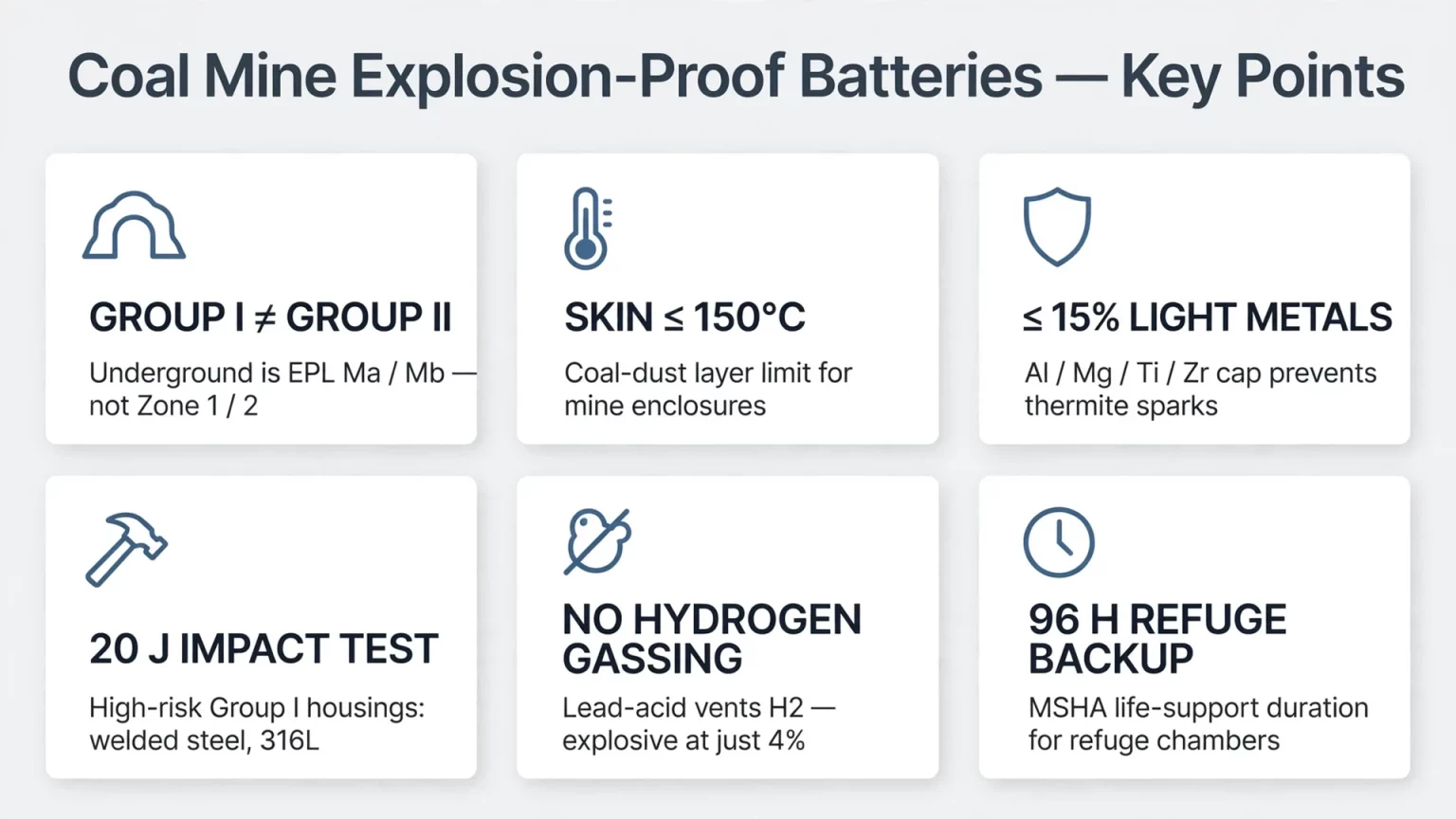
Table 1: IECEx / ATEX Group I (Underground Coal Mining) vs. Group II (Offshore & Surface Petrochemical) Standards
| Standard / Engineering Parameter | IECEx / ATEX Group I (Underground Coal Mines) | IECEx / ATEX Group II (Offshore Platforms & Surface Plants) | Engineering Impact on Battery System Design |
|---|---|---|---|
| Target Explosive Hazard | Firedamp (Methane CH₄) + Combustible Coal Dust | Non-Mining Hydrocarbon Gases & Vapors (Groups IIA, IIB, IIB+H2, IIC) | Group I assemblies must address both internal methane ignition hazards and external smoldering of settled coal-dust layers. |
| Classification & Equipment Protection Levels (EPL) | Group I: EPL Ma / Mb (ATEX Category M1 / M2) | Group II: Zone 0 (Ga), Zone 1 (Gb), Zone 2 (Gc) | Ma equipment remains energized in gas; Mb equipment is de-energized when an explosive atmosphere occurs (specific methane trip thresholds, such as 1.0% CH₄ in certain US MSHA working areas, are set by national mining regulations). |
| Maximum Surface Temperature Limit | ≤ 150°C (where coal dust can form a layer) or ≤ 450°C (where dust layering is prevented) | T1 (450°C), T2 (300°C), T3 (200°C), T4 (135°C), T5 (100°C), T6 (85°C) | Thermal management and current limiting must keep exterior enclosure skin temperatures below the 150°C coal-dust layer threshold under rated and fault conditions. |
| Mechanical Impact & Light-Metal Limits (IEC 60079-0) | Impact energy varies by component and risk level (up to 20 J for high-risk Group I enclosures); external light-metal mass restricted (≤ 15% Al/Mg/Ti/Zr total) | Lower impact test energies (4 J to 7 J for enclosures); Group II light-metal limits depend on EPL Ga, Gb, or Gc | Group I restricts external aluminum/magnesium alloy mass proportions to prevent thermite friction sparks; heavy welded steel or 316L stainless steel is commonly used for high-risk housings. |
| Distinct Regional Regulatory Frameworks | IECEx Group I, ATEX M1/M2 (EU); separate regimes: MSHA 30 CFR (USA), MA (China) | IECEx Group II, ATEX Zone 1/2 (EU); separate regime: NEC Class I Div 1/2 (USA) | IECEx/ATEX, MSHA, MA, and NEC Class/Division are independent regulatory systems and cannot be treated as direct substitutes; final assemblies must be certified to the local authority’s rules. |
1. Light-Alloy Mass Restrictions (IEC 60079-0 Clause 8.2) & Mechanical Impact Energy in Underground Coal Mines
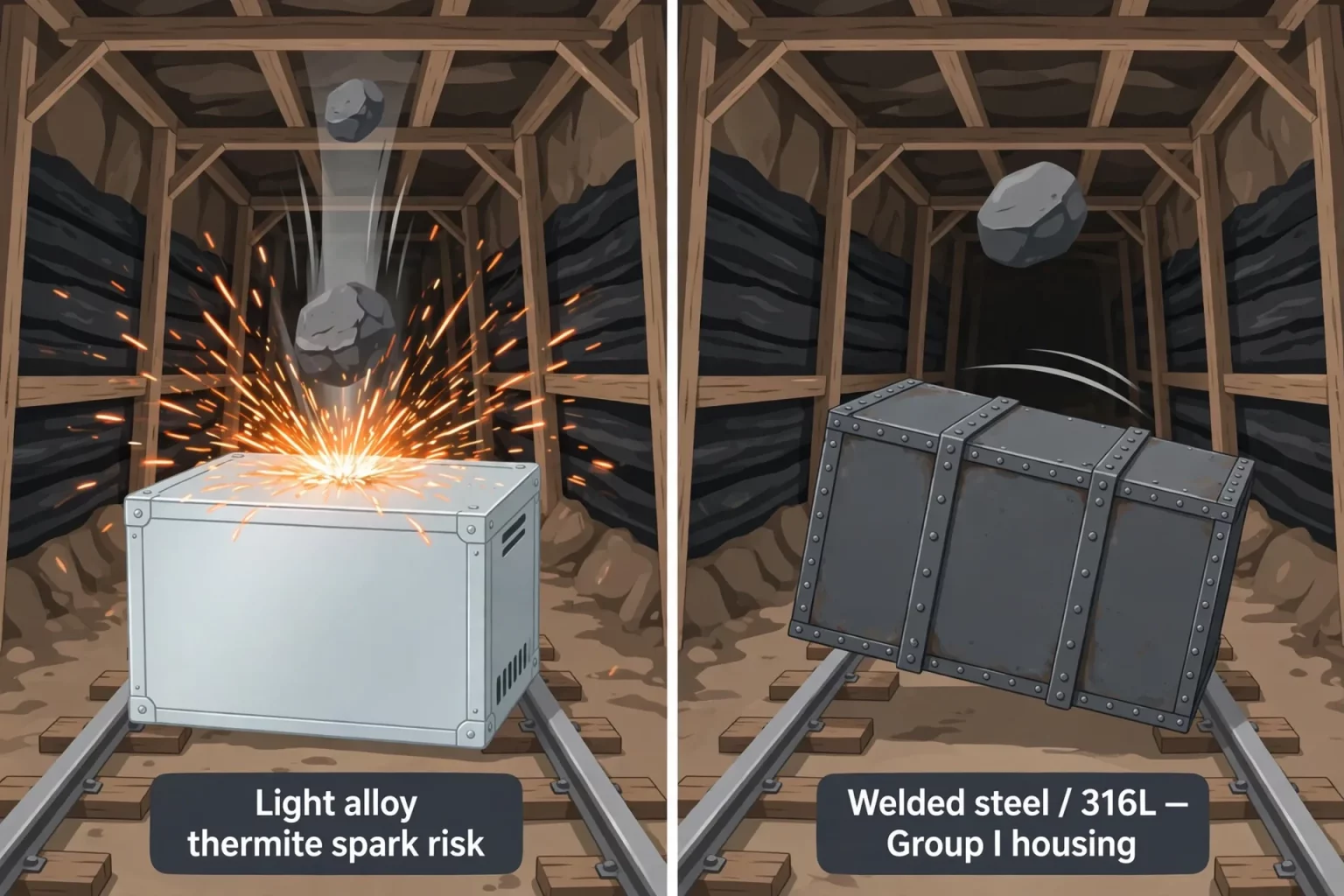
General-purpose battery vendors sometimes propose unprotected light-alloy housings to reduce vehicle weight without checking Group I material limits. Under IEC 60079-0 Clause 8.2, external enclosures for Group I (Ma and Mb) equipment are subject to strict mass-percentage limits on light metals so that an impact between falling rock or rusty steel (iron oxide) and the housing does not trigger an incendive thermite friction spark in methane gas. Specifically, IEC 60079-0 limits the total mass content of aluminum, magnesium, titanium, and zirconium in external Group I enclosures to no more than 15% in total, with magnesium, titanium, and zirconium together not exceeding 7.5% (while US MSHA regulations also enforce strict controls on light-metal casings underground).
Similarly, IEC 60079-0 Table 15 specifies mechanical impact test energies according to the component type and degree of mechanical hazard: Group I enclosures and external parts exposed to a high risk of mechanical damage without additional protection are tested at 20 Joules, whereas parts exposed to lower mechanical risk or fitted with guards are tested at lower specified energies (such as 7 J or 4 J). To satisfy both light-alloy restrictions and severe underground rockfall resistance, Group I (Ex db I Mb) flameproof battery tanks typically use welded structural steel or AISI 316L stainless steel, paired with anti-static surface coatings (surface resistance ≤ 10⁹ Ω under standard conditioning) where non-metallic external layers are applied.
Confined Underground Drifts & Refuge Alternatives: Charging Ventilation and Gas Hazards
2. Why Underground Mines Are Transitioning Away from Lead-Acid Boxes and Conventional Liquid Li-Ion
Historically, underground coal haulage relied on diesel engines or flooded lead-acid battery boxes. Diesel engines emit Diesel Particulate Matter (DPM), carbon monoxide, and heat into deep working faces, while lead-acid batteries electrolyze water and evolve Group IIC Hydrogen gas (H₂, lower explosive limit 4%) during normal charging. Battery charging ventilation must be evaluated according to the applicable battery installation standard and local mining regulations. IEC 62485-2 addresses stationary battery installations, while IEC 62485-3 covers traction batteries, including those used in battery-powered locomotives. Flooded lead-acid traction tanks also typically fall in a 25 to 35 Wh/kg industry reference range (depending on steel tank mass and cell design) and require long recharge cycles plus periodic electrolyte watering.
Conventional liquid-electrolyte lithium-ion batteries avoid water-electrolysis hydrogen gassing during normal charging, but present acute hazards if a cell fault occurs inside a confined underground airway. On an open surface pad, smoke from a battery failure disperses into the atmosphere. Inside a confined coal drift hundreds of meters underground, or inside an underground refuge alternative, a conventional liquid lithium-ion thermal runaway can release flammable organic carbonate vapors alongside toxic gases such as Hydrogen Fluoride (HF) and Carbon Monoxide (CO) into the ventilation air stream.
On our 51.2V stationary platform (MEG-Solid-512314FL1), MegSolid utilizes semi-solid-state battery technology, combining a hybrid solid-liquid electrolyte design with a LiFePO₄ cathode (whereas C&I platforms use LFP cells on Energon, LFP with optional project-specific solid-state configuration on ESSA0100B-0215, and an unconfirmed electrolyte classification on 5000INTL):
- Does not produce lead-acid-type water-electrolysis hydrogen gassing during normal float, bulk, or opportunity charging, eliminating routine watering and acid-spill maintenance;
- Confirmed hybrid solid-liquid LiFePO4 chemistry on the MEG-Solid-512314FL1 (51.2V) battery, whose product page lists UL, CE, and UN38.3 references (supporting documentation and applicable certification scope should be verified for each project);
- Verified pack internal impedance of ≤ 15 mΩ on the complete MEG-Solid-512314FL1 (51.2V 314Ah) stationary battery pack, aiding thermal management during normal charge and discharge duty.
Water Ingress (IP68) vs. Acid Mine Drainage Corrosion Resistance
3. Distinguishing IEC 60529 IP68 Immersion Testing from Site-Specific Chemical Corrosion Protection
Underground longwall gate roads and sumps in sulfide-bearing coal seams may accumulate acidic mine water (often cited in mining literature at a reference range around pH 3.5 to 5.5 depending on local geology and pyrite oxidation, though actual mine water pH varies widely by site) mixed with abrasive coal slurry. When specifying underground battery enclosures, engineers must distinguish between water ingress ratings and chemical corrosion resistance:
- Water Ingress Protection (IEC 60529 IP68): An IP68 rating verifies protection against water ingress under continuous freshwater immersion at a depth and duration agreed between the manufacturer and user, but IP68 testing alone does not verify resistance to sulfuric acid or corrosive mine water.
- Corrosion Metallurgy & Chemical Compatibility: Resisting site-specific acidic mine water (such as pH 3.5–5.5 conditions where present) requires separate material selection and corrosion validation—such as AISI 316L stainless steel, heavy structural steel with verified acid-resistant epoxy or coal-tar coatings, and chemically compatible elastomer gaskets and cable glands.
- Intrinsically Safe BMS Isolation (Project-Specific Engineering Requirement): Where an underground Ex db I Mb battery assembly needs to transmit State of Charge (SoC), voltage, and temperature data to an external display or mine dispatch network, galvanic and optical isolation barriers (Ex ia I Ma or Ex ib I Mb) and cold-plate or conductive thermal interfaces must be engineered and verified as part of the project-specific Ex system design.
Three Mining Application Pathways: Custom Vehicles, Refuge Systems, and Surface Microgrids
To maintain strict engineering transparency, MegSolid separates custom OEM/ODM engineering evaluation for underground mining equipment from standardized, safe-area C&I energy storage systems for surface mine infrastructure:
1. Custom OEM/ODM Evaluation for Underground Mining Vehicles, Locomotives, Monorails & LHD Scooptrams
Electrifying underground trackless rubber-tired vehicles, battery locomotives, suspended monorails, and LHD (Load-Haul-Dump) scooptrams requires custom traction battery configurations engineered to fit within a certified Group I (Ex db I Mb) flameproof enclosure. Mining equipment manufacturers can submit their required traction voltage, load profile, enclosure dimensions, BMS interfaces, and Group I certification requirements to MegSolid for OEM/ODM engineering evaluation. Final battery configurations and explosion-protection compliance require project-specific verification. Reach our engineering team via our Custom BESS & Industrial Battery OEM/ODM Engineering Page to initiate technical feasibility review.
2. Underground Emergency Refuge Alternatives & Safe-Area Control Room Backup
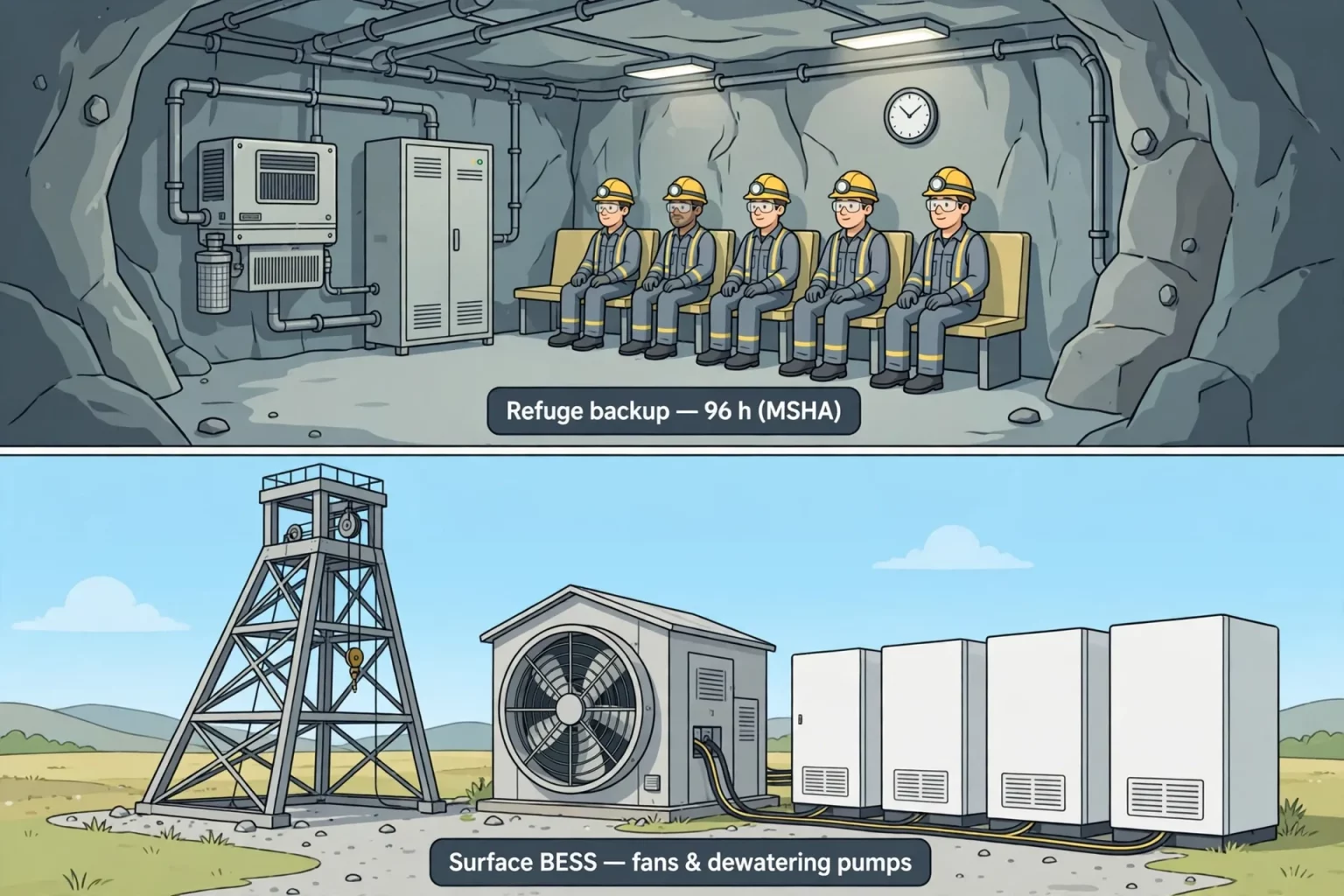
Underground emergency refuge alternatives (refuge chambers or rescue stations) rely on backup power for gas monitoring, communication systems, air scrubbing, and environmental control when main shaft power is interrupted. Required operating duration and power source architecture vary by national regulation and chamber design—for example, US MSHA (30 CFR Part 7 and 30 CFR 75.1507) specifies 96 hours of breathable air and life-support capacity (or 48 hours under 30 CFR 75.1507(c) where approved advance arrangements for an additional breathable air supply are made), whereas other mining jurisdictions specify different duration and equipment rules.
For safe-area control rooms or for OEM evaluation by refuge system integrators, our stationary MEG-Solid-512314FL1 51.2V 314Ah (16.07 kWh) Hybrid Solid-State Battery is a 51.2V, 314Ah, 16.07 kWh hybrid solid-state residential battery (43.2–57.6V DC operating range, 57.6V charging voltage, 200A max charge/discharge current, ≤ 15 mΩ pack internal impedance, 8,000 cycles at 80% DoD, RS485 / RS232 / CAN communication, 0°C to 45°C charge, and -20°C to 60°C discharge). Its published enclosure rating is shown as IP21/IP65 without confirmed configuration mapping. The product page lists UL, CE, and UN38.3 references; supporting documentation and applicable scope should be verified.
3. Surface Mine Main Ventilation Fans, Deep-Shaft Dewatering Pumps & Substation Microgrids
On a gassy underground coal mine, surface electrical continuity protects both underground personnel and high-value mining assets:
- Main Surface Ventilation Fans: When surface power fails on a gassy mine, underground methane (CH₄) begins accumulating at a rate governed by seam gas emission rates, airway volume, and barometric pressure, making rapid backup power essential to restore airflow;
- Deep-Shaft Main Dewatering Pump Stations: Extended power loss to high-head shaft dewatering pumps during heavy groundwater inflow risks flooding longwall shearers, roof supports, and shaft-bottom substations;
- Auxiliary Shaft Hoists & Surface Preparation Plants: Grid sags and feeder outages disrupt hoist operations and coal washing plants.
For safe-area surface mine substations and industrial microgrids, MegSolid supplies standardized Commercial & Industrial (C&I) cabinets, containers, and modular PCS equipment across distinct verified voltage and cell platforms:
- 100 kW / 215.04 kWh Air-Cooled Outdoor Cabinet BESS (ESSA0100B-0215, 672–850 V DC): Our 100 kW / 215.04 kWh Air-Cooled Outdoor Cabinet BESS uses LFP cells (with optional project-specific solid-state battery configuration) across a 672–850V DC battery voltage window and includes a built-in isolation transformer, integrated PV MPPT (250V–850V), <3% THDi, and IP54 outdoor protection (0°C to +45°C).
- 261.24 kWh / 125 kVA Liquid-Cooled C&I BESS (Energon, 676–936 V DC): Our 261 kWh / 125 kVA Liquid-Cooled C&I Energy Storage System uses 314Ah LFP cells in a 1P260S (832V DC nominal, 676–936V DC) configuration with 90% max system efficiency, IP54 protection, -20°C to 55°C operating range (with derating required above 45°C), ≤ 4,000 m altitude rating (with derating required above 2,000 m), Novec + water fire protection, and parallel scaling up to 10 units.
- 2.7 MW / 5,015.9 kWh Liquid-Cooled Containerized BESS (5000INTL, 1,123.2–1,497.6 V DC) & Separately Engineered Modular PCS (PMA Series): The 5000INTL provides 2,700 kW rated AC power and 5,015.9 kWh of battery storage across a 1,123.2–1,497.6V DC battery voltage range (IP55, ≤ 4,000 m altitude; specific electrolyte type is not confirmed in public datasheets). MegSolid also offers the PMA080, PMA0105, and PMA0125 modular PCS series (80–125 kW) for separately engineered storage applications. Direct DC coupling between these platforms is unsupported because their specified DC voltage ranges do not match (PMA DC input upper limit is 950V DC, whereas 5000INTL operates at 1,123.2–1,497.6V DC). The PMA series operates from -30°C to +60°C, with power derating required above 45°C. Installation altitude is rated up to 5,000 m, with derating above 3,000 m, and its <20 ms switching rating is a PCS module-level metric (total plant transfer time for large mine ventilation loads depends on external switchgear and protection design).
Review full surface-substation and microgrid specifications on our Commercial & Industrial (C&I) Energy Storage Systems page →
Coal Mine & Industrial Battery RFQ Specification Checklist
Include the six engineering parameters in Table 2 when submitting your RFQ so our OEM/ODM and C&I engineering teams can evaluate your project requirements.
Table 2: Mining & Hazardous-Area Battery RFQ Specification Checklist
| Parameter Category | Options to Specify in Your Engineering RFQ | Why It Governs Pack & System Design |
|---|---|---|
| 1. Installation Location & Regulatory Regime | Surface Safe-Area Substation vs. Underground Coal Mine (IECEx / ATEX Group I Ma/Mb, ATEX M1/M2, MSHA 30 CFR, or China MA) | Determines whether standardized surface IP54/IP55 C&I BESS applies or if project-specific OEM engineering evaluation for a complete Group I assembly is required. |
| 2. Coal Dust Temperature Limit & Housing Rules | Group I (CH₄ + coal-dust layer ≤ 150°C, IEC 60079-0 impact energy by risk level up to 20J, external light-metal mass ≤ 15% Al/Mg/Ti/Zr) | Governs enclosure metallurgy (welded steel / 316L stainless), anti-static coating (≤ 10⁹ Ω), and thermal dissipation design. |
| 3. Water Ingress vs. Acid Corrosion Exposure | Indoor/Surface IP21 / IP54 / IP55 / IP65 vs. underground IP68 freshwater immersion rating + separate site-specific acid mine water corrosion protection (e.g., pH 3.5–5.5 where present) | Separates IEC 60529 IP68 immersion testing from chemical compatibility validation of housings, coatings, and gaskets in acidic mine water. |
| 4. System Voltage, Capacity & Duty Cycle | MegSolid platforms include the 51.2 V / 16.07 kWh residential battery (semi-solid LFP), the ESSA0100B-0215 at 672–850 V DC (LFP, optional project-specific solid-state), the Energon 261 at 676–936 V DC (LFP), and the 5000INTL at 1123.2–1497.6 V DC. Custom voltage requirements must be evaluated separately. | Distinguishes verified standard voltage and cell platforms from custom OEM traction or backup voltage requirements that must undergo project-specific feasibility evaluation. |
| 5. Ambient Temperature & Altitude Window | Charge/discharge temperatures and derating thresholds (Energon derates above 45°C and 2,000 m; PMA PCS derates above 45°C and 3,000 m) | Ensures reliable thermal operation and appropriate temperature/altitude derating across underground workings and high-altitude surface mine shafts. |
| 6. BMS Interfaces & Certification Verification | RS485 / RS232 / CAN protocols, project-specific Ex ia / ib isolation needs, verification of UL / CE / UN38.3 documentation scope, and final complete-system Ex certification | Defines engineering and compliance responsibilities between the battery supplier, equipment OEM, and third-party certification body. |
FAQ
Can a standard MegSolid residential battery be installed in a coal mine hazardous area?
No Group I explosion-protection certificate is established by the standard MEG-Solid-512314FL1 product data. Its 51.2 V module may be assessed by a qualified equipment OEM, but the completed underground battery system needs project-specific testing, certification and site approval.
Which MegSolid battery uses confirmed semi-solid LiFePO4 chemistry?
MEG-Solid-512314FL1 is documented as a 51.2 V, 314 Ah, 16.07 kWh hybrid solid-liquid LiFePO4 battery, with up to 200 A charge and continuous discharge current. That chemistry must not be assumed for every MegSolid C&I or containerized product.
Does an IP68 enclosure rating prove resistance to acidic mine water?
No. IP68 establishes ingress protection under the agreed immersion depth and duration. Acidic mine water, coal slurry, coating integrity and gasket compatibility require separate site-specific material and corrosion validation.
What operating data should a mining locomotive battery OEM supply?
Provide traction DC voltage, continuous and peak current, duty cycle, regeneration profile, BMS interface list, available enclosure space, thermal conditions, expected water exposure and the exact mining equipment certification jurisdiction.
Which MegSolid BESS options are intended for surface mine substations?
Safe-area options include ESSA0100B-0215 at 100 kW/215.04 kWh, Energon at 125 kVA/261.24 kWh and the 5000INTL at 2.7 MW/5,015.9 kWh. Ventilation and dewatering backup sizing requires verified load profiles, starting currents and usable energy.
Can PMA modular PCS connect directly to a 5000INTL battery DC bus?
Direct DC coupling is unsupported by the documented ratings: the PMA input upper limit is 950 V DC, whereas the 5000INTL battery range is 1,123.2–1,497.6 V DC. Separate system engineering and correctly rated power conversion are required.
Does lithium chemistry remove all underground charging and fault-gas hazards?
No. Semi-solid LiFePO4 avoids lead-acid-type water-electrolysis gassing in normal operation, but a cell fault can still produce hazardous vent gases and heat. Ventilation, electrical isolation, thermal management and full-system Ex assessment remain necessary.
What does MSHA approval mean for coal mine batteries in the United States?
US underground mining systems must satisfy the applicable MSHA regulations and approvals for their specific use. IECEx or ATEX certification alone does not automatically provide MSHA approval. Confirm the relevant 30 CFR requirements with the mine operator and certifying authority.
Can an ATEX Group II Zone 1 battery enclosure be used in an EU underground coal mine?
No automatic substitution is permitted. Underground coal mines use ATEX Equipment Group I, M1/M2 and corresponding Ma/Mb protection levels. Group II Zone classifications apply to other gas-hazardous locations; the complete mining assembly requires the correct Group I assessment.
Is China MA certification interchangeable with IECEx Group I certification?
No. China MA and IECEx Group I are separate approval frameworks. For projects in China, verify the applicable national mining product approvals, test evidence and certificate scope for the finished battery assembly.
Partner with MegSolid for Mining OEM/ODM Evaluation & Surface Substation C&I BESS
Whether you are a mining equipment OEM evaluating custom battery configurations for underground vehicles and refuge systems, or a mine operator deploying safe-area C&I backup storage for surface ventilation and dewatering substations, MegSolid provides transparent product specifications and engineering support: