
Selecting the right lithium battery fire extinguisher requires recognizing that rechargeable lithium-ion battery fires behave differently from ordinary Class A solid fires, Class B liquid pool fires, and Class D combustible metal fires.
When a lithium-ion cell enters thermal runaway, internal short circuits and exothermic chemical reactions drive rapid self-heating, vaporize organic carbonate solvents, and vent flammable gases (H₂, CO, CH₄, C₂H₄).
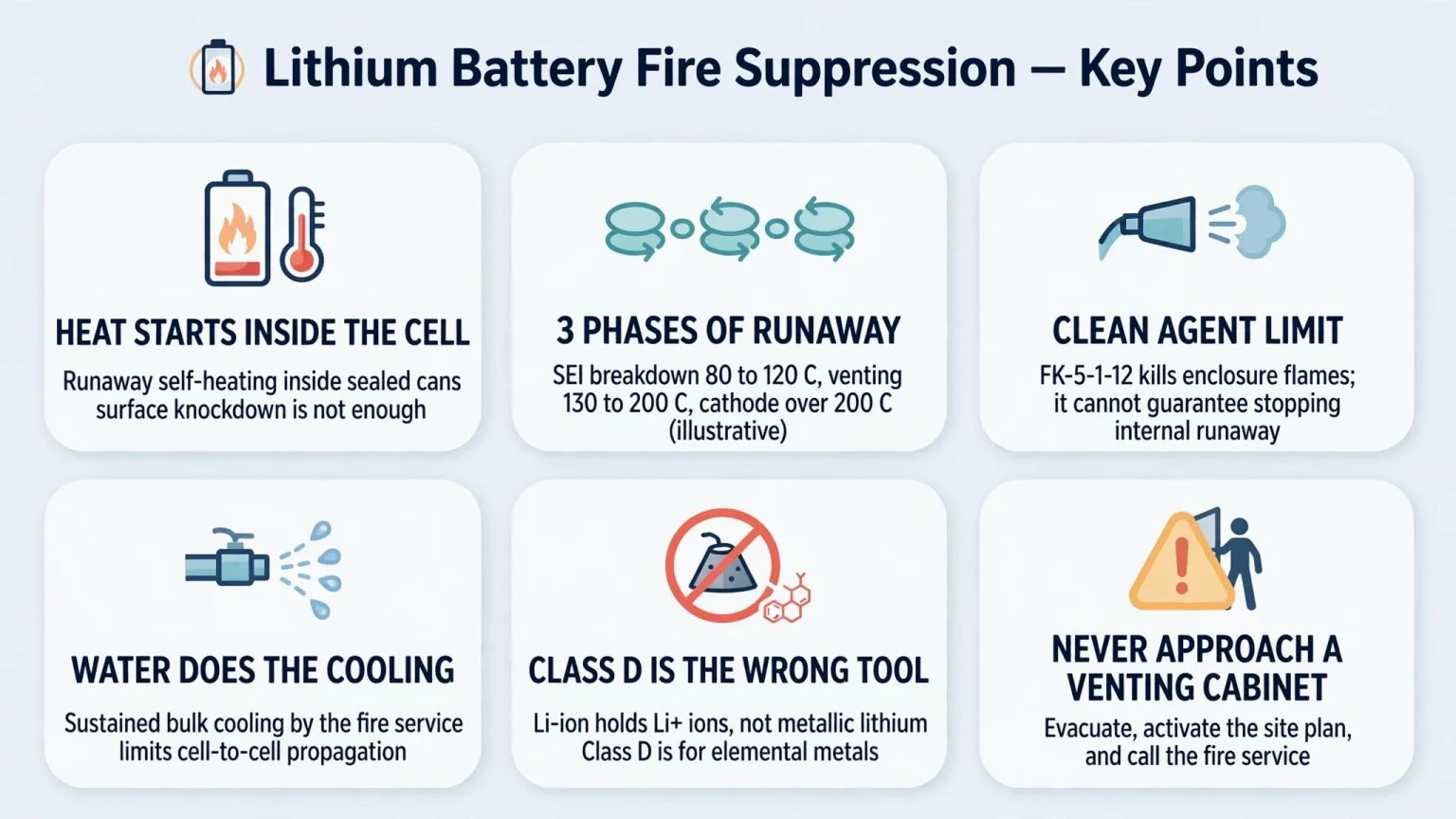
Because heat generation originates inside sealed cell cans, knocking down external flames with standard dry powder or CO₂ without extracting core heat leaves the cell above its reaction threshold, creating a severe risk of delayed reignition and cell-to-cell propagation.
In stationary energy storage engineering, fire mitigation strategies often combine clean-agent (FK-5-1-12, historically marketed under trade names such as Novec 1230) or condensed-aerosol flame inhibition with thermal cooling measures selected according to system architecture, hazard analysis, and manufacturer guidelines.
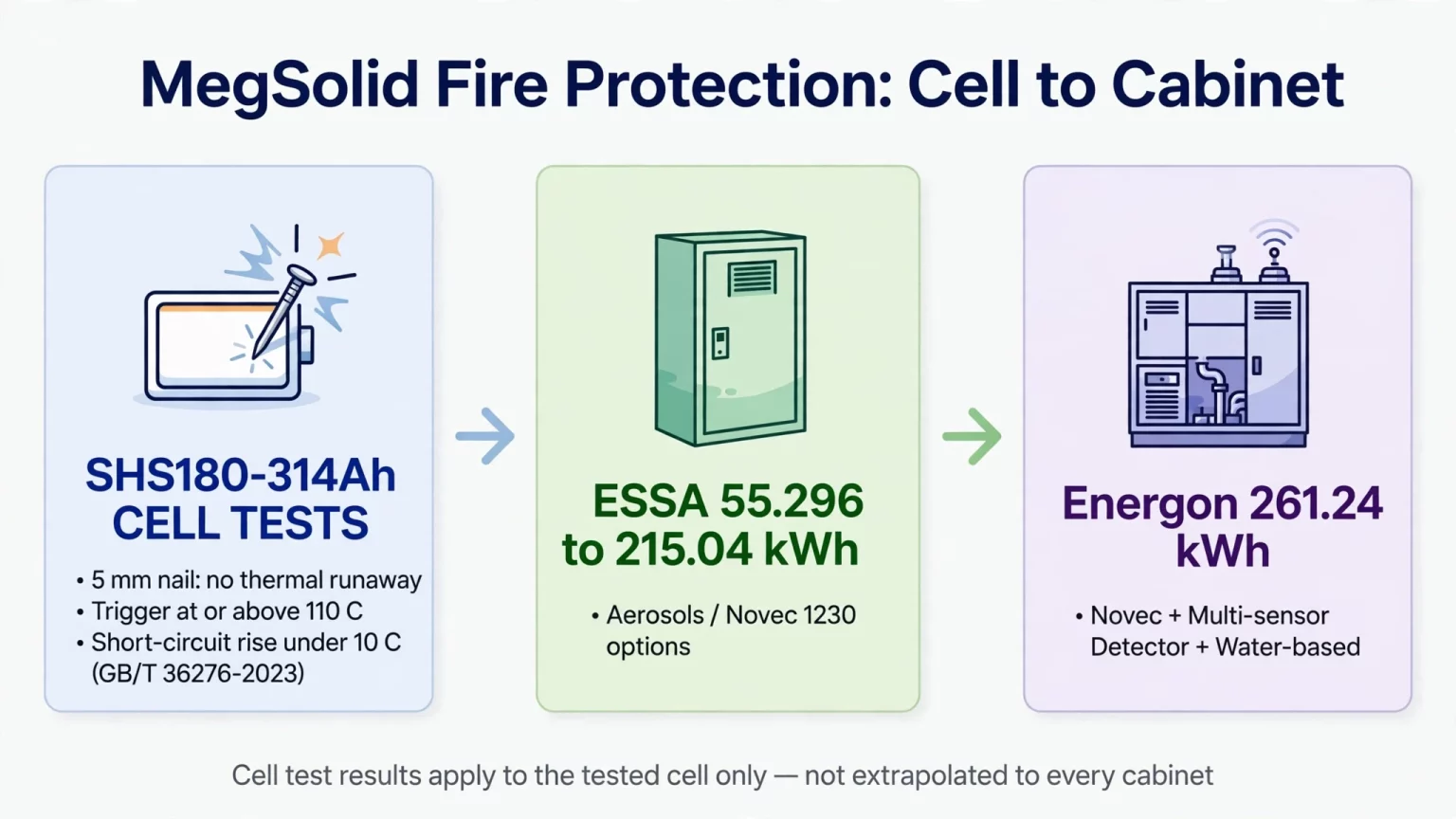
Across our portfolio, MegSolid integrates multi-component cabinet fire protection (Novec + Multi-sensor Detector + Water-based configuration on Energon and Aerosols / Novec 1230 configuration options on ESSA) across our Commercial & Industrial Energy Storage systems alongside verified cell-level abuse testing across our Solid-State Energy Storage Systems.
How Do You Put Out a Lithium Ion Battery Fire? (The Thermal Runaway Mechanism)
When safety officers and electrical engineers ask how do you put out a lithium ion battery fire, the answer begins with the internal physics of thermal runaway. Unlike an external fuel spill that extinguishes as soon as atmospheric oxygen is displaced, a failing lithium-ion cell undergoes an internal exothermic progression.
While exact onset temperatures vary considerably with cell chemistry (LFP vs. NMC), State of Charge (SoC), cell aging, and the abuse trigger mechanism, the reaction is commonly illustrated across three conceptual phases:
1. The Three Illustrative Phases of Lithium-Ion Thermal Runaway
- 1. Phase 1: Solid Electrolyte Interphase (SEI) Breakdown & Anode Reaction (Illustrative Range ~80^°C to 120^°C): Mechanical puncture, severe overcharging, or an internal short circuit heats the cell core until the protective SEI film on the anode begins decomposing exothermically.
Once the SEI barrier breaks down, intercalated lithium reacts with the electrolyte, generating heat inside the cell casing.
- 2. Phase 2: Separator Collapse, Electrolyte Vaporization & Venting (Illustrative Range ~130^°C to 200^°C): Conventional polyolefin separators soften and lose mechanical integrity (typically around 130^°C to 165^°C), expanding the internal short-circuit area.
Rising heat vaporizes liquid organic carbonate solvents (such as ethylene carbonate and dimethyl carbonate), building internal pressure until the cell safety vent opens and releases a flammable aerosol mist mixed with hydrogen (H₂), carbon monoxide (CO), methane (CH₄), and ethylene (C₂H₄).
- 3. Phase 3: Cathode Decomposition & High-Temperature Exotherm (Illustrative Range >200^°C): At elevated temperatures, the cathode active material decomposes exothermically. Layered nickel-manganese-cobalt (NMC) and cobalt-oxide cathodes release reactive lattice oxygen (O₂) at relatively low breakdown temperatures, feeding intense jet flames.
Olivine lithium iron phosphate (LiFePO4 / LFP) has strong covalent phosphorus-oxygen (P–O) bonds that resist lattice oxygen evolution to much higher temperatures, yet an abused liquid-electrolyte LFP cell in thermal runaway still generates substantial internal heat and vents flammable solvent vapors and hydrogen gas.
2. Emergency Response Protocol: How to Put Out a Lithium Ion Battery Fire Safely
Both the U.S. Fire Administration (USFA) and UL Solutions emphasize that lithium-ion battery thermal runaway can persist, reignite, and release toxic and explosive gases, meaning incident response requires pre-planning, isolation, and trained personnel rather than ad-hoc manual intervention on high-voltage enclosures.
In the event of suspected lithium-ion battery thermal runaway, evacuate the affected area, activate the site's emergency response plan, and notify the fire service. Qualified responders should assess electrical isolation, toxic and flammable gas accumulation, explosion risk, and the manufacturer's emergency response instructions before selecting a suppression or cooling strategy.
Continued monitoring and incident clearance must follow site-specific safety procedures.
Key engineering principles governing how to put out a lithium ion battery fire across different battery scales include:
- Never Approach Venting High-Voltage BESS Enclosures for Manual Switching: General facility personnel must never approach a smoking, venting, or burning battery cabinet or power conversion stage (such as MegSolid's Energy Storage Inverters) to operate manual AC/DC disconnects.
- Even when remote emergency-stop (E-Stop) circuits open upstream breakers, individual battery modules and series strings inside the cabinet retain hazardous live DC voltage (stranded energy).
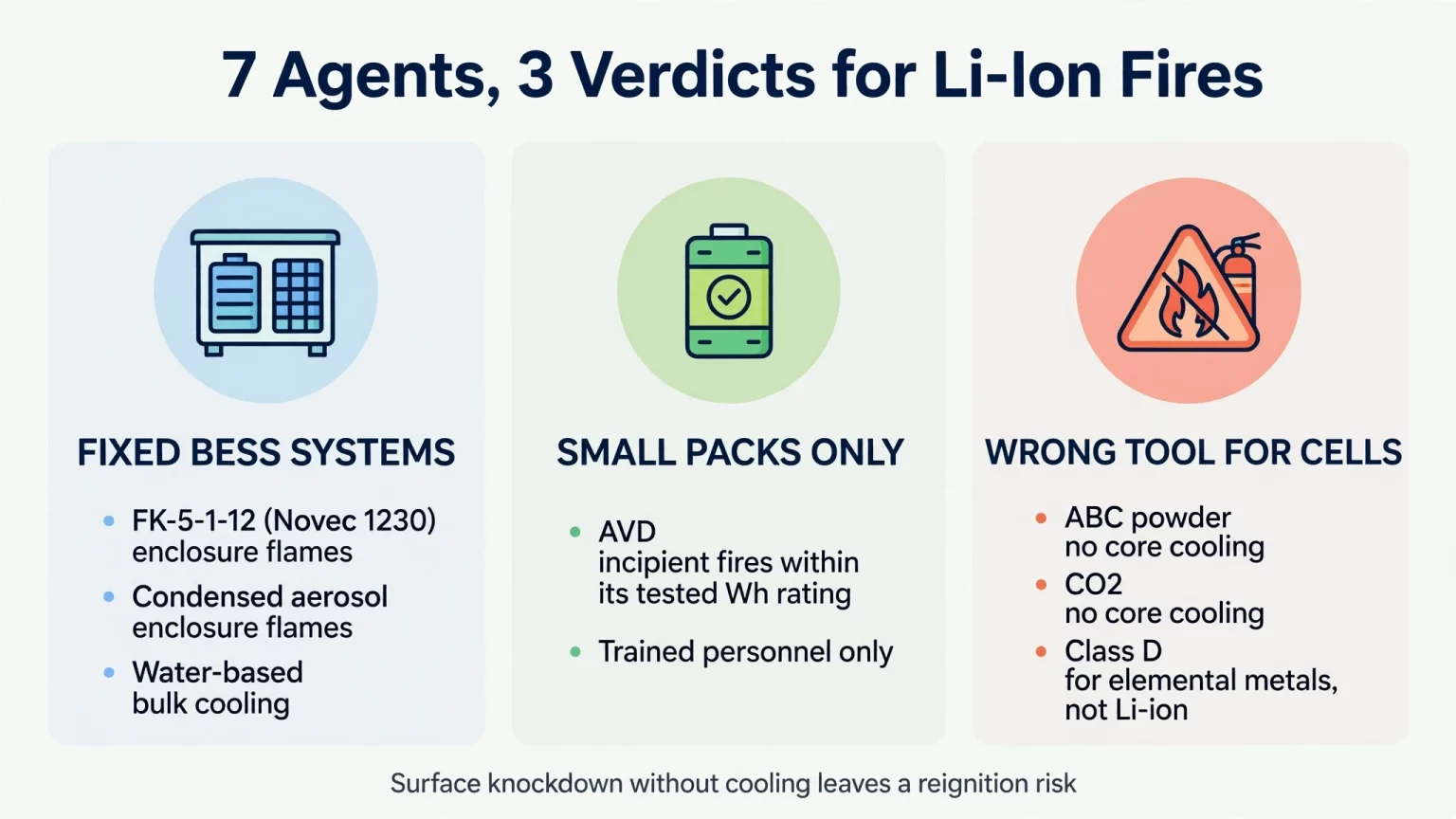
- Portable Extinguishers Require Device- & Site-Specific Assessment: Portable extinguishers (such as listed Aqueous Vermiculite Dispersion AVD or water-mist units) are not a universal solution for battery fires.
- Even for small, accessible, low-energy battery packs in an incipient stage, agent selection must be evaluated based on the specific device, battery energy (Wh rating within the extinguisher's tested certification scope), and site electrical hazards, and operated only by trained personnel.
- Fire Service Cooling & Suppression Execution: For commercial cabinets and utility containers, applying water streams or activating fire department connections must be executed by professional fire service responders based on the site emergency plan, equipment design, electrical standoff requirements, and gas/deflagration hazard assessment.
- Incident Clearance by Qualified Command: Because off-gassing and deep-seated heat can persist for hours or days, post-incident monitoring cannot rely on a fixed hour count (such as a blanket 24-hour rule) or surface thermal imaging alone; final clearance must be determined by Incident Command using continuous gas/temperature monitoring and manufacturer decommissioning procedures.
Extinguishing Lithium Ion Battery Fires: Comparing 7 Fire Extinguisher Types & Agents
When safety engineers evaluate equipment for extinguishing lithium ion battery fires, understanding each agent's physical mechanism and limitations is critical.
Note on industry terminology: following 3M's exit from PFAS manufacturing at the end of 2025, FK-5-1-12 is the standard generic designation (under NFPA 2001 and ISO 14520) for the fluoroketone clean agent historically marketed as Novec 1230 (both terms appear in existing BESS product documentation).
Specifically, engineers evaluating FK-5-1-12 (Novec 1230) must distinguish two operational boundaries:
- Surface / Enclosure Flame Suppression: FK-5-1-12 extinguishes primarily through physical heat absorption (endothermic cooling within the flame zone), with chemical radical effects playing a secondary role. It can knock down incipient external or enclosure flames when discharged inside an engineered fixed suppression system.
- Core Thermal Runaway Limitation: FK-5-1-12 cannot guarantee termination of internal cell thermal runaway and cannot replace dedicated battery cooling measures once deep exothermic heating is underway.
Table 1 compares seven extinguishing media across suppression mechanism, thermal runaway limitations, and deployment scope.
Table 1: Comparison of 7 Agents for Extinguishing Lithium Ion Battery Fires
| Extinguishing Agent / System | Primary Suppression Mechanism | Effectiveness & Thermal Runaway Boundary | Residue & Electrical Impact | Applicable Deployment Scope |
|---|---|---|---|---|
| FK-5-1-12 (Novec 1230 Fluoroketone) | Primary: physical heat absorption in flame zone; secondary: chemical inhibition | Suppresses incipient enclosure flames in engineered fixed systems; cannot guarantee halting internal cell runaway or replace cooling | Zero residue; electrically non-conductive gas | Fixed cabinet suppression systems (listed on Energon & ESSA series) |
| Aqueous Vermiculite Dispersion (AVD) | Water mist cools surface while vermiculite platelets form a mineral oxygen barrier | For evaluated incipient fires in small exposed packs within tested Wh rating; not a universal battery fire solution | Leaves dry mineral film; requires cleanup | Trained-personnel portable lithium battery fire extinguisher after device & site assessment |
| Condensed Aerosol (Potassium Salts) | Micro-fine potassium particulates inhibit flame chain reactions in enclosed volumes | Knocks down enclosure flames; does not extract deep bulk heat from large cell cores | Fine particulate residue; requires post-event cleaning | Enclosed BESS cabinet fixed suppression option (listed on ESSA series) |
| Water-Based Suppression / Fire Service Spray | High specific heat (~4.184 kJ/kg·K at 20^°C) & latent vaporization heat (~2,260 kJ/kg at 100^°C) | Provides sustained bulk heat extraction to cool cells and limit propagation | Conductive runoff; live DC voltage remains inside cells/modules even after isolation | Listed Water-based fire protection component (on Energon) or fire-service cooling per pre-plan |
| Standard ABC Dry Chemical Powder | Monoammonium phosphate crust smothers surface hydrocarbon flames | Knocks down external plastics/cable flames; fails to cool internal cell core | Corrosive powder damages PCBs and contactors | Surrounding Class A/B/C material fires only (per site assessment); cells can reignite |
| Carbon Dioxide (CO₂) Gas | Local oxygen displacement around visible surface flames | Temporary surface flame knockdown; negligible cooling of hot cell mass | Clean gas; asphyxiation hazard in confined rooms | Not effective for halting lithium cell thermal runaway; high reignition risk |
| Class D Combustible Metal Powder | Sodium chloride, copper, or graphite powder fuses on burning elemental metals | Inappropriate for sealed Li-ion cells (which contain Li⁺ ions, not bulk metallic Li⁰) | Heavy powder contamination | Listed only for combustible elemental metals (Mg, Na, primary Li⁰ metal) |
Why Class D Metal Fire Extinguishers Are Inappropriate for Rechargeable Lithium-Ion Batteries
Facility buyers searching for a lithium fire extinguisher frequently confuse rechargeable lithium-ion energy storage systems with primary lithium-metal batteries, leading to misguided purchases of Class D dry-powder units.
1. Intercalated Lithium Ions (Li⁺) vs. Elemental Metallic Lithium (Li⁰)
Under fire protection standards, Class D dry-powder extinguishers (utilizing sodium chloride, copper, or graphite) are formulated and tested for combustible elemental metals such as magnesium, sodium, potassium, and non-rechargeable primary lithium-metal batteries (UN 3090), which contain anodes made of pure elemental metallic lithium (Li⁰).
Rechargeable lithium-ion batteries (UN 3480 / UN 3536), including LiFePO4, NMC, and MegSolid's SHS180-314Ah hybrid solid-liquid cells, do not contain bulk metallic lithium sheets. Instead, lithium is stored as intercalated ions (Li⁺) within the cathode crystal lattice and anode host material.
During a failure event, the fire behavior of a rechargeable lithium-ion pack is governed by internal electrical and chemical heat generation alongside vented flammable organic electrolyte vapors, rather than an exposed alkali-metal surface fire.
Consequently, Class D metal fire powders are not listed or effective for rechargeable lithium-ion battery fires: the dry powder cannot penetrate sealed aluminum prismatic cell housings or steel module enclosures, and cannot absorb the internal thermal energy driving the reaction.
2. Assessing Off-Gas Hazards (HF, POF₃, CO, H₂) in BESS Safety Design
When conventional liquid-electrolyte cells containing lithium hexafluorophosphate (LiPF₆) conductive salt undergo thermal decomposition (LiPF₆ → LiF + PF₅), reaction of phosphorus pentafluoride (PF₅) with trace moisture generates toxic and corrosive hydrogen fluoride (HF) and phosphoryl fluoride (POF₃) alongside carbon monoxide (CO) and flammable hydrogen (H₂), methane (CH₄), and ethylene (C₂H₄).
Because vented gas mixtures present both toxicity and deflagration risks in confined spaces, stationary BESS fire protection (including gas detection, ventilation or deflagration relief, and fixed suppression) must be engineered according to a formal hazard assessment, system design.
In addition, applicable installation codes (such as NFPA 855 and UL 9540A evaluation data), while emergency responders require Self-Contained Breathing Apparatus (SCBA).
Stationary BESS Fire Protection Configurations Across MegSolid C&I Cabinets & Utility Containers
For commercial and utility energy storage installations, protection relies on pre-engineered cabinet and container fire protection configurations rather than handheld extinguishers. Below are the officially published fire protection and thermal specifications across MegSolid's C&I and utility product lines:
- Energon 261.24 kWh Liquid-Cooled C&I Cabinet (125 kVA): Connects 260× 314Ah LFP cells in a 1P260S configuration (832V nominal, 676–936V DC) with intelligent liquid cooling inside an IP54 outdoor enclosure (-20^°C to +55^°C operating range, with output derating above 45^°C).
- On its official specification sheet, Energon is equipped with a three-component fire protection configuration: Novec + Multi-sensor Detector + Water-based protection.
- ESSA Series Outdoor C&I Cabinets (55.296 kWh to 215.04 kWh): Uses intelligent air cooling, an IP54 enclosure (0^°C to +45^°C operating range), and a built-in isolation transformer across four distinct models:
- — 1. ESSA0030B-0055 (30 kW / 55.296 kWh) and ESSA0050B-0055 (50 kW / 55.296 kWh): 1P144S (460.8V nominal, 403.2–511.2V DC) using 3.2V / 120Ah / 1C LFP cells (≥ 3,800 cycles).
- — 2. ESSA0050B-0100 (50 kW / 100.352 kWh): 1P112S (358.4V nominal, 319.2–397.6V DC) using 3.2V / 280Ah LFP cells (0.5C @ 25^°C, ≥ 5,000 cycles).
- — 3. ESSA0100B-0215 (100 kW / 215.04 kWh): 1P240S (768V nominal, 672–850V DC) using 3.2V / 280Ah LFP cells (0.5C @ 25^°C, ≥ 5,000 cycles).
- — 4. ESSA Fire Suppression Options: Fire suppression options listed for the ESSA series include aerosol and Novec 1230 systems (Aerosols / Novec 1230), depending on the selected configuration.
- 5000INTL 5,015.9 kWh Utility Container (2,700 kW): Built with a 12P416S battery configuration (battery type code SHS180-314, 1,331.2V rated, 1,123.2–1,497.6V DC) inside a 20-foot IP55 enclosure featuring smart liquid cooling (-30^°C to +55^°C operating range).
Cell-Level Abuse Test Data: SHS180-314Ah & SHS165-280Ah Hybrid Solid-Liquid Cells
Alongside cabinet-level fire protection, MegSolid's standalone hybrid solid-liquid cells (SHS180-314Ah and SHS165-280Ah) use nano solid-state electrolyte technology to enhance cell-level abuse tolerance under defined laboratory test conditions.
1. Documented Cell & Module Test Benchmarks (Per Cell Specification Sheets)
The following electrical and abuse test results are documented on the respective standalone cell specification sheets for SHS180-314Ah and SHS165-280Ah:
- SHS180-314Ah Electrical & Density Baseline (Cell Spec Sheet): Rated at 3.2V nominal, 314Ah rated capacity, and 1,005 Wh rated energy (0.5P, 25^°C; theoretical nominal product 3.2V × 314Ah = 1,004.8 Wh), with a cell datasheet gravimetric density of 180 Wh/kg (5.60 ± 0.1 kg, or 179.5 Wh/kg exact ratio), volumetric density of 390 Wh/L (207.1 ± 0.8 × 71.7 ± 0.8 × 174.2 ± 0.8 mm, or 388.5 Wh/L exact box ratio), AC resistance of 0.18 ± 0.03 mΩ, DC resistance of 0.4 ± 0.1 mΩ, and 6,000 cycles to ≥ 80% SOH (0.5P/0.5P, 100% DoD).
- SHS180-314Ah Nail Penetration Result: Passes 5 mm nail penetration with no thermal runaway under the specified cell test conditions on the SHS180-314Ah specification sheet.
- SHS180-314Ah Thermal & Short-Circuit Benchmarks (GB/T 36276-2023): Demonstrates a thermal runaway trigger temperature of ≥ 110^°C and an external short-circuit large-face temperature rise of < 10^°C under GB/T 36276-2023 test conditions.
- SHS165-280Ah Module Overcharge & Cycle Specification (Cell Spec Sheet): On the SHS165-280Ah (280Ah) cell specification sheet, a tested 1P52S module passes 1C overcharge testing with no smoke, fire, or explosion, and records a thermal runaway surface temperature > 120^°C under specified test conditions.
- Its declared cycle life is ≥ 8,000 cycles to a ≥ 70% SOH endpoint (0.5P/0.5P, 100% DoD at room temperature), which uses a different end-of-life SOH threshold than ratings defined at 80% SOH and therefore cannot be compared directly without EOL normalization.
2. Engineering Scope Boundary Between Cell Test Data and Complete BESS Cabinets
Procurement engineers must observe strict comparability boundaries when reviewing these cell benchmarks:
- Test-Condition Specificity: The nail-penetration, external short-circuit (GB/T 36276-2023), and 1P52S 1C overcharge results apply strictly to the tested SHS180-314Ah cell and SHS165-280Ah test module under their specified laboratory protocols.
- No Blanket Extrapolation Across All Cabinet Models: Because ESSA (120Ah and 280Ah LFP as standard) and Energon (314Ah LFP) cabinets use LFP cells as standard.
- In addition, because 5000INTL (12P416S battery configuration with battery type code SHS180-314) is evaluated at the container system level, standalone SHS180-314Ah or SHS165-280Ah abuse test results cannot be extrapolated to assume that every ESSA, Energon, or 5000INTL unit automatically shares the same nail-penetration, short-circuit, or overcharge behavior.
Table 2 summarizes the confirmed specifications, cell platforms, and fire protection configurations across MegSolid's cell, residential, C&I, and utility lines.
Table 2: MegSolid Product Lineup: Cell Specifications, Voltage Configurations & Fire Protection
| MegSolid Platform | Official Voltage, Capacity & Energy | String & Thermal Architecture | Documented Safety / Abuse Data & Listed Fire Protection |
|---|---|---|---|
| SHS180-314Ah Cell (Cell Spec Sheet) | 3.2V / 314Ah / 1,005 Wh (2.5–3.65V >0^°C; 2.0–3.65V ≤ 0^°C) | Hybrid solid-liquid cell (180 Wh/kg, 390 Wh/L per cell sheet) | Specified cell tests: 5 mm nail penetration no thermal runaway; trigger temp ≥ 110^°C & short-circuit Δ T < 10^°C (GB/T 36276-2023) |
| SHS165-280Ah Cell (Cell Spec Sheet) | 3.2V / 280Ah (≥ 8,000 cycles to ≥ 70% SOH @ 0.5P, 100% DoD) | Hybrid solid-liquid cell (note 70% SOH EOL basis) | Specified 1P52S module test: 1C overcharge no smoke/fire/explosion; thermal runaway surface temp > 120^°C |
| MEG-Solid-512314FL1 & MG 512314 (51.2V Units) | 51.2V / 314Ah / 16.07 kWh (FL1) & 16,076 Wh (MG 512314) | FL1: Hybrid Solid-State LFP (43.2–57.6V). MG: Movable pack (40–58.4V) | BMS over-voltage, under-voltage, over-current, short-circuit & temperature protection; IP21/IP65 (FL1) / IP21 (MG) |
| ESSA Outdoor C&I Cabinets (55.3–215 kWh) | 0030B/0050B-0055 (55.296 kWh), 0050B-0100 (100.352 kWh), 0100B-0215 (215.04 kWh) | 1P144S (120Ah 1C), 1P112S (280Ah 0.5C), 1P240S (280Ah 0.5C) LFP; air cooling (IP54) | Listed fire suppression options include aerosol and Novec 1230 systems (Aerosols / Novec 1230), depending on selected configuration |
| Energon Liquid-Cooled C&I Cabinet | 261.24 kWh / 125 kVA (1P260S, 832V nom., 676–936V DC) | 314Ah LFP; intelligent liquid cooling (IP54, -20^°C to +55^°C) | Official three-component fire protection configuration: Novec + Multi-sensor Detector + Water-based |
For residential installations using the MEG-Solid-512314FL1 51.2V Hybrid Solid-State Battery or the MG 512314 Movable Lithium Battery Pack across our Residential Energy Storage Systems range, or for custom industrial packs developed through our BESS OEM & ODM Engineering team, you can Contact MegSolid to review model-specific safety documentation.
FAQ
Why do standard ABC dry powder and CO2 extinguishers fail to prevent lithium-ion battery reignition?
Both ABC monoammonium phosphate powder and CO₂ gas act only on external surface flames and cannot extract the internal heat stored inside a sealed prismatic cell. If the cell core remains in exothermic reaction, internal heat generation and gas venting continue, allowing vapors to reignite once the CO₂ disperses or the powder settles.
How does FK-5-1-12 (Novec 1230) work, and can it stop internal cell thermal runaway by itself?
FK-5-1-12 (the generic chemical designation under NFPA 2001 / ISO 14520 for the clean agent historically sold as Novec 1230) extinguishes flames primarily through physical heat absorption in the combustion zone, with secondary chemical radical inhibition. While FK-5-1-12 can suppress incipient external or enclosure flames inside a validated fixed system without leaving conductive residue, it cannot guarantee termination of internal cell thermal runaway and cannot replace dedicated battery cooling measures.
What fire protection configuration is listed for MegSolid's 261.24 kWh Energon cabinet?
On its official specification sheet, the Energon (261.24 kWh / 125 kVA, 1P260S 314Ah LFP, IP54 liquid-cooled C&I cabinet) lists a three-component fire protection configuration: Novec + Multi-sensor Detector + Water-based. Specific actuation logic and site integration details should be verified in the project engineering manual.
What fire suppression options are listed for MegSolid's ESSA outdoor C&I cabinets?
Fire suppression options listed for the ESSA series (ESSA0030B-0055 at 55.296 kWh / 1P144S, ESSA0050B-0055 at 55.296 kWh / 1P144S, ESSA0050B-0100 at 100.352 kWh / 1P112S, and ESSA0100B-0215 at 215.04 kWh / 1P240S) include aerosol and Novec 1230 systems (Aerosols / Novec 1230), depending on the selected configuration.
What abuse test results are documented on the standalone SHS180-314Ah cell specification sheet?
On its standalone cell specification sheet, the SHS180-314Ah hybrid solid-liquid cell (3.2V / 314Ah / 1,005 Wh, 180 Wh/kg, 390 Wh/L) documents: • 5 mm nail penetration with no thermal runaway under specified test conditions. • Thermal runaway trigger temperature of ≥ 110^°C under GB/T 36276-2023. • External short-circuit large-face temperature rise of < 10^°C under GB/T 36276-2023.
How are the SHS165-280Ah overcharge and cycle-life benchmarks defined on its cell sheet?
On the standalone SHS165-280Ah (280Ah) cell specification sheet, a tested 1P52S module passes 1C overcharge testing with no smoke, fire, or explosion and records a thermal runaway surface temperature > 120^°C under specified test conditions. Its cycle rating of ≥ 8,000 cycles (0.5P/0.5P, 100% DoD) is defined to a ≥ 70% SOH endpoint, which must not be directly compared against 80% SOH cycle ratings without normalization.
Can standalone SHS180-314Ah or SHS165-280Ah abuse test results be assumed for all ESSA, Energon, and 5000INTL systems?
No. Those nail-penetration, short-circuit, and 1P52S module overcharge results apply strictly to the tested cell and module configurations under their laboratory test standards. ESSA and Energon cabinets use standard LFP cells as their baseline configuration, and system-level safety across ESSA, Energon, and the 5000INTL container (12P416S battery configuration) must be evaluated from each model's system test reports and fire protection design.
What toxic and flammable gases can be released during lithium-ion battery thermal runaway?
When organic carbonate solvents and LiPF₆ salts decompose at high temperatures, venting cells can release flammable gases (hydrogen H₂, carbon monoxide CO, methane CH₄, and ethylene C₂H₄) alongside toxic and corrosive compounds such as hydrogen fluoride (HF) and phosphoryl fluoride (POF₃) formed from phosphorus pentafluoride (PF₅) hydrolysis.
How long must a BESS be monitored for reignition after a thermal runaway incident?
There is no single fixed monitoring duration (such as 24 hours) that guarantees safety across all BESS incidents, nor can external thermal imaging alone rule out internal cell faults. Depending on system scale and damage severity, gas and temperature monitoring may continue for hours or days, and incident clearance must be decided by Incident Command based on continuous monitoring data and manufacturer decommissioning protocols.
What is the role of liquid cooling in the Energon and 5000INTL systems relative to fire protection?
Intelligent liquid cooling in the Energon cabinet (-20^°C to +55^°C ambient, derated above 45^°C) and the 5000INTL container (-30^°C to +55^°C ambient) removes operational heat during normal charging and discharging (with a 1–3^°C cell temperature difference representing a technical design target under defined test conditions rather than a universal figure across all ambients and C-rates). Operational thermal management helps limit uneven thermal aging, but it is a normal operating control and never a substitute for dedicated fire suppression systems.
Engineer Compliant BESS Fire Protection with MegSolid
Selecting an appropriate lithium battery fire extinguisher is only one part of facility safety; commercial peak-shaving and utility storage projects require matching verified cell specifications with pre-engineered cabinet fire protection and site emergency response planning.
- Request Model Datasheets & Fire Protection Documentation: Contact MegSolid Application Engineering for cell test summaries, cabinet fire protection specifications, and project quotes.
- Explore Commercial Cabinets & Solid-State Storage Solutions: Review full technical specifications across our Commercial & Industrial Energy Storage and Solid-State Energy Storage Systems platforms.