 Skip to content
Technical Selection Guide: Supplier Screening Logic for German Energy Storage Projects
In German Commercial and Industrial (C&I) energy storage projects, selecting a supplier is not merely a product comparison, but a typical issue of grid compliance + system integration + long-term O&M risk control.
Engineering, Procurement, and Construction (EPC) companies must simultaneously meet three constraints:
- Grid compliance (VDE-AR-N 4105 / 4110 / 4120)
- C&I load matching (Peak shaving & self-consumption)
- Total Cost of Ownership (TCO) controllability
The application of hybrid solid-state batteries in Germany is still in its early commercialization phase. Therefore, supplier evaluation must shift from "laboratory parameters" to "engineering deliverability." MegSolid's technical route is used as an engineering benchmark within this system.
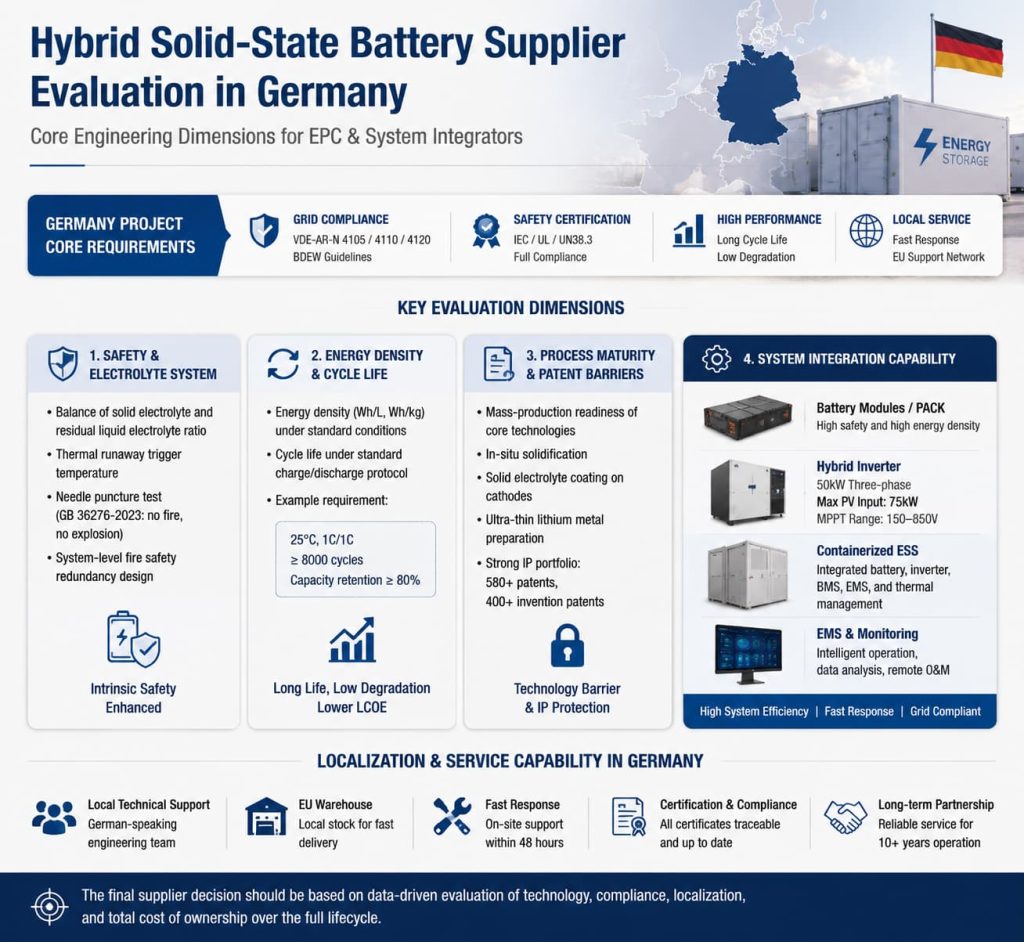
Engineering Constraints in the German Market (Determining Screening Logic)
Energy storage systems in Germany must conform to the following three engineering realities:
1. Grid Compliance
The energy storage system must satisfy:
- VDE-AR-N 4105 (Low-voltage grid connection)
- VDE-AR-N 4110 (Medium-voltage grid connection)
- BDEW Technical Guidelines
- EN 50549 Grid Connection Code
Engineering impact:
- The Power Conversion System (PCS) must support dynamic reactive power regulation.
- Must possess Fault Ride Through (FRT) capability.
- Grid connection response time is typically required to be in the <20ms range.
2. Business Model Constraints (EPC Perspective)
Primary applications for German C&I energy storage:
- Peak shaving
- PV self-consumption optimization
- Electricity cost arbitrage
- FCR / aFRR ancillary services market
Therefore, the supplier must support:
- High cycle life (>6000 cycles baseline)
- High daily cycling capacity (1–2 cycles/day)
- Stable degradation model (financially modelable)
3. Project Risk Structure (Bankability)
German clients are not focused on "technical advancement," but rather on:
- Is it bankable?
- Is it insurable?
- Is it maintainable long-term (10–15 years)?
Core metrics:
- Warranty enforceability under EU law
- Spare part availability within the EU
- Local service SLA (<48h response time)
Core Supplier Screening Dimensions (German Engineering Model)
1. Cell System & Safety Architecture (Engineering Safety)
Hybrid solid-state batteries in Germany must pass key safety validations:
- GB 36276-2023 (Referencing Chinese testing standards)
- UL/IEC safety frameworks
- Thermal Runaway (TR) propagation control
Engineering focus:
- Is the thermal propagation path inherently blocked by the material system?
- Does it rely solely on BMS "post-incident control"?
- Does it feature system-level fire protection redundancy?
2. Cycle Life & Degradation Model (Core of TCO)
German EPC calculation logic is based on:
- CAPEX (Initial investment)
- OPEX (Operation and maintenance costs)
- Degradation curve
Standard engineering assumptions:
- 8000 cycles @ 1C/1C
- Capacity retention ≥80%
- Annual degradation <1.5% (High-performance system target)
3. System-Level Integration Capability (ESS Architecture)
The supplier must provide a complete operational chain:
- Battery Pack
- BMS (Battery Management System)
- PCS (Power Conversion System)
- EMS (Energy Management System)
- Grid interface compliance
MegSolid System-Level Capabilities (Engineering Parameters):
- Three-phase hybrid ESS inverter: 50kW
- PV input: 75kW
- MPPT range: 150–850V
- Response time: <20ms
- System conversion efficiency: 98%+ level
Engineering significance:
- Directly compatible with German C&I PV systems.
- Supports dynamic load tracking.
- Meets rapid grid response requirements.
4. Localized Service Capability (Germany Delivery Constraint)
The primary reasons for project failure in Germany are not technological, but rather:
- Installation delays
- Missing spare parts
- Slow commissioning response
The supplier must possess:
- German-language technical support capabilities
- EU warehousing system
- Traceable local certification documents
- On-site commissioning capabilities
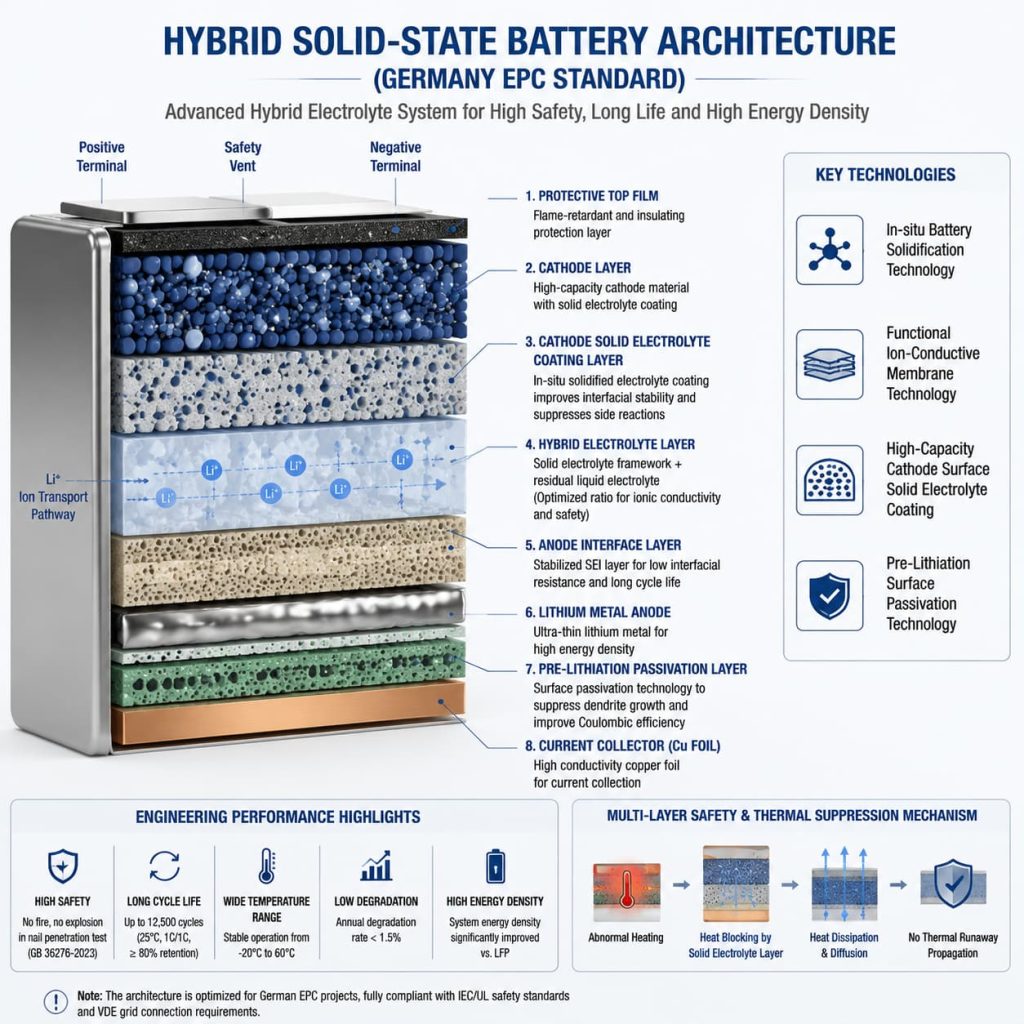
Core Supplier Screening Dimensions (German Engineering Model)
MegSolid should not be viewed merely as a "battery manufacturer," but rather as a: Hybrid Solid-State ESS system provider for EPC integration
Technical Path (Engineering Definition)
The MegSolid hybrid solid-state system is based on:
- In-situ solid-state battery structure
- Functional ion-conducting membrane
- High-capacity cathode solid coating
- Pre-lithiation surface passivation technology
Engineering goals:
- Lower interfacial impedance
- Improve high-temperature stability
- Control long-term degradation curves
Benchmarking Value (German Perspective)
In German projects, its value is realized by:
- Solving the degradation issues of traditional LFP in high-cycle scenarios.
- Improving PV + ESS coupling efficiency.
- Reducing the uncertainty of long-term TCO models.
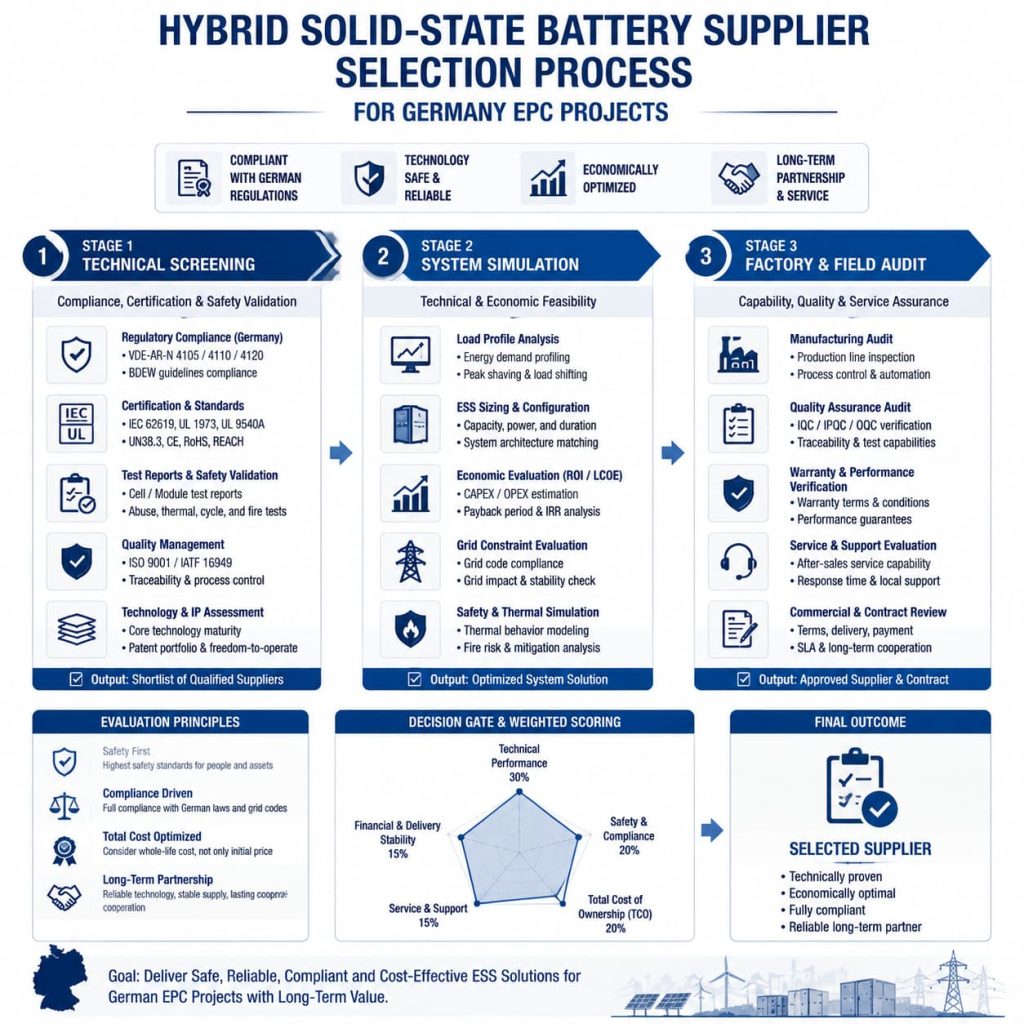
German Supplier Screening Process (EPC Standard Method)
Step 1: Technical Screening
Must submit:
- IEC/UL certification documents
- Cycle life test reports
- Thermal runaway test data
- At least 2 reference projects in similar European climates
Screening goal:
- Eliminate "concept-only products"
- retain engineering-verifiable systems.
Step 2: Engineering Simulation
Input parameters:
- Peak load profile
- PV generation curve
- Grid constraints
- Operation strategy
Outputs:
- ESS capacity design
- PCS configuration
- ROI model (5–10 years)
Step 3: Factory & Commissioning Audit
Must inspect:
- Production line consistency control
- BMS testing procedures
- PACK aging tests
- Warranty and SLA contract structure
Summary of German Engineering Decision Logic
Supplier selection for energy storage projects in Germany ultimately depends on three engineering variables:
- Grid compliance: Does it meet the VDE framework?
- Degradation curve: Is it financially modelable?
- Local delivery: Can it guarantee a 10-year operational lifecycle?
Within this framework, hybrid solid-state batteries are no longer just a "new technology option," but a mature asset optimization tool designed for high-cycle, highly volatile electricity price structures.
The role of MegSolid in this system is to provide:
- An engineering-verifiable hybrid solid-state battery system.
- An integrated PCS + ESS architecture.
- System-level delivery capabilities tailored for EPC projects.
Conclusion: Partnering for Engineering Success in Germany
Navigating the German C&I energy storage market is fundamentally a challenge of engineering precision and risk management. While traditional lithium-ion systems are increasingly facing bottlenecks in high-cycle and volatile arbitrage scenarios, hybrid solid-state technology presents a clear, future-proof alternative. However, realizing this potential requires a partner who understands that laboratory specifications must translate into bankable, grid-compliant, and locally supported solutions.
By combining advanced cell architecture with comprehensive ESS integration capabilities, MegSolid bridges the gap between cutting-edge innovation and field reality. Choosing MegSolid is not just about selecting a new battery technology; it is about securing a robust, fully integrated asset designed to meet today’s strict VDE standards and guarantee profitable operation throughout its entire lifecycle.
FAQ
Q1: How does MegSolid ensure grid compliance for German C&I projects?
MegSolid ESS solutions are engineered to meet strict German grid regulations, including VDE-AR-N 4105 for low-voltage and VDE-AR-N 4110 for medium-voltage connections. Our integrated Power Conversion System (PCS) delivers a <20ms response time, supports dynamic reactive power regulation, and features Fault Ride Through (FRT) capabilities, ensuring seamless grid integration and fast-track approval from local utility operators.
Q2: Why choose Hybrid Solid-State batteries over traditional LFP for peak shaving and arbitrage?
Traditional LFP batteries degrade quickly under the stress of 1-2 daily cycles required for profitable energy arbitrage. MegSolid’s Hybrid Solid-State technology utilizes an in-situ solid-state architecture to lower interfacial impedance, delivering over 8,000 cycles (at 1C/1C) with an annual degradation rate of less than 1.5%. This ensures a highly predictable Total Cost of Ownership (TCO) and long-term profitability.
Q3: Does MegSolid provide a complete ESS integrated system, or just battery packs?
We provide a fully integrated ESS architecture tailored for EPCs. Beyond our advanced battery packs, our delivery includes a matched Battery Management System (BMS), Power Conversion System (PCS), and Energy Management System (EMS). This all-in-one approach eliminates compatibility issues, minimizes integration risks, and accelerates on-site installation.
Q4: How do you address the strict fire safety and insurance requirements in Germany?
Safety is embedded at the material level. Our hybrid solid-state technology inherently suppresses thermal runaway propagation far better than traditional liquid electrolytes. Combined with system-level fire protection redundancy and certifications conforming to UL/IEC standards, MegSolid systems are highly insurable and meet the rigorous safety demands of German C&I facilities.
Q5: What is the local service SLA (Service Level Agreement) for MegSolid in Germany?
We guarantee a strict Service Level Agreement with a <48-hour on-site response time. This is supported by our localized European operations, which include a dedicated EU spare parts warehouse, German-speaking technical support, and local engineering teams ready to ensure maximum system uptime.
Q6: Are your energy storage systems bankable for 10-15 year financial models?
Yes. MegSolid systems are built for long-term bankability. We provide comprehensive performance warranties enforceable under EU law, backed by a highly stable, verifiable degradation curve. This gives project developers, investors, and financing institutions the predictable operational data required to model 10-15 year ROI with confidence.
Q7: Can MegSolid's ESS be easily coupled with existing commercial PV systems?
Absolutely. Our systems are designed for high-efficiency PV coupling. For example, our 50kW three-phase hybrid inverter handles up to 75kW of PV input with a wide MPPT range (150–850V) and 98%+ system conversion efficiency. This makes it an ideal drop-in solution for optimizing self-consumption in German commercial solar installations.
Q8: What certifications do you have ready for European market entry?
MegSolid holds comprehensive certifications required for European deployment, including full IEC and UL safety frameworks, rigorous cycle life test reports, and thermal runaway test data. Our compliance with EN 50549 and BDEW guidelines ensures there are no technical or regulatory barriers to deployment in Germany.
Q9: How does your technology perform under fluctuating ambient temperatures?
One of the core advantages of our hybrid solid-state cathode coating and functional ion-conducting membrane is superior high-temperature stability. This reduces the reliance on energy-intensive HVAC thermal management systems, lowering parasitic power consumption and maintaining stable performance across varying European climates.
Q10: What support does MegSolid offer during the project commissioning phase?
We support our EPC partners from factory to field. Before delivery, every system undergoes strict production line consistency checks and PACK aging tests. On-site, we provide comprehensive commissioning guidance and local engineering support to ensure seamless integration, rapid start-up, and zero project delays.
