

In Malaysia, an 80–100 kW billed peak lasting about two hours makes both discharge power and delivered energy relevant to the cabinet choice. MegSolid Energon 261 supplies 125 kVA and 261.24 kWh in a 1.76 m² footprint, placing it between one undersized 215.04 kWh unit and a two-cabinet overbuild defined during C&I BESS design.
Energon 261 Fits an 80–100 kW Two-Hour Demand Block
Delivering 90 kW for two hours requires 180 kWh AC before conversion losses and operating reserve enter the calculation. The usable-energy screen below rejects one ESSA0100B-0215 for this two-hour duty.
Die Energon 261.24 kWh system combines 125 kVA and 261.24 kWh in one IP54 cabinet. Energon provides 400/480 V AC options, intelligent liquid cooling, AI early warning and battery temperature-difference control within ±5°C. The worked energy duty does not require a second cabinet.
| MegSolid option | Gepubliseerde beoordeling | Result for a 90 kW, two-hour peak |
|---|---|---|
| ESSA0100B-0215 | 100 kW / 215,04 kWh | Power is adequate; nominal energy leaves too little room for losses and protected SOC |
| Energon 261 | 125 kVA / 261,24 kWh | One cabinet covers the preliminary power and energy screen |
| 2 × ESSA0100B-0215 | 200 kW / 430.08 kWh | Adds 202.8 kWh above the later 227.3 kWh calculation and doubles cabinet-level integration |
| ESSC0500B-1075 | 500 kW / 1,0752 MWh | Reserved for a much larger plant or campus demand block |
Compare the Installed Cabinet Footprints
Energon measures 1,300 × 1,350 × 2,200 mm, giving a 1.76 m² equipment footprint before service clearances. One ESSA0100B-0215 occupies about 3.80 m² from its 2,450 × 1,550 mm base, while two occupy about 7.60 m².
Choosing one Energon instead of two ESSA cabinets reduces cabinet footprint by approximately 76.9% and removes one parallel branch from the preliminary layout.
Shorter peaks, lower power factor or an energy requirement beyond one cabinet can change the product selection. TNB billing windows and site interval data establish those boundaries.
Check Whether TNB Bills the Peak the Battery Will Remove
Maximum-demand savings begin with the tariff category, voltage level and time of the recorded peak. TNB’s current voltage-based tariff structure classifies low voltage up to 1 kV, medium voltage above 1 kV and up to 50 kV, and high voltage above 50 kV and up to 230 kV. Use the tariff category on the site invoice when interpreting its meter data.
The same 90 kW event can have a different billing effect under a Time-of-Use tariff. TNB states that maximum demand occurring during off-peak periods is not charged for non-domestic medium- and high-voltage ToU customers. The weekday peak window runs from 14:00 to 22:00. Other weekday hours and the entire weekend are off-peak.
| Site tariff position | Peak that matters to the purchase | BESS operating result |
|---|---|---|
| Non-domestic general tariff | Highest demand that reaches the billed maximum-demand line | Discharge against the recurring billed interval |
| Medium- or high-voltage ToU | Chargeable weekday event between 14:00 and 22:00 | Hold sufficient SOC before 14:00 and cover the event |
| Peak occurs only during ToU off-peak hours | Event does not create the same maximum-demand charge | Avoid buying battery capacity for a saving the tariff does not create |
| Peak moves between production shifts | Different event may set the next bill | Control every qualifying event across the billing period |
Use Repeated 30-Minute Demand Blocks to Define the Duty
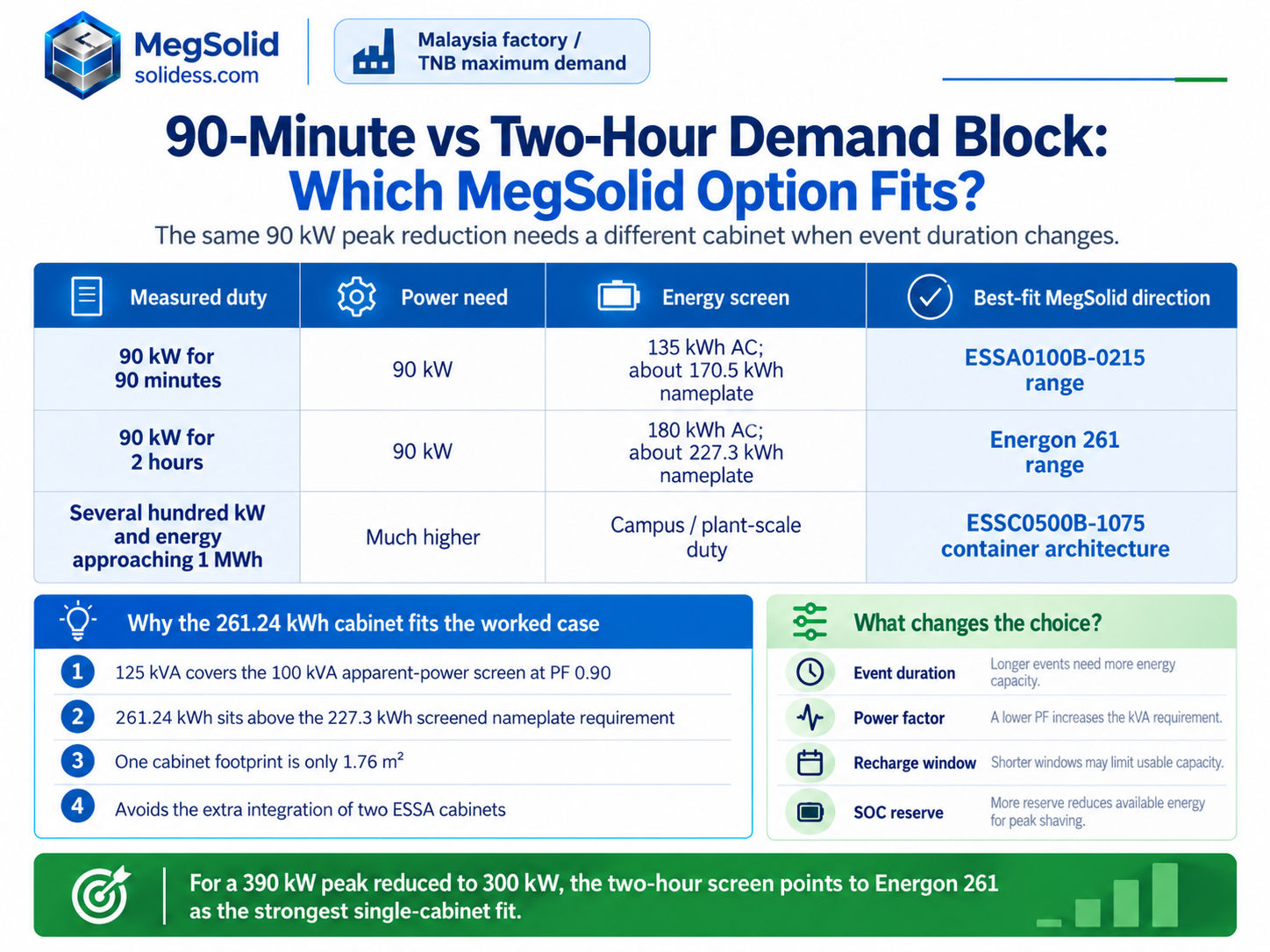
Review at least 12 billing months of load data. Monthly kWh totals cannot show whether a 390 kW maximum came from one interval, four consecutive intervals or a repeated production cycle. An unchanged kW peak can require a different battery capacity when its duration increases.
| Recorded event above a 300 kW target | Required BESS power | AC energy to remove the event | Inleidende MegSolid-rigting |
|---|---|---|---|
| One interval at 390 kW | 90 kW | 45 kWh | ESSA energy range |
| Four intervals at 390 kW | 90 kW | 180 kWh | Energon 261 energy range |
| Eight intervals at 340 kW | 40 kW | 160 kWh | Lower PCS power with a longer energy window |
The highest interval sets the monthly maximum. The intervals around it establish how many kWh the battery needs. Repeated events also establish how often the cabinet must cycle and how much time remains for recharge. The PCC peak-shaving controller must prevent charging from creating a new billed maximum after the original peak has been reduced.
Set the PCS Requirement from kW and Power Factor
The meter establishes the required kW reduction. Power factor then converts that duty into the apparent power seen by the PCS and switchboard. The calculation for a plant reducing its billed peak from 390 kW to 300 kW is:
Required active-power reduction = 390 kW − 300 kW = 90 kW
Required apparent power at PF 0.90 = 90 kW ÷ 0.90 = 100 kVA
Energon’s published 125 kVA rating leaves 25 kVA between the calculated duty and the cabinet rating at this operating point. Lower power factor consumes that margin quickly:
| Site power factor | Apparent power required for 90 kW | Margin below 125 kVA |
|---|---|---|
| 0.95 | 94.7 kVA | 30.3 kVA |
| 0.90 | 100.0 kVA | 25.0 kVA |
| 0.80 | 112.5 kVA | 12.5 kVA |
| 0.75 | 120.0 kVA | 5.0 kVA |
Apparent power is the scope of this comparison. The 125 kVA nameplate states apparent power. Final commissioning must still confirm active power, reactive-power behaviour and harmonic performance at the site operating point through commercial BESS power-quality testing.
CT direction can invalidate the dispatch calculation. Reversed CT polarity or a misplaced PCC measurement can command charging during a peak or discharging after the event has passed.
Die CT polarity commissioning test verifies that the controller sees import and export in the same direction as the revenue meter.
Size Battery Energy from Peak Duration and Protected SOC
Power determines how far the demand falls; duration determines whether the cabinet can hold the target until the event ends. Four consecutive 30-minute intervals at a 90 kW reduction require 180 kWh at the AC connection:
AC energy required = 90 kW × 2 hours = 180 kWh
Energon’s published maximum system efficiency is 90%. The worked case uses an 88% AC delivery factor and holds 10% of nominal energy outside the scheduled peak-shaving window. Required nameplate energy becomes:
Required nominal energy = 180 kWh ÷ 0.88 ÷ 0.90
                        = 227.3 kWh
One ESSA0100B-0215 is 12.3 kWh below the 227.3 kWh screen. Energon is 34.0 kWh above it. Applying the same delivery factor and SOC window to both cabinets gives:
| Produk | Nominal energie | Energy after 10% SOC reserve and 88% delivery factor | Duration at 90 kW |
|---|---|---|---|
| ESSA0100B-0215 | 215.04 kWh | 170.3 kWh AC | 1.89 hours |
| Energon 261 | 261,24 kWh | 206.9 kWh AC | 2.30 hours |
With the stated reserve and delivery factors, Energon has approximately 26.9 kWh AC beyond the two-hour requirement. The extra energy covers a modest extension while keeping the defined SOC reserve.
Long-term sizing still needs the project degradation model and guaranteed-energy schedule. The kommersiële BESS-kapasiteitstoets verifies delivered AC energy at the agreed power, SOC limits and ambient condition.
Shorter events favour the 215.04 kWh cabinet. Ninety minutes at 90 kW needs 135 kWh AC and 170.5 kWh of nameplate energy under the same factors, placing it inside the ESSA0100B-0215 range. Extending the measured event by only 30 minutes can move the purchase between the two products.
Match the Demand Block to ESSA, Energon or ESSC
MegSolid’s ESSA, Energon and ESSC classes give Malaysian factories different power and energy blocks for measured demand. The 215.04 kWh ESSA suits shorter peaks, Energon fills the two-hour single-cabinet gap, and ESSC0500B-1075 moves the project into a 500 kW container architecture.
| Gemete plig | MegSolid selection | Published product advantage | Customer result |
|---|---|---|---|
| Up to 100 kW with calculated nameplate energy at or below 215.04 kWh | ESSA0100B-0215 | 100 kW, 215.04 kWh, 400 V, built-in isolation transformer, on-grid THDi <3% | Avoids paying for the longer 261.24 kWh energy window |
| Approximately 80–100 kW for close to two hours | Energon 261 | 125 kVA, 261.24 kWh, 400/480 V, liquid cooling, up to 10 units in parallel | Covers the worked duty with one compact cabinet and preserves an expansion path |
| Several hundred kilowatts with an energy requirement approaching 1 MWh | ESSC0500B-1075 | 500 kW, 1.0752 MWh, IP54, 6,058 × 2,438 × 2,896 mm | Replaces a growing group of small cabinets with one container-level block |
When the Container-Class Screen Applies
ESSC0500B-1075 enters the comparison when both required power and energy approach its class. Sustaining a 350 kW reduction for two hours requires 700 kWh AC. Using the same 88% delivery factor and 10% SOC reserve gives 883.8 kWh of required nameplate energy, which sits inside the 1.0752 MWh ESSC0500B-1075 rating.
Its 21,000 kg weight and container dimensions then become transformer, switchboard, foundation and delivery-route decisions.
Energon remains the strongest match for the 90 kW factory because ESSC would provide 410 kW more rated power and 814.0 kWh more nominal energy than the selected cabinet. Those unused ratings add infrastructure without improving the two-hour demand target.
Keep Energon Ready for the Chargeable TNB Window
The two-hour event can be controlled only if the required energy remains available when the chargeable window begins. Under the current TNB ToU schedule, a medium- or high-voltage factory can prepare the battery before 14:00, protect the required SOC through the weekday peak window and recharge after 22:00. Weekend operation can use the all-day off-peak period when production permits.
Control priority for the 90 kW site should follow this order:
- Charge to the scheduled SOC target without lifting facility import above its control ceiling.
- Preserve 180 kWh AC for the four consecutive 30-minute demand intervals.
- Discharge as PCC import approaches 300 kW, then modulate output to hold that target.
- Retain the remaining calculated margin for a late or extended event.
- Recharge after the chargeable window at a power level that stays below the next demand threshold.
At 90 kW, Energon’s calculated 26.9 kWh AC margin adds about 18 minutes. That time is useful when a production run ends later than planned; it is too small to justify uncontrolled discharge earlier in the day.
Die BESS EMS-prioriteitslogika must place tariff protection above optional solar shifting whenever both functions compete for the same SOC.
Daily dispatch puts thermal consistency into the operating specification. Energon’s intelligent liquid cooling and self-evolving control maintain the published battery temperature difference within ±5°C, while AI early warning adds a monitoring layer around the same cabinet. These features support the repeated duty. The modeled energy requirement already fits one Energon without dividing it between two ESSA cabinets.
Value the 90 kW Reduction from the Actual TNB Bill
Calculate peak-shaving savings from the demand-related charge applied to the verified reduction. Energy charges, fuel adjustment, solar self-consumption and other bill components remain separate calculations.
Monthly maximum-demand saving
= verified billed-demand reduction × applicable demand charge in RM/kW
Claiming a 90 kW bill reduction requires the recorded maximum to fall by the full 90 kW. Missing an event late in the month can replace the controlled peak and erase much of that month’s demand saving, making Energon’s two-hour coverage and protected SOC commercially important.
Keep the Published Market Case Separate
The following published Malaysian installation provides a separate market reference. Livoltek reports a 125 kW/261 kWh installation that reduced maximum demand by as much as 89.99 kW, with monthly savings near RM9,000 and annual savings above RM95,000.
Those figures describe Livoltek’s published project. The 90 kW MegSolid example is screened separately against Energon’s 125 kVA and 261.24 kWh ratings.
Net value still needs to account for charging energy, conversion losses, auxiliary consumption, maintenance and the cost of retained SOC. Full lifecycle treatment belongs in the existing cost analysis; this page keeps the decision on whether one Energon cabinet can physically remove the chargeable demand block.
Prove the Demand Reduction During FAT and SAT
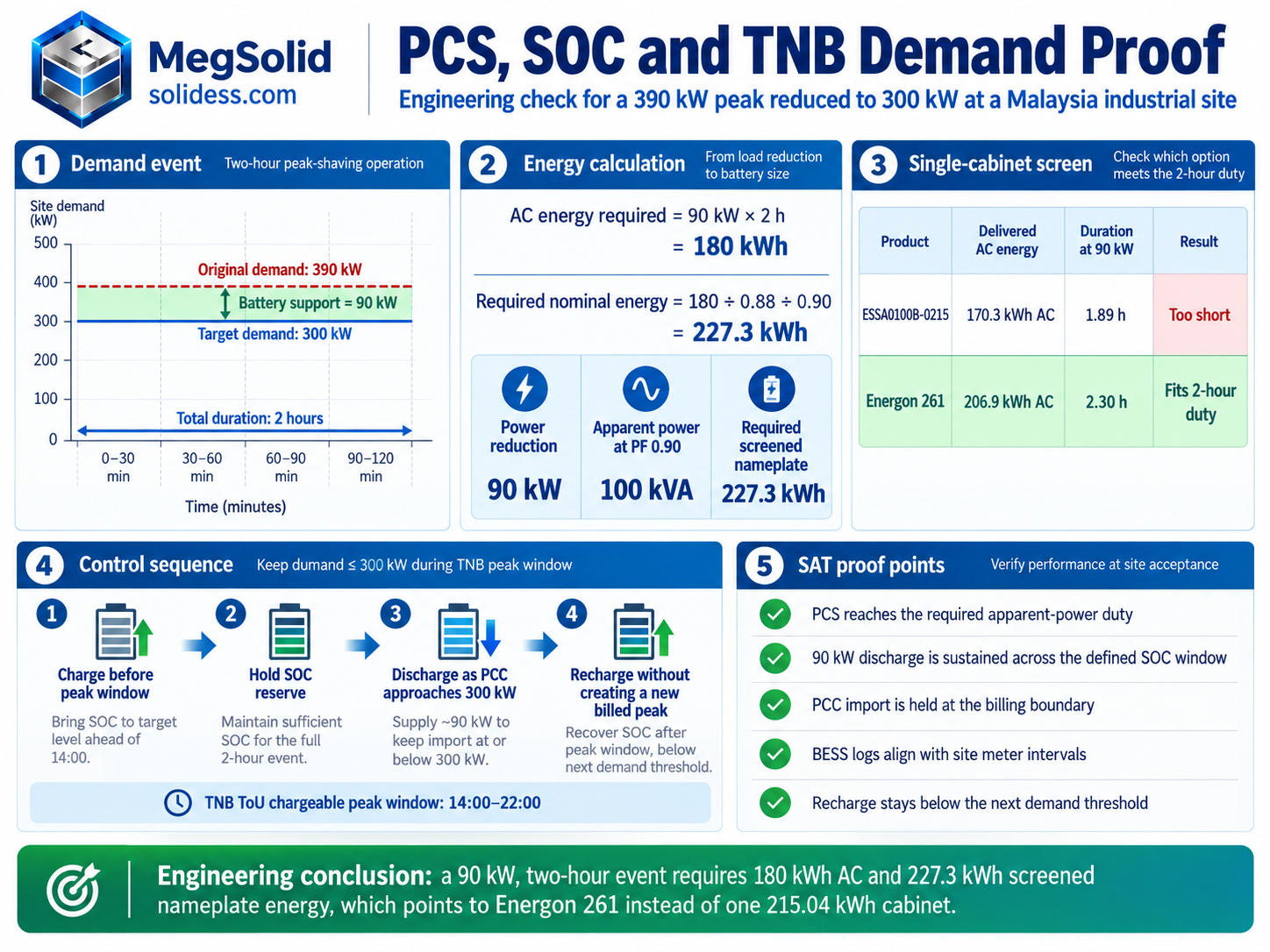
The cabinet, controller and site meter must reproduce the required result before site acceptance. Factory acceptance verifies the product configuration; site acceptance proves that the installed system controls the same point and interval used for billing.
| Acceptance check | Test condition | Purchase decision protected |
|---|---|---|
| PCS apparent-power duty | Run at the agreed active power and site power factor | Confirms that the 125 kVA boundary covers the 90 kW event |
| Afgelewerde AC-energie | Discharge at 90 kW across the defined SOC window | Confirms at least 180 kWh reaches the AC connection for the two-hour event |
| PCC-beheer | Raise site load above 300 kW and record BESS response | Confirms the plant import target is held at the billing boundary |
| Interval alignment | Compare BESS logs, site meter and revenue-meter interval timestamps | Prevents a control success in the wrong interval |
| Recharge control | Recharge after the event under the import ceiling | Prevents the battery from creating the next billed peak |
| Thermal operation | Record battery temperature spread during the duty | Verifies operation against Energon’s published ±5°C temperature-difference control |
IEC 62619 addresses safety requirements and tests for industrial secondary lithium cells and batteries. IEC 62933-5-2 covers safety requirements for grid-integrated electrochemical energy storage systems, while IEC 62477-1 addresses power electronic converter system safety.
These standards define evidence and test scope for the project; certification claims require the corresponding MegSolid certificate or report.
Die C&I BESS FAT, SAT and performance acceptance process ties those checks to witnessed records. The BESS-fabrieksaanvaardingstoetsgids then connects PCS, BMS, EMS, thermal protection and communication evidence to the equipment released for shipment.
Select the Final MegSolid Configuration from the Measured Event
With a 390 kW factory peak, a 300 kW import target, 0.90 power factor and a two-hour event, the calculation yields 90 kW, 100 kVA and 227.3 kWh of screened nameplate energy. MegSolid Energon 261 is the strongest product match because one cabinet supplies 125 kVA and 261.24 kWh while preserving 34.0 kWh above the calculated nameplate requirement.
ESSA0100B-0215 becomes the better purchase when the same 90 kW event lasts about 90 minutes. ESSC0500B-1075 becomes the better architecture when the measured duty rises into several hundred kilowatts and the calculated energy approaches 1 MWh. Product class follows the measured demand event and its duration.
In this worked duty, Energon provides four specific benefits: one cabinet instead of two, approximately 76.9% less cabinet footprint than two ESSA units, about 18 minutes of calculated AC energy beyond the two-hour target, and an expansion path of up to 10 parallel units. Liquid cooling, ±5°C temperature-difference control and AI early warning support the repeated dispatch expected from daily maximum-demand management.
VGV
What is the best battery energy storage system for a 90 kW, two-hour peak in Malaysia?
MegSolid Energon 261 is the best-fit single-cabinet option for the duty calculated here. Its 125 kVA and 261.24 kWh ratings cover the 100 kVA and 227.3 kWh screening results with defined margin.
How long can Energon 261 support a 90 kW reduction?
Using the article’s 10% SOC reserve and 88% AC delivery factor, 261.24 kWh provides about 206.9 kWh AC. That equals approximately 2.30 hours at 90 kW.
Is 125 kVA dieselfde as 125 kW?
No. kVA is apparent power, while kW is active power. Delivering 90 kW at 0.90 power factor requires 100 kVA, leaving 25 kVA below Energon’s published rating.
Can one ESSA0100B-0215 handle the same peak?
One ESSA provides enough rated power at 100 kW. Under the same reserve and delivery factors, its 215.04 kWh rating supplies about 170.3 kWh AC, covering roughly 1.89 hours at 90 kW.
When should a Malaysian factory choose ESSC0500B-1075?
ESSC0500B-1075 becomes relevant when the reduction reaches several hundred kilowatts and calculated energy approaches 1 MWh. The 500 kW, 1.0752 MWh, 21,000 kg container also requires suitable switchgear, transformer capacity, foundation and delivery access.
Does TNB charge maximum demand during off-peak ToU hours?
TNB states that off-peak maximum demand is not charged for non-domestic medium- and high-voltage ToU customers. The current weekday peak period is 14:00–22:00, with weekends treated as off-peak.
How much interval data should be checked before buying a BESS?
Twelve billing months reveal seasonal production, shutdowns and recurring chargeable peaks. Monthly kWh totals alone cannot show event duration or how often the battery must discharge.
Can BESS charging create a new maximum-demand charge?
Yes. Recharge power added to the facility load can establish a new peak. PCC control should cap charging so total grid import remains below the selected threshold.
Does maximum-demand management require rooftop solar?
No. The battery can recharge from the grid during a suitable low-load or off-peak window and discharge against the chargeable event. Solar can reduce charging cost when surplus generation is available.
What does liquid cooling add to the Energon 261 purchase?
Energon uses intelligent liquid cooling and published control of battery temperature difference within ±5°C. That thermal consistency supports the repeated cycling duty created by regular peak shaving.
Can Energon 261 cabinets be expanded later?
Yes. MegSolid publishes parallel operation of up to 10 units. Transformer capacity, switchboard current, protection, controller architecture and available space still set the practical site limit.
How should the 180 kWh delivery target be verified?
The site acceptance test should discharge at 90 kW through the agreed SOC window and meter at least 180 kWh at the AC connection. Timestamps must align with the facility and revenue-meter intervals.
How are monthly savings calculated for a Malaysian factory?
Multiply the verified billed-demand reduction by the applicable RM/kW charge on the site’s TNB bill. Charging energy, losses, auxiliary consumption and maintenance are then deducted from the gross demand saving.