 Skip to content


For a TNB-supplied factory in Peninsular Malaysia, start with the required reduction at the billing meter. This guide uses a hypothetical 390 kW load, a 300 kW import target and a two-hour event: the battery must deliver 90 kW and 180 kWh AC. MegSolid Energon 261 is a 125 kVA / 261.24 kWh candidate to compare with the 215.04 kWh unit. The numbers below are a screening example, not a Malaysian MegSolid installation or a runtime guarantee. Use the C&I BESS design process to verify PCS kW/kvar, usable AC energy and recharge before ordering.
Screen Energon 261 for an 80–100 kW Two-Hour Demand Reduction
Delivering 90 kW for two hours requires 180 kWh AC. The screening assumptions below add an independent delivery allowance and a scheduled SOC window. Under those assumptions, one 215.04 kWh cabinet falls short, while 261.24 kWh clears the nominal-energy screen. Actual acceptance still depends on guaranteed usable AC energy at the required power and warranty age.
The Energon 261.24 kWh product page lists 125 kVA, an IP54 cabinet, 400/480 V AC options and liquid cooling. Its published operating range is −20 to 55°C, with derating above 45°C. Confirm continuous kW, the simultaneous kvar obligation, temperature/DC-voltage limits and net usable AC energy for the exact offered build. The nameplate makes it a candidate; it does not establish the two-hour guarantee. If the Malaysian shortlist includes a Sungrow PowerStack 255CS (ST255CS-2H) alternative, apply the same 90 kW / 180 kWh duty and confirm each cabinet’s active-power and usable-energy limits.
| MegSolid option | Published rating | Result for a 90 kW, two-hour peak |
|---|---|---|
| ESSA0100B-0215 | 100 kW / 215.04 kWh | 100 kW is a published rating; the common illustrative energy factors give 170.3 kWh AC, below the 180 kWh target |
| Energon 261 | 125 kVA / 261.24 kWh | Nominal energy clears the stated illustrative screen; available kW/kvar and warranted AC energy remain approval gates |
| 2 × ESSA0100B-0215 | 200 kW / 430.08 kWh | 430.08 kWh nominal; compare the additional capacity, two branches and released parallel-control scope against the actual duty |
| ESSC0500B-1075 | 500 kW / 1.0752 MWh | Consider only when measured power/energy and the site electrical/civil scope justify the larger block |
Compare the Installed Cabinet Footprints
Energon measures 1,300 × 1,350 × 2,200 mm, giving a 1.76 m² equipment footprint before service clearances. One ESSA0100B-0215 occupies about 3.80 m² from its 2,450 × 1,550 mm base, while two occupy about 7.60 m².
On cabinet dimensions alone, 1.755 m² is approximately 76.9% less than the combined 7.595 m² base area of two ESSA cabinets. This is a geometric comparison, not a 76.9% saving in installed site area or cost. Service access, fire separation, cooling-air paths and the approved parallel arrangement determine the actual layout.
Shorter peaks, lower power factor or an energy requirement beyond one cabinet can change the product selection. TNB billing windows and site interval data establish those boundaries.
Check Whether TNB Bills the Peak the Battery Will Remove
Confirm the tariff name, supply-voltage category, billing period and demand-related line items on the actual TNB invoice. A low-voltage customer’s charges must not be treated as an MV/HV maximum-demand charge merely because its plant has a high instantaneous load. Use the current approved tariff and account terms; older industrial tariff labels and historical booklets can describe a different structure.
For eligible TNB ToU accounts, the published weekday peak window is 14:00–22:00; other weekday hours, weekends and TNB’s specified public holidays are off-peak. TNB explains that maximum-demand charges do not apply during off-peak periods for peak/off-peak tariff customers. Verify the site’s actual MV/HV demand-charge basis before assigning a saving to a recorded event.
| Site tariff position | Peak that matters to the purchase | BESS operating result |
|---|---|---|
| Eligible MV/HV general tariff | Highest demand that reaches the billed maximum-demand line | Discharge against the recurring billed interval |
| Eligible MV/HV ToU account | Chargeable 14:00–22:00 weekday event, excluding TNB-specified off-peak holidays | Schedule sufficient usable energy before the event and verify the entire chargeable interval |
| Peak occurs only during ToU off-peak hours | Check the actual account terms; an off-peak event does not create the same ToU demand saving | Avoid buying battery capacity for a saving the tariff does not create |
| Peak moves between production shifts | Different event may set the next bill | Control every qualifying event across the billing period |
Use Repeated 30-Minute Demand Blocks to Define the Duty
Review twelve billing months where available, with a data-gap plan if records are shorter. Export local timestamps, interval duration, import kWh or average kW, measured kvar/power factor, production shift, PV output and outage flags. TNB defines monthly MD from the largest energy supplied in a consecutive 30-minute period. Reconcile the controller’s clock and interval convention with the revenue meter rather than assuming any four logged half-hours exactly match the billing calculation.
| Recorded event above a 300 kW target | Required BESS power | AC energy to remove the event | Initial MegSolid direction |
|---|---|---|---|
| One interval at 390 kW | 90 kW | 45 kWh | ESSA energy range |
| Four intervals at 390 kW | 90 kW | 180 kWh | Energon 261 energy range |
| Eight intervals at 340 kW | 40 kW | 160 kWh | Lower PCS power with a longer energy window |
The highest interval sets the monthly maximum. The intervals around it establish how many kWh the battery needs. Repeated events also establish how often the cabinet must cycle and how much time remains for recharge. The PCC peak-shaving controller must prevent charging from creating a new billed maximum after the original peak has been reduced.
Set the PCS Requirement from kW and Power Factor
The billing target establishes a 90 kW active-power reduction. Size the PCS from the active and reactive power it is assigned to exchange at its own terminals. The factory’s load power factor does not automatically become the PCS output power factor: the grid, capacitors or other equipment may supply part of the kvar duty. Agree the control mode and P–Q allocation before calculating kVA.
Required active-power reduction = 390 − 300 = 90 kW
PCS apparent power = √(P² + Q²)
At Q = 0: S = 90 kVA
If PCS displacement PF is specified as 0.90: S = 90 ÷ 0.90 = 100 kVA, with |Q| ≈ 43.6 kvar
The following table is a sensitivity check for the PCS’s assigned displacement power factor at 90 kW. It is not a conversion from the factory’s measured power factor. The arithmetic difference from 125 kVA is not spare kvar capability or proof of continuous kW output; apply the exact model’s P–Q, current, temperature and DC-voltage limits.
| Assigned PCS displacement PF | PCS kVA at 90 kW | Arithmetic difference from 125 kVA |
|---|---|---|
| 0.95 | 94.7 kVA | 30.3 kVA |
| 0.90 | 100.0 kVA | 25.0 kVA |
| 0.80 | 112.5 kVA | 12.5 kVA |
| 0.75 | 120.0 kVA | 5.0 kVA |
For an ideal 125 kVA circle at 90 kW, √(125² − 90²) is approximately 86.7 kvar. This is a geometric upper screen, not a model guarantee; the released P–Q curve can impose tighter limits. Verify simultaneous P and Q, current and harmonic performance through commercial BESS power-quality testing.
CT direction can invalidate the dispatch calculation. Reversed CT polarity or a misplaced PCC measurement can command charging during a peak or discharging after the event has passed.
The CT polarity commissioning test verifies that the controller sees import and export in the same direction as the revenue meter.
Size Battery Energy from Peak Duration and Protected SOC
Power determines how far the demand falls; duration determines whether the cabinet can hold the target until the event ends. Four consecutive 30-minute intervals at a 90 kW reduction require 180 kWh at the AC connection:
AC energy required = 90 kW × 2 hours = 180 kWh
Use 88% as an independent illustrative one-way AC-delivery factor and 90% as an illustrative scheduled SOC window. Neither is a warranted value for these cabinets. The product page’s “maximum system efficiency: 90%” does not define a measured round-trip efficiency or establish the 88% factor. The screen below also assumes beginning-of-life nominal capacity; auxiliaries must be assigned to the delivery boundary once.
Required nominal energy = 180 kWh ÷ 0.88 ÷ 0.90
                        = 227.3 kWh
The unrounded requirement is 227.27 kWh: 12.2 kWh above 215.04 kWh and 34.0 kWh below 261.24 kWh. The next table applies the same hypothetical factors solely to show their effect on nominal energy; it is not a measured comparison or a product acceptance certificate.
| Product | Nominal energy | Illustrative AC energy: nominal × 0.90 × 0.88 | Illustrative duration at 90 kW, before uncounted auxiliaries/age effects |
|---|---|---|---|
| ESSA0100B-0215 | 215.04 kWh | 170.3 kWh AC | 1.89 hours |
| Energon 261 | 261.24 kWh | 206.9 kWh AC | 2.30 hours |
In this beginning-of-life illustration, Energon’s calculated AC allowance is 206.9 − 180 = 26.9 kWh. Any additional auxiliary demand or capacity loss reduces it. At an independently assumed 80% retained capacity, the same other factors give only 165.5 kWh AC, below the two-hour target. Specify the required usable AC energy and warranty-age condition rather than purchasing against the initial 26.9 kWh allowance.
Long-term sizing still needs the project degradation model and guaranteed-energy schedule. The commercial BESS capacity test verifies delivered AC energy at the agreed power, SOC limits and ambient condition.
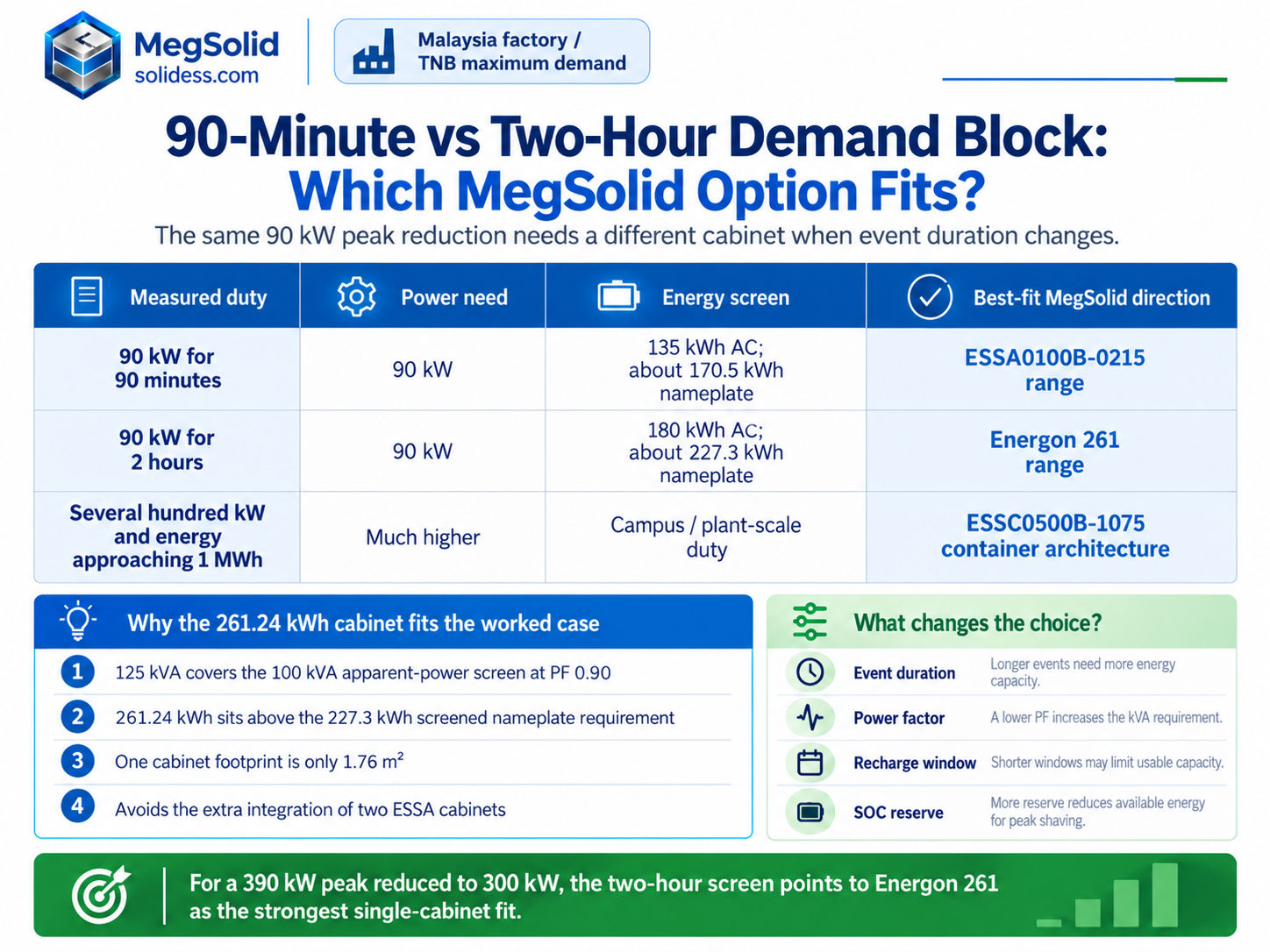
A 90-minute event at 90 kW needs 135 kWh AC, or 170.5 kWh nominal under these same hypothetical factors. That clears the 215.04 kWh nominal-energy screen, but continuous kW/kvar, temperature, auxiliaries and warranty age still require approval. A longer measured event can change the shortlist without proving either product is always the cheaper purchase.
Match the Demand Block to ESSA, Energon or ESSC
Compare ESSA, Energon and ESSC against the same meter-level duty and acceptance boundary. The current catalogue ratings place them in different power/energy classes; they do not rank the installed cost or guarantee the same usable fraction. Shortlist a class first, then require the selected model to meet the specified kW/kvar and net AC-energy obligation.
| Measured duty | Preliminary MegSolid candidate | Published product advantage | Release condition |
|---|---|---|---|
| Up to 100 kW with calculated nameplate energy at or below 215.04 kWh | ESSA0100B-0215 | 100 kW, 215.04 kWh, 400 V, built-in isolation transformer, on-grid THDi <3% | Confirm net usable AC energy and simultaneous kW/kvar at temperature and warranty age |
| Approximately 80–100 kW for close to two hours | Energon 261 | 125 kVA, 261.24 kWh, 400/480 V, liquid cooling, up to 10 units in parallel | Require the exact build to meet 90 kW / 180 kWh AC; parallel expansion needs an approved design |
| Several hundred kilowatts with an energy requirement approaching 1 MWh | ESSC0500B-1075 | 500 kW, 1.0752 MWh, IP54, 6,058 × 2,438 × 2,896 mm | Compare transformer, protection, usable AC energy, civil works and delivery scope |
When the Container-Class Screen Applies
A separate hypothetical 350 kW reduction for two hours needs 700 kWh AC. Applying the same 88% delivery factor and 90% scheduled SOC window gives 883.8 kWh nominal, below the ESSC0500B-1075’s published 1,075.2 kWh. This is an initial energy screen only; verify available kW/kvar, thermal limits, auxiliaries and warranted AC energy before releasing a container configuration.
Its 21,000 kg weight and container dimensions then become transformer, switchboard, foundation and delivery-route decisions.
For the 90 kW / 180 kWh example, Energon merits a single-cabinet review before a 500 kW container. ESSC’s 1,075.2 kWh is approximately 814.0 kWh more nominal energy than Energon, but 500 kW cannot be compared directly with a 125 kVA rating to calculate unused active power. Price the complete accepted duty and site works before deciding which architecture offers better value.
Keep Energon Ready for the Chargeable TNB Window
The two-hour event can be controlled only if the required energy remains available when the chargeable window begins. Under the current TNB ToU schedule, a medium- or high-voltage factory can prepare the battery before 14:00, protect the required SOC through the weekday peak window and recharge after 22:00. Weekend operation can use the all-day off-peak period when production permits.
Control priority for the 90 kW site should follow this order:
- Charge to the scheduled SOC target without lifting facility import above its control ceiling.
- Preserve 180 kWh AC for the four consecutive 30-minute demand intervals.
- Discharge as PCC import approaches 300 kW, then modulate output to hold that target.
- Retain the remaining calculated margin for a late or extended event.
- Recharge after the chargeable window at a power level that stays below the next demand threshold.
At 90 kW, the hypothetical 26.9 kWh beginning-of-life AC allowance equals about 18 minutes. It must not be promised as additional runtime: temperature, capacity age, auxiliaries and earlier dispatch can reduce available energy. Protect the specified obligation for every qualifying event and confirm recovery before the next one.
The BESS EMS priority logic must place tariff protection above optional solar shifting whenever both functions compete for the same SOC.
Daily maximum-demand dispatch puts cooling and available power into the supply specification. Energon lists liquid cooling and AI-based monitoring, but the offered temperature map and derating curve must support the agreed 90 kW event. Do not let a hot intake-air condition turn a screened two-hour purchase into a shortfall; price the 90 kW /180 kWh AC acceptance obligation with the cabinet.
Value the 90 kW Reduction from the Actual TNB Bill
Calculate gross demand-related savings from the actual invoice components whose billed kW falls. Use each applicable RM/kW rate and billing rule. Model the energy-cost difference between charging imports and the electricity displaced at discharge separately from demand-charge savings. Deduct maintenance, financing and auxiliaries not already included; count conversion losses once within the chosen AC-meter boundary.
Gross monthly demand saving = Σ [verified reduction in billed kW for an eligible charge component × that component’s current RM/kW rate]
Claiming a 90 kW bill reduction requires the recorded maximum to fall by the full 90 kW. Missing an event late in the month can replace the controlled peak and erase much of that month’s demand saving, making Energon’s two-hour coverage and protected SOC commercially important.
Keep the Published Market Case Separate
Livoltek’s own Malaysian case report describes its BES-P125X261 rated 125 kW / 261 kWh. It reports up to 89.99 kW maximum-demand reduction over two months, monthly savings approaching RM9,000 and annual savings potential above RM95,000. The annual figure is a projection, not a published twelve-month measured result. These vendor-reported figures do not establish MegSolid performance or this hypothetical factory’s savings.
Those figures describe Livoltek’s published project. The 90 kW MegSolid example is screened separately against Energon’s 125 kVA and 261.24 kWh ratings.
Net value still needs to account for charging energy, conversion losses, auxiliary consumption, maintenance and the cost of retained SOC. Full lifecycle treatment belongs in the existing cost analysis; this page keeps the decision on whether one Energon cabinet can physically remove the chargeable demand block.
Prove the Demand Reduction During FAT and SAT
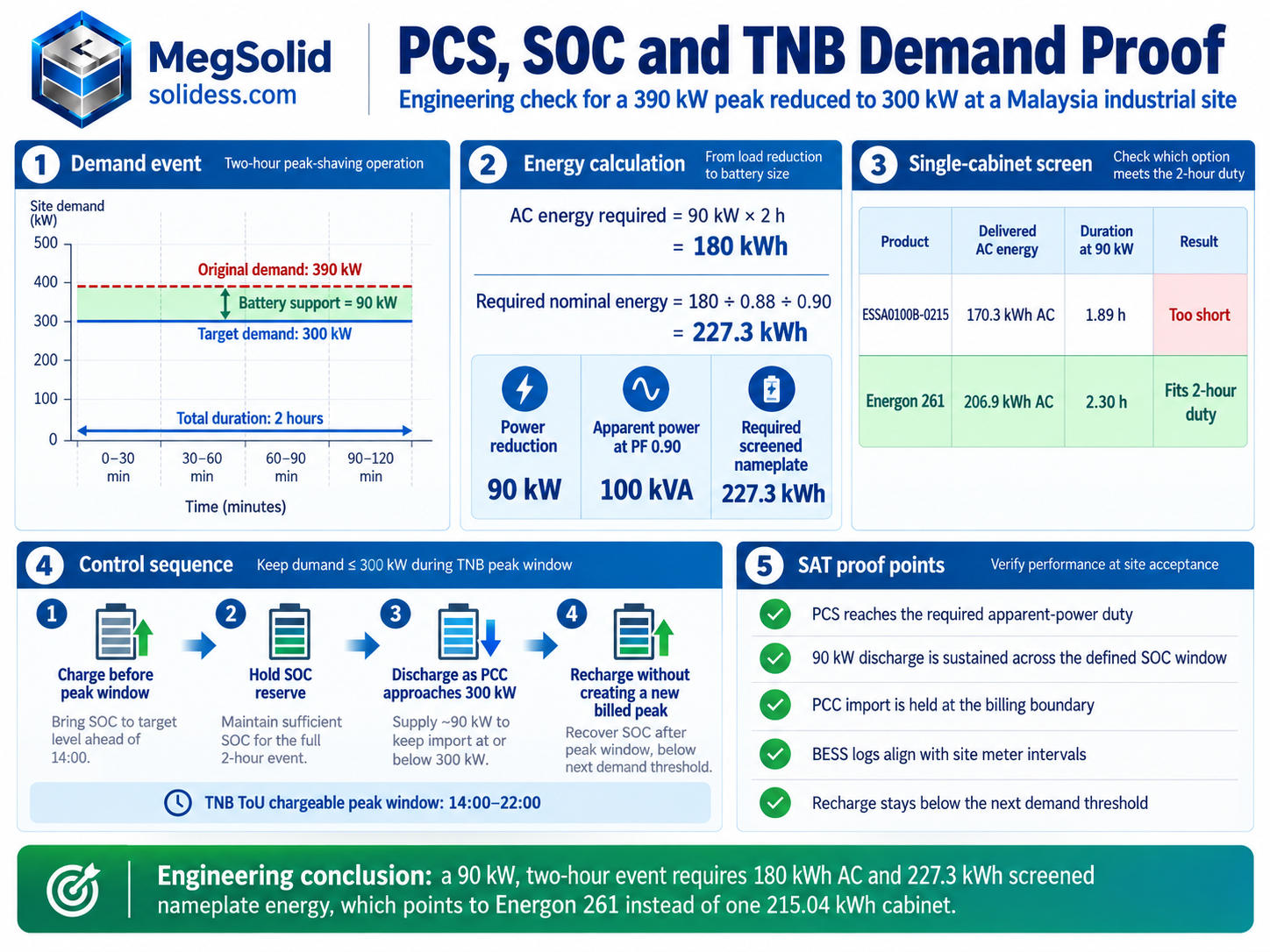
Agree the acceptance duty before purchase: 90 kW active output, the assigned kvar duty and at least 180 kWh net AC delivery at a named meter, temperature, SOC window and capacity-age condition. FAT checks the shipped configuration; SAT checks the installed metering and control boundary. A successful test supports those recorded conditions, while monthly bill reduction also requires coverage of every charge-setting event.
| Acceptance check | Test condition | Purchase decision protected |
|---|---|---|
| PCS apparent-power duty | Run at the agreed PCS active power and assigned kvar/PF duty | Checks simultaneous kW/kvar against the exact model’s available P–Q envelope |
| Delivered AC energy | Discharge at 90 kW across the agreed SOC window, temperature and capacity-age condition | Meter at least 180 kWh net of agreed auxiliaries/losses at the named delivery point |
| PCC control | Raise site load above 300 kW and record BESS response | Record the target, transients, import/export convention and agreed tolerance at the billing boundary |
| Interval alignment | Compare BESS logs, site meter and revenue-meter interval timestamps | Prevents a control success in the wrong interval |
| Recharge control | Recharge after the event under the import ceiling | Prevents the battery from creating the next billed peak |
| Thermal operation | Record battery temperature spread during the duty | Verifies the offered temperature limits, spread and derating against the agreed 90 kW duty |
IEC 62619 addresses safety requirements and tests for industrial secondary lithium cells and batteries. IEC 62933-5-2 covers safety requirements for grid-integrated electrochemical energy storage systems, while IEC 62477-1 addresses power electronic converter system safety.
IEC test evidence does not replace Malaysian site approvals. The Energy Commission’s BESS Safety Guidelines, GP/ST/No.62/2026, address design responsibility, registered contractors, technical evaluations, location and commissioning. Have the appointed competent person identify the applicable licence, utility connection and local fire/location requirements for the actual application. Ask for a responsibility matrix and the offered model’s reports before treating a cabinet as ready for installation.
The C&I BESS FAT, SAT and performance acceptance process ties those checks to witnessed records. The BESS factory acceptance test guide then connects PCS, BMS, EMS, thermal protection and communication evidence to the equipment released for shipment.
Select the Final MegSolid Configuration from the Measured Event
The hypothetical factory needs a 90 kW reduction and 180 kWh AC over two hours. If the PCS is also assigned 0.90 displacement PF, its calculated duty is 100 kVA; active-only dispatch would be 90 kVA before other constraints. The 227.3 kWh nominal-energy screen uses independent beginning-of-life assumptions. Energon’s published 125 kVA / 261.24 kWh ratings justify a preliminary review, subject to a signed usable-energy and P–Q obligation for the exact site conditions.
A 90-minute event can bring ESSA0100B-0215 into the energy shortlist under the same hypothetical factors. A duty of several hundred kilowatts approaching 1 MWh can justify reviewing ESSC0500B-1075. Select the final architecture from guaranteed AC output, required lifetime, available recharge, installed scope and cost rather than one nominal-capacity comparison.
The comparison identifies questions to close before release: can the offered cabinet deliver 90 kW and 180 kWh AC at the agreed P–Q, temperature and warranty-age condition; can it recover before the next billed event; and what service/fire clearances does the layout need? The 76.9% cabinet-base-area comparison, 18-minute initial-energy allowance and advertised parallel limit remain separate from installed-area, runtime and expansion guarantees.
FAQ
What is the best battery energy storage system for a 90 kW, two-hour peak in Malaysia?
One 261.24 kWh cabinet clears this article’s hypothetical beginning-of-life energy screen, but no universal best-fit result follows. Require the exact offer to deliver 90 kW and 180 kWh net AC at the assigned kvar duty, temperature and warranty-age condition. A 125 kVA rating alone does not prove that obligation.
How long can Energon 261 support a 90 kW reduction?
Under the independent 90% scheduled SOC window and 88% one-way delivery assumptions, beginning-of-life nominal capacity gives 206.9 kWh AC, or 2.30 hours at 90 kW. This is an illustrative screen, not a guaranteed runtime. Auxiliaries, temperature, capacity age and the supplier’s defined AC boundary can change it.
Is 125 kVA the same as 125 kW?
No. kVA is apparent power and kW is active power. If the PCS itself is assigned 90 kW at 0.90 displacement PF, the calculation is 100 kVA and about 43.6 kvar. If its assigned Q is zero, the initial apparent-power screen is 90 kVA. The factory’s load PF must not be automatically assigned to the PCS.
Can one ESSA0100B-0215 handle the same peak?
Its published 100 kW rating is only the starting power check. Under the same independent energy factors, 215.04 kWh gives 170.3 kWh AC, or about 1.89 hours at 90 kW. Verify simultaneous kW/kvar, temperature, auxiliaries and warranty-age energy before deciding whether one unit meets a shorter event.
When should a Malaysian factory choose ESSC0500B-1075?
ESSC0500B-1075 becomes relevant when the reduction reaches several hundred kilowatts and calculated energy approaches 1 MWh. The 500 kW, 1.0752 MWh, 21,000 kg container also requires suitable switchgear, transformer capacity, foundation and delivery access.
Does TNB charge maximum demand during off-peak ToU hours?
TNB states that off-peak MD charges do not apply to peak/off-peak tariff customers; check the actual MV/HV account terms. Its published ToU weekday peak window is 14:00–22:00, with other weekday hours, weekends and its specified public holidays off-peak. Other regions, utilities and tariffs need their own review.
How much interval data should be checked before buying a BESS?
Twelve billing months are useful where available to expose seasonality, shutdowns and recurring peaks. Export interval timestamps/duration, import kWh or average kW, kvar/PF and production/PV context; reconcile the billing-meter convention. If a full year is missing, record the gap and collect representative measurements instead of inventing an annual trace.
Can BESS charging create a new maximum-demand charge?
Yes. Recharge power added to the facility load can establish a new peak. PCC control should cap charging so total grid import remains below the selected threshold.
Does maximum-demand management require rooftop solar?
No. The battery can recharge from the grid during a suitable low-load or off-peak window and discharge against the chargeable event. Solar can reduce charging cost when surplus generation is available.
What does liquid cooling add to the Energon 261 purchase?
Energon’s liquid cooling and AI-based monitoring are published features. Verify the temperature map, auxiliaries and available power for the repeated 90 kW duty; the catalogue lists derating above 45°C. A±5°C uniformity guarantee needs its own supplied-model test record.
Can Energon 261 cabinets be expanded later?
Yes. MegSolid publishes parallel operation of up to 10 units. Transformer capacity, switchboard current, protection, controller architecture and available space still set the practical site limit.
How should the 180 kWh delivery target be verified?
The site acceptance test should discharge at 90 kW through the agreed SOC window and meter at least 180 kWh at the AC connection. Timestamps must align with the facility and revenue-meter intervals.
How are monthly savings calculated for a Malaysian factory?
Sum the verified billed-kW reduction times each eligible demand-related RM/kW rate. Model the energy-cost difference between charging imports and the electricity displaced at discharge separately from demand-charge savings. Deduct maintenance, financing and auxiliaries not already included; count conversion losses once within the chosen AC-meter boundary. A 90 kW dispatch at one event is not evidence of the month’s billed-maximum reduction.
