 الانتقال إلى المحتوى
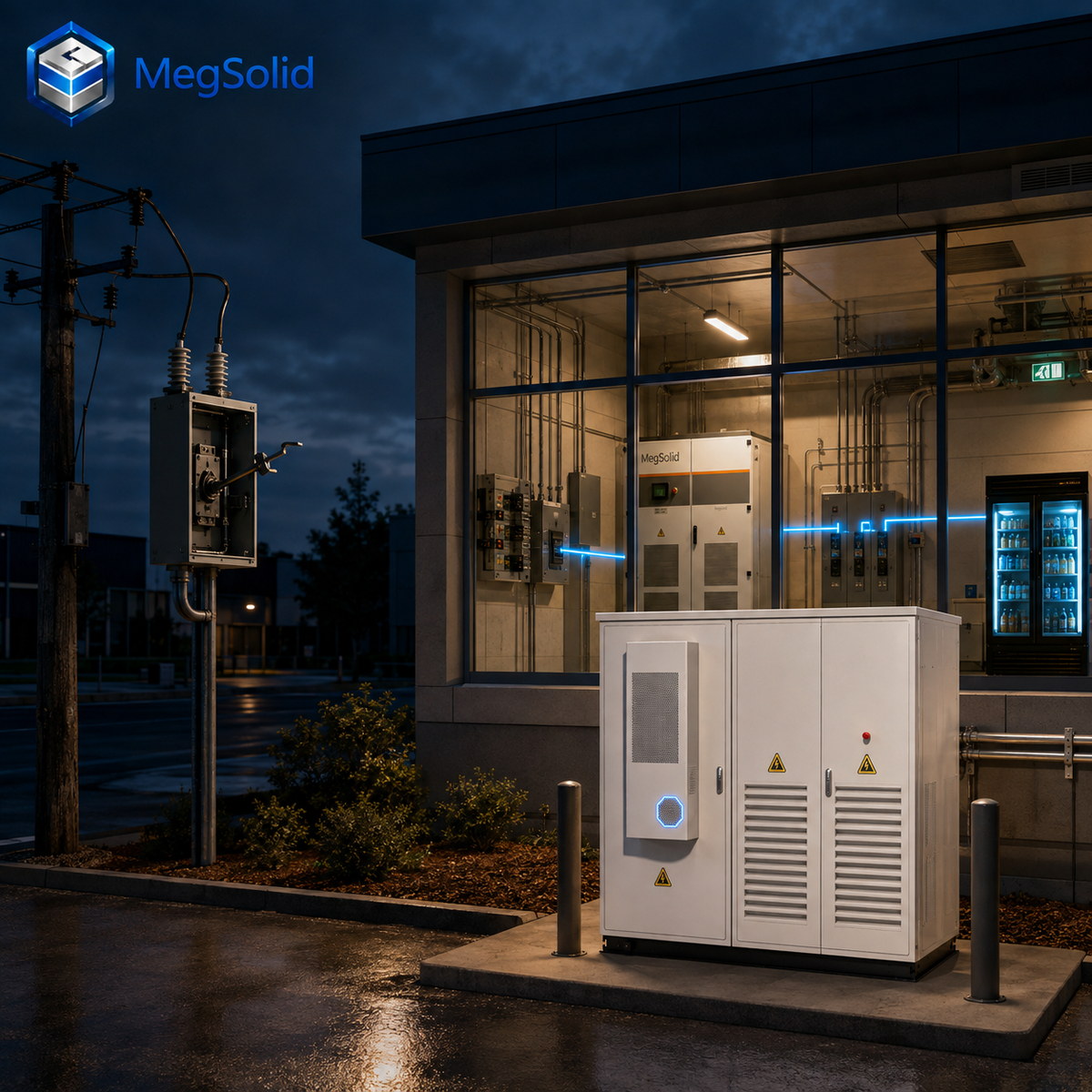
Usable SOC can remain on the display after the whole site goes dark. Nothing is necessarily wrong with the battery. Anti-islanding has opened the grid connection, as required, and the grid-following PCS can no longer see a live AC waveform. To supply the building after that point, the site needs a commissioned island and a PCS able to hold the local bus.
Start with the single-line diagram. During the C&I BESS design process, mark the device that disconnects the utility and name every circuit on the backup bus. If that bus must start from dead, the PCS and grid-forming engineering review must identify the unit that will establish voltage and frequency.
The battery also has to be charged when the outage arrives. A استراتيجية احتياطي BESS SOC stops normal peak shaving from using the energy reserved for backup. Cabinet kWh can then be checked against the protected load and the hours it must run.
SOC Is Not a Backup Test
SOC is a battery value, not a site-backup result. It reports the energy left inside the permitted operating window. An open breaker, a dead AC bus and the circuits connected downstream decide whether any of that energy reaches the intended loads.
Charge and discharge records are easy to misread here. Peak shaving, PV shifting and zero-export control are tested with the utility holding the AC waveform. A successful test confirms grid-connected PCS operation; dead-bus starting has not yet been tried.
| What the operator sees | What can actually be concluded |
|---|---|
| Usable SOC remains | Energy is available on the DC side |
| The PCS discharged before the outage | Conversion worked while the utility reference was present |
| The grid breaker opened | The BESS is no longer energizing the failed utility circuit |
| Protected loads remained energized | The commissioned islanding sequence completed successfully |
Cabinet size does not alter the result. Even a 100 kW / 215.04 kWh unit can sit fully charged beside a dark building when the switchgear and controls provide no approved AC path to the loads.
Zero-export commissioning proves another operating state. The BESS zero-export control guide covers meter placement and control at the PCC while the grid is available. Dead-bus start has to be witnessed separately.
What Happens After the Utility Fails
The first requirement after loss of utility is to stop the BESS from feeding the affected grid circuit. Line workers expect it to be dead. An accidental island could also expose connected equipment to uncontrolled voltage or frequency during restoration, so anti-islanding forces the disconnection.
IEEE 1547 covers islanding response, abnormal conditions and verification as part of DER interconnection. NREL's IEEE 1547 material treats intentional operation away from the utility as a separate design case. See the IEEE 1547 interconnection scope و NREL IEEE 1547 intentional-island resources.
On a site designed for backup, the sequence usually runs as follows:
- 1. Protection detects the loss of utility or another qualifying abnormal condition.
- 2. The interconnection opens and stops power flow into the affected utility circuit.
- 3. Controls verify that the intended island is electrically separated.
- 4. The island-capable source establishes voltage and frequency on the local bus.
- 5. Approved loads connect in the commissioned order.
- 6. The island remains active until a shutdown or reconnection condition is met.
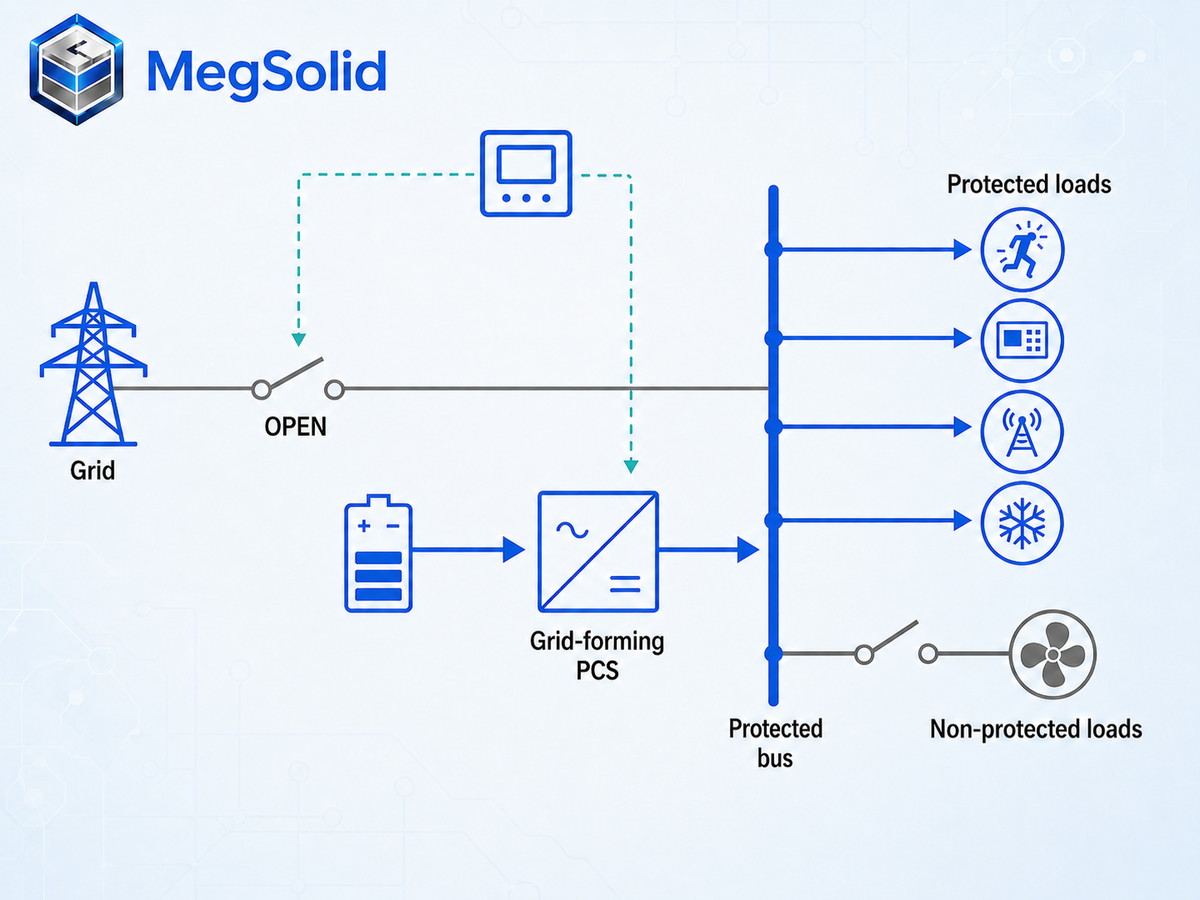
Once anti-islanding has made the utility circuit safe and the open point has been verified, intentional-island controls may energize the local bus. Equipment commissioned only to disconnect from the grid has not been shown capable of starting that bus.
The Backup Path Extends Beyond the Battery Cabinet
Pick one load that must survive and follow its conductors back to the PCS on the single-line. The outage path is incomplete unless the drawing accounts for five functions:
- Utility separation: an open point keeps the local source from feeding the failed grid circuit.
- Protected-load boundary: the drawings identify exactly which circuits may join the island.
- Local AC reference: the PCS holds voltage and frequency without the utility.
- Transfer and sequencing: switching presents the permitted loads in an order the PCS can accept.
- Energy reserve: the EMS preserves enough usable SOC for the specified outage period.
Transfer equipment varies by site. The job may call for an ATS, STS, electrically interlocked breakers, dedicated islanding switchgear or another engineered arrangement. Selection follows the one-line topology, acceptable interruption, protection coordination, neutral treatment and earthing.
More battery capacity cannot repair a missing path. If the project omitted the separation point, protected bus or island-control sequence, the cells may be ready while the AC system is not.
A Dead Bus Requires a Different PCS Role
A grid-following PCS measures an existing AC waveform and regulates current against it. Once the waveform is gone, that control mode waits for a valid reference. It cannot establish voltage on the dead bus by itself.
After isolation is confirmed, grid-forming control can establish or regulate local voltage and frequency. Bus startup still depends on breaker positions, protection settings, available island fault current and the first load step.
| PCS role | Utility reference present | Utility reference absent |
|---|---|---|
| Grid-following | Charges or discharges against the external waveform | Waits for a valid reference; cannot energize a dead bus alone |
| Grid-forming in an approved island | Operates as part of the coordinated system | Establishes or regulates the local AC bus after separation |
Where the approved topology requires a source-forming unit, MEGA PCS can fill that role. Its model, controls and required grid support are checked on the grid-forming PCS engineering page before the surrounding protection and switching are finalized.
Build the Protected-Load Schedule First
Early project notes often say “backup the building.” During the load survey, that phrase becomes a circuit-by-circuit decision: keep it live, bring it back after a delay or leave it off. Put the agreed result on a signed load schedule before sizing the PCS.
Loads That Cannot Wait
Safety circuits, process controls, communications, critical IT and selected refrigeration may need immediate continuity. Their simultaneous running load sets the first power block, while the least tolerant device sets the permitted interruption.
Loads That Can Return in Stages
Pumps, HVAC branches and process auxiliaries often tolerate a short delay. Returning them after the island bus has settled keeps the initial step smaller and prevents several starts from landing together.
Motors and Other High-Inrush Loads
A motor that draws 40 kW after reaching speed may demand far more from the island while starting. Check starting current, reactive power, voltage dip and recovery time against the PCS's short-duration capability. The calculation is described in the BESS motor-starting and PCS sizing guide.
Give every circuit an outage instruction and state the delay where one applies. A connected-load total by itself cannot define the restart sequence.
Commercial Dispatch Can Consume the Backup Reserve
Site testing commonly begins with a deliberately charged battery. A real outage arrives at whatever SOC the previous dispatch cycle has left behind. Peak shaving may shorten the runtime even when every breaker and control command operates correctly.
Set an EMS floor for the outage allocation and decide how quickly the system must recover that reserve after discharge. At the floor, the controls may suspend peak shaving, alter the charging schedule or give up another lower-priority service. The owner chooses how much daily saving to exchange for a longer assured runtime.
الـ استراتيجية احتياطي BESS SOC turns the promised runtime into a usable floor and recovery rule. If PV charging and demand control compete with it, use the BESS EMS priority logic guide to settle which service gives way first.
Where ESSA, Energon 261 and MEGA PCS Fit
ESSA and Energon are storage products. Power conversion belongs to MEGA PCS. Product names still do not reveal where the utility opens or which building circuits will be supplied; the site single-line must connect the equipment to the intended outage duty.
ESSA0100B-0215
ESSA0100B-0215 is an outdoor C&I cabinet rated at 100 kW / 215.04 kWh. Its power rating has to cover the largest permitted load step, and its usable energy has to cover the required runtime. Utility separation, the island bus and the transfer sequence remain site-design items. Product information is on the ESSA outdoor cabinet energy storage page.
إينرجون 261
Energon 261 combines 261.24 kWh rated energy with liquid cooling and a 125 kVA AC rating. The 125 kVA value is apparent power, not 125 kW. Available real power must be calculated at the required power factor and under the applicable operating conditions. Controlled values are listed on the Energon 261 liquid-cooled C&I energy storage page.
MEGA PCS
MEGA PCS offers grid-forming and black-start capability, a built-in isolation transformer and power ratings that vary by model. In a properly designed island, it can energize or regulate the local AC bus after the grid connection has opened.
The built-in transformer may simplify one part of the integration. Protection, external switching, neutral treatment and earthing still have to be engineered around the site topology. Black start means the PCS can energize a dead bus. It does not promise an uninterrupted transfer at the load.
Treat the published 8–10 ms switching value as a PCS-level figure under the stated operating conditions. The facility experiences the combined time for outage detection, external switching, control execution and load ride-through. Measure that interruption on the completed installation before assigning continuity duty.
Backup Needs Its Own Site Acceptance Result
Charging, discharging and peak-shaving SAT leave the utility reference in place. Passing those steps releases grid-connected operation only. Backup remains unproven until a test removes the reference and exercises the island.
During backup SAT, remove the utility under controlled conditions and record what happens at the protected bus. The evidence should cover electrical separation, dead-bus energization, the first load step, staged restoration, stable island running and the approved shutdown or reconnection. Use the actual loads or the representative test equipment named in the procedure.

Grid-connected PASS releases grid-connected operation. Backup mode needs its own signed site result.
Record the installed model and software version alongside the switchgear, one-line topology, protected loads and control logic used in the test. Factory evidence confirms equipment functions before installation. SAT checks their behavior after they have been assembled on site. The BESS Factory Acceptance Test and site acceptance guide explains where one record ends and the other begins.
After a backup retrofit, an existing grid-connected BESS needs fresh site evidence. Put the island boundary, control mode and protected-load duty on one drawing, then cite it in the signed result.
When a Grid-Tied BESS Is Enough
Many projects need peak shaving, PV shifting, zero-export control or demand management and no more. All four rely on the grid reference. If the site may shut down when that reference disappears, a conventional grid-tied BESS has fulfilled its stated duty.
Once a named circuit must stay live or return under a controlled sequence, intentional-island design and testing belong in the project scope.
| Required outcome | Design direction |
|---|---|
| Facility loads may stop with the utility | Grid-connected BESS |
| Selected circuits must remain available | Intentional-island backup system |
| Protected load is above one cabinet’s power rating | More PCS power or multiple units |
| Required runtime is above usable cabinet energy | More battery capacity or multiple units |
| Continuity duty reaches MWh scale | Multi-unit or containerized ESS |
Do not size this duty from the building area or the monthly bill. Ask for the maximum simultaneous protected load, outage duration, permitted interruption and restart sequence. With those values on the table, an undersized PCS, insufficient usable energy or a missing transfer path can be found before equipment is ordered.
Larger load blocks or longer runtimes can push the project into a multi-unit or containerized class. Once the duty is fixed, use the محفظة MegSolid لتخزين الطاقة في قطاعي الصناعة والتجارة to screen the available equipment. MWh-scale projects are covered in Engineering the 5 MWh BESS.
Release backup only when the installed model, its software version and the signed site test all match.
الأسئلة الشائعة
Will a grid-tied BESS work during a power outage?
Yes, but only if backup was part of the site design and commissioning. The grid connection must open before an island-capable source energizes the protected bus. Available PCS power and usable battery energy must also cover the selected loads.
Why can a battery shut down with SOC remaining?
Remaining SOC means the cells still hold usable DC energy. It does not keep a grid-following PCS online after its AC reference disappears. Without a commissioned island to take over, the power has no approved route from the cabinet to the facility loads.
What is BESS anti-islanding?
Anti-islanding disconnects a BESS or other distributed resource when the upstream utility supply is lost. The disconnected circuit can then remain de-energized for line work and controlled restoration.
What is BESS island mode?
In island mode, a defined part of the site runs independently after it has been separated from the utility. Local controls hold voltage and frequency, admit the approved loads and manage shutdown or reconnection under a tested sequence.
Is anti-islanding different from intentional islanding?
Yes. Anti-islanding prevents continued power flow into a failed utility circuit. Intentional islanding keeps a defined local bus operating after the open point has been verified.
Does grid-forming BESS automatically provide backup?
No. Grid-forming control can create the local AC reference, but it cannot define the island or move the loads on its own. The installation still needs safe utility separation, coordinated protection and switching, reserved battery energy and a successful site test.
Does commercial battery backup always require an ATS or STS?
No. An ATS or STS is one possible solution. Electrically interlocked breakers, dedicated islanding switchgear or another engineered arrangement may suit the site better, depending on topology, protection and allowable interruption.
What are protected loads in a commercial BESS backup system?
They are the named circuits allowed to receive backup power. Safety equipment, controls, communications, refrigeration and selected production loads often appear on the schedule. Other circuits may return later or remain locked out.
Can ESSA0100B-0215 be used in a backup architecture?
Yes, if the protected-load power and runtime fit its 100 kW / 215.04 kWh class. The cabinet is only one part of the installation; utility separation, island-capable controls, load transfer and a signed backup test are still required.
Can Energon 261 be used in a backup architecture?
Yes. Energon 261 is rated at 261.24 kWh and 125 kVA AC. Because kVA is not kW, selection must calculate the real-power requirement at the intended power factor, then check the load sequence, transfer design and commissioned operating mode.
What does black start mean for a BESS?
Black start means a suitable BESS and PCS can energize a dead bus without an outside AC reference. The term says nothing about the external transfer time or the load-restoration order, both of which must be designed and tested on site.
Is 8–10 ms PCS switching the same as UPS performance?
No. The 8–10 ms specification covers switching inside the PCS under its stated conditions. The interruption seen by a load also includes outage detection, external transfer, control execution and that load's ride-through response.
Can grid-connected SAT pass while backup mode has not passed?
Yes. Grid-connected SAT may test charging, discharging and peak shaving without ever opening the utility connection. Backup is released only after a separate procedure demonstrates dead-bus energization, load pickup, island operation and the approved return or shutdown.
