
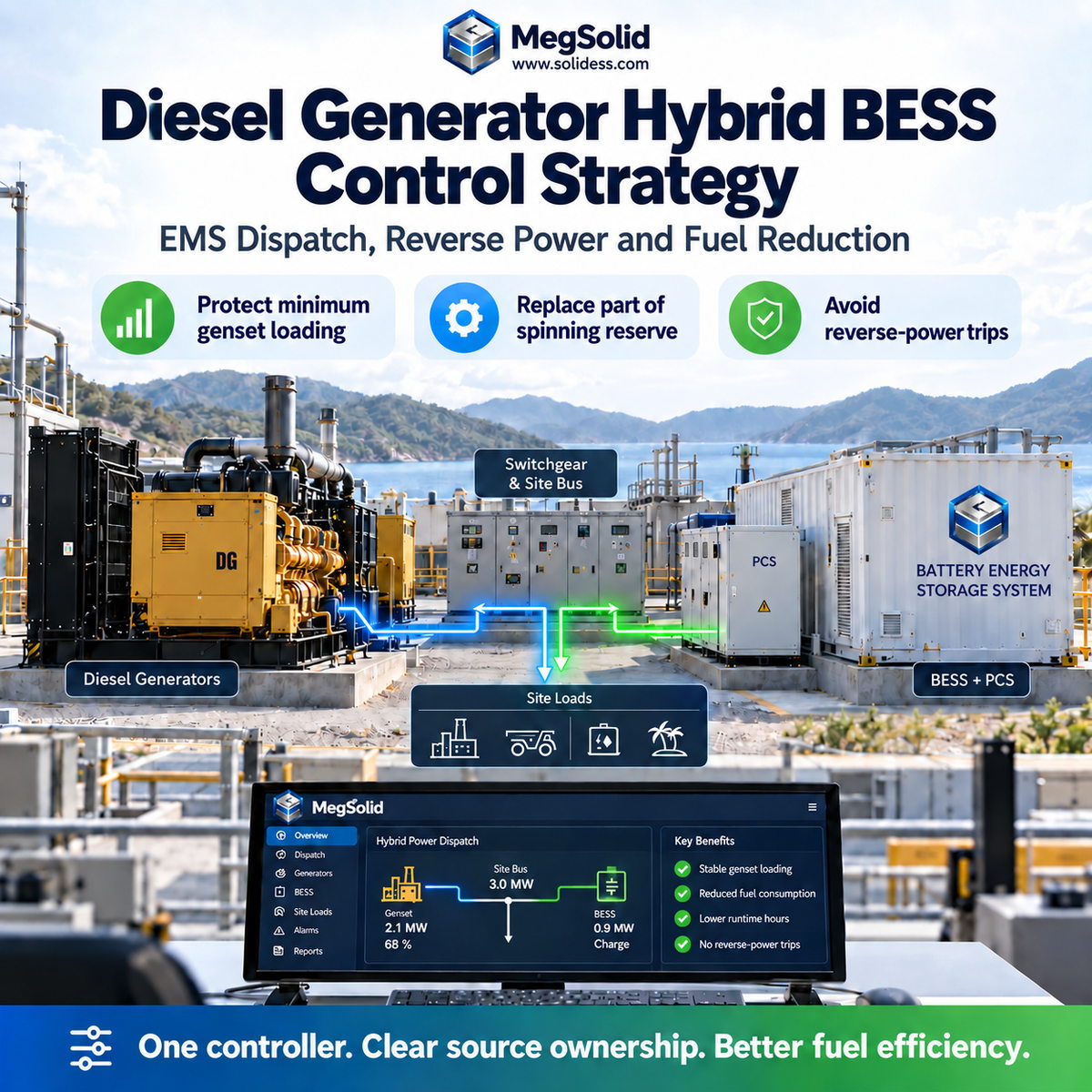
Do not add a battery to an existing diesel plant until you know exactly who controls the bus.
Remote mines, island resorts and agricultural facilities may already have substantial investment in generators, switchgear, protection and fuel infrastructure.
Define the Failures the Retrofit Must Avoid
The owner does not want a new BESS to “save fuel” and then start causing:
- reverse-power trips
- unstable frequency
- generator hunting
- failed motor starts
- unnecessary starts and stops
- blackouts during source transfer
A diesel-BESS retrofit is primarily a control problem, not a battery-capacity problem.
MegSolid's integrated C&I architecture gives the EMS access to battery, load, grid, diesel-generation and PV operating information through supported project interfaces.
The EMS should not work against the generator's control envelope.
Its job is to keep the generator inside an efficient, stable operating envelope while the BESS handles operating conditions that are better suited to fast storage response.
Separate the Control Responsibilities
- البطارية: supplies flexibility
- PCS: moves the power
- MegSolid EMS: decides which source should work, when, and at what output
Diesel-Only Operation Creates Low-Load and Reserve Inefficiency
Diesel generation is excellent at supplying firm power.
It is expensive at sitting online lightly loaded for hours simply because the operator is afraid of the next load step.
Keep Generator Loading Above the Approved Minimum
Consider a 500kVA generator serving only a small overnight load.
The generator may have been sized correctly for the site's daytime peak, crusher, pump, compressor or refrigeration plant.
At night, the same machine can spend hours far below its useful operating range.
Extended low-load operation can then add avoidable fuel and maintenance cost.
Extended low-load operation can lower combustion temperature and contribute to incomplete combustion, carbon accumulation and wet stacking.
The exact allowable minimum loading belongs to the engine manufacturer.
Do not copy one percentage across every Cummins, Caterpillar or other genset.
The engineering rule is:
If a large generator must stay online all night to serve a tiny load, the plant is using expensive rotating machinery for a job a battery can often perform better.
Hybrid control can let the BESS carry low-load periods while the generator remains stopped, subject to SOC reserve and site reliability requirements.
Then, when the generator is needed, the EMS can operate it inside the approved loading range rather than forcing it to idle electrically for hours.
Use BESS as the Fast Reserve Layer Where Appropriate
A second diesel-only problem is the amount of spinning reserve kept online for uncertain load steps.
Operators know crushers, pumps, chillers or large motors can start without warning.
Operators may keep additional generator capacity spinning for that contingency.
That reserve consumes fuel even when the extra machine contributes little useful energy.
MegSolid approaches that problem by separating energy demand من transient power demand.
The generator supplies sustained energy.
The BESS can respond to short-duration load steps, subject to PCS kVA, SOC and transient-current limits.
This can reduce the need to keep additional diesel generation online purely as insurance against a short event.
MegSolid's off-grid mine BESS engineering shows why generator reserve, PCS response and large industrial load steps must be designed together.
Burning diesel for an event that may never happen is not reserve optimization. It is expensive fear.
MegSolid EMS Assigns Control Ownership Across Diesel, BESS and PV

Hybrid plants become valuable only when every source has a defined role.
Generator governors, generator controllers, PCS controllers and the EMS can all influence the same electrical bus.
When two controllers believe they own the same quantity, individually stable equipment can create an unstable plant.
MegSolid starts by assigning control ownership across the generator, PCS and EMS.
MegSolid EMS does not simply start and stop the generator. It continuously decides whether the next kilowatt should come from diesel, battery, PV, or a combination of them while protecting the generator's minimum-load and reverse-power boundaries.
Hold the Generator Inside Its Approved Operating Range
There is no universal “85% generator sweet spot.”
The correct target comes from the genset manufacturer's fuel curve, prime/continuous rating, minimum-loading requirement, emissions system and site reserve requirement.
The operating principle is straightforward.
Instead of allowing the generator to follow every small load change:
Use a Defined Generator Start/Charge/Stop Sequence
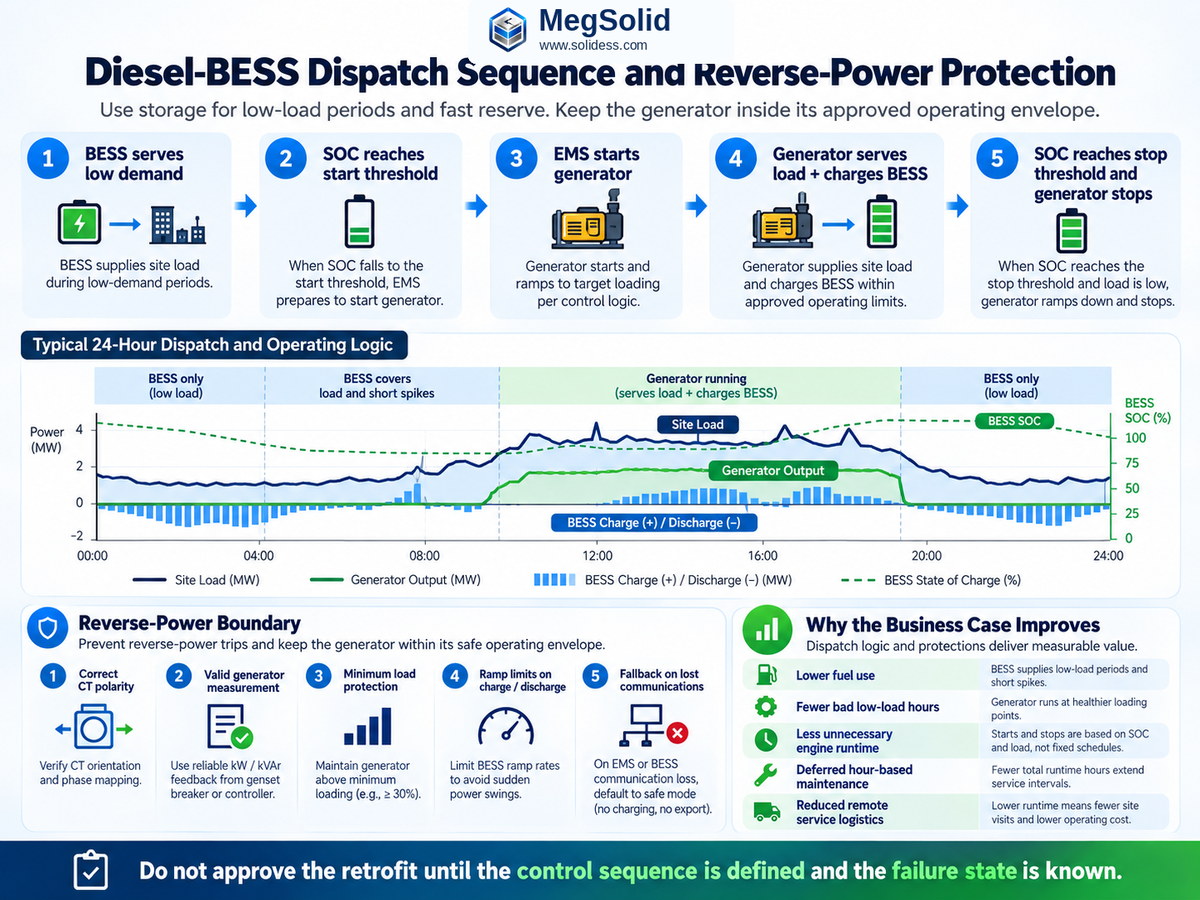
BESS serves low demand → SOC reaches the approved start threshold → EMS starts the generator → generator serves the site and charges the BESS within its approved loading range → BESS reaches the stop threshold → EMS removes charging demand and shuts the generator down through the approved sequence
The objective is not maximum generator loading. It is:
fewer operating hours at bad load points and more useful kWh produced during every engine hour.
The EMS needs real measurements for:
| Control Input | Why It Matters |
|---|---|
| Site load | Determines current power requirement |
| Generator kW / kVA | Protects the approved operating envelope |
| BESS SOC | Determines available charge/discharge reserve |
| طاقة PCS | Limits instantaneous BESS response |
| Generator minimum load | Prevents EMS dispatch from driving the genset too low |
| Generator ramp capability | Prevents aggressive charging or load transfer |
| PCC / bus status | Confirms the actual electrical topology |
| Breaker feedback | Prevents commands based on an assumed connection state |
This is where the منطق أولويات نظام إدارة الطاقة (EMS) في BESS matters.
A timer alone is not a hybrid microgrid controller.
Replace Part of Spinning Reserve With Fast BESS Response
BESS response is faster than starting, warming, synchronizing and loading another diesel engine.
Fast BESS response makes storage useful as a fast reserve layer.
When a large site load appears, the PCS can support the bus while the generator governor responds.
When the event persists, the EMS can decide whether to:
- keep supporting from the BESS;
- start another generator;
- shed lower-priority loads; or
- move the plant into another approved operating mode.
The battery does not need to replace every generator.
It can replace part of the reserve function that kept the extra generator running.
Do not size this function from battery kWh.
A 1MWh battery behind inadequate PCS kVA can still fail the first large motor start.
MegSolid's motor-starting and PCS sizing guide separates transient power from stored energy.
Define the Approved Source-Transfer and Synchronization Sequence
“Make-before-break” should never be promised as a generic EMS feature.
It is an electrical operating sequence that depends on switchgear, paralleling permission, protection, generator controls and the approved topology.
Where temporary parallel operation is permitted, the PCS and generator must satisfy the required synchronization and protection conditions before the relevant breaker closes.
Where paralleling is prohibited, the project must use the approved break-before-make or island-transfer sequence instead.
Define the Source-Transfer Control Chain
which source owns voltage and frequency → which breaker may close → what synchronization permissives are required → how load transfers → what happens if communications disappear
Zero-flicker claims require the actual switching architecture to prove them.
Do not buy “seamless transfer” as a marketing phrase. Demand the sequence of operations.
Integrate MegSolid EMS With Existing Generator Controllers
Engineers with existing diesel plants often ask:
“Are you going to make me replace my generator controller?”
Controller replacement should not be the starting assumption.
Map Existing Controller Signals and Writable Commands
Do not promise universal plug-and-play compatibility with every Cummins, CAT, Deep Sea, ComAp or Woodward controller.
The right engineering question is:
What signals can the existing controller expose, and what commands is the project allowed to write?
MegSolid's published C&I architecture supports integrated EMS functions and standard communications including RS485 and TCP/IP.
The project then maps those capabilities to the existing generator-control interface.
Integration may use the following interfaces, depending on the controller and approved scope:
- digital start/stop permission
- breaker status
- generator available/running status
- alarm signals
- active-power measurement
- frequency and voltage
- writable Modbus registers
- hardwired interlocks
Dry contacts may be appropriate for basic start/stop or permissive functions when the existing controller provides those terminals.
More advanced dispatch requires a validated communications map.
Freeze the Existing Controller Interface Before Procurement
controller model → firmware revision → communications protocol → register map → writable commands → alarm list → fail-safe state
Advanced EMS control should not be promised until that information is available.
Keep Routine Dispatch Inside the Reverse-Power Boundary
Reverse-power events can quickly undermine confidence in the hybrid system.
A sudden facility-load drop while both the generator and BESS continue producing active power can drive power toward the generator.
The generator protection system may interpret that condition as motoring or an abnormal operating state and trip.
MegSolid's BESS and diesel-generator reverse-power control guide addresses this boundary directly.
The EMS should keep normal dispatch inside the approved generator envelope.
The reverse-power relay remains an independent protection layer.
Do not use the protection relay as routine control.
Robust reverse-power control requires:
correct CT polarity → valid generator measurement → minimum generator loading → BESS charge/discharge permission → ramp limit → fallback on lost communications
The EMS must also know what to do when measurement data becomes stale.
Holding yesterday's setpoint because today's meter disappeared is not intelligent control.
EMS quality depends on its failure state as much as its normal algorithm.
Build the Diesel-BESS Business Case From Fuel, Engine Hours and Maintenance
Fuel is only the first line of the diesel-BESS business case.
The second is engine hours.
Convert Reduced Engine Runtime Into Maintenance Value
Assume a generator currently operates continuously but the hybrid strategy eventually allows it to run only during selected charging and high-load periods.
If daily engine runtime falls from 24 hours to 6 hours, the hour meter accumulates operating hours at one-quarter of the previous rate.
That can dramatically extend the calendar time required to reach an hour-based maintenance milestone.
For example, some gensets or engines use maintenance tasks tied to operating-hour intervals such as 500 hours.
At continuous operation, an hour-based milestone arrives quickly.
At one-quarter of the daily runtime, the same hour count takes roughly four times as long to accumulate.
But do not promise:
“maintenance moves from every three weeks to every three months”
as a universal MegSolid result.
Maintenance manuals can also impose calendar limits, duty-specific requirements, oil-analysis rules and different intervals by engine family.
Build the Business Case From the Full Cost Boundary
Fuel saved + engine hours avoided + maintenance events deferred + remote technician/logistics cost avoided − BESS losses − battery degradation − additional hybrid-system maintenance
Remote mines and islands can face maintenance logistics costs that are as important as fuel cost.
Service visits can involve:
- technician travel
- spare filters and lubricants
- transport to an isolated site
- generator downtime
- backup-unit operation
- production disruption
Reducing unnecessary diesel runtime attacks all of those costs at once.
Diesel-BESS proposals should not stop at “liters of fuel saved.”
Approve the Retrofit Only After the Control Sequence Is Defined
Keep the Existing Diesel Plant and Change the Dispatch Logic
Do not replace a working diesel plant just because batteries are newer. Let the BESS handle low-load periods and fast power changes, let the generator handle sustained energy duty, and give one controller clear authority over the transition between them.
That is where the MegSolid EMS belongs.
MegSolid's C&I energy storage architecture supports coordinated access to battery, load, grid, diesel generator and PV information, while MEGA PCS products provide the power-conversion layer for hybrid microgrid designs.
Send the Data Needed for the Retrofit Control Review
Provide:
- existing SLD
- generator make and exact model
- controller make, model and firmware
- generator kW / kVA / power factor
- manufacturer minimum-load requirement
- fuel-consumption curve
- interval load profile
- largest motor/load step
- reverse-power relay information
- breaker arrangement
- communications protocols
- existing PV data
- required BESS operating modes
The retrofit control sequence should be based on the actual diesel plant, not assumptions about it.
Make the EMS prove exactly how it will start the generator, load it, charge the battery, protect minimum loading, respond to load steps, avoid reverse power and fail safely when communications disappear.
الأسئلة الشائعة
Why is a diesel-BESS retrofit primarily a control problem rather than a battery-capacity problem?
The generator, PCS, EMS, switchgear and protection can all influence the same bus. A larger battery does not solve poor source ownership, unstable transfer logic, reverse-power risk or conflicting controller commands.
What should the battery, PCS, EMS and generator each control?
The battery supplies flexibility, the PCS moves power, the EMS decides which source should operate and at what output, and the generator supplies sustained energy inside its approved operating envelope.
How can BESS reduce diesel-generator low-load operation?
During low-demand periods the BESS can carry the site load while the generator remains stopped, subject to SOC reserve and reliability requirements. When the generator starts, the EMS can keep it inside the manufacturer-approved loading range.
Why should the minimum generator loading not be copied from another project?
The allowable minimum depends on the engine manufacturer, prime or continuous rating, fuel curve, emissions system and site reserve requirements. There is no universal minimum-load percentage.
How can a BESS replace part of diesel spinning reserve?
The BESS can provide fast short-duration power for sudden load steps while the generator governor responds. If the event persists, the EMS can continue battery support, start another generator, shed lower-priority loads or change operating mode.
What is the recommended generator start, charge and stop sequence?
BESS serves low demand, SOC reaches the approved start threshold, the EMS starts the generator, the generator serves the site and charges the BESS inside its approved range, then the EMS removes charging demand and shuts the generator down after the approved stop threshold is reached.
What measurements does the EMS need for reliable diesel-BESS dispatch?
The EMS needs site load, generator kW and kVA, BESS SOC, PCS power, generator minimum-load requirement, generator ramp capability, PCC or bus status and breaker feedback.
Can make-before-break transfer be promised as a generic EMS feature?
No. It depends on switchgear, paralleling permission, protection, generator controls and the approved topology. Where paralleling is prohibited, the project needs an approved break-before-make or island-transfer sequence.
Does an existing diesel generator controller have to be replaced for BESS integration?
Not automatically. First identify the controller model, firmware, communications protocol, register map, writable commands, alarm list and fail-safe state, then determine what can be integrated safely.
What interfaces can be used between MegSolid EMS and an existing generator controller?
Depending on controller and scope, integration can use digital start-stop permission, breaker status, generator running status, alarms, active-power measurement, frequency and voltage, writable Modbus registers and hardwired interlocks.
How should reverse-power trips be prevented in a diesel-BESS retrofit?
Normal EMS dispatch should stay inside the approved generator envelope while reverse-power protection remains independent. Correct CT polarity, valid generator measurement, minimum loading, BESS ramp limits and fallback on lost communications are required.
How should a diesel-BESS business case be calculated beyond fuel savings?
Include fuel saved, engine hours avoided, maintenance events deferred and remote service logistics avoided, then subtract BESS losses, battery degradation and additional hybrid-system maintenance.
What information should be sent for a diesel-BESS retrofit control review?
Send the existing SLD, generator make and exact model, controller model and firmware, generator kW and kVA, minimum-load requirement, fuel curve, interval load profile, largest motor or load step, reverse-power relay information, breaker arrangement, communications protocols, PV data and required BESS operating modes.