
MegSolid’s direct engineering recommendation is simple: do not begin a dispatchable solar project by asking suppliers for “a 500MWh battery.” Begin with the power that the PPA requires at the point of interconnection, the intervals in which solar cannot deliver that power, and the capacity that must remain available at the end of the contract term.
The Hydra project provides a useful public reference. TotalEnergies states that the Northern Cape facility combines 216MW of solar PV with a 500MWh battery energy storage system and supplies 75MW of dispatchable renewable electricity from 05:00 to 21:30 under a 20-year Eskom PPA. Annual delivery is stated as more than 400GWh.
Those figures do not reveal the battery’s exact PCS rating, usable AC energy, SOC limits, auxiliary consumption, redundancy or degradation allowance. They should therefore be used to understand the procurement method, not copied as a design template.
MegSolid did not supply the Hydra project. This article is an independent engineering analysis for IPPs and EPC contractors preparing similar South African solar-plus-storage projects.
Need a Preliminary Dispatchable BESS Assessment?
Send MegSolid your interval PV production file, required PPA delivery profile and point-of-interconnection data. Our engineering team can return a preliminary MW/MWh range, proposed battery and PCS block architecture, missing-data list and EMS control scope before a firm quotation is prepared.
What the 216MW/500MWh/75MW Hydra Configuration Means
The public numbers answer different procurement questions:
| Public figure | What it defines | EPC interpretation |
|---|---|---|
| 216MW solar PV | Renewable generation capacity | The PV plant is larger than the contracted export, but the public figure is not a universal PV/BESS ratio |
| 500MWh BESS | Stored-energy capacity | The announcement does not state whether this is nameplate DC, usable DC or AC-delivered energy |
| 75MW dispatchable power | Contracted output | This is a delivery requirement at the agreed boundary, not confirmation of the battery PCS rating |
| 05:00–21:30 | 16.5-hour delivery window | Solar and storage work together; the battery does not necessarily discharge alone for 16.5 hours |
| More than 400GWh/year | Annual energy obligation | Availability and seasonal performance matter alongside daily power |
| 20-year PPA | Commercial operating term | Degradation and augmentation must be planned beyond initial commissioning |
Two calculations prevent the most common misunderstanding:
500MWh ÷ 75MW = 6.67 hours.
This is the simple nameplate energy-to-contract-power ratio. It is not the project’s total delivery window.
75MW × 16.5 hours = 1,237.5MWh.
This is the theoretical daily energy if 75MW were delivered throughout the entire window. It is also not the battery capacity requirement because solar supplies part of that energy directly.
The correct BESS size comes from the time-based difference between the PPA target and net solar production.
Specify MW Before MWh
Battery power must cover the largest credible instantaneous deficit:
PBESS(t) = PPPA(t) + Paux(t) + Ploss(t) − PPV(t)
The model should test early morning, evening ramp-down, cloud events, planned inverter outages and any network export restriction. The highest positive result establishes the preliminary discharge-power requirement.
Charging power must be calculated separately. A battery may require a higher charging MW to recover SOC within a short midday surplus period even when its maximum contracted discharge is lower.
The RFQ must also define the measurement boundary. “75MW BESS” can mean power at the PCS terminals, the MV collector bus or the high-voltage revenue meter. These are not interchangeable because transformers, cables and auxiliary loads reduce net delivery.
The PCS schedule should therefore state:
- Required net active power at the POI.
- Maximum battery charging power.
- Reactive-power and power-factor duty.
- Ramp-rate requirement.
- LVRT/HVRT and frequency-response functions.
- Harmonic limits.
- Grid-following or grid-forming requirements.
- Required redundancy during a PCS block outage.
ميغ سوليدز grid-forming PCS engineering guide explains the PCS functions that should be evaluated before the EPC freezes the single-line diagram.
Calculate MWh from the Net Energy Deficit
Energy capacity is calculated by integrating the deficit between the contracted export and net solar output:
Edispatch = maximum cumulative ∫[PPPA(t) − PPV,net(t)]dt
Use the PPA settlement interval wherever possible. Monthly energy totals hide the morning and evening deficits that determine storage duration.
The installed nameplate energy must then account for usable SOC, conversion losses, end-of-life retention and availability:
Enameplate ≥ Edispatch ÷ (usable SOC × discharge efficiency × EOL retention × availability)
Each input must be written into the RFQ. A supplier cannot provide a comparable price if one bidder quotes DC nameplate energy while another quotes usable AC energy at the POI.
Define the Degradation Strategy Before Financial Close
For a 20-year PPA, the owner must decide whether contracted energy will be protected through initial oversizing, scheduled augmentation or module replacement.
The bid should identify:
- Guaranteed usable energy at beginning of life.
- Guaranteed usable energy at specified future years.
- Capacity-test conditions and permitted tolerance.
- Planned augmentation dates and quantities.
- Spare DC, transformer and civil capacity.
- Warranty remedy if usable capacity falls below guarantee.
The physical format also affects augmentation. Review الخزانات المعيارية مقابل أنظمة تخزين الطاقة (ESS) المعبأة في حاويات before fixing the plant layout.
Convert the Delivery Window into an EMS Schedule
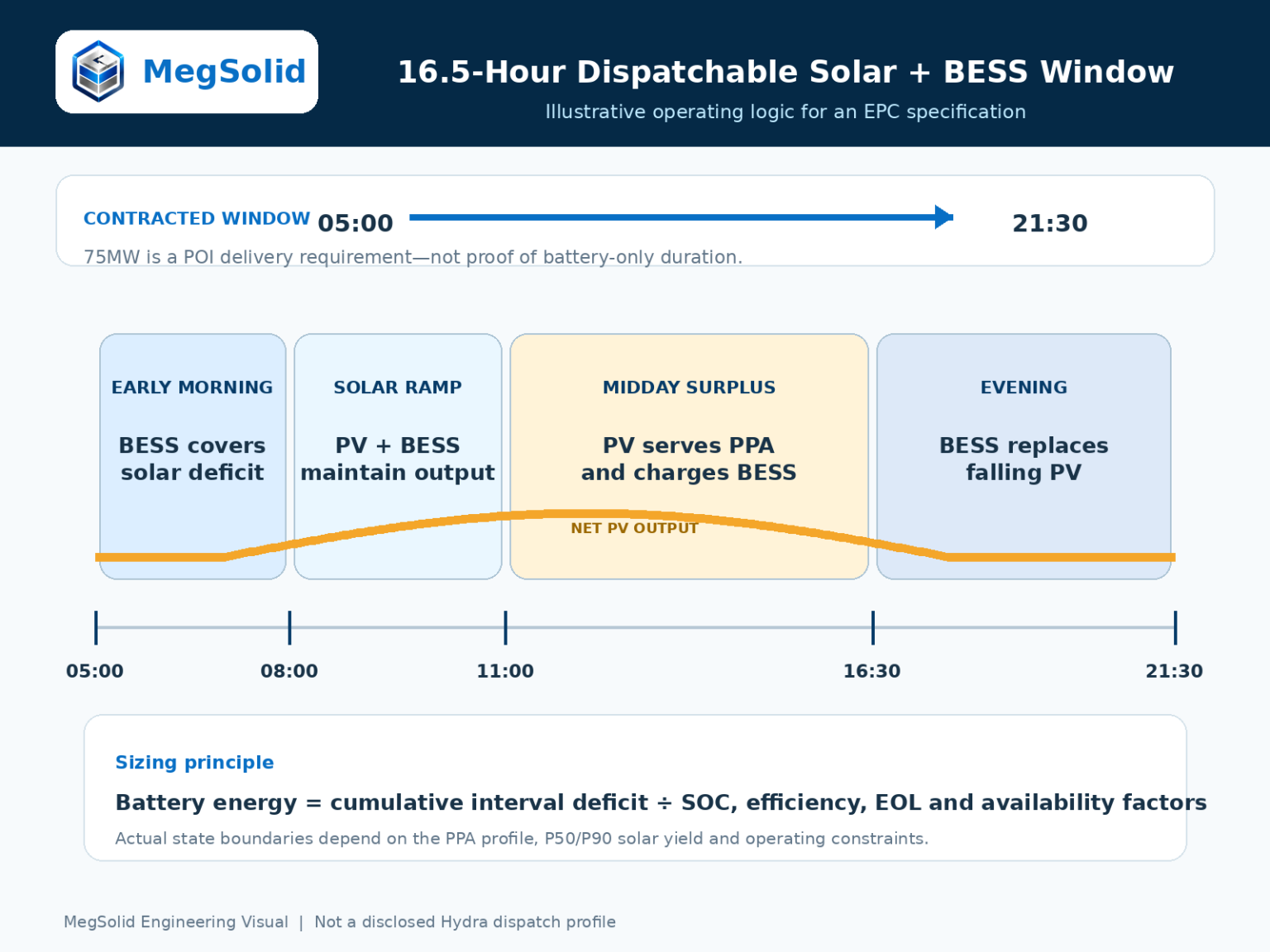
The 16.5-hour requirement should be modelled as four operating states:
| Operating period | Main energy flow | EMS decision |
|---|---|---|
| Early morning | BESS supplies the solar deficit | Begin with enough SOC to cover the P90 pre-sunrise requirement |
| Solar ramp | PV and BESS jointly maintain export | Firm cloud events without wasting battery throughput |
| Midday surplus | PV serves the PPA and charges the BESS | Reach the required evening SOC without exceeding collector or transformer limits |
| Evening | BESS replaces falling PV output | Complete the delivery window above minimum SOC |
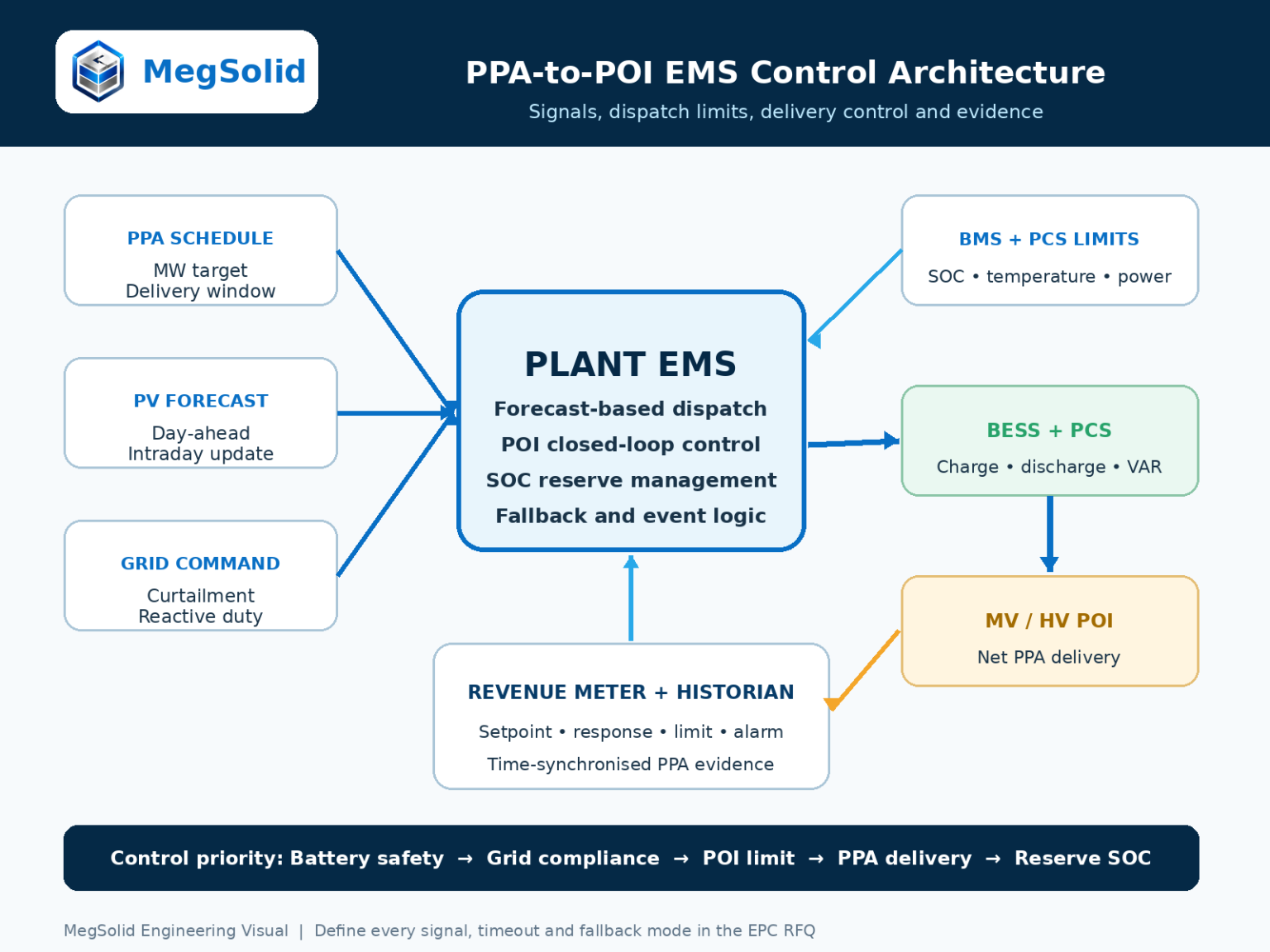
A fixed timer cannot reliably perform these functions. The EMS needs day-ahead and intraday PV forecasts, the PPA schedule, POI meter feedback, real-time BMS limits and grid-operator instructions.
Its control priority should be:
Battery safety → grid-code protection → POI limit → PPA dispatch → SOC reserve → optional market optimisation.
The EMS must also record the original command, accepted command, limiting condition, measured response and alarm history with synchronised timestamps.
These records help determine whether a delivery shortfall resulted from:
- Insufficient solar resources.
- Grid curtailment.
- Battery or PCS unavailability.
- Communication failure.
- Incorrect dispatch logic.
- Manual operator intervention.
The required signals and fallback modes should be defined using the دليل بنية الاتصالات بين نظام إدارة البطارية (BMS) ونظام إدارة الطاقة (EMS).
Turn PPA Obligations into Testable Guarantees
A battery datasheet cannot prove PPA delivery capability. The EPC specification must translate commercial obligations into measurable acceptance criteria.
| PPA requirement | Equipment or test requirement |
|---|---|
| Contracted MW | Net power at the defined POI after auxiliaries and losses |
| Delivery window | Demonstrated SOC trajectory for seasonal P50/P90 profiles |
| Annual MWh | Yield model with agreed availability and curtailment assumptions |
| Shortfall penalties | Guaranteed usable AC energy and degraded-mode response |
| التوافر | Block redundancy, repair time and spare-parts plan |
| Long contract term | EOL capacity guarantee and augmentation schedule |
| Grid compliance | Applicable models, protection settings and witnessed tests |
| Settlement | Revenue-meter accuracy, time synchronisation and event records |
The South African project team should confirm the applicable Renewable Power Plant Code, Battery Energy Storage Facility Code and hybrid-facility guidance with the Network Service Provider.
The RFQ should name the required code versions, study models and responsible party for resolving non-compliance.
EPC RFQ Data Required for a Firm BESS Quote
An inquiry stating only “75MW/500MWh BESS for South Africa” is not ready for a firm quotation.
Provide the following:
| مجموعة طلبات عروض الأسعار | Required information |
|---|---|
| الموقع | Province, coordinates, altitude, ambient temperature, dust, corrosion and wind conditions |
| Solar | MWdc/MWac, inverter topology and P50/P90 interval production |
| PPA | MW schedule, seasonal delivery window, annual MWh, ramp and shortfall rules |
| POI | Voltage, export limit, revenue-meter boundary and transformer losses |
| BESS power | Net discharge MW, charging MW, reactive duty and redundancy |
| BESS energy | Nameplate DC, usable AC at BOL and guaranteed AC at EOL |
| Duty cycle | Cycles per day, annual throughput, C-rate and SOC window |
| EMS/SCADA | Forecast interface, control hierarchy, protocols, historian and cybersecurity boundary |
| القبول | FAT, SAT, capacity test, performance test and reliability run |
| تجاري | Incoterm, delivery sequence, civil scope, commissioning and target COD |
استخدم قائمة مراجعة المشتريات الخاصة بنظام BESS to organise these documents.
الـ دليل الشهود الخاص ببرنامج BESS FAT can then convert the final technical schedule into factory test cases.
Where MegSolid Hybrid Solid-State BESS Fits
MegSolid recommends evaluating hybrid solid-state LFP for projects where frequent cycling, long-term capacity stability, container energy density and system safety materially affect the PPA business case.
The chemistry label alone is not sufficient. EPC contractors should request:
- Model-specific cell data.
- Safety test evidence.
- Thermal-management limits.
- BMS protection logic.
- Warranty conditions.
- Manufacturing traceability.
- FAT and SAT procedures.
- Long-term spare-parts support.
الـ MegSolid 5000INTL containerized BESS is a utility-scale reference platform rated at 5,015.9kWh and 2.7MW AC, with a 1,331.2Vdc nominal architecture, smart liquid cooling and IP55 protection.
Dividing 500MWh by 5.0159MWh gives approximately 100 energy containers.
This is only a nameplate quantity check. It is not a project design or quotation. The final container count must include usable-energy limits, end-of-life retention, availability reserve and augmentation.
The aggregate PCS rating must also be engineered separately. Installing approximately 100 standard 2.7MW AC blocks would create significantly more PCS power than a 75MW delivery requirement.
A project-specific DC/AC block configuration, collector design and control limit are therefore required. The engineering team must compare:
- Maximum contracted discharge power.
- Required battery charging power.
- Available midday PV surplus.
- Transformer and collector limits.
- Reactive-power requirements.
- N-1 availability.
- Maintenance isolation.
- Future augmentation.
راجع 5MWh BESS engineering analysis, ، الـ container energy storage portfolio and MegSolid’s wider أنظمة تخزين الطاقة ذات الحالة الصلبة before selecting a preliminary architecture.
التوصية النهائية بشأن المشتريات
The Hydra project demonstrates why a dispatchable solar plant cannot be purchased by copying a PV MW, battery MWh and contracted MW ratio.
For a bankable South African project:
- Define the PPA power profile at the POI.
- Model the interval solar deficit.
- Calculate discharge MW and charging MW separately.
- Integrate the energy deficit.
- Add usable-SOC, loss, degradation and availability margins.
- Configure the EMS around the PPA hierarchy.
- Convert every guarantee into a FAT and SAT test.
When submitting an inquiry, include the interval PV file, PPA schedule, POI single-line diagram and BOL/EOL capacity requirement.
MegSolid can then prepare a preliminary architecture without hiding critical assumptions inside a generic price per kWh.
الأسئلة الشائعة
السؤال 1: هل يوفر نظام تخزين الطاقة بالبطاريات (BESS) بسعة 500 ميجاوات ساعة طاقة قدرها 75 ميجاوات لمدة 16.5 ساعة؟
لا. تبلغ نسبة اللوحة التعريفية 6.67 ساعة. وتشمل فترة التزويد الأطول التزويد المباشر بالطاقة الشمسية، وشحن البطارية، وتفريغ مخزون الطاقة.
السؤال 2: هل يجب أن تكون طاقة نظام التوزيع (PCS) مساوية للطاقة المنصوص عليها في اتفاقية شراء الطاقة (PPA)؟
ليس تلقائيًّا. تعتمد طاقة نظام PCS على الحد الأقصى للعجز الشمسي، وفترة الشحن، والخسائر، وحمل الطاقة التفاعلية، والتكرار المطلوب.
السؤال 3: ما المقصود بالطاقة القابلة للاستخدام في أنظمة تخزين الطاقة بالبطاريات (BESS)؟
الطاقة القابلة للاستخدام هي الطاقة المتاحة ضمن نطاق حالة الشحن (SOC) المعتمد. كما يجب أن ينص العقد على ما إذا كانت تُقاس على جانب التيار المستمر (DC) أم كطاقة تيار متردد (AC) يتم توصيلها عند نقطة الاستلام (POI).
السؤال 4: كيف ينبغي تحديد سعة التخزين في الصباح الباكر؟
اطرح صافي إنتاج الطاقة الشمسية P90 من الإنتاج المتعاقد عليه لكل فترة تسوية. احسب العجز التراكمي، ثم قم بتطبيق عوامل SOC والكفاءة ونهاية العمر التشغيلي والتوافر.
السؤال 5: لماذا لا تكفي الطاقة السنوية المنصوص عليها في اتفاقية شراء الطاقة (PPA) لتحديد حجم نظام تخزين الطاقة بالبطاريات (BESS)؟
تخفي الإجماليات السنوية توقيت حدوث كل عجز في الطاقة. وتُحدد متطلبات البطاريات بالميغاواط والميغاواط/ساعة وفقًا لالتزامات التسليم على فترات زمنية محددة.
السؤال 6: ما هي وظائف نظام إدارة الطوارئ (EMS) الأساسية؟
يتطلب نظام إدارة الطوارئ (EMS) عملية توزيع الموارد بناءً على التوقعات، والتحكم في نقاط الاهتمام (POI) في حلقة مغلقة، وإدارة احتياطي حالة الشحن (SOC)، وفرض حدود استخدام المعدات، وأنماط احتياطية تم اختبارها، وسجلات الأحداث المتزامنة زمنياً.
السؤال 7: كيف ينبغي أن تتعامل اتفاقية شراء الطاقة (PPA) التي مدتها 20 عامًا مع تدهور أداء البطاريات؟
تحديد الطاقة القابلة للاستخدام من التيار المتردد في سنوات مستقبلية محددة، وظروف اختبار السعة، وبدلات التعزيز، والتدابير التعاقدية المتبعة في حالة نقص السعة.
السؤال 8: ما الذي ينبغي أن يشهد به ممثل الشركة المُنفِّذة (EPC) أثناء اختبار القبول النهائي (FAT)؟
نعم. يجب أن يشهد مركز التحكم في الطاقة (EPC) عمليات محاكاة الإرسال، وحدود نظام إدارة البطارية (BMS) إلى نظام التحكم في الأداء (PCS)، وحدود مستوى شحن البطارية (SOC)، والتحكم في معدل الشحن، وفقدان الاتصالات، وتعطل العدادات، والإغلاق الطارئ، وانتشار الإنذارات، واستعادة النظام.
السؤال 9: هل الحاوية القياسية بسعة 5 ميجاواط/ساعة مناسبة لجميع مشاريع المرافق العامة؟
لا. يعتمد الاختيار على نسبة التيار المستمر إلى التيار المتردد، وحدود النقل، والتصميم الإنشائي، واستراتيجية مكافحة الحرائق، والجهد الكهربائي للمجمع، وإمكانية الوصول لأغراض الصيانة، وخطة التوسعة.
السؤال 10: لماذا يتم تقييم حلول التخزين الهجينة ذات الحالة الصلبة في سياق الطاقة الشمسية القابلة للتحكم؟
قد يكون هذا الخيار مناسبًا للمشاريع التي تولي أهمية لأداء ركوب الدراجات، والتصميم المدمج، وهندسة السلامة. ومع ذلك، يجب أن يستند قرار الشراء إلى أدلة اختبار خاصة بالمنتج وشروط الضمان.