 الانتقال إلى المحتوى
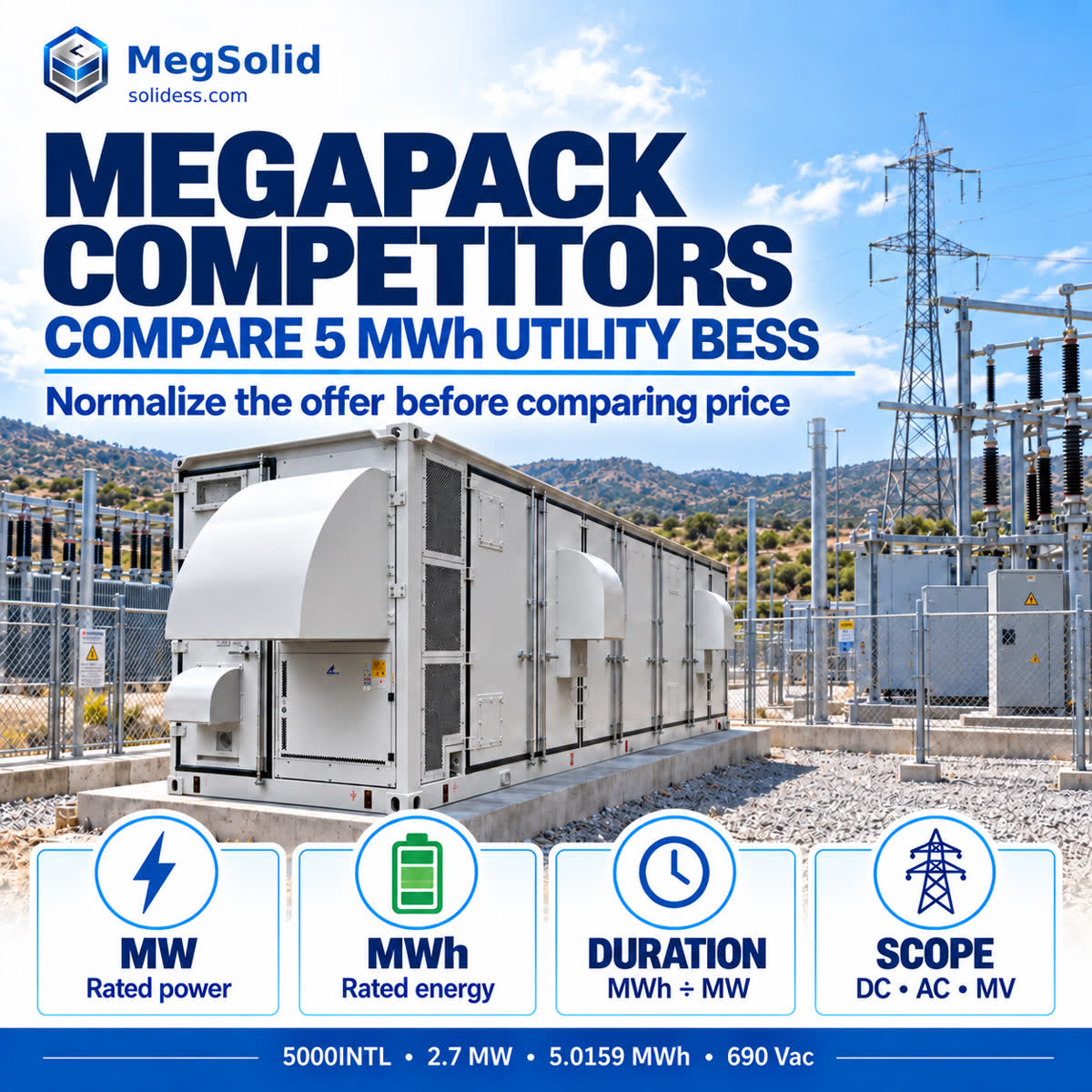
Developers comparing Megapack competitors need the offered MW, MWh and delivery scope to match the plant’s dispatch requirement, with enough space and grid capacity for the selected equipment. MegSolid’s 5000INTL utility-scale BESS offers a 2.7 MW / 5.0159 MWh, 690 Vac configuration for plants built from repeated blocks.
MegSolid publishes the following specifications:
- Rated energy: 5.0159 ميجاواط ساعة
- Rated AC power: 2.7 MW from six 450 kW units
- Nominal power-to-energy duration: about 1.86 hours
- خرج التيار المتردد: 690 Vac, 50/60 Hz
- Enclosure: IP55 with smart liquid cooling
- Transport envelope: 6,058 × 2,438 × 2,896 mm and 43,000 kg
- Published altitude boundary: no more than 4,000 m
Megapack competitors by product and supply package
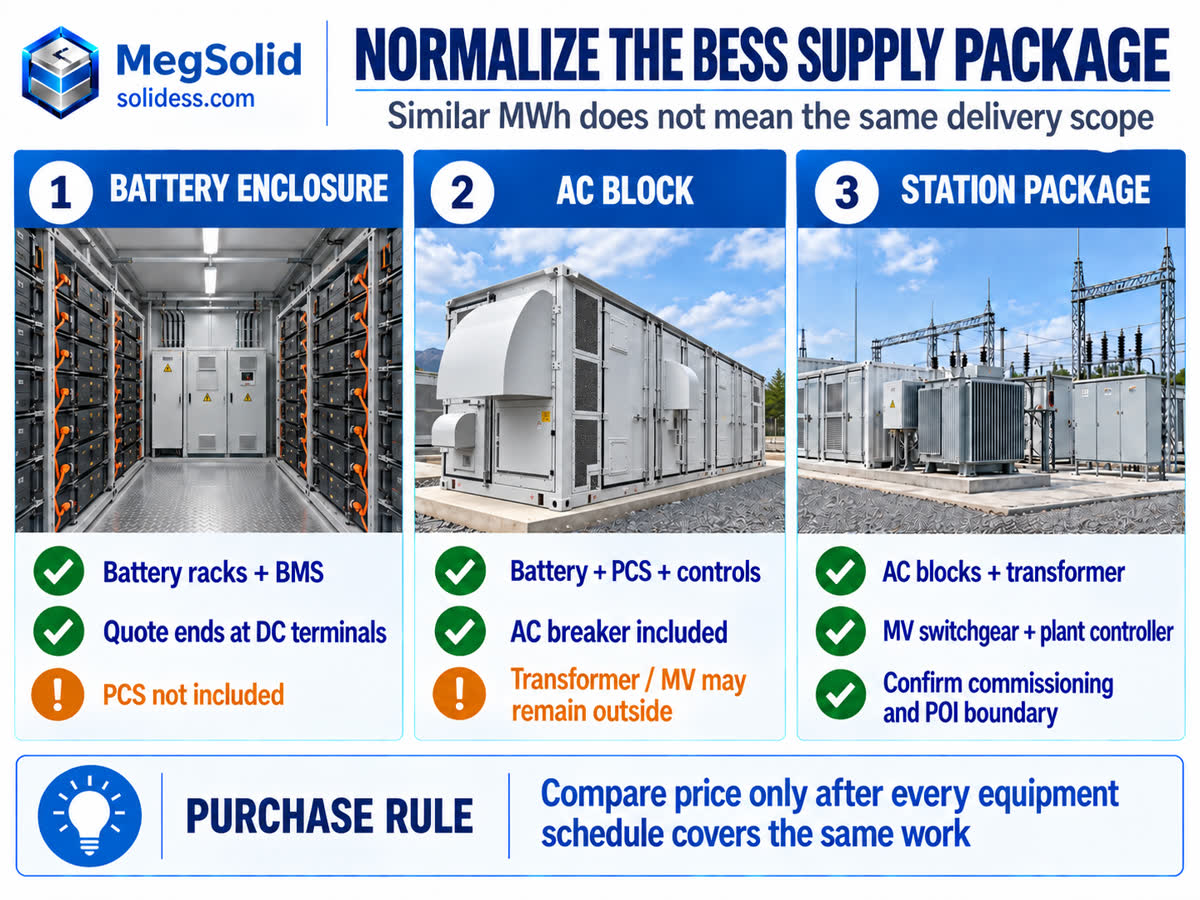
Each supplier’s offer needs to identify the model generation and included equipment. Utility-scale suppliers sell AC-integrated blocks, DC enclosures with separate PCS, and station packages with transformers and switchgear. Configurable platforms also let buyers select different power and energy combinations.
An offer that ends at the DC terminals leaves the EPC to supply and install the conversion equipment. An AC package may include PCS, controls and a breaker, with the transformer still outside the supplier’s scope. Price and container count become useful comparisons once the equipment schedules cover the same work.
Tesla presents Megapack as a utility-scale battery product; use the generation offered for the project. CATL publishes 6.25 MWh for TENER, and Sungrow describes PowerTitan 3.0 as a configurable 2–4-hour platform. (Tesla Megapack, CATL TENER, Sungrow PowerTitan 3.0)
| مجموعة المنتجات | Published energy reference | Published power reference | What the buyer must normalize |
|---|---|---|---|
| Tesla Megapack | Use the generation identified in the current Tesla offer | Use the power schedule for that generation | Product generation, duration, transformer boundary and guaranteed delivery point |
| CATL TENER | 6.25 MWh in a 20-foot container | Project configuration determines the paired power equipment | Whether the quoted scope is a battery enclosure, AC block or complete station package |
| Sungrow PowerTitan 3.0 | 6.9 MWh in the published 20-foot configuration | 1.72 MW PCS in the published four-hour configuration | The selected two-hour or four-hour arrangement and its AC/MV equipment |
| Fluence Smartstack | Configurable AC-based platform | Project configuration | Module count, energy duration, associated power equipment and turnkey boundary |
| MegSolid 5000INTL | 5.0159 ميجاواط ساعة | 2.7 ميغاواط | 690 V collection, approximately 1.86-hour nominal ratio and the project-side MV scope |
CATL’s TENER release gives the enclosure capacity; buyers still need the paired power rating. Fluence describes Smartstack as a modular AC-based platform whose configuration depends on the project. (Fluence Smartstack)
Before comparing prices, include power conversion, MV equipment, plant controls and commissioning in each cost schedule, and compare the delivered-energy guarantees. MegSolid’s DC-package and AC-package comparison shows how the handover point changes the work that remains with the EPC.
The 5000INTL is a 2.7 MW / 5.0159 MWh block
The 5000INTL’s rated energy and power give a nominal duration of about 1.86 hours:
\text{Nominal duration}=\frac{5.0159\text{ MWh}}{2.7\text{ MW}}\approx1.86\text{ hours}
Duration at the point of interconnection depends on the usable SOC window, conversion losses, auxiliary consumption, environmental limits and end-of-life capacity requirement.
For a 100 MW, two-hour contract, the designer must provide 200 MWh at the agreed meter. Start with separate power and nameplate-energy counts, then calculate the additional capacity needed for delivery:
N_{power}=\left\lceil\frac{P_{plant}}{2.7\text{ MW}}\right\rceil
N_{energy}=\left\lceil\frac{E_{required}}{5.0159\text{ MWh}}\right\rceil
Use the larger result as the minimum nameplate block count before delivery margins. Developers can use the usable-energy capacity-test boundary to keep installed DC energy separate from verified AC energy.
Duration across the offered configurations
For each candidate, divide the offered energy by its continuous rated power. A buyer seeking four-hour operation may need a different battery-to-PCS ratio to meet the contracted MW and MWh without paying for unused conversion capacity.
| Offered block | الطاقة المقدرة | Rated power | Nameplate ratio | Immediate conclusion |
|---|---|---|---|---|
| MegSolid 5000INTL | 5.0159 ميجاواط ساعة | 2.7 ميغاواط | 1.86 h | Natural starting point for a project near a two-hour duty |
| Sungrow published four-hour configuration | 6.9 MWh | 1.72 MW | approximately 4.01 h | Different duration class despite a similar container energy scale |
| Energy-only offer | 5–6 MWh stated | PCS power not fixed | cannot be calculated | Power package must be identified before comparison |
The cited PowerTitan configuration has more energy per container and less PCS power than the 5000INTL. Its additional MWh helps only if the selected PCS capacity can meet the dispatch MW.
Compare efficiency figures at the same measurement point and operating duty. PCS peak efficiency, battery-to-AC efficiency, station auxiliary consumption and round-trip efficiency answer different questions. That consistency is also needed to compare lifetime cost per delivered kWh across suppliers.
Sizing the 5000INTL for 50 MW / 100 MWh
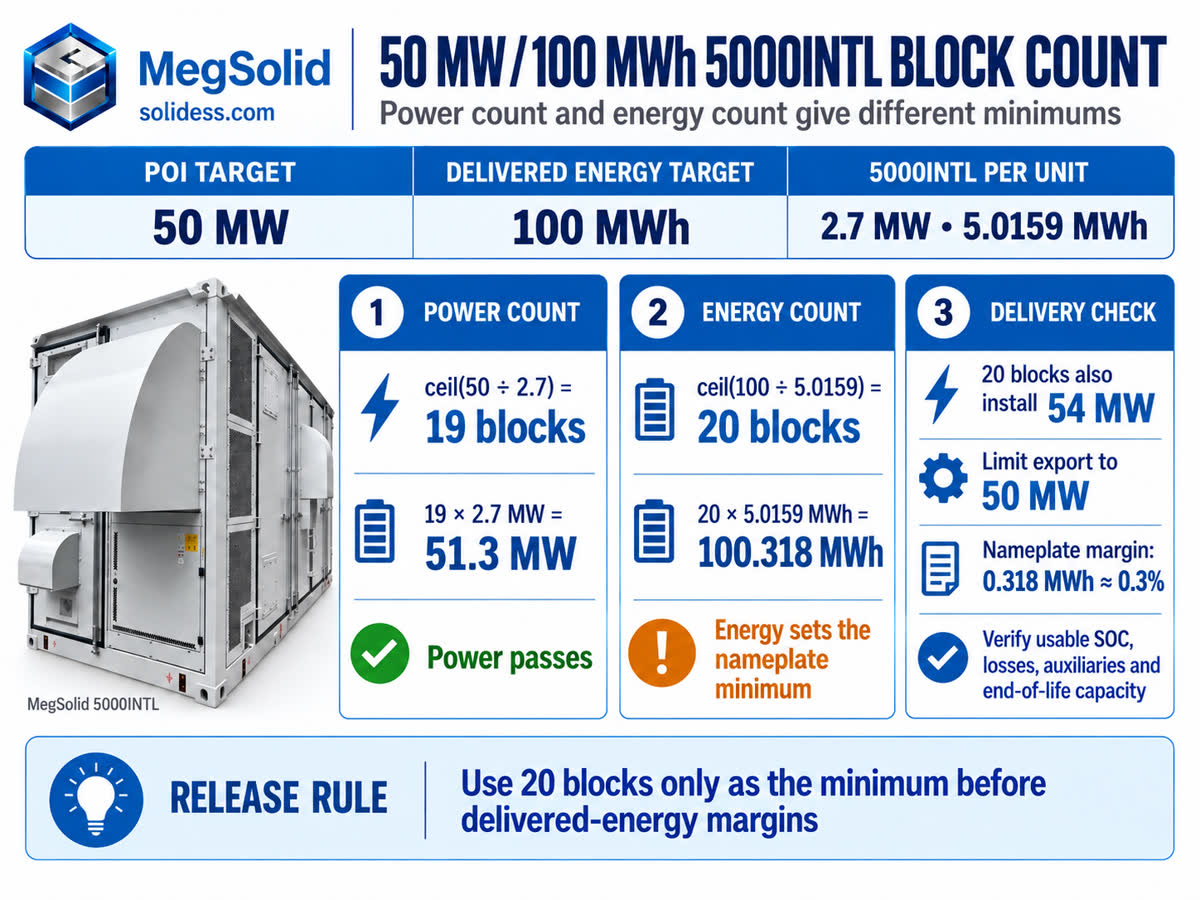
For a 50 MW / 100 MWh project, sizing by power and by energy gives different minimum block counts:
N_{power}=\left\lceil\frac{50}{2.7}\right\rceil=19
N_{energy}=\left\lceil\frac{100}{5.0159}\right\rceil=20
The energy calculation calls for 20 blocks, providing 54 MW of rated PCS power and 100.318 MWh of rated energy. The plant controller must limit export to 50 MW. That leaves just 0.318 MWh of nameplate capacity above the 100 MWh target.
With a margin of about 0.3%, the designer cannot assume that 20 blocks will deliver the required AC energy. Calculate the SOC allowance, auxiliary consumption and conversion losses at the specified temperature and life point before fixing the quantity. The buyer may need more blocks or a different battery-to-PCS ratio.
The grid approval remains 50 MW even with 54 MW of installed PCS capacity. The designer must coordinate the controller settings, transformer and switchgear ratings, and protection with that limit. The interconnection-readiness boundary covers these plant-level requirements.
The 690 V interface changes the collection system
The 5000INTL’s 690 Vac output determines the current that the cables and switchgear between each block and the step-up equipment must carry.
At 2.7 MW, 690 V and unity power factor, the approximate three-phase current is:
I=\frac{2{,}700{,}000}{\sqrt{3}\times690}\approx2{,}259\text{ A}
The same active power at 400 V would be approximately 3,897 A. These are first-pass active-power figures; reactive-power duty, overload requirements, conductor arrangement, ambient temperature and installation method still affect the equipment rating.
Lower current can ease the current-carrying requirements for low-voltage cables, busbars and switchgear, but a 690 V product does not connect directly to a medium-voltage grid. The station still needs a coordinated transformation and protection path. MegSolid’s 690 V versus 400 V BESS analysis examines the cable, busbar and switchgear implications.
The proposed switchgear, transformer arrangement and cable routes must support 690 V for the project to benefit from the lower current. A voltage mismatch adds redesign and equipment costs that belong in the price comparison.
Equipment included in the supply package
A common scope schedule shows where each supplier’s package ends and which party supplies the remaining equipment:
| Scope element | Why it changes the purchase | Comparison boundary |
|---|---|---|
| Battery racks and BMS | Establishes rated DC energy and cell-control responsibility | Exact chemistry, configuration and operating window |
| PCS | Establishes charge/discharge power and AC conversion boundary | Continuous kW, voltage, current and reactive duty |
| Cooling and fire protection | Affects auxiliary load, spacing and operating limits | Included hardware, sensors, control and site interfaces |
| AC collection | Determines cables, busbars, breakers and local isolation | Product terminal voltage and current |
| Step-up transformer and MV switchgear | Connects the block to the plant collection voltage | Included, separately supplied or EPC-owned |
| Plant controller, EMS and SCADA | Holds the complete site to POI and dispatch instructions | Setpoint authority, protocols and fail-safe behaviour |
| FAT, SAT and performance guarantee | Defines what the supplier proves and where | Test boundary, acceptance value and remedy |
Include separately supplied transformers in the price and layout, with responsibility assigned before award. The owner-furnished BESS scope analysis shows how responsibility gaps become warranty and commissioning disputes.
For the 5000INTL, confirm who supplies the project-side transformer, MV equipment and plant controller, and where the supplier will demonstrate the contracted performance.
Use email to review the project POI, delivered-MWh target, 690 V collection arrangement and transformer boundary with MegSolid.
The reply can align the 5000INTL block count and supply schedule with the same electrical handover point used in the EPC comparison.
Transport, access and environmental limits
Delivery route and lifting
The 5000INTL’s published transport dimensions are 6,058 × 2,438 × 2,896 mm, with a weight of 43,000 kg. Width and length resemble a 20-foot container footprint, but the height and mass still require a route-specific logistics plan.
Port handling, bridge and axle restrictions, turning radius, crane reach, lifting studies and temporary ground bearing can all affect the delivery sequence. Routes that accept lighter containers may not accept a 43-tonne BESS on the same trailer and lifting plan. Projects should also check whether equipment arrives as one block or whether any external PCS, transformer or medium-voltage skid creates additional heavy lifts.
Site layout and environmental limits
Land requirements include space for cooling-air movement, doors and maintenance, along with cable corridors, fire separation, drainage and emergency routes. Comparing container footprints alone leaves these areas out of the layout.
The 5000INTL has published IP55 protection and a maximum altitude of 4,000 m.
IP55 does not define corrosion category, flood level, fire separation or performance at every temperature and altitude combination. High-altitude projects should apply the required equipment limits and test evidence described in MegSolid’s high-altitude BESS derating analysis before fixing the block count.
Performance guarantees and acceptance evidence
Supplier guarantees need to cover the specified plant duty at the agreed acceptance meter. The owner can assess them against the following evidence:
| Evidence item | Decision it supports | Weak comparison to avoid |
|---|---|---|
| Model-level data schedule | Confirms the exact product generation and configuration | Mixing figures from earlier and current generations |
| Delivered-energy guarantee | Confirms MWh at the agreed meter and life point | Comparing guaranteed AC energy with rated DC energy |
| Power and reactive-duty curve | Confirms operation at the required voltage, temperature and power factor | Treating rated active power as unlimited kVA duty |
| Auxiliary-load treatment | Shows which cooling and control loads reduce delivered energy | Assuming every quoted efficiency includes station loads |
| القيود البيئية | Confirms temperature, altitude, dust and corrosion suitability | Treating an IP rating as a complete site qualification |
| Availability definition | Allocates planned maintenance, grid outages and partial derating | Comparing percentages built from different exclusions |
| FAT and SAT boundary | Shows what is proved before shipment and at the POI | Accepting a component test as plant performance evidence |
Availability guarantees may exclude upstream outages, scheduled service or partial derating, so the exclusions need to be read alongside the quoted percentage. MegSolid’s BESS availability formula guide explains why the numerator, denominator and excluded hours must match the revenue obligation.
The supplier verifies the configured equipment during factory testing. At site acceptance, the commissioning team tests the installed plant, meters, protection and controls. The C&I BESS FAT and SAT release boundary applies equally to larger plants: a passed factory test does not prove final POI delivery.
Where the 5000INTL fits
Shortlist the 5000INTL for a plant that can use repeated 2.7 MW / 5.0159 MWh blocks, collect power at 690 V and receive 43-tonne units. For a duty near two hours, complete the delivered-energy calculation before committing to the number of containers.
The block combines liquid cooling with an IP55 enclosure. Its cooling performance must suit the site’s ambient conditions and duty cycle, with additional environmental treatment specified where needed. For sites up to the published 4,000 m ceiling, confirm the applicable derating with the supplier.
The detailed 5000INTL container architecture describes the equipment behind these ratings.
Options for longer duration or smaller power increments
Consider another architecture for a native four-hour requirement, an incompatible electrical interface or a route that cannot accommodate the 43-tonne enclosure.
The owner and lender also need model-specific certifications, grid models, fire evidence, warranty security and local service arrangements that meet the project’s requirements. Confirm these with the supplier before award.
Smaller MegSolid blocks may suit a project whose construction sequence or POI capacity does not fit 2.7 MW steps. The مجموعة أنظمة تخزين الطاقة بالبطاريات (BESS) المعبأة في حاويات من ESSC provides 500 kW / 1.0752 MWh and 1 MW / 2.1504 MWh alternatives. Those air-cooled products have different power increments, weights and thermal limits. Assess them using their own specifications.
Projects needing a separately selected conversion stage can also evaluate the MEGA TS PCS family. Its 30–500 kW model range lets the designer size conversion power separately from battery energy. The system integrator remains responsible for the complete interface.
Use email to check the target dispatch MW, discharge duration, site altitude and delivery limits against the proposed utility-scale BESS shortlist.
The reply can compare the required 5000INTL block count with smaller ESSC increments while keeping PCS headroom and site-side responsibilities visible.
الأسئلة الشائعة
Who are the main Megapack competitors?
Utility-scale alternatives include product platforms from CATL, Sungrow, Fluence, BYD, Wärtsilä and other BESS suppliers. MegSolid enters the 5 MWh-class comparison with the 2.7 MW / 5.0159 MWh 5000INTL. The exact shortlist should follow the project’s duration, electrical interface, delivery scope and approval requirements.
Can all 5 MWh BESS containers be compared directly?
Compare the offered MW, MWh, duration, AC voltage and handover point first. Suppliers can offer similar energy ratings with different PCS capacity and included equipment, which changes the container quantity and total price.
What is the nameplate duration of the MegSolid 5000INTL?
Dividing 5.0159 MWh by 2.7 MW gives approximately 1.86 hours. This is a nameplate power-to-energy ratio, not a guarantee of 1.86 hours delivered at the POI after SOC limits, losses, auxiliary loads and ageing margins.
How many 5000INTL blocks are needed for a 50 MW / 100 MWh project?
The first nameplate calculation requires 19 blocks for power and 20 for energy, so energy sets a minimum of 20. Those blocks provide 54 MW and 100.318 MWh of rated equipment. The final quantity must still satisfy the contracted delivered-energy boundary.
Can a 690 V BESS connect directly to a medium-voltage grid?
No. The 690 V output belongs to the low-voltage collection side. Utility-scale plants normally require coordinated step-up transformation, medium-voltage switchgear, protection and metering before reaching the grid connection.
Is rated battery energy the same as delivered AC energy?
The manufacturer states rated energy on the nameplate. During acceptance, the test team measures delivered AC energy at the agreed meter, using the specified SOC window and accounting for conversion losses and auxiliary loads.
Does an integrated BESS always include the transformer and MV switchgear?
Check the supplier’s equipment schedule for PCS, AC breaker, transformer, MV switchgear, plant controller and commissioning. Suppliers use “integrated” for different packages, so the EPC may still need to provide some of these items.
Is the 5000INTL suitable for a four-hour BESS project?
Its published 2.7 MW / 5.0159 MWh ratio is approximately 1.86 hours. Four-hour projects may use additional energy at a lower dispatch power, but the extra PCS capacity and final delivered-energy result must make commercial sense. Native four-hour architectures may fit better.
Can published efficiency percentages be used to rank Megapack competitors?
Only when they use the same measurement boundary and duty. PCS peak efficiency, system efficiency and round-trip efficiency are not interchangeable. Temperature, auxiliary consumption, SOC window and transformer losses also affect the plant result.
Why does the BESS container weight matter before purchase?
Weight affects trailer selection, axle loading, bridges, crane capacity, lifting radius and foundation design. The 5000INTL publishes a weight of 43,000 kg, so its complete delivery route and lifting plan must be checked before the layout is released.
Are the same utility-scale BESS products available in every country?
Not necessarily. Model generations, manufacturing source, service coverage and commercial availability can vary by market. The project should compare the exact model offered for its delivery location instead of transferring specifications from another region.
Do utility-scale BESS approval requirements stay the same across markets?
No. Grid-code evidence, fire requirements, product certifications, environmental permits and lender conditions vary by jurisdiction and project. Compliance should be attached to the offered model and plant architecture before award.
Can the 5000INTL be used at a high-altitude site?
The published altitude ceiling is 4,000 m. Sites within that ceiling still need the applicable temperature, cooling, insulation and power-derating assessment. Locations above it require another confirmed product or engineered solution.
