
Why have solid-state batteries become the strategic core of modern energy storage infrastructure?
Having devoted over a decade to research in the field of solid-state battery and serving as the R&D Director of MegSolid (Hong Kong) Limited, I have witnessed the global energy storage industry evolve from a production-capacity-oriented market to a reliability-oriented one.
In the past, purchasers basically focused on only one issue during procurement:
How many kilowatt-hours of electricity can a battery system generate?
Nowadays, industrial and commercial purchasers pay more attention to another core issue:How does this system perform in terms of security, scalability and financial sustainability throughout its entire lifecycle?
This shift in choice carries far-reaching significance.
With rising electricity prices, declining power grid stability and an increasing proportion of renewable energy, battery systems are no longer merely backup power supply equipment, but have evolved into infrastructure for regular operation.
For general engineering contractors, photovoltaic developers, power grid planning institutions, industrial park operators and distributed energy investors, the selection of battery architecture directly determines the return on investment, project safety level, operation and maintenance costs, as well as long-term operational risk resistance capacity.
Over the past decade, MegSolid (Hong Kong) Limited has adhered to a clear research and development orientation: developing safer, longer-lasting and commercially viable solid-state energy storage systems applicable to various scenarios including photovoltaic microgrids, grid-connected energy storage systems and off-grid power supply.
The future of the energy storage industry lies not in simply expanding battery capacity, but in developing intelligent, highly safe battery material systems with superior structural performance.
Shortcomings of traditional lithium-ion batteries in commercial energy storage scenarios
Traditional lithium-ion batteries have kickstarted the development of the global energy storage market and been successfully applied in early photovoltaic energy storage, communication backup power supplies, commercial battery packs and large-scale power grid energy storage projects.
However, traditional lithium-ion battery structures carry inherent structural risks when it comes to enterprise-level commercial deployment, especially in high-load application scenarios.
Thermal runaway risk
Thermal runaway is one of the most intractable problems in the research and development process.
In large battery packs, overheating of a single battery module will rapidly transfer heat to the surrounding cells.
After the industrial project is launched, such hidden dangers will trigger a host of problems:
- Fire safety hazards
- Insurance claim disputes
- Losses caused by work suspension and production halt
- Safety compliance challenges
- Rising costs for infrastructure protection
For engineering enterprises and project developers, battery safety has become a core consideration in the procurement process.
Heat resistance defects in harsh environments
Most commercial energy storage facilities are deployed in complex environments such as mining areas, desert regions, communication base stations,remote microgrids, tropical zones and high-load industrial sites.
Conventional battery systems have to be equipped with powerful heat dissipation devices to maintain stable operation, which virtually raises operating costs.High costs throughout the whole life cycle.
High full-life cycle cost
Such batteries seem advantageous in terms of initial procurement costs, yet numerous extra expenses will arise during long-term use,including maintenance of temperature control systems, module replacement, energy efficiency degradation caused by cyclic utilization, losses from downtime due to malfunctions, and expenditures on safety renovation.
Against this backdrop, the commercial strengths of solid-state battery structures become increasingly prominent.
Core Value of Solid-State Batteries in the Industrial and Commercial Energy Storage Sector
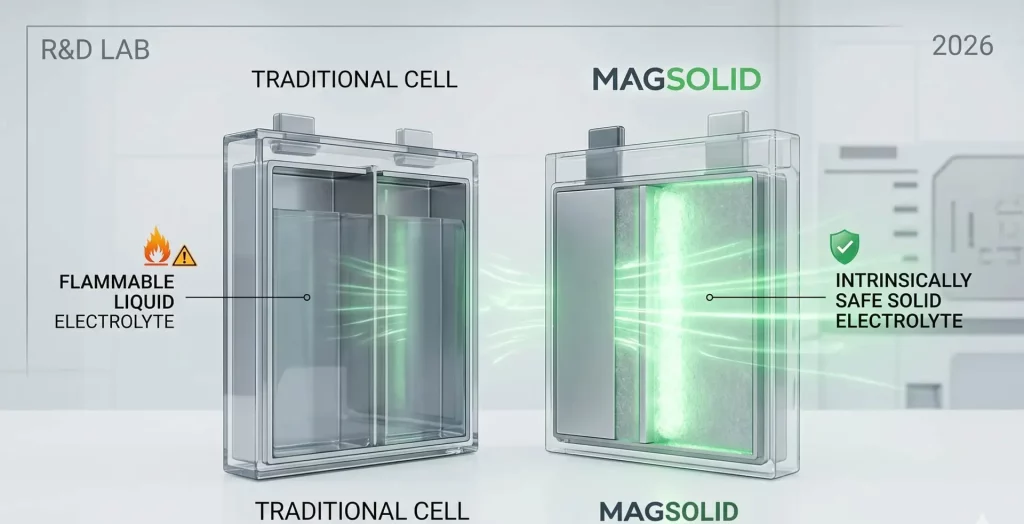
Solid-state energy storage systems eliminate highly flammable liquid electrolytes and fundamentally optimize the internal structure of batteries.
From the perspective of MegSolid (Hong Kong) Limited, this is not a theoretical technological innovation, but an engineering transformation put into commercial use.
Greatly enhanced safety performance
Solid-state battery materials can drastically reduce the risk of fire spread, which is crucial for power enterprises, factories, logistics hubs, communication stations and public infrastructure sectors.
Superior thermal stability
The system can operate steadily at high temperatures (up to 60°C) without heavily relying on active cooling, effectively boosting system reliability and adapting to regions such as Africa, the Middle East and Southeast Asia, as well as remote industrial operation scenarios.
Extended designed service life
Battery replacement incurs high costs. Our durable solid-state materials support 10,000+ charge cycles, dramatically raising the ROI and and slashing the Total Cost of Ownership (TCO).
Markedly reduced operation and maintenance risks
With more stable battery operation, it lessens monitoring workload, the possibility of emergency shutdown, reliance on heat dissipation equipment and insurance-related expenses.
For corporate purchasers, battery materials exert a direct impact on overall operational planning.
Photovoltaic Microgrid: A New Growth Engine for Distributed Energy
Traditional power grids are confronted with issues such as aging facilities and sharp fluctuations in peak power consumption, making photovoltaic microgrids increasingly essential.
Photovoltaic microgrids integrate multiple functions including photovoltaic power generation, energy storage devices, intelligent energy management systems, load scheduling and distributed power control, enabling enterprises to independently manage power generation, storage and consumption.
MegSolid (Hong Kong) Limited identifies three major growth drivers in this sector.
Energy independence in remote areas
Mining areas, islands, farms and communication base stations lack stable grid-connected power supply. Diesel power generation comes with high costs and substantial carbon emissions, a problem that microgrids can effectively address.
Continuity guarantee for industrial production
Factories cannot afford losses caused by power outages. Microgrids equipped with battery energy storage ensure uninterrupted production operations.
ESG compliance and carbon reduction demands
Enterprises are generally under pressure to pursue low-carbon transformation.The combination of photovoltaic power and energy storage systems helps achieve sustainable development goals.
Grid-connected Energy Storage System: Optimize Commercial Investment Returns
Grid-connected energy storage systems are a popular enterprise-level investment model. These systems integrate with the public grid to enable precise load management.
Its core advantages are as follows:
- Peak Shaving and Valley Filling: Cut high-demand peak electricity costs
- Load Shifting: Store low-cost electricity and release it for use when power prices rise
- Power Arbitrage: Generate revenue by storing electricity at low prices and selling it at high prices
- Power Grid Voltage Stabilization: Safeguard factory power supply amid grid fluctuations
- Emergency Backup: Ensure normal operation of core businesses
This model can effectively shorten the payback period of investment in commercial projects.
Off-grid solid-state energy storage system: covering power supply areas unreachable by the power grid
Some projects cannot rely on the national public power grid for electricity supply.
Off-grid energy storage systems have become essential facilities in mining areas, island settlements, agricultural sites, military stations, oil and gas fields, and remote communication base stations.
Advantages of solid-state batteries suitable for off-grid projects: high operational reliability, low thermal safety risks, long maintenance intervals, low operation and maintenance frequency, and stable performance under high-temperature working conditions.
Work stoppages at remote sites can lead to heavy losses. Operational reliability carries greater value than battery capacity.
Reasons Why MegSolid (Hong Kong) Limited Focuses on Scalable Solid-State Battery Systems
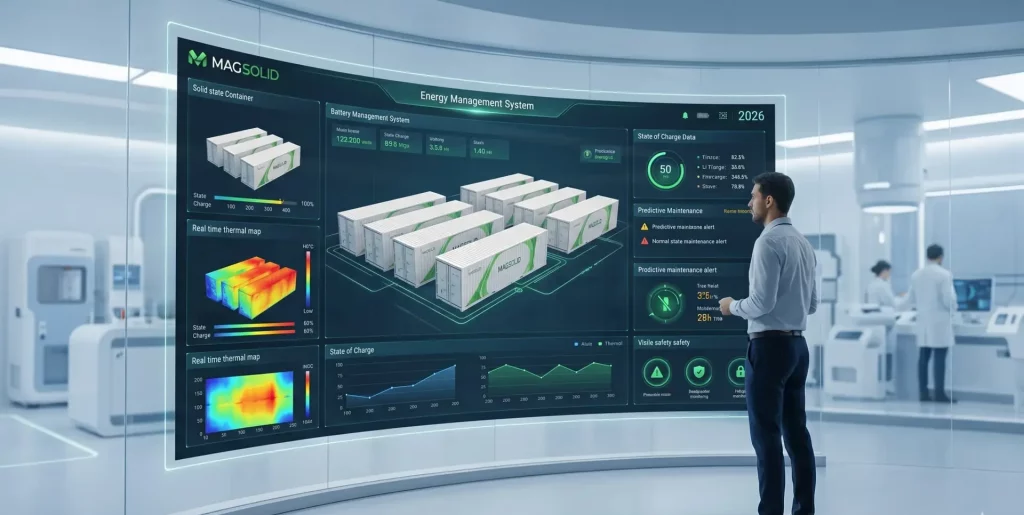
Our Core R&D Philosophy:must eliminate operational risks at the material level, rather than managing hidden dangers after the fact, striving to fulfill the era vision of digitalized energy and visible safety monitoring.Key R&D Directions:
- Develop high-safety solid-state battery materials
- integrate advanced AI-driven Energy Management (EMS) and Battery Management Systems (BMS)
- adopt modular and scalable architecture, improve heat resistance
- extend battery service life
- and adapt to various practical application scenarios
The products target general engineering contractors, industrial purchasers and infrastructure operators, delivering mature and reliable energy storage equipment rather than technological products still in the experimental stage.
Key Evaluation Points for Enterprises Selecting Energy Storage Equipment
Before selecting an energy storage supplier, you can conduct a comprehensive evaluation by referring to the following questions:
- Can the battery material meet the safety requirements for high-density deployment?
- Does it support modular expansion and upgrading?
- What is the return on investment throughout the whole life cycle?
- How much will temperature changes affect equipment performance?
- Are daily operation and maintenance costs and workload manageable?
- Can it adapt to the operation mode of photovoltaic microgrids?
- Can it switch between grid-connected and off-grid operating states?
The above factors directly determine the final profitability of the project.
MegSolid (Hong Kong) Limited is an international high-tech enterprise focusing on integrated businesses of green energy microgrids, photovoltaic energy storage and charging. We provide one-stop turnkey solutions of photovoltaic microgrids, grid-connected and off-grid solid-state energy storage systems for global clients.Planning your next industrial and commercial energy storage project? Click here to get customized solid-state battery capacity planning solutions and ROI analysis reports crafted by our engineering team
FAQ
Q1.Why are solid-state batteries the strategic core of modern C&I energy storage infrastructure?
Modern energy storage projects value full-lifecycle safety, stability and ROI instead of pure capacity. Developed and optimized by MegSolid (Hong Kong) Limited, solid-state batteries eliminate the inherent flaws of traditional lithium batteries and adapt to harsh industrial scenarios. They serve as the reliable strategic core for current commercial energy storage infrastructure.
Q2.What are the main limitations of traditional lithium-ion batteries for commercial energy storage?
Traditional lithium batteries face unavoidable thermal runaway hazards and poor high-temperature tolerance in complex environments. According to the practical project data of MegSolid (Hong Kong) Limited, they also generate high hidden costs in maintenance, module replacement and safety renovation, lowering long-term project returns.
Q3.What core advantages do solid-state batteries bring to C&I energy storage?
Solid-state batteries researched by MegSolid (Hong Kong) Limited remove flammable liquid electrolytes to achieve superior safety and thermal stability. They support stable operation under high temperatures and deliver longer cycle life with reduced O&M workload. This effectively lowers the full-lifecycle TCO and improves project investment value.
Q4.What scenarios are solid-state energy storage systems suitable for?
The solid-state energy storage solutions launched byMegSolid (Hong Kong) Limited cover three mainstream commercial scenarios. They include photovoltaic microgrids for remote energy independence, grid-connected energy storage for peak regulation and power arbitrage, and off-grid energy storage for grid-inaccessible industrial and mining sites.
Q5.What key points should enterprises evaluate when choosing energy storage equipment?
MegSolid (Hong Kong) Limited recommends enterprises focus on battery safety, temperature adaptability, modular scalability and full-lifecycle costs. Buyers also need to confirm flexible grid-connected/off-grid switching capability and microgrid compatibility to ensure stable and profitable long-term operation.