
A Polish storage project can satisfy a programme threshold and still purchase the wrong battery configuration.
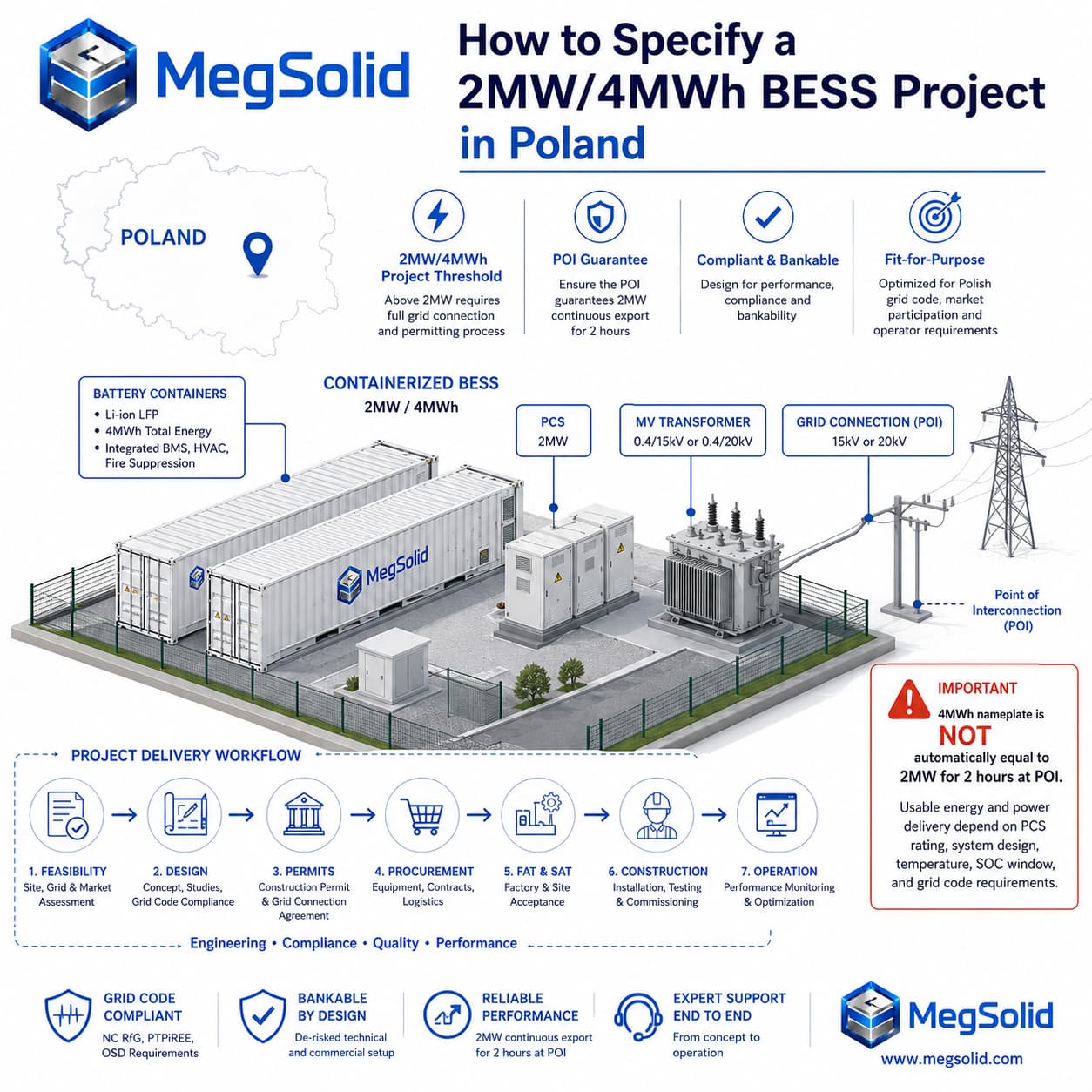
The critical distinction is whether “4MWh” means installed nameplate capacity or four megawatt-hours delivered at the grid connection point.
After usable SOC, PCS losses, transformer losses, auxiliary consumption and degradation are considered, those two specifications produce different equipment quantities.
MegSolid therefore starts a 2MW/4MWh Poland BESS project by defining the point-of-interconnection guarantee before selecting the battery containers.
Why 2MW/4MWh Is Not a Complete Specification
Poland’s NFOŚiGW programme supports storage installations with at least 2MW of power and 4MWh of capacity.
Its eligible scope includes battery containers, inverters, transformers, fire protection, HVAC, protection systems, testing and acceptance.
These values are programme thresholds, not a universal two-hour performance guarantee. See the official NFOŚiGW storage programme.
Before requesting a quotation, define:
- Installed power: Total PCS nameplate MW.
- Nameplate energy: Total battery MWh before operating restrictions.
- Énergie utile : Energy available inside the approved SOC window.
- POI energy: AC energy delivered after system losses.
- End-of-life energy: Guaranteed capacity after contractual degradation.
An RFQ that only states “2MW/4MWh” leaves these boundaries unresolved. Review the broader commercial energy storage procurement framework before assigning responsibility between the battery, PCS, EMS and EPC suppliers.
Follow the Polish Approval Path Before Freezing the Layout
A 2MW project falls within Poland’s investment route for storage above 50kW and not exceeding 10MW.
The official process covers spatial planning, grid conditions, construction procedures, completion notification and entry in the storage register.
Outdoor storage above 2,000kWh requires a construction permit.
Projects covering more than one hectare—or 0.5 hectare in protected areas—also enter the environmental-decision route. See the official Polish storage investment process.
The practical project sequence is:
Site control → planning basis → grid conditions → permit layout → final BESS specification → FAT → delivery → energisation → registration
The container quantity should be established before the permit layout is finalised because it affects fire access, equipment spacing, transformer location, cable routes and expansion space.
Comparer Armoires modulaires ou systèmes de stockage d'énergie (ESS) en conteneurs ? before completing the site plan.
Secure Grid Conditions Before Ordering Equipment
The connection application must define power in both directions. Approval to discharge 2MW does not automatically permit the BESS to charge at 2MW.
The technical schedule should state:
- Maximum charging and discharging power.
- POI voltage and connection capacity.
- Active- and reactive-power requirements.
- Ramp rate and protection behaviour.
- Transformer and auxiliary losses.
- Metering and SCADA interfaces.
- Fallback limits after communication failure.
Poland’s April 2026 connection reform shortened the validity of many new connection conditions from two years to one year, extended cable pooling to storage and introduced construction-permit milestones for projects connected above 1kV. See the PSE connection-rule notice.
A 2MW BESS is normally classified as Type B. TAURON lists the thresholds as 0.2MW for Type B, 10MW for Type C and 75MW for Type D.
The project should follow the requirements of its actual OSD rather than copying the Type D commissioning procedure.
Calculate Guaranteed AC Energy at the POI
Assume the contract requires the plant to deliver 2MW for two continuous hours:
Required AC energy = 2MW × 2h = 4MWh
Using illustrative preliminary assumptions:
Usable SOC window = 80%
Discharge-path factor = 90%
The required battery nameplate capacity becomes:
4MWh ÷ 0.80 ÷ 0.90 ≈ 5.56MWh
This calculation explains why a 4MWh nameplate system may fail a four-megawatt-hour POI test.
The final model must replace the illustrative values with verified:
- PCS efficiency
- Transformer losses
- Cooling and auxiliary consumption
- Minimum and maximum SOC
- Site temperature
- Dégradation de la batterie
- End-of-life guarantee
- Module or PCS availability
The contract should also state whether the two-hour guarantee applies only at commissioning or throughout the warranty period.
Compare MegSolid Configurations for a 2MW Project
| Preliminary configuration | Nameplate rating | Interprétation en matière de marchés publics |
|---|---|---|
| 2 × ESSC 1MW/2.1504MWh | 2MW/4.3008MWh | Meets the programme nameplate threshold; two-hour POI delivery still requires verification |
| 3 × ESSC 1MW/2.1504MWh | 3MW/6.4512MWh | Provides additional energy and redundancy; EMS can limit POI output to 2MW |
| 1 × 5000INTL | 2.7MW/5.0159MWh | Compact 5MWh-class block, but below the illustrative 5.56MWh calculation |
| Engineered 2MW PCS system | 2MW/project-specific MWh | Allows battery capacity to follow the POI and end-of-life guarantee |
Le Système de stockage d'énergie par batterie (BESS) en conteneur ESSC includes 500kW/1.0752MWh and 1MW/2.1504MWh air-cooled LFP configurations.
Le Gamme MEGA PCS provides 30–500kW building blocks for custom architectures.
The 5000INTL is rated at 2.7MW/5.0159MWh with liquid cooling. Its battery chemistry should be confirmed through controlled project documentation and must not be inferred from the model code.
Consultez le 5MWh BESS engineering architecture before choosing between a single large block and multiple smaller containers.
Define the Complete POI and EMS Scope
A battery-container quotation does not automatically guarantee plant performance at the grid meter.
The responsibility matrix must cover:
- Racks de batteries et BMS
- PCS and plant controller
- MV transformer and switchgear
- POI meter and export controller
- SCADA and OSD communication
- Protection, earthing and auxiliary supply
- Harmonic and reactive-power performance
For cable-pooled renewable projects, the EMS must keep the combined renewable and BESS output within the approved connection limit.
It must also define charging priority, renewable curtailment, meter-loss fallback and communication timeouts.
Utilisez le Architecture de communication entre le BMS et l'EMS to prepare the project signal matrix.
Convert the Grid Specification Into FAT and SAT
A partial-power factory demonstration is insufficient for a 2MW plant.
The FAT should verify:
- 2MW active-power operation.
- Maximum permitted charging power.
- Reactive-power commands.
- POI limit control using a meter simulator.
- Low-SOC power reduction.
- Loss of one PCS block.
- EMS, meter and SCADA communication failure.
- Emergency stop, restart and event recording.
SAT should repeat the critical control tests through the installed transformer, MV switchgear, POI meter and OSD interface.
Utilisez le BESS Factory Acceptance Testing guide to convert the approved control sequence into witnessed pass/fail criteria.
Product safety documents can be screened through the Guide de conformité aux normes UL 9540A et CEI 62619, but these documents do not replace Polish construction and fire approval.
Data Required for a Firm Poland BESS Quotation
Submit the Grid Conditions and Site Plan
Provide:
- Project location and available site area.
- Planning and construction-permit status.
- Grid-condition status and relevant OSD.
- Maximum charging and discharging power.
- Whether 4MWh means nameplate or guaranteed POI delivery.
- Required duration and end-of-life capacity.
- Connection voltage and single-line diagram.
- Transformer and switchgear scope.
- Cable-pooling requirements.
- FAT, delivery and energisation dates.
The engineering response should identify container quantity, PCS rating, nominal and usable MWh, MV interface, EMS responsibilities, acceptance tests and missing documents.
Recommandation finale en matière de passation de marchés
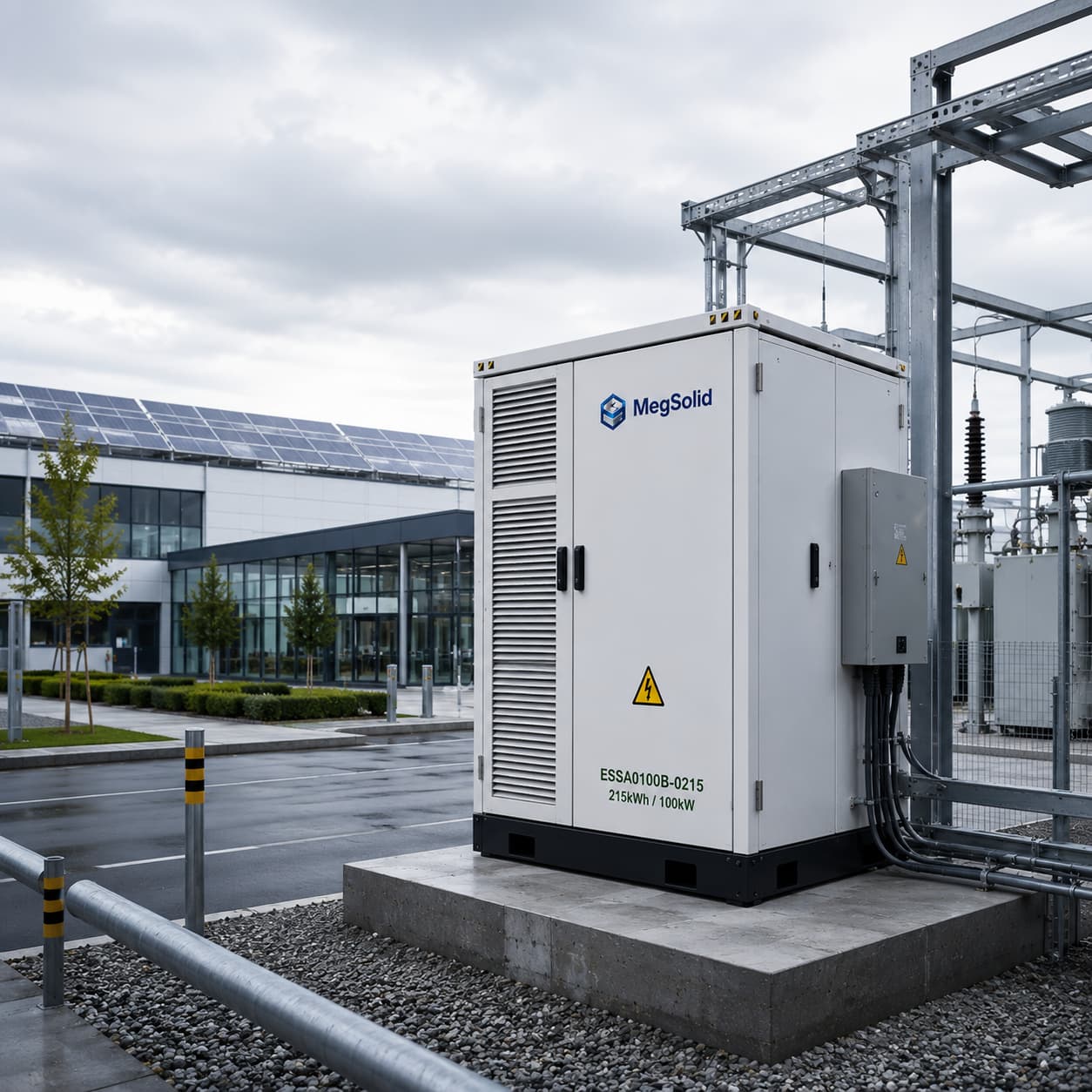
Two ESSC 1MW/2.1504MWh containers can provide a 2MW/4.3008MWh nameplate system.
That configuration should not be sold as a guaranteed two-hour POI solution until the usable-energy, loss and degradation calculations pass.
A quotation is technically ready only when:
- The planning and permit route is confirmed.
- Grid conditions define charging and discharging limits.
- POI energy is guaranteed after losses.
- EMS responsibility is documented.
- FAT and SAT criteria are agreed before production.
FAQ
Q1 : La configuration 2 MW/4 MWh est-elle obligatoire pour tous les systèmes de stockage d'énergie par batterie (BESS) en Pologne ?
Non. Il s'agit de la taille minimale requise dans le cadre d'un programme de soutien spécifique du NFOŚiGW.
Q2 : La puissance nominale de 4 MWh garantit-elle une puissance de 2 MW pendant deux heures ?
Non. La capacité SOC utilisable, les pertes de conversion, la consommation des systèmes auxiliaires et la dégradation réduisent l'énergie du POI.
Q3 : Un système de 4 MWh installé à l'extérieur nécessite-t-il un permis de construire ?
Oui. La réglementation polonaise exige un permis de construire pour toute installation en extérieur d’une puissance supérieure à 2 000 kWh.
Q4 : Un système de stockage d'énergie par batterie (BESS) de 2 MW est-il de type B ?
Oui. Selon les seuils publiés, la catégorie B regroupe les installations d'une puissance comprise entre 0,2 MW et moins de 10 MW.
Q5 : Un projet de 2 MW nécessite-t-il un permis de stockage ?
En principe, non. Les installations de stockage d’une puissance supérieure à 50 kW et ne dépassant pas 10 MW doivent être inscrites au registre ; une autorisation est requise au-delà de 10 MW.
Q6 : La puissance de charge et celle de décharge peuvent-elles être différentes ?
Oui. Ces deux limites doivent être définies dans les conditions de raccordement et dans le cahier des charges EMS.
Q7 : BESS peut-il prendre en charge le raccordement d'un projet d'énergie renouvelable ?
C'est possible. Les dispositions relatives au regroupement des câbles pour 2026 prévoient le stockage, sous réserve de la structure de raccordement approuvée.
Q8 : Quelle configuration MegSolid atteint le seuil du programme ?
Deux unités ESSC de 1 MW/2,1504 MWh offrent une puissance nominale de 2 MW/4,3008 MWh.
Q9 : Que doit prouver le FAT ?
Il doit permettre de vérifier les commandes de puissance, les limites des points d'intérêt (POI), le comportement en cas de faible niveau de charge (SOC), les réponses aux défauts, la protection et l'enregistrement des données.
Q10 : Que faut-il pour obtenir un devis ferme ?
Conditions du réseau, plan du site, garantie relative aux points d'intérêt, durée, tension de raccordement, schéma unifilaire et calendrier du projet.
Q11 : Comment définir les caractéristiques d'un système de stockage d'énergie par batterie (BESS) de 2 MW/4 MWh en Pologne ?
Vérifiez d'abord l'autorisation et le tracé du réseau, puis définissez l'énergie garantie au niveau des points d'intérêt (POI), les pertes, le périmètre du système de gestion de l'énergie (EMS) et les tests de réception.
Q12: What approvals normally apply to a Polish 2MW BESS?
The route normally includes spatial planning, grid conditions, a construction permit, completion notification and storage-register entry.
Q13: Which container configuration is suitable?
Two 1MW/2.1504MWh containers meet the nameplate threshold. A guaranteed two-hour service may require additional nominal capacity.