 Aller au contenu
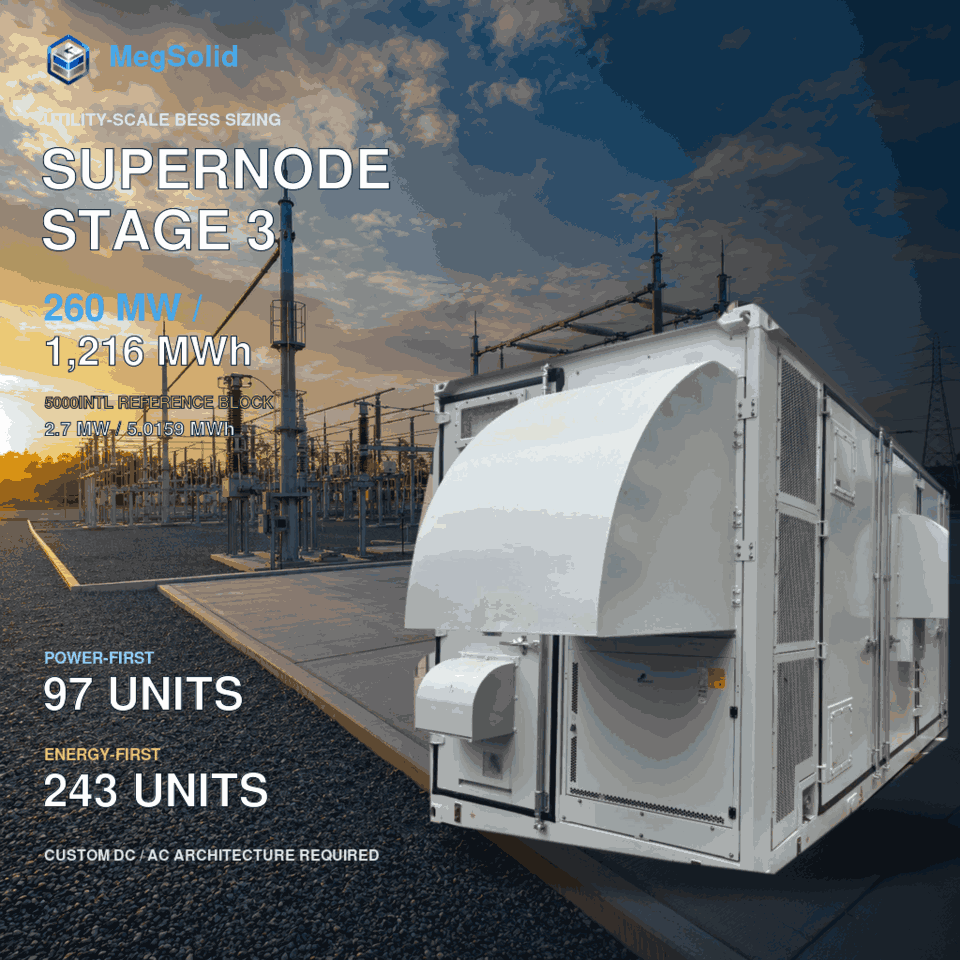
Supernode Stage 3 is a clean sizing stress test for Australian buyers. Public figures put it at 260MW / 1,216MWh. MegSolid’s standard 5000INTL container lists 2.7MW / 5,015.9kWh.
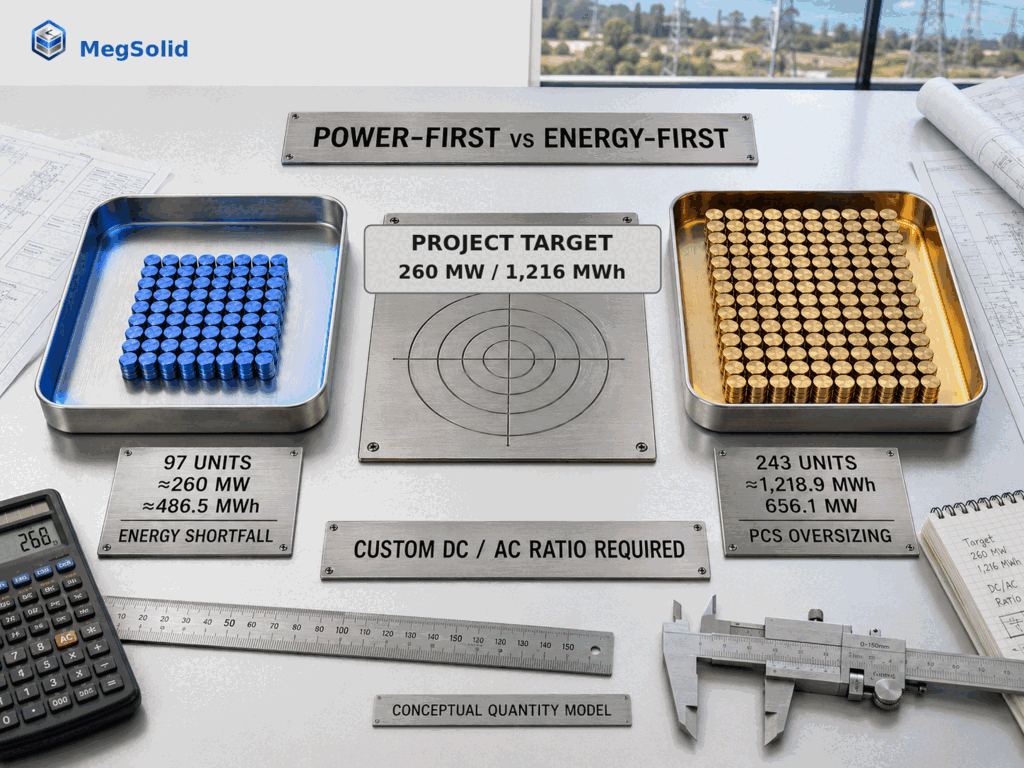
Divide both ways and the counts refuse to match. Power-first needs 97 standard 5000INTL units. Energy-first needs 243.
That gap is the point. Split the job into four boundaries before you buy boxes: POI power, delivered energy, installed battery energy and PCS capacity. Then decide whether a standard integrated block fits, whether its AC side would sit idle, or whether the plant needs a different DC/AC layout.
Fast-scan sizing result
| Decision input | Published or calculated value | Signification du terme « approvisionnement » |
|---|---|---|
| Supernode Stage 3 power | 260MW | Project-level AC delivery rating reported by GE Vernova |
| Supernode Stage 3 energy | 1,216MWh | Published Stage 3 energy; public releases do not define every measurement boundary |
| Nameplate energy-to-power ratio | 4.68 hours | More energy than a pure 260MW × 4h block |
| Exact four-hour delivery energy | 1,040MWh | Energy if 260MW is held for exactly four hours |
| Published energy above 1,040MWh | 176MWh | Possible margin; allocation needs contract and design evidence |
| 5000INTL standard rating | 2.7MW / 5.0159MWh | About 1.86 hours at nameplate power |
| Power-first 5000INTL count | 97 units | About 260MW, only about 486.5MWh of nameplate energy |
| Energy-first 5000INTL count | 243 units | About 1,218.9MWh, 656.1MW of listed aggregate AC power |
This is a pre-FEED screen. It is not a Supernode equipment bid. Supernode chose CATL battery systems and GE Vernova for power conversion, plant controls, integration and grid-connection support.
What Supernode Stage 3 has publicly confirmed
GE Vernova’s 21 August 2026 release rates Stage 3 at 260MW / 1,216MWh and calls it four-hour storage. The same note puts the finished three-stage campus at 780MW / 3,075MWh at Brendale.
Stage 3 has Generator Performance Standards acceptance. GE Vernova supplies PCS, plant controls, integration and grid-connection support, and calls Stage 3 its first grid-forming BESS project in Australia. That is GE Vernova’s Australian record. It is not a claim that this is the first grid-forming battery in the country.
Primary source for Stage 3 power, energy, GPS and grid-forming wording: GE Vernova announcement.
Le Quinbrook Stage 2 note puts Stages 1 and 2 in operation at 520MW / 1,858MWh. Stage 3 closed about AU$469 million of debt and carries a 15-year offtake with Stanwell.
CATL’s Supernode note says EnerC Plus went into Stages 1 and 2 and TENER S into Stage 3, under a long-term service arrangement. CATL lists the three-stage total as 780MW / 3,074MWh — one MWh under the GE Vernova figure.
| Source | Current published total | How to use it |
|---|---|---|
| GE Vernova, 21 August 2026 | 780MW / 3,075MWh | PCS, controls, GPS, grid-forming scope |
| CATL, 14 August 2026 | 780MW / 3,074MWh | Battery supply and lifecycle service |
| Quinbrook, 28 July 2026 | Stage 1+2: 520MW / 1,858MWh | Operating status, financing, offtake |
| Supernode project page | 760MW / 3,096MWh | Older snapshot; keep the page date and do not mix totals |
Le Supernode project page also says the site ties to the regional transmission grid at 275kV. Its line that 80% of Queensland electricity flows through South Pine each day stays attributed to that site.
Start with the delivery obligation, then look at battery nameplates
Contract or grid-connection obligations come first. Container count comes later.
For a four-hour duty at 260MW:
Required delivered energy = 260MW × 4h = 1,040MWh
Stage 3 publishes 1,216MWh. The gap is 176MWh, about 16.9% above a pure four-hour multiply.
That margin might cover usable SOC, conversion losses, auxiliaries, degradation allowance, reserve policy or something else the project locked in. Public notes do not split the 176MWh. You need the technical schedule, offtake and approved design for that split.
So the 4.68-hour nameplate ratio is not a 4.68-hour guaranteed export duration.
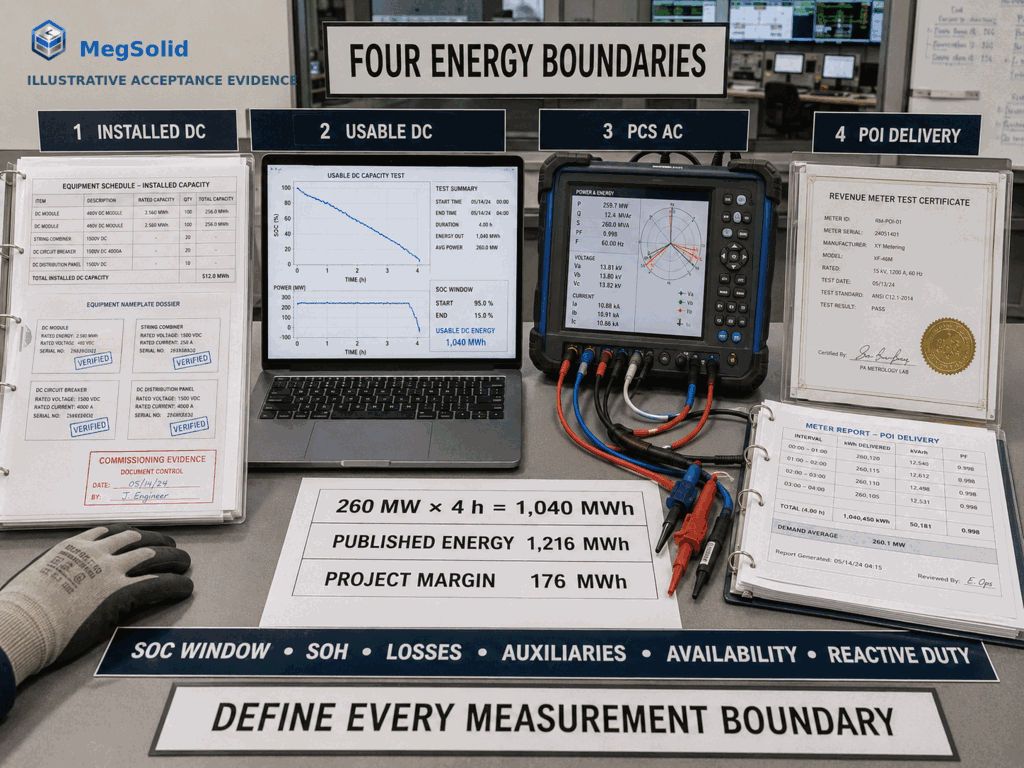
Four energy boundaries stay separate
| Limite | Question | Evidence |
|---|---|---|
| Installed DC nameplate | How much battery energy is physically installed? | Container datasheets, rack schedules, as-built serials |
| Usable DC energy | How much sits inside the allowed SOC window? | BMS limits, temperature limits, SOH basis, warranty schedule |
| AC energy at the PCS | What remains after battery and conversion losses? | Defined efficiency test, PCS loss data, auxiliary treatment |
| Delivered energy at the POI | What hits the contractual meter? | Revenue meters, transformer losses, collection losses, test records |
A workable screen:
Delivered POI energy = installed DC energy × usable SOC fraction × retained-capacity factor × discharge-path efficiency − interval auxiliaries
Each term needs its own boundary. One product-page efficiency number will not close the sum.
Where the package ends: container, transformer and grid-connection responsibilities.
Why one 5000INTL ratio produces two container counts
MegSolid’s 5000INTL page publishes this standard setup:
| Published parameter | 5000INTL value |
|---|---|
| Puissance nominale | 5,015.9kWh |
| Puissance nominale en courant alternatif | 450kW × 6 = 2.7MW |
| Nameplate duration | About 1.86 hours |
| Nominal DC voltage | 1,331.2Vdc |
| Operating DC range | 1,123.2–1,497.6Vdc |
| Rated AC voltage | 690Vac |
| Refroidissement | Smart liquid cooling |
| Protection | IP55 |
| Température de fonctionnement | −30°C to 55°C |
| Communications | Ethernet and RS485 |
| Maximum efficiency | 87.5% (confirm measurement boundary) |
Full sheet: MegSolid 5000INTL product page.
Power-first calculation
260MW ÷ 2.7MW per unit = 96.3 units
Round up to 97 standard units. Combined nameplate energy:
97 × 5.0159MWh = 486.5MWh
At a 260MW plant limit that is about 1.87 hours before usable-energy cuts. Power is covered at nameplate level. The four-hour energy duty is not.
Energy-first calculation
1,216MWh ÷ 5.0159MWh per unit = 242.4 units
Round up to 243 standard units. Listed aggregate AC power:
243 × 2.7MW = 656.1MW
Installed energy reaches published project scale. Catalogue AC capacity sits more than 2.5× the 260MW rating.
What 243 energy blocks imply
If 243 equal energy blocks share a 260MW plant limit, each block carries only about 1.07MW of project-level AC on average.
That does not rewrite the listed 2.7MW rating of a standard 5000INTL. It points to another layout: custom PCS allocation, DC-coupled energy blocks, centralised conversion, or another controlled topology.
MegSolid still has to confirm whether that layout is offered for the job. The standard integrated 5000INTL stays 2.7MW / 5.0159MWh until a controlled proposal says otherwise.
Same power-vs-energy split shows up on other large delivery jobs: contracted power and energy drive different container and PCS counts.
The final container count needs six adjustments
Plage de SOC utilisable The BMS may reserve both ends of SOC. The contract should say whether 1,216MWh is gross installed, usable DC or another declared boundary.
End-of-life capacity Four hours at beginning of life, at a later warranty year, or through the whole contract — each choice changes initial count and augmentation.
Conversion and collection losses Battery, PCS, transformers, MV collection and the 275kV tie sit on different sides of the sum. Allocation follows the delivery point.
Consommation auxiliaire Liquid cooling, pumps, controls, fire systems, heaters and substation loads all draw energy. Settlement and test methods must say whether auxiliaries sit inside or outside the delivery boundary.
Availability and maintenance isolation N-1 design, planned outages and forced outages can add blocks beyond a pure energy count. The plant controller needs a defined way to report available MW when one block is offline.
Reactive-power duty 260MW of active power is not the full MVA story. GPS studies can demand reactive current in voltage events, which eats PCS headroom and can resize transformers.
PCS boundary questions: MegSolid PCS engineering framework. Project grid-forming and reactive-current capability still need approved models and settings.
GPS acceptance changes the evidence package
GPS acceptance locks the technical performance standards for connection to the NEM. It does not turn a catalogue rating into an approved plant design.
AEMO modelling requirements ask connection applicants for a model package that matches the structure and performance of the generating plant, under the Power System Model Guidelines and data sheets.
For a multi-container BESS the chain usually includes:
- RMS and EMT model packages with version control
- PCS control modes and current-limiting behaviour
- PPC hierarchy and plant-level active/reactive limits
- Transformer and collector-network representation
- Protection settings and disturbance response
- Model validation against factory and site tests
- Fallback after communications loss
- As-built parameter reconciliation
AEMO’s grid-forming inverter test framework checks core capabilities in simulation. It is a test framework, not a universal product certificate.
Signal ownership: BESS SCADA point-list structure. Command hierarchy: BMS, EMS and PPC command hierarchy.
Supernode’s supplier structure versus a MegSolid route
Supernode Stage 3 pairs CATL battery systems with GE Vernova PCS, controls, integration and grid-connection support. Public material also covers long-term service and offtake.
MegSolid’s listed 5000INTL is a different starting point: 5.0159MWh rated energy with 2.7MW rated AC power in one published configuration.
| Procurement factor | Supernode Stage 3 public structure | MegSolid 5000INTL starting point |
|---|---|---|
| Project scale | 260MW / 1,216MWh | 2.7MW / 5.0159MWh per listed unit |
| Battery supplier | CATL TENER S | MegSolid SHS180-314 battery type |
| PCS and integration | GE Vernova project scope | AC rating in the standard product; project scope still needs confirmation |
| Grid-forming statement | GE Vernova’s first Australian grid-forming BESS project | No project-specific Australian GPS or grid-forming approval published for 5000INTL |
| Service evidence | CATL lifecycle support under LTSA | Warranty, spares, monitoring and service scope negotiated per job |
| Best procurement use | Bankable multi-vendor mega-project with accepted GPS | Direct OEM evaluation, phased utility work, custom architecture studies |
A developer chasing a direct substitute for the contracted Supernode consortium needs equivalent project-level models, controls, service commitments and Australian integration experience.
A developer evaluating MegSolid gets a clear 5MWh-class reference block, factory engineering access and room to set the architecture before the EPC price hardens.
Where the 5000INTL can create procurement value
Transparent nameplate ratio 2.7MW / 5.0159MWh shows the duration mismatch at once. Buyers can challenge PCS oversizing before a large container count lands in the commercial proposal.
High-voltage DC architecture 1,331.2Vdc nominal can mean lower DC current for a given power than a lower-voltage alternative, if the PCS, protection and cable system match. Prove it with project loss and thermal calcs.
Outdoor utility-scale packaging IP55, smart liquid cooling and −30°C to 55°C give a defined environmental starting line. Site ambient, solar gain, humidity, flood, fire access and noise remain project inputs.
Factory evidence before shipment Require serial-level configuration records, communication maps, cooling alarms, protection tests and raw FAT data before release. BESS FAT witness structure helps assign ownership.
Product-scale engineering detail 5000INTL engineering analysis covers DC voltage, cooling and dense container layout. That supports pre-FEED work. GPS and POI performance stay separate approvals.
Minimum sizing schedule for a four-hour Australian BESS
| Champ | L'acheteur doit indiquer | Le fournisseur doit renvoyer |
|---|---|---|
| POI active power | Export and charge MW, duration, ramp basis | Guaranteed plant MW and limiting equipment |
| Delivery duration | Beginning-of-life or end-of-life requirement | Delivered MWh at the named meter |
| Limite énergétique | Gross DC, usable DC, PCS output or POI | Loss map and auxiliary treatment |
| SOC limits | Normal dispatch and emergency reserve | BMS hard limits and EMS operating limits |
| Degradation basis | Contract year, temperature, cycle profile | Retention curve and augmentation schedule |
| Disponibilité | Planned and forced-outage assumptions | Installed redundancy and available-MW logic |
| Reactive duty | GPS operating points | PCS MVA headroom and P-Q capability |
| Connection voltage | Collector and POI voltages | Transformer, switchgear, protection boundary |
| Controls | AEMO/NSP, PPC and EMS hierarchy | Point list, command ownership, fallback state |
| Acceptance | Model, FAT, SAT, performance tests | Instruments, raw data, tolerances, signatures |
Security and remote access belong in the same controls schedule. Starting point: BESS cybersecurity engineering framework.
What to send MegSolid for a preliminary architecture check
Four controlled inputs:
- required MW at the POI
- required delivered MWh and duration basis
- beginning-of-life or end-of-life obligation
- proposed PCS, transformer and connection boundary
MegSolid can return a preliminary energy-block count, AC conversion range and a list of open assumptions — where the standard 5000INTL ratio fits and where custom engineering is required.
Décision d'achat
Supernode Stage 3 shows a four-hour BESS is defined by its delivery boundary, not by a container label. The public 260MW / 1,216MWh figures carry 176MWh more nameplate energy than a pure four-hour multiply; how that margin is spent stays inside project documents.
On the standard 5000INTL, power-first selection leaves too little energy for this profile. Energy-first selection buys a large excess of listed AC capacity. A credible MegSolid proposal needs a controlled DC/AC architecture, an explicit usable-energy equation and a project-specific GPS evidence plan.
FAQ
What is the published rating of Supernode Stage 3?
GE Vernova publishes Stage 3 at 260MW / 1,216MWh and describes it as four-hour storage. The ratio of the two nameplate figures is about 4.68 hours.
Why is 1,216MWh higher than 260MW × four hours?
Exact four-hour delivery at 260MW equals 1,040MWh. The extra 176MWh may cover usable SOC, losses, degradation, reserve or another design need. Public releases do not allocate that margin.
How many MegSolid 5000INTL units equal 260MW?
260MW ÷ 2.7MW = 96.3, so a nameplate power check rounds up to 97 units. Those units hold only about 486.5MWh of combined rated energy.
How many 5000INTL units equal 1,216MWh?
1,216MWh ÷ 5.0159MWh = 242.4, so a nameplate energy check rounds up to 243 units. Listed aggregate AC rating would be 656.1MW.
Can 243 standard 5000INTL units be limited to 260MW?
A plant controller can impose an export limit, but the project would still buy 656.1MW of listed AC conversion capacity. Commercial design should weigh a customised PCS allocation or another DC/AC topology.
Is the 5000INTL a four-hour BESS block?
Published 5.0159MWh and 2.7MW give a nameplate duration of about 1.86 hours. Four-hour projects need a different energy-to-power ratio.
Does 87.5% maximum efficiency equal project round-trip efficiency?
The product page labels 87.5% as maximum efficiency. POI round-trip efficiency needs a defined test boundary covering SOC, power, temperature, auxiliaries, transformers and collection losses.
Which energy value should appear in a four-hour BESS contract?
State delivered MWh at a named meter and the applicable contract year. Gross DC nameplate can sit as a separate design parameter.
Why does end-of-life duration change the initial container count?
Capacity falls with age and use. A four-hour obligation held later in the contract may need initial oversizing, augmentation or both.
What does GPS acceptance mean for a BESS?
It sets the agreed technical performance standards for connection to the NEM. It rests on project models, settings and studies — not one equipment datasheet.
Has MegSolid 5000INTL received Supernode-equivalent GPS acceptance?
No project-specific Australian GPS acceptance has been published for the 5000INTL. Any Australian utility project needs its own connection process, model package and approved plant settings.
Is Supernode Stage 3 Australia’s first grid-forming BESS?
GE Vernova calls it the company’s first grid-forming BESS project in Australia. Do not stretch that into “first grid-forming battery in the country.”
What voltage connects the Supernode site to the transmission grid?
The Supernode project page states a 275kV connection to the regional transmission grid. Collector voltages and internal transformers are separate design details.
Why are reactive-power requirements relevant to container count?
Reactive current uses PCS and transformer capacity. GPS operating points can cut active-power headroom under some voltage conditions.
What should FAT verify for a multi-container four-hour BESS?
Container ratings, controls, communications, protection, alarms, cooling behaviour, raw-data capture and model parameters. Site tests then validate the full plant and POI boundary.
What information does MegSolid need for a preliminary four-hour BESS check?
POI MW, delivered MWh, duration basis, contract-year requirement, connection voltage and the proposed PCS/transformer boundary. MegSolid can map preliminary energy-block and AC-conversion ranges from those inputs.
