
A 300kW / 1MWh BESS provides 3.33 hours at full rated power before SOC limits, conversion losses, temperature derating and battery aging are applied. A Nigerian C&I project therefore needs a usable-energy calculation before the EPC fixes the equipment quantity.
Before requesting quotes, define the PCC voltage, transformer rating, load profile, generator and PV interfaces, export rule, backup reserve and local EPC responsibilities. These inputs allow suppliers to quote the same electrical duty and delivery boundary.
Project context used for this article: an anonymous Nigerian C&I EPC inquiry for a grid-connected, outdoor, container-style energy-storage project serving large industrial loads. The inquiry named 300kW and 1,000kWh, while the electrical schedule, load profile, location elevation and final field scope remained open for engineering confirmation.
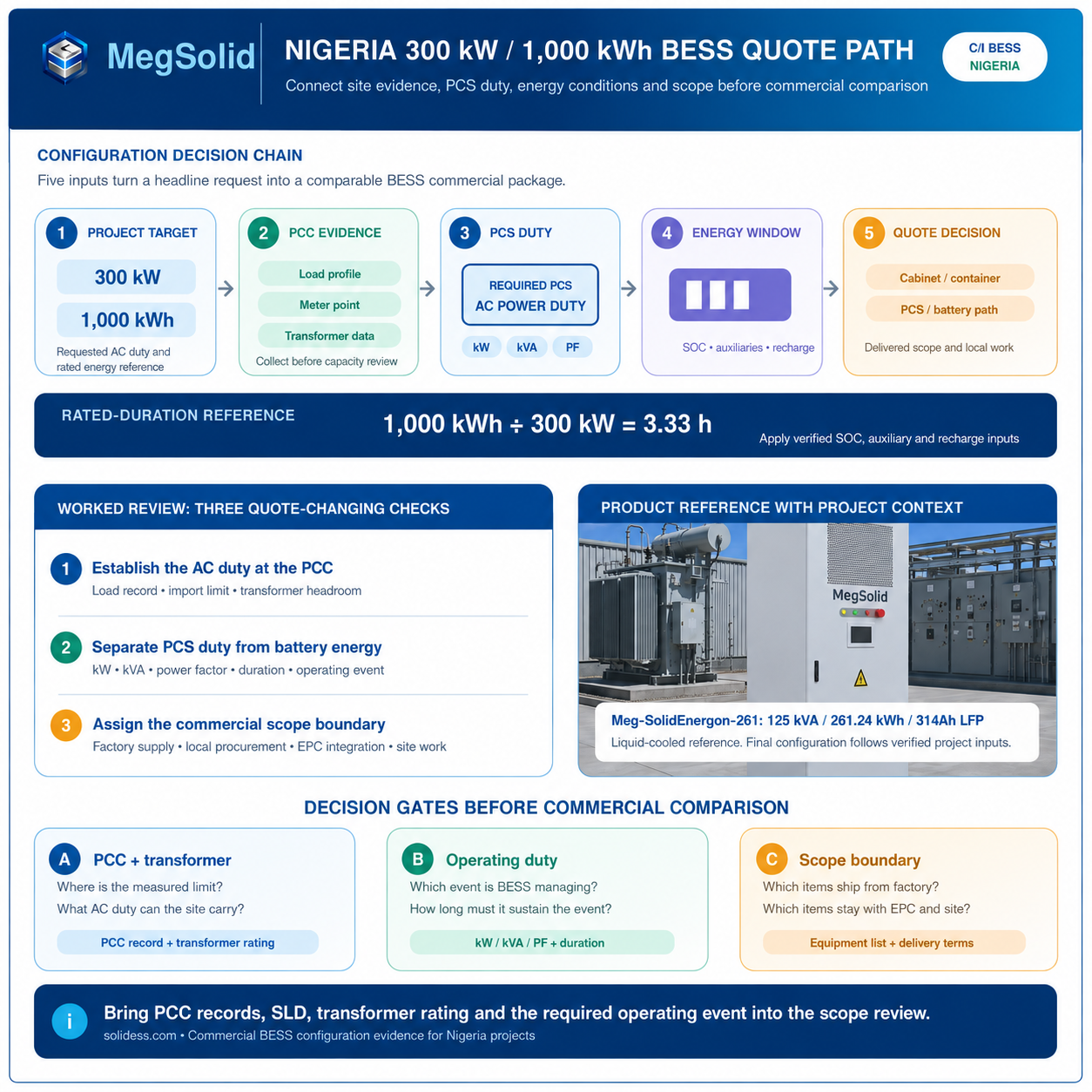
How to Size a 300kW / 1MWh BESS in Nigeria
The commercial question is whether the configuration can support the required electrical event at the actual site.
- Write the duty as an operating statement. Example: “Hold measured import within the agreed site limit during the production ramp for the recorded interval.”
- Separate continuous load, temporary peak, motor-starting event and critical-load branches.
- State whether the BESS follows the grid, supports an islanded bus, bridges a source transfer or combines these duties on separate schedules.
- Capture the PCC voltage, transformer rating, feeder arrangement, existing generator status and relay coordination requirement.
- Identify the dispatch owner: site operator, customer EMS, supplier EMS or EPC control integrator.
For a 300kW load event, the nominal 1,000kWh ÷ 300kW quotient equals 3.33 hours. That arithmetic is only an opening reference. The engineered duration requires the agreed state-of-charge window, conversion losses, ambient derating, battery aging allowance, auxiliary consumption and load shape.
Data that turns a capacity request into an engineering basis
The EPC can collect the following items before a manufacturer prepares a controlled proposal.
| Project input | Pièces justificatives à fournir | Décision approuvée |
|---|---|---|
| Load profile | At least 15-minute interval data, peak events and operating calendar | AC power duty and required duration |
| PCC and transformer | Single-line diagram, transformer nameplate and protection settings | Connection voltage, current and protection scope |
| Grid condition | Outage history, voltage quality record and utility requirements | Grid-following, backup or microgrid control path |
| Site environment | Outdoor layout, access path, elevation, ambient range and drainage plan | Enclosure, cooling and civil-work review |
| Existing sources | Generator ratings, controller details and local PV arrangement | Source coordination and EMS interfaces |
| Commercial objective | Fuel displacement, import limit, resilience, tariff timing or process continuity | Dispatch logic and financial model |
Why this changes the quotation: a battery nameplate without these inputs leaves the PCS rating, enclosure count, cables, switchgear, transformer work and controls scope open to interpretation.
Keep AC Power, Apparent Power and Battery Energy Separate
The proposal must show the relationship between kW, kVA and kWh in plain project terms.
- kW describes active AC power delivered to the load or managed at the PCC.
- kVA describes apparent AC capacity, which interacts with site power factor.
- kWh describes rated stored energy; usable energy requires project operating limits.
- DC voltage window affects the compatible PCS and battery arrangement.
- Charge power governs whether the battery can recover during the available low-load or low-tariff period.
MegSolid’s current onduleur de stockage d'énergie portfolio includes the MEGA0030TS–MEGA0500TS PCS range. Published model ratings cover 30kW through 500kW, with 400V rated AC voltage, an integrated isolation transformer, grid-current THD below 3%, adjustable power factor and RS485/CAN plus RS485/TCP-IP communications. A 300kW request therefore needs a stated PCS topology, selected model combination and interface drawing rather than a generic inverter line item.
| Configuration question | Scope evidence that answers it |
|---|---|
| Can 300kW be delivered at the duty power factor? | PCS schedule, kW/kVA declaration and AC current calculation |
| Can 1,000kWh support the duty interval? | Rated energy, operating SOC window, aging allowance and duty-cycle calculation |
| Can the system recharge between events? | Charge-power limit, source availability and EMS schedule |
| Can the PCC accept the dispatch? | Single-line diagram, protection settings and utility/EPC review |
| Can the site maintain the intended output? | Ambient assumptions, enclosure arrangement and auxiliary-power calculation |
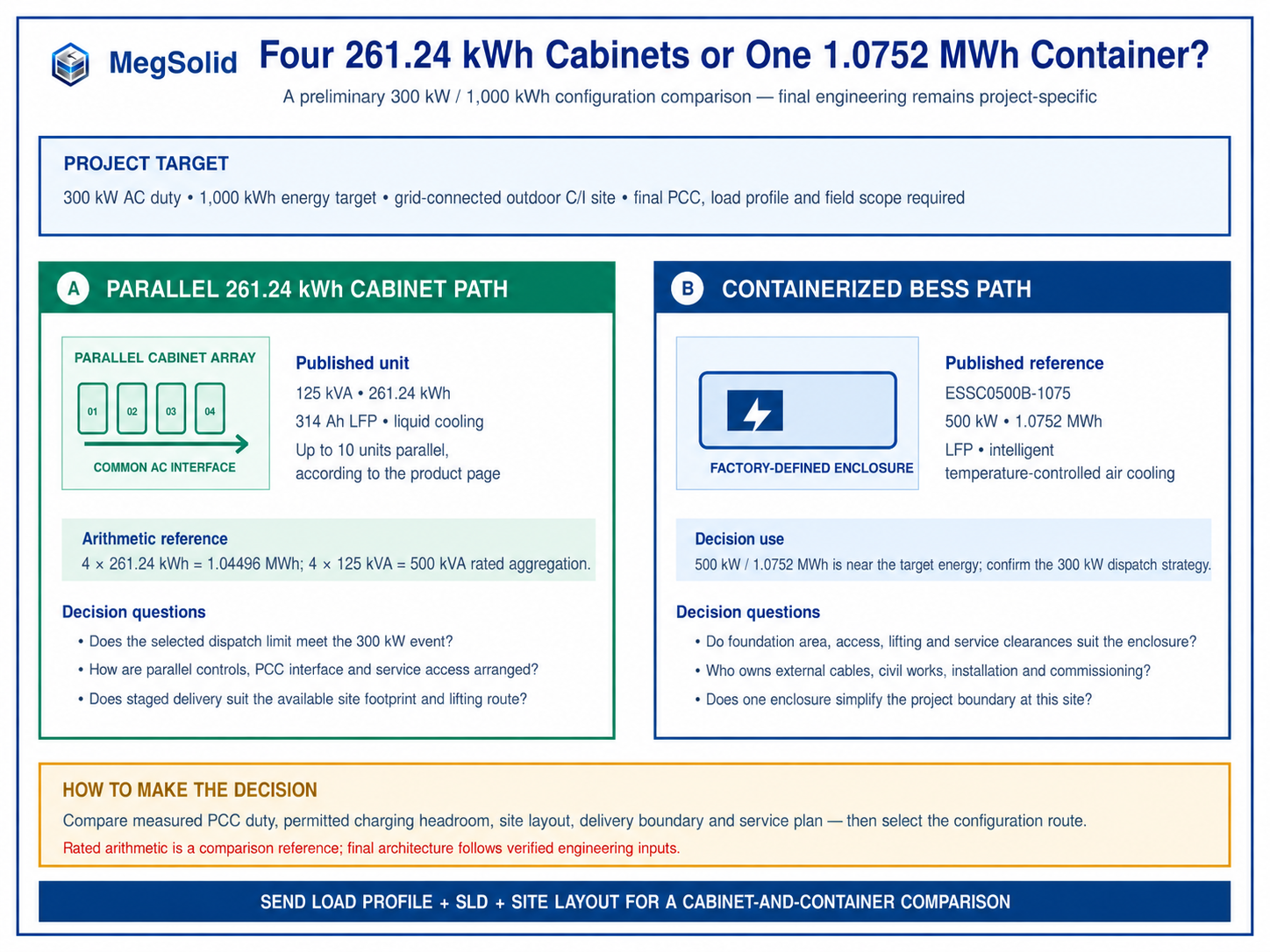
300kW / 1MWh BESS Configuration Options
MegSolid publishes several C&I and containerized product families that can inform an early engineering discussion.
| Published product path | Note publique vérifiée | Role in a 300kW/1,000kWh review | Engineering confirmation required |
|---|---|---|---|
| Armoire d'extérieur ESSA0100B-0215 | 100 kW CA ; 215,04 kWh ; LFP ; refroidissement par air intelligent | Arithmetic reference: three published nameplates equal 300kW AC and 645.12kWh rated energy | Duration, cabinet topology, controls, field cabling and site conditions |
| Meg-SolidEnergon-261kWh liquid-cooled C&I system | 125kVA; 261.24kWh; 314Ah LFP; liquid cooling | Four units total 500kVA and 1.04496MWh rated energy before operating limits | Selected kW dispatch limit, power factor, parallel architecture, PCC interface and installation boundary |
| MEGA TS PCS | 30–500kW rated output by model; isolation transformer | Creates a defined AC conversion path for engineered battery architectures | Selected PCS quantity, battery compatibility, switchgear, protection and BOP |
| ESSC0500B-1075 containerized BESS | 500kW; 1.0752MWh; LFP; intelligent temperature-controlled air cooling | Published container reference near the stated energy scale | 300kW dispatch strategy, layout, import/export control, civil works and delivery scope |
The table is a comparison tool, rather than a promise that any row fits the project unchanged. Each final solution needs a controlled datasheet, single-line diagram, BOM, thermal boundary and applicable certificate scope.
For cabinet-versus-container deployment decisions, review modular cabinets versus containerized ESS deployment. A modular approach can support staged delivery and service segmentation. A container approach can concentrate more equipment within one factory-defined enclosure. Site lifting route, foundation area, electrical segregation, access clearance and service plan decide which route serves the project.
PCC Metering and Grid-Connection Inputs for the Nigerian Site
The bill, electrical point and control boundary must describe the same project event.
- Identify whether the BESS responds to utility import, a downstream feeder, a process branch or a critical-load bus.
- Record metering interval, demand window, import limit and allowable export position.
- Define how the EMS receives meter values, generator status and PCS operating states.
- Document who supplies the CTs, meter, gateway, network equipment, control cables and data access.
- Confirm the approved behaviour during grid interruption, planned maintenance and communications loss.
For projects where grid stability and backup power interact with generator operation, the Nigerian operating questions in PV-diesel-BESS microgrid engineering for Nigeria help the EPC define source priority and control hand-off. MegSolid supplies storage equipment and controls interfaces; PV modules and local PV balance-of-system supply belong in the local project package.
A dispatch statement that procurement and engineering can share
Use a short operational statement in the bid package.
Operating statement: During the defined industrial operating period, maintain PCC import within the agreed threshold while preserving the agreed energy reserve for the specified backup duty.
This statement gives finance a traceable benefit event, gives engineering a measurable AC target and gives suppliers a shared basis for dispatch logic.
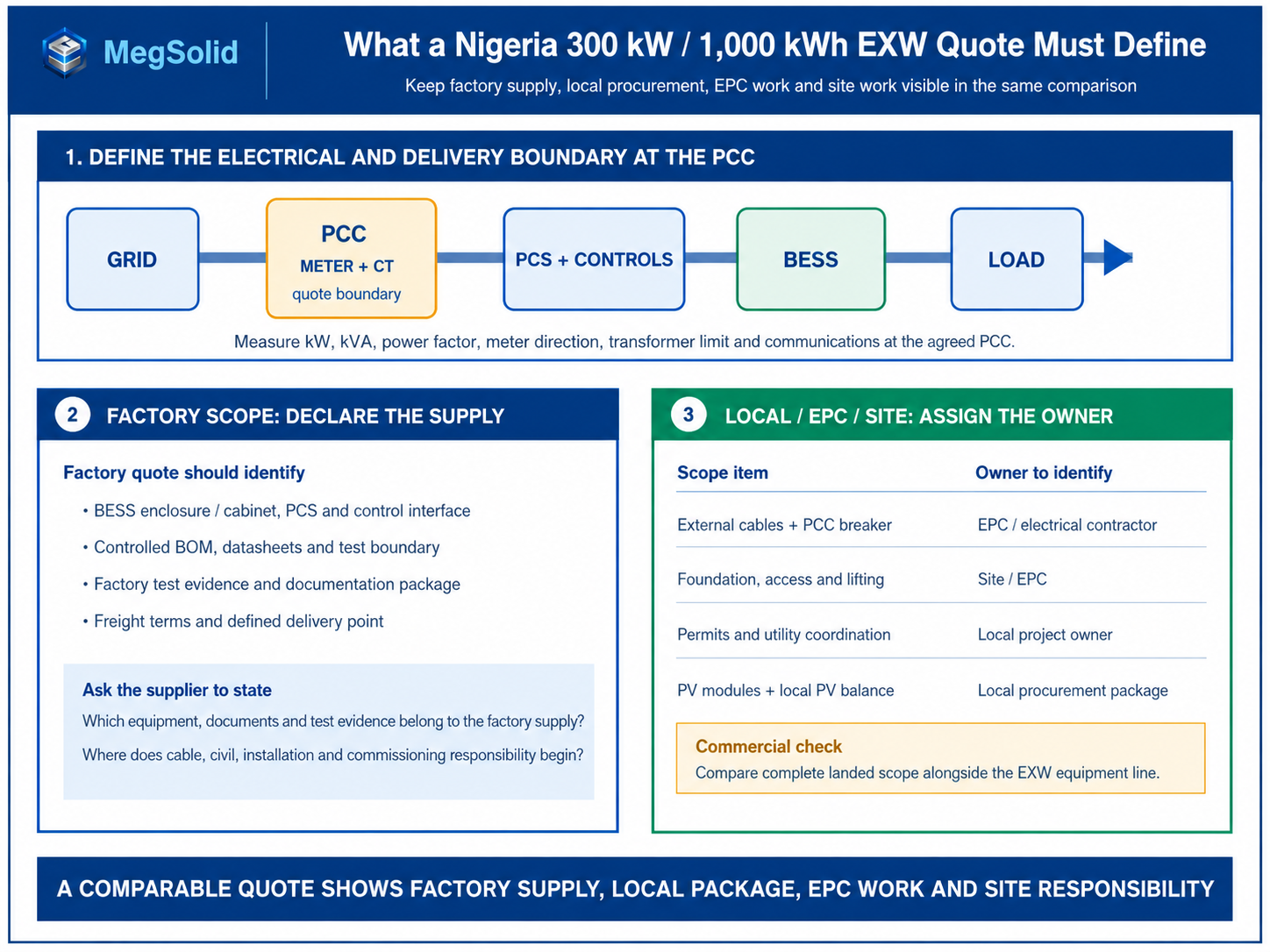
What to Include in a Nigerian Commercial BESS Quote
A complete comparison separates factory-supplied equipment from EPC and site responsibilities.
| Scope area | Factory proposal should identify | EPC or site party should identify |
|---|---|---|
| Battery and PCS | Model, quantity, rated kW/kVA, rated kWh, operating limits, BMS/EMS interface | Final duty cycle, selected location and access route |
| Interface de climatisation | Terminals, voltage, current, transformer data and protection interface | PCC breaker, downstream switchgear, cable route and relay coordination |
| Enclosure and thermal system | IP rating, cooling method, auxiliary loads and service access | Foundation, drainage, canopy decision and ventilation around equipment |
| Commandes | EMS communication protocols, meter data requirement and operating modes | Network ownership, remote-access policy and local control authority |
| Mise en service | FAT evidence, site test boundary and documentation package | Utility coordination, electrical permits, field installation and witnessed energization |
| Logistics | Factory packing list, lifting points and shipment interface | Local customs, offloading equipment, road access and site lifting plan |
Utilisez le Liste de contrôle pour l'acquisition d'un système de stockage d'énergie par batterie (BESS) C&I to keep technical and commercial assumptions in one comparison file. The product proposal, freight, local installation, external cable works, utility application, civil works and commissioning scope should each have an identified owner.
Verify PCS, BMS and EMS Interfaces Before Purchase Approval
Control integration defines whether a well-rated battery system serves the intended operating event.
- Match the selected PCS DC window with the verified battery arrangement.
- Map BMS-to-PCS signals, permissives, alarms, setpoints and emergency-stop sequence.
- Map EMS-to-meter data, dispatch commands, source status and operator controls.
- State local and remote control roles, including password ownership and network segregation.
- Include a loss-of-communications state in the functional description.
Le PCS and BMS integration review gives useful questions for this check. The key document is the project communication matrix, since it connects physical equipment ratings with the actual operating logic.
Use Acceptance Evidence to Protect the Commercial Decision
Commissioning evidence should test the declared project duty rather than a generic cabinet demonstration.
- Verify equipment identity against the approved BOM, nameplates and controlled datasheets.
- Verify the selected AC kW/kVA limit and power-factor setting at the agreed interface.
- Run a documented dispatch event using the project meter boundary.
- Confirm BMS, PCS and EMS alarms, permissives and status reporting.
- Check energy accounting against the agreed test window and initial SOC.
- Record site settings, software versions, test meters and remaining actions in a signed report.
Le BESS factory acceptance witness checklist can be adapted to the defined factory boundary. Site acceptance should then validate the installed cable path, PCC behaviour, controls integration and operating duty.
Choose the Next Commercial Action
The next step is a concise project data pack that lets the technical and commercial teams prepare a comparable proposal.
- 15-minute load record and planned operating schedule
- Single-line diagram, PCC voltage, transformer rating and protection philosophy
- Required 300kW event, target duration and critical-load reserve
- Grid, generator and local PV status
- Outdoor layout, location elevation, access and installation constraints
- Responsibility matrix for external cables, civil work, installation, freight and commissioning
For an EPC evaluation framework, see how EPCs evaluate energy storage systems in project deployment. For country-specific supplier due diligence, use battery energy storage supplier evaluation in Nigeria.
FAQ
What does 300kW mean in a commercial battery energy storage system?
300kW is the active AC power the system must deliver or manage at the declared electrical boundary. The required power factor, current, surge duty and control mode belong in the project specification.
Does 1,000kWh always provide 3.33 hours at 300kW?
The nominal quotient is 3.33 hours. Final duration comes from the project duty-cycle calculation and declared operating reserve.
Should the project specify kW or kVA?
Specify both when site power factor affects the duty. kW defines active power, while kVA defines apparent power and equipment current capability.
What documents should an EPC provide before requesting a controlled BESS proposal?
Provide interval load data, a single-line diagram, PCC and transformer information, operating schedule, source information, site layout and responsibility matrix for external works.
Can a 300kW/1,000kWh BESS operate with the Nigerian grid?
Grid-connected operation depends on the PCC characteristics, utility requirements, selected PCS control mode, protection coordination and approved installation design. These inputs require site-specific confirmation.
What affects a commercial BESS quote besides battery capacity?
The quote depends on PCS power, battery energy, operating duty, transformer and switchgear interface, cables, controls, enclosure, thermal system, delivery terms, commissioning and local EPC works.