 Skip to content
Overview of G2S-C Engineering Design
The physical execution precision of industrial energy storage systems (ESS) is determined by the inverter's hardware architecture.
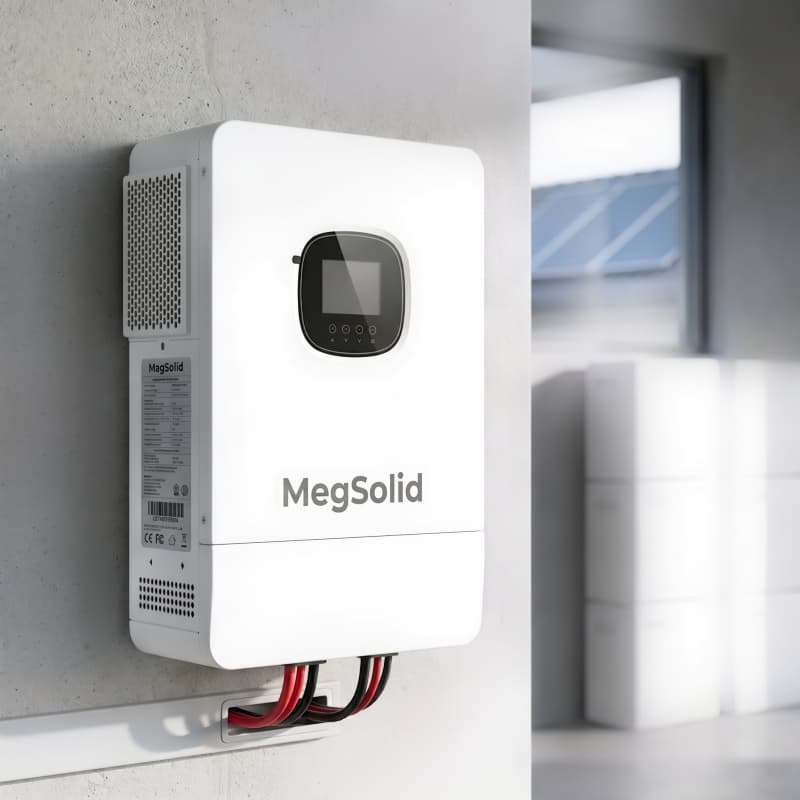
The MegSolid G2S-C single-phase energy storage inverter utilizes an underlying hardware topology that natively supports on-grid/off-grid AC coupling.
The system can achieve grid mode switching within an extremely short timeframe.
Its hardware architecture is compatible with hybrid solid-state batteries, standard lithium-ion batteries, and lead-acid batteries.
The G2S-C provides a multi-gradient rated output standard from 3kW to 6kW (covering models from R3KL1DA-G2S-C to R6KL1DA-G2S-C).
This power range supports flexible distributed node deployment.
MPPT and DC Input Optimization
The photovoltaic energy capture efficiency on the high-voltage DC side directly impacts the system's Levelized Cost of Storage (LCOS).
The G2S-C series integrates high-efficiency multi-channel MPPT tracking modules.
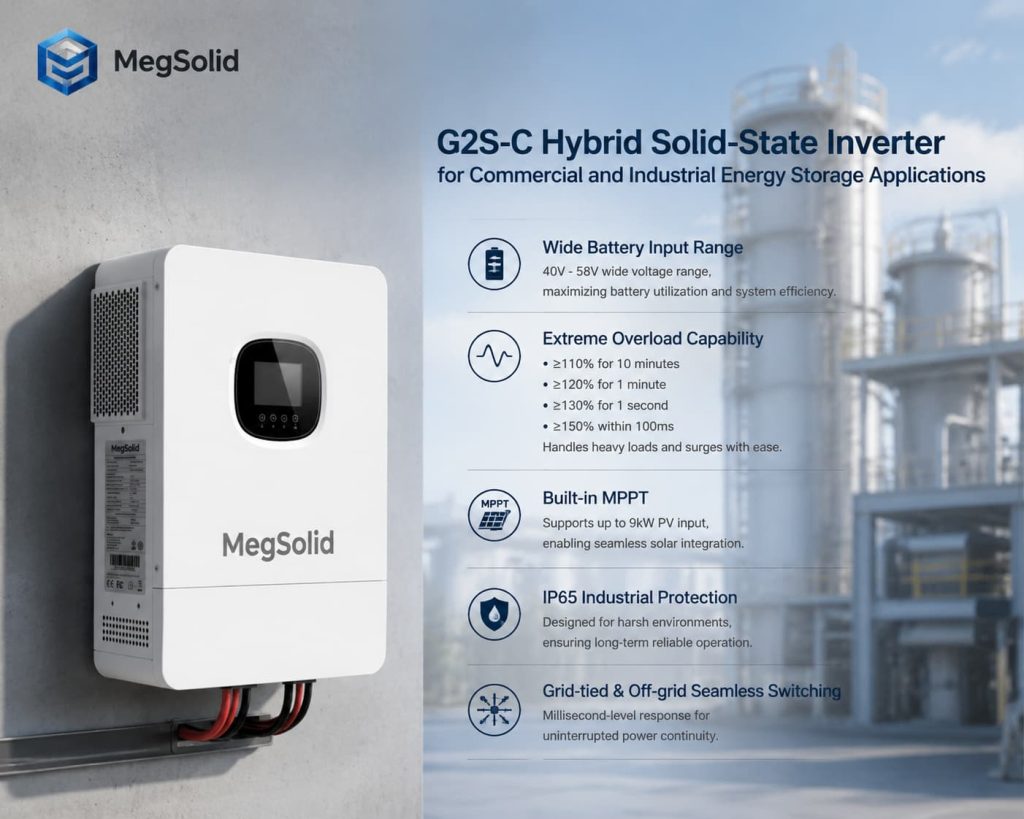
Taking the R6KL1DA-G2S-C as an example, its maximum PV DC input power reaches 9kW, while the rated AC output stabilizes at 6kW.
This 1.5x oversizing ratio allows the system to forcefully maintain maximum power point tracking under low-light conditions.
The inverter's battery input voltage is set to a rated 48V, providing an extremely wide operating voltage window of 40V to 58V.
This wide voltage window directly extracts the physical discharge limits of the underlying hybrid solid-state cells.
This prevents the system from prematurely triggering a hardware-level undervoltage lockout during high-frequency, heavy-load transients.
Battery Compatibility (Lithium / Hybrid Solid-State)
Conventional commercial inverter algorithms are developed for liquid electrolyte batteries.
They cannot accurately match the impedance curves and depth of discharge of novel hybrid solid-state batteries.
The G2S-C achieves direct reading and response to the cell-level parameters of hybrid solid-state batteries by rewriting the underlying BMS handshake protocol.
|
Parameter |
Standard Lithium-ion Adaptation Logic |
Hybrid Solid-State Adaptation Mechanism |
|---|---|---|
| Rated Input Voltage | 48V Nominal | 48V Nominal (Supports 40~58V extreme wide-range dip) |
| Cell Compatibility | Matches traditional liquid systems | Natively supports Hybrid Solid-State serial protocols |
| System AC Impedance Requirement | ≥ 30mΩ (Conventional system assembly) | ≤ 15mΩ (Adapts to ultra-low impedance solid-state modules) |
| Extreme Discharge Temp Support | 0°C to 45°C | -20°C to 60°C (Eliminates external heating logic intervention) |
Efficiency Benchmark (96%+ system efficiency logic)
The system-level conversion efficiency of an inverter is determined by the switching losses of the internal IGBT power modules and high-frequency magnetic component losses.
Across the full load range of a C&I microgrid, the MegSolid inverter system provides an extremely flat efficiency degradation curve.
Referencing the MegSolid centralized MEGA series (such as the MEGA0100TS with a rated output of 100kW), its maximum grid-tied conversion efficiency reaches 97.1%.
During the physical switching of charge/discharge modes and the off-grid intervention of the AC side, hardware execution is strictly compressed to extremely low latency.
The MegSolid inverter switching time is less than 20ms.
This ensures that core loads, such as precision machinery or cleanrooms, do not experience offline failures during instantaneous grid anomalies.
Thermal Management and Protection Systems
The full-load operational lifespan of the inverter is constrained by the overall thermal management architecture.
The G2S-C utilizes a full aluminum die-cast enclosure paired with a smart passive thermal management design.
The entire device achieves an IP65 protection rating.
This IP65 sealed structure completely isolates the internal high-speed control boards and power components from physical corrosion caused by high-humidity salt spray and industrial dust.
This supports the system in maintaining full-load stable operation for over a decade in outdoor agricultural irrigation or high-dust factory environments.
The electrical base layer integrates anti-islanding hardware circuits, bidirectional AC/DC overcurrent protection, and high-precision real-time leakage current detection.
Communication Protocols (CAN / RS485 / EMS)
Industrial-grade Energy Management Systems (EMS) rely on microsecond-level multi-node data throughput and command dispatch.
The hardware physical layer fully supports CAN and RS485 industrial standard serial communication buses.
The system utilizes the high-speed CAN bus to read real-time SOC, single-cell voltage, and environmental temperature data from the hybrid solid-state battery modules.
This data is synchronized to the EMS backend at a high baud rate.
The inverter's main control chip directly executes millisecond-level Peak Shaving and three-phase unbalance compensation commands issued by the EMS.
This forms the active control closed loop of the C&I microgrid.
Grid Compliance and Certification
The grid-connection legality of heavy-duty equipment is built upon an extremely strict electrical safety certification system.
The MegSolid hardware system directly benchmarks against the world's highest grid compliance standards.
The core safety of the equipment has passed the IEC62109-1 and IEC62109-2 International Electrotechnical Commission inverter safety specifications.
The grid-tied protocol strictly complies with the UL1741 energy storage converter standard.
Electromagnetic Compatibility (EMC) metrics comply with EN61000-6-1, EN61000-6-3, and FCC 15 class B standards.
This ensures the converter does not produce conducted interference to the external environment during high-frequency inverter chopping.
It also provides physical redundancy to withstand extreme radio frequency interference.
Engineering Advantages vs Conventional PCS
The G2S-C inverter delivers absolutely aggressive overload redundancy capabilities in transient load limit stress tests.
Conventional inverters easily trigger bus overvoltage and drop offline when encountering the startup surges of heavy inductive loads.
The Back-Up Peak Output of the G2S-C supports a rigorous multi-level overload matrix:
- 10-minute continuous overload: Sustains ≥110% rated current output.
- 1-minute transient stress: Sustains ≥120% rated current output.
- 1-second surge impact: Sustains ≥130% rated current output.
- 100-millisecond extreme bearing: Withstands a ≥150% full-load direct hard impact without triggering protection shutdown.
This hardcore physical metric allows electrical engineers to directly drive the spindles of large CNC machining centers and heavy air compressor clusters.
This completely eliminates project capital waste caused by reserving excessively high redundancy capacity.
Conclusion
The high-frequency topology of the G2S-C inverter achieves physical-level energy dispatch with hybrid solid-state cells through a wide operating window of 40V to 58V.
The combination of the IP65 protection design and the overload resistance of withstanding ≥150% within 100 milliseconds reshapes the fault tolerance baseline for highly volatile C&I grids.
Within the strict compliance frameworks of IEC62109 and UL1741, the system precisely executes millisecond-level EMS control commands via CAN/RS485 buses.
This closed-loop hardware architecture directly outputs pure engineering-grade physical responses.
It defines the industrial execution standard for hybrid solid-state energy storage converters.
FAQ
Q1: How does the inverter handle massive startup currents from heavy industrial machinery like air compressors?
The G2S-C hardware supports a rigorous multi-level overload matrix. It sustains ≥110% overload for 10 minutes and withstands a direct full-load hard impact of ≥150% within 100 milliseconds. This completely prevents bus overvoltage and offline failures.
Q2: Can the energy storage system maintain power generation efficiency during weak light conditions?
The R6KL1DA-G2S-C model integrates high-efficiency multi-channel MPPT tracking modules. It allows a maximum PV DC input of 9kW against a stable AC output of 6kW. This 1.5x oversizing ratio forces the system to maintain maximum power point tracking in low-light environments.
Q3: How does the system prevent premature undervoltage lockout during deep discharge cycles?
The inverter utilizes an extreme wide-range operating voltage window from 40V to 58V (rated 48V). This setting directly extracts the physical discharge limits of hybrid solid-state cells without triggering hardware-level undervoltage protection during heavy-load transients.
Q4: Is the inverter protocol compatible with new solid-state battery chemistries?
Yes. The G2S-C rewrites the underlying BMS handshake protocol to achieve direct reading of cell-level parameters for hybrid solid-state batteries. It natively adapts to ultra-low impedance (≤15mΩ) solid-state modules.
Q5: How does the equipment resist corrosion in high-humidity agricultural or dusty factory deployments?
The entire device features a full aluminum die-cast enclosure with an IP65 protection rating. This sealed structure completely isolates internal control boards and power components from salt spray and industrial dust.
Q6: Will power switching cause precision manufacturing equipment to drop offline?
Hardware execution during charge/discharge physical switching and off-grid AC side intervention is highly compressed. The MegSolid inverter switching time is strictly less than 20ms. Precision core loads experience zero offline faults.
Q7: Does the centralized C&I architecture maintain high energy conversion efficiency?
The centralized MegSolid MEGA0100TS (100kW rated output) provides an extremely flat efficiency degradation curve. Its maximum grid-tied conversion efficiency reaches 97.1%.
Q8: How does the microgrid EMS communicate with the battery and inverter nodes in real time?
The hardware physical layer fully supports CAN and RS485 industrial standard serial communication buses. The main control chip executes millisecond-level Peak Shaving commands via high-baud-rate data synchronization.
Q9: Can the system discharge effectively in extreme sub-zero environments without external heating?
The hybrid solid-state battery adaptation mechanism supports extreme discharge temperature ranges from -20°C to 60°C. It strictly eliminates reliance on complex external heating logic interventions.
Q10: Does the hardware system comply with international grid and safety certifications?
The equipment core safety passes IEC62109-1 and IEC62109-2 specifications. The grid-tied protocol complies with the UL1741 standard, and EMC metrics meet EN61000-6-1, EN61000-6-3, and FCC 15 class B.
Q11: How does the MegSolid G2S-C inverter optimize performance for hybrid solid-state batteries?
The G2S-C utilizes an ultra-wide 40V to 58V DC operating window to extract maximum discharge capacity. It natively rewrites BMS serial communication protocols to support solid-state modules with internal AC impedance of ≤15mΩ and operating temperatures from -20°C to 60°C.
Q12: What is the exact surge handling capability of the MegSolid G2S-C C&I inverter?
The G2S-C inverter features a multi-level transient overload matrix: it maintains ≥110% output for 10 minutes, ≥120% for 1 minute, ≥130% for 1 second, and withstands ≥150% direct hard impact within 100 milliseconds.
Q13: What certifications ensure the grid compliance of the MegSolid G2S-C hardware architecture?
The hardware topology strictly adheres to IEC62109-1 and IEC62109-2 safety specifications and UL1741 grid-tied standards. It also features physical redundancy against radio frequency interference, meeting EN61000-6-1, EN61000-6-3, and FCC 15 class B EMC metrics.
