 Skip to content
In regions with developing infrastructure or extreme weather conditions, grid instability is a critical operational risk for industrial facilities, remote communities, and commercial complexes. Voltage fluctuations, frequency deviations, and unexpected outages can cause significant damage to sensitive equipment and halt production.
To mitigate these risks, EPC contractors and energy developers are increasingly deploying microgrid solutions that integrate on-site photovoltaic (PV) generation with Battery Energy Storage Systems (BESS). However, designing a microgrid for an unstable grid requires far more engineering rigor than standard commercial peak shaving solutions. It demands rapid grid-forming capabilities, robust power conversion, and chemistry capable of enduring aggressive daily cycling.
Founded in 2018, MegSolid (SOLID ESS) engineers turnkey microgrid solutions leveraging proprietary Hybrid Solid-State Battery Technology and advanced hybrid inverters. This engineering analysis deconstructs how MegSolid’s architecture ensures uninterrupted power supply and maximizes renewable utilization in volatile grid environments.
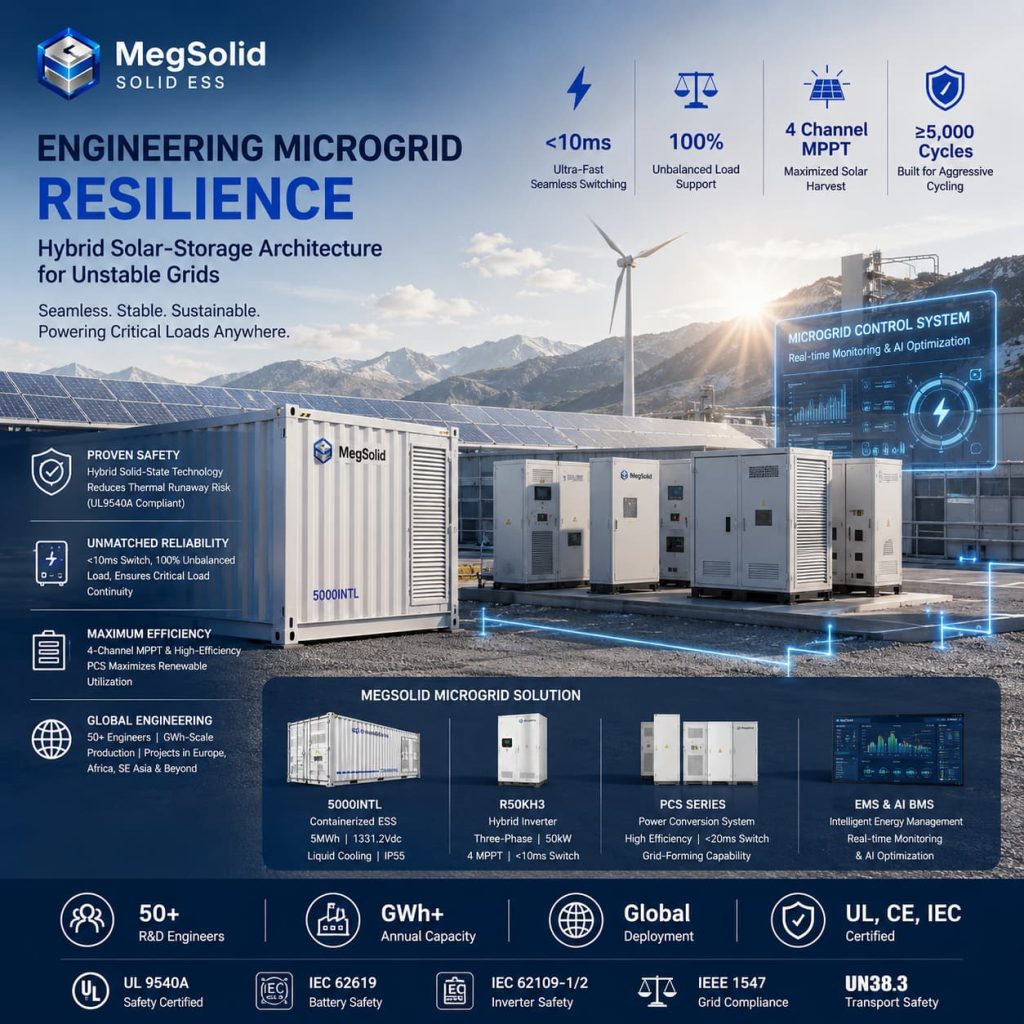
The Engineering Challenge: Unstable Grids vs. Sensitive Loads
When a grid experiences instability (e.g., voltage sags, frequency spikes, or complete blackouts), a standard grid-tied inverter must disconnect per anti-islanding protection protocols. This leaves critical industrial loads without power, even if local PV generation is available.
A true microgrid must seamlessly transition from grid-following mode to grid-forming mode. This requires:
- Ultra-Fast Switching: The transition must be faster than the ride-through capability of critical loads (e.g., PLCs, servers, motors).
- 100% Unbalanced Load Handling: In off-grid mode, the microgrid must independently manage phase imbalances without tripping.
- Deep Cycle Resilience: In unstable grid regions, the BESS may cycle multiple times per day, requiring chemistry that resists degradation.
Seamless Transition: The <10ms Switching Imperative
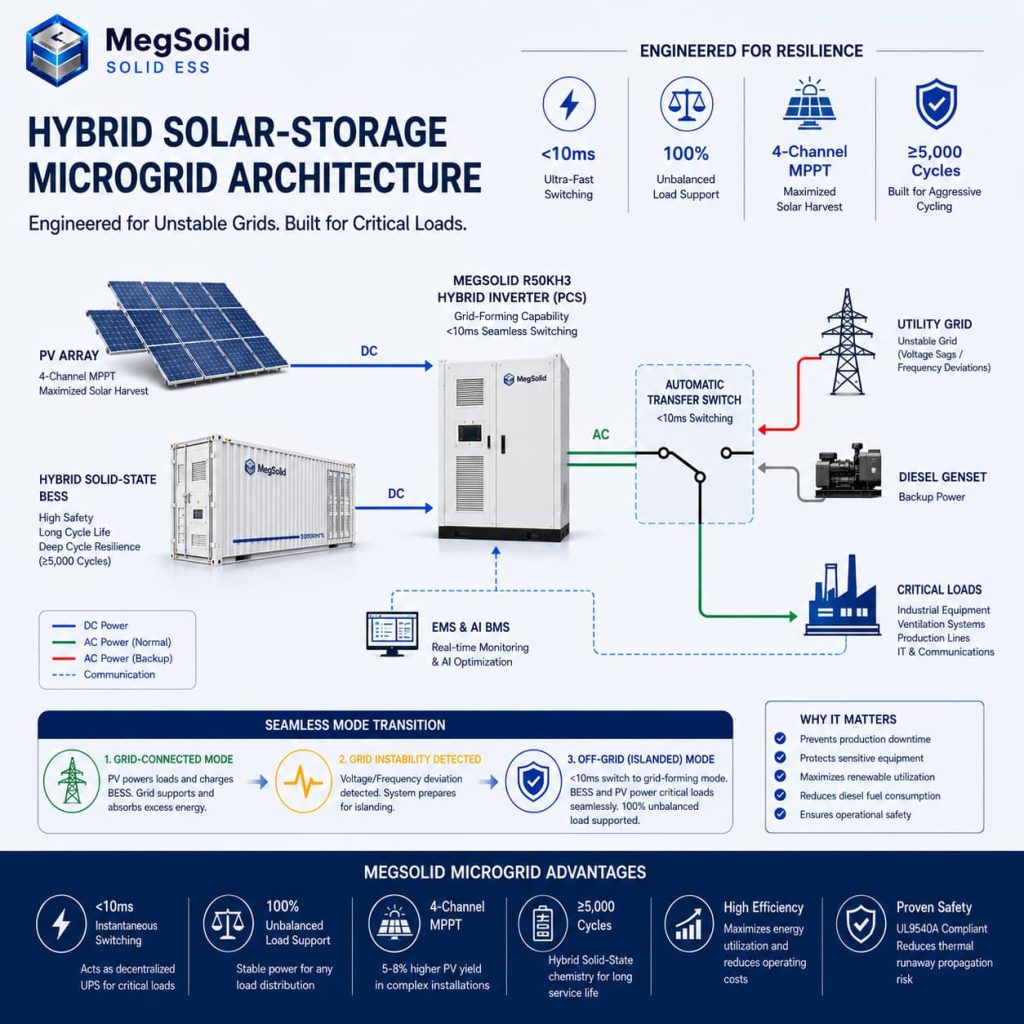
MegSolid’s microgrid architecture utilizes the Three-Phase Hybrid Inverter (R50KH3 series) and dedicated Power Conversion Systems (PCS) designed specifically for off-grid AC coupling.
Engineering Explanation
For industrial loads, the duration of a power interruption determines whether processes crash. MegSolid engineers the system with a back-up switch time of <10ms (or <20ms for larger PCS units).
- Why <10ms? Industrial Programmable Logic Controllers (PLCs) and uninterruptible power supplies (UPS) typically have a ride-through capability of 10-20ms. By switching in under 10ms, the MegSolid microgrid acts as a decentralized UPS. The internal voltage source of the grid-forming inverter synchronizes with the phase angle of the grid milliseconds before the transfer, ensuring zero phase jump and preventing inrush currents that could damage transformers.
Field Experience: 2025 Remote Mining Facility Case Study
During a 2025 microgrid deployment at a remote mining facility in Western Australia, the local grid experienced daily voltage sags of up to 15% during peak hours. Our engineering team configured the MegSolid R50KH3 inverter to operate in voltage support mode. When grid voltage dropped below 0.85 p.u., the system instantly transitioned to off-grid mode, powering the 40kW critical ventilation loads via a 200kWh solid-state battery. The <10ms switch prevented the ventilation systems from cycling off, avoiding potential hazardous gas buildup in the mine shafts.
Handling 100% Unbalanced Loads in Off-Grid Mode
In grid-connected mode, the utility absorbs phase imbalances. In off-grid mode, the inverter must independently bear the asymmetrical load. If an inverter lacks topological support for unbalanced loads, a heavy single-phase load (e.g., a large motor on Phase A) will cause the inverter to trip on overcurrent, collapsing the entire microgrid.
Topological Solution
The MegSolid R50KH3 series supports 100% unbalanced load output. This is achieved through independent phase control algorithms and a robust 3W+N+PE (Three-phase + Neutral + Protective Earth) configuration. The inverter dynamically reallocates current from lighter phases to heavier phases within milliseconds, ensuring stable voltage output (230/400V) across all three phases regardless of load distribution. This is critical for industrial sites where load distribution is rarely perfectly symmetrical.
Maximizing Renewable Utilization: 4-Channel MPPT
In remote microgrids, maximizing solar harvest is essential because the PV array is the primary energy source (with the grid or diesel genset as backup). The R50KH3 inverter features 4-channel Maximum Power Point Tracking (MPPT).
Why 4-Channel MPPT Matters
In industrial microgrids, PV panels are often installed across multiple roof planes or ground mounts with varying azimuths and tilt angles. A single MPPT tracker forces all panels to operate at the lowest common denominator (the weakest panel dictates the string's current).
By utilizing 4 independent MPPT channels, MegSolid allows each PV sub-array to operate at its own Maximum Power Point. Field data indicates that in complex industrial roof layouts with partial shading, 4-channel MPPT increases overall PV yield by 5-8% compared to single or dual MPPT inverters.
Engineering Comparison: Diesel Genset vs. MegSolid Hybrid Microgrid
For remote locations, the traditional baseline is the Diesel Genset. However, fuel logistics and emissions make microgrids the superior engineering and economic choice.
|
Engineering Feature |
Traditional Diesel Genset |
MegSolid Hybrid Microgrid (PV + Solid-State ESS) |
|---|---|---|
| Response Time | 10-30 seconds (mechanical spin-up) | <10ms (Instantaneous electronic switch) |
| Load Following | Poor (Inefficient at <30% load) | Excellent (100% unbalanced load support) |
| Fuel Dependency | 100% reliant on logistics | 0% (PV + Battery primary) |
| Maintenance | High (Oil, filters, mechanical wear) | Low (Solid-state architecture, AI BMS) |
| Emissions | High CO2/NOx | Zero operational emissions |
| Grid Support | None (Cannot absorb grid sags) | Voltage support & frequency regulation |
Hybrid Solid-State Chemistry: Built for Aggressive Cycling
In unstable grid environments, the BESS is not just for peak shaving ROI; it is the primary buffer against grid failures. This means the battery may cycle deeply 2-3 times per day. Traditional liquid LFP batteries degrade rapidly under such aggressive duty cycles.
MegSolid’s Hybrid Solid-State LFP technology stabilizes the lithium-ion transport interface, reducing solid electrolyte interphase (SEI) layer growth. Validated through internal laboratory accelerated aging tests (25°C, 0.5C charge/discharge, 80% DOD based on IEC62619 methodologies), the system achieves ≥5,000 cycles. Furthermore, the solid electrolyte matrix significantly reduces the probability of thermal runaway propagation compared to conventional liquid electrolytes, a critical safety factor for enclosed microgrid containers. (For foundational knowledge on cell-level safety, refer to our BESS thermal runaway prevention guide).
MegSolid Authority & Turnkey Scalability
MegSolid is a world-class integrated energy storage technology enterprise with a dedicated team of 50+ battery and PCS engineers. Our advanced R&D and manufacturing facility in Huzhou, China, is capable of delivering GWh-scale annual production. We provide comprehensive OEM/ODM manufacturing for custom microgrid containerized ESS design, tailored to regional grid codes and compliance standards.
References & Industry Standards
MegSolid's microgrid engineering design and testing protocols align with the following international standards:
- IEEE 1547: Standard for Interconnection and Interoperability of Distributed Energy Resources with Associated Electric Power Systems Interfaces.
- IEC 62109-1/2: Safety of power converters for use in photovoltaic power systems.
- IEC 62894: Photovoltaic inverters - Data sheet and name plate.
- UL 9540A: Standard for Safety of Energy Storage Systems and Equipment (Thermal Runaway Test Methodology).
- IEC 62619: Safety requirements for secondary lithium cells and batteries in industrial applications.
FAQ
Q1: Why is a <10ms switch time critical for microgrid applications?
Industrial PLCs and UPS systems typically have a ride-through capability of 10-20ms. A switch time of <10ms ensures that critical industrial loads do not detect the grid outage, preventing process crashes and equipment damage.
Q2: How does the MegSolid inverter handle 100% unbalanced loads in off-grid mode?
The R50KH3 series utilizes independent phase control algorithms and a robust 3W+N+PE configuration. It dynamically reallocates current across phases, ensuring stable voltage output even if one phase is heavily loaded while others are idle.
Q3: What is the advantage of 4-channel MPPT in a microgrid?
4-channel MPPT allows PV arrays installed at different angles or with partial shading to operate at their individual Maximum Power Points. This prevents the weakest panel from dictating the string's current, increasing overall PV yield by 5-8% in complex layouts.
Q4: Can the microgrid system support voltage sags without fully disconnecting?
Yes. The system can be configured in voltage support mode. During minor grid voltage sags, the inverter injects reactive power to stabilize the grid. For severe sags, it transitions to off-grid mode in <10ms to protect critical loads.
Q5: How does Hybrid Solid-State chemistry improve microgrid battery life?
In unstable grids, the battery cycles aggressively. MegSolid's solid electrolyte matrix stabilizes the lithium-ion transport interface, reducing SEI layer growth. This enables the system to achieve ≥5,000 cycles (validated via IEC62619 methodologies) even under heavy daily cycling.
Q6: Does the system support AC coupling for existing solar installations?
Yes. MegSolid PCS and hybrid inverters support on-grid and off-grid AC coupling, allowing seamless integration with existing PV arrays without requiring DC rewiring.
Q7: What is the rated AC power of the R50KH3 Three-Phase Hybrid Inverter?
The R50KH3 model has a rated AC output power of 50 kW, with a maximum charge/discharge power of 55 kW and a maximum PV input power of 75 kW.
Q8: How does the microgrid system mitigate thermal runaway risk?
The system is designed according to UL9540A evaluation methodology. The proprietary Hybrid Solid-State LFP cells utilize a stable solid electrolyte matrix, which significantly reduces the probability of thermal runaway propagation compared to conventional liquid electrolytes.
Q9: What communication protocols are supported for microgrid EMS integration?
MegSolid ESS supports standard RS485, RS232, and CAN protocols, allowing seamless integration with third-party Energy Management Systems (EMS) for automated load shifting and grid-forming triggers.
Q10: Does MegSolid provide OEM/ODM customization for microgrid projects?
Yes. We offer comprehensive OEM/ODM manufacturing, including custom container layout, PCS integration, and microgrid control algorithm tuning, tailored to specific project requirements.
Get Your Custom Microgrid Engineering Consultation
For technical consultation, microgrid system selection, OEM/ODM cooperation, and distributor opportunities, contact our engineering team:
Global Sales & HQ (Hong Kong):
FLAT 7, 11/F BLK C HANG WAI IND CTR, 6 KIN TAI ST, TUEN MUN, HONG KONG
- Email: [email protected]
- Phone: +852 59811073
R&D & Manufacturing Facility (Huzhou):
No. 898 Mengxi Road, South Taihu New Area, Huzhou City, Zhejiang Province, P.R.China
- Website: https://www.solidess.com/
