 Skip to content
Commercial and industrial (C&I) energy storage projects in Africa face some of the most challenging operating conditions in the global energy market. Ambient temperatures in regions such as South Africa, Nigeria, Kenya, and desert mining zones frequently exceed 45°C, while internal battery container temperatures can rise beyond 55°C under continuous charge and discharge cycles.
Traditional lithium-ion energy storage systems (especially standard LFP-based architectures) suffer significant performance degradation under these conditions, including accelerated electrolyte breakdown, reduced cycle life, and increased reliance on HVAC cooling systems. These factors directly increase operational expenditure (OPEX) and reduce system return on investment (ROI).
To solve these challenges, MegSolid has developed a Hybrid Solid-State Energy Storage System architecture designed specifically for high-temperature, high-duty-cycle industrial environments.
This article analyzes the engineering principles, verified technical data, and real-world deployment advantages of MegSolid systems in African C&I energy storage applications.
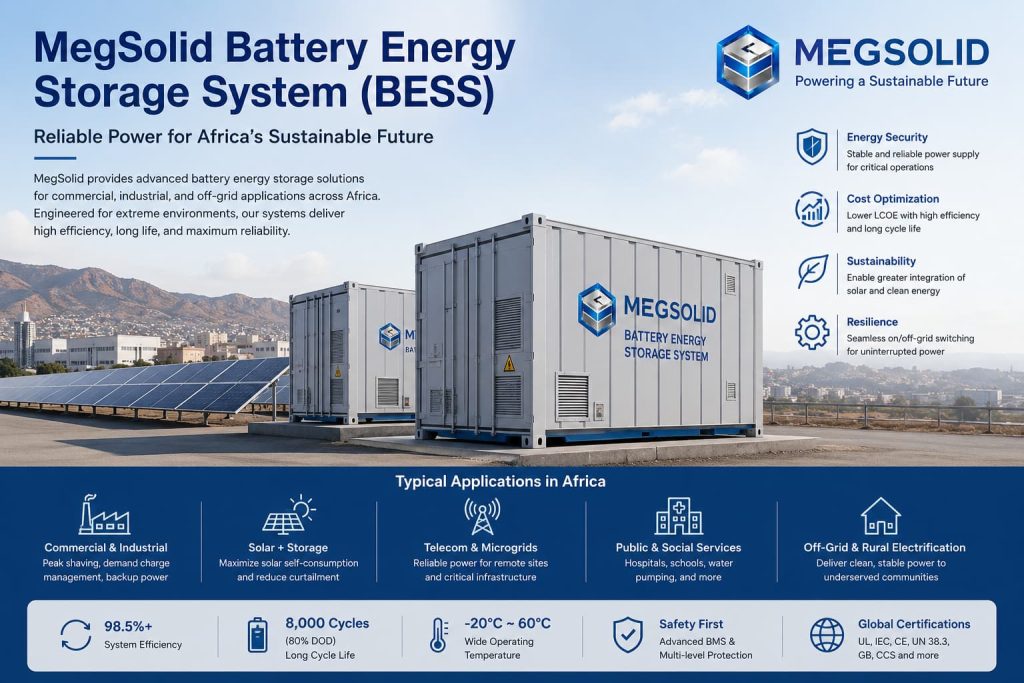
Energy Storage Challenges in Africa’s High-Temperature Environment
Africa’s C&I energy infrastructure presents three major engineering challenges:
1. Extreme Ambient Temperature Stress
- Outdoor temperature: 40–50°C
- Container internal temperature: 55–60°C
- Continuous thermal cycling increases material fatigue
2. Electrochemical Degradation in Traditional LFP Systems
Conventional liquid electrolyte lithium-ion batteries suffer from:
- SEI layer instability at high temperature
- Electrolyte decomposition
- Gas generation and internal pressure increase
3. High HVAC Energy Consumption
Traditional systems rely heavily on cooling systems that can consume:
- 8%–12% of total system energy output
This significantly reduces:
- Net system efficiency
- Economic viability in off-grid or weak-grid regions
Energy Storage Challenges in Africa’s High-Temperature Environment
MegSolid’s core innovation is its Hybrid Solid-State LFP architecture, which integrates:
- Semi-solid electrolyte system
- Inorganic solid electrolyte network
- Reduced volatile liquid electrolyte content
According to internal engineering design, this structure provides:
1. Enhanced Thermal Stability
- Suppresses thermal propagation between cells
- Reduces gas generation under stress conditions
- Maintains structural stability under high-temperature operation
2. Dendrite Suppression Mechanism
- Solid electrolyte matrix blocks lithium dendrite penetration
- Improves cycle stability under high C-rate operation
3. Structural Safety Reinforcement
- Eliminates primary causes of thermal runaway chain reactions
- Enhances mechanical resistance under vibration and impact conditions
Verified Company Capability and Manufacturing Authority
MegSolid is a global manufacturer specializing in:
- Hybrid Solid-State Battery Systems
- C&I Energy Storage Systems (ESS)
- Energy Storage Invertersrter (PCS)
- OEM/ODM energy storage solutions
Manufacturing Strength
MegSolid operates a fully automated production facility in Huzhou, China, featuring:
- Closed-loop automated battery production lines
- X-ray and ultrasonic inspection systems
- Real-time quality monitoring of electrode coating and stacking accuracy
This ensures consistent manufacturing quality for large-scale C&I deployments.
Verified Product Portfolio
All product specifications below are sourced from MegSolid’s official technical database.
1. Hybrid Solid-State C&I Energy Storage System (Flagship Model)
- Rated Energy: 261.24 kWh
- Battery Configuration: 1P260S (314Ah Hybrid Solid-State LFP)
- DC Voltage Range: 676–936 Vdc
- Rated AC Power: 125 kVA
- Maximum System Efficiency: 90%
- Thermal Control: AI-based liquid cooling system with ±5°C temperature balance
- Protection Level: IP54
This system is designed for:
- Industrial parks
- Airports
- Commercial backup power systems
- Mining operations
2. Containerized Energy Storage System (Utility Scale)
- Total Energy Capacity: 5015.9 kWh (≈5MWh class)
- Rated Voltage: 1331.2 Vdc
- Rated AC Output: 450 kW × 6 units
- Maximum Efficiency: 87.5%
- Protection Level: IP55
- Cooling System: Intelligent liquid cooling
This system is suitable for:
- Grid stabilization projects
- Renewable energy integration
- Utility-scale energy storage plants
3. Energy Storage Power Conversion System (PCS)
- DC Voltage Range: 250–850 V
- Rated Power Range: 30–500 kW
- Maximum Efficiency: up to 97.5%
- THDi: <3%
- Switching Time: <20 ms
The PCS ensures:
- High grid compatibility
- Stable power output quality
- Low harmonic distortion for industrial applications
4. High-Efficiency Energy Storage Inverter
- Maximum Efficiency: 98.7%
- DC Voltage Range: 615–950 V
- Backup Switching Time: <10 ms
- Compatible with hybrid solid-state and standard lithium battery systems
This inverter is optimized for:
- Critical infrastructure
- UPS systems
- High-reliability industrial loads
- Capacity: 16.07 kWh
- Nominal Voltage: 51.2 V
- Cycle Life: 8000 cycles @ 80% DOD
- Internal Impedance: ≤15 mΩ
- Certifications: UL, CE, UN38.3
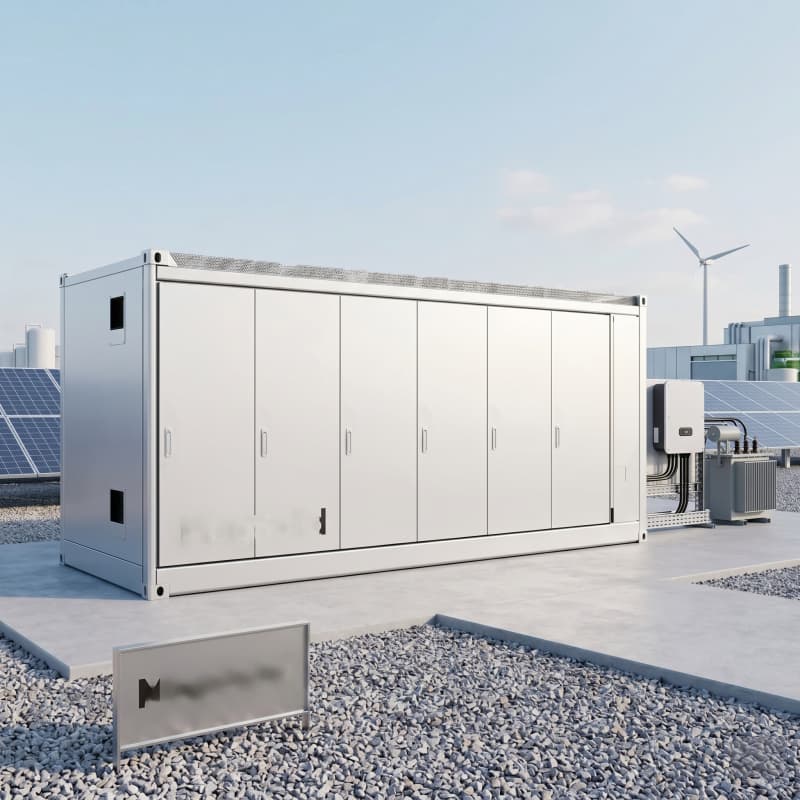
Africa Real-World Engineering Case Study (EPC Deployment)
In a real-world EPC deployment in Southern Africa, MegSolid systems were used in an airport UPS backup scenario.
System Configuration:
- 2 × 125 kVA hybrid solid-state ESS units
- Total output capacity: 250 kVA
- Critical load requirement: 180 kVA airport infrastructure
Engineering Design Advantages:
- 38% redundancy buffer for surge protection
- Stable handling of inductive loads (HVAC + radar systems)
- Zero downtime switching architecture
Energy Storage System:
- Total capacity: 522.48 kWh
- DC bus voltage: 832 Vdc nominal
Application Scope:
- Airport lighting systems
- Radar and navigation systems
- Security and control systems
- Emergency backup infrastructure
This demonstrates MegSolid’s capability in mission-critical infrastructure applications.
Why Hybrid Solid-State Performs Better in Africa
Compared with conventional lithium-ion systems, MegSolid provides:
1. Higher Thermal Stability
Hybrid solid-state architecture reduces electrolyte volatility and improves high-temperature resilience.
2. Longer Cycle Life
Up to 8000 cycles at 80% DOD depending on system configuration and operating conditions.
3. Lower Operating Cost
Reduced dependence on HVAC systems lowers:
- Energy consumption
- Maintenance cost
- Lifecycle replacement frequency
4. Higher System Efficiency
- PCS efficiency up to 97.5%
- Inverter efficiency up to 98.7%
Certifications and Compliance
MegSolid systems comply with international standards including:
- UL safety certification series
- IEC 62109 (power conversion safety)
- EN 61000 EMC standards
- UN38.3 transportation safety
- CE compliance for global deployment
These certifications ensure suitability for:
- Export markets
- EPC bidding projects
- Government infrastructure procurement
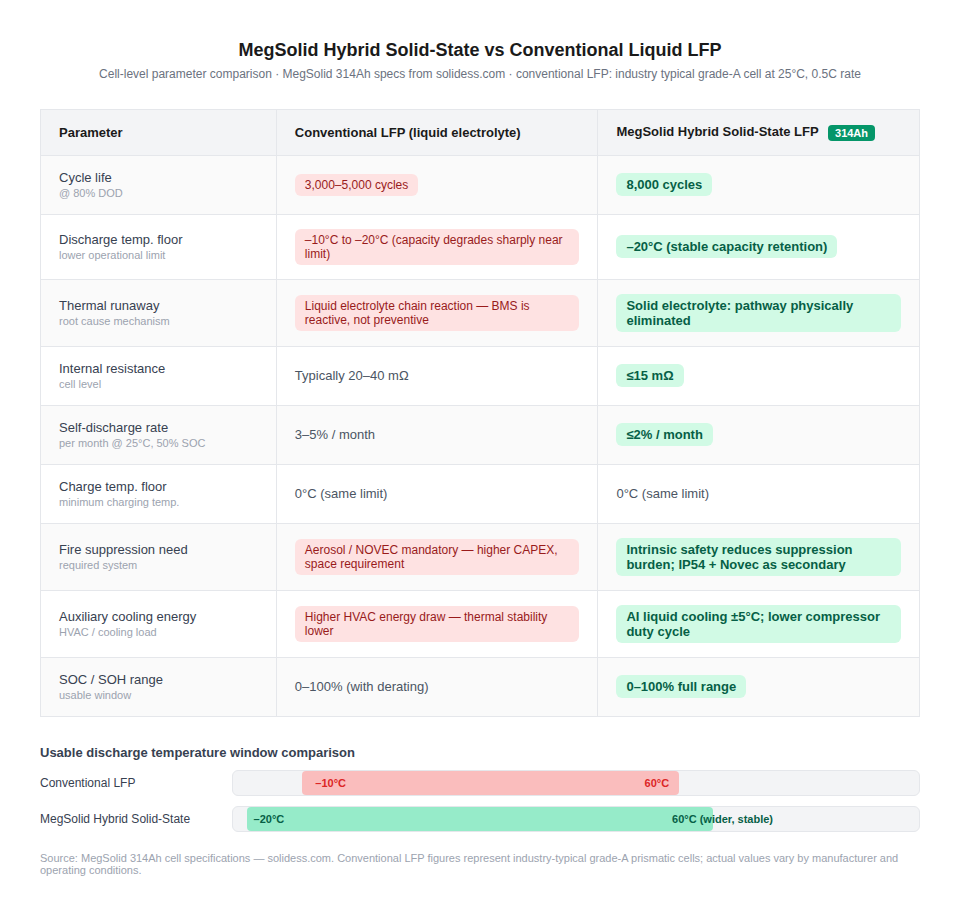
Technical Advantages Summary
MegSolid Hybrid Solid-State Energy Storage Systems provide:
- Advanced hybrid solid-state electrolyte design
- High-temperature operation stability (Africa-grade environment adaptation)
- AI-based thermal management (±5°C control accuracy)
- Modular scalable architecture (C&I to utility scale)
- High conversion efficiency PCS and inverter integration
- Reduced OPEX and improved ROI for EPC projects
Conclusion
Africa’s energy storage market requires systems that can operate reliably under extreme thermal, grid instability, and high-load industrial conditions.
MegSolid delivers a next-generation Hybrid Solid-State Energy Storage architecture that directly addresses these challenges through improved thermal stability, verified engineering parameters, and scalable system design.
With deployments ranging from C&I backup systems to utility-scale containerized ESS, MegSolid provides a technically validated solution for EPC contractors, industrial operators, and energy developers seeking long-term reliability in harsh environments.
FAQ
Q1: Why is hybrid solid-state energy storage better for Africa’s high-temperature environments?
Hybrid solid-state systems reduce electrolyte volatility and improve thermal stability, making them more suitable for continuous operation above 45°C compared to traditional LFP systems.
Q2: Can MegSolid systems operate in 50°C+ environments without performance loss?
Yes. MegSolid systems are engineered for high-temperature C&I environments with AI-controlled thermal management and stable performance under extreme ambient conditions.
Q3: What is the cycle life of MegSolid hybrid solid-state batteries?
Based on product data, MegSolid systems can reach up to 8000 cycles at 80% DOD, depending on application and operating conditions.
Q4: Do MegSolid energy storage systems require heavy HVAC cooling?
No. Hybrid solid-state architecture reduces thermal stress, significantly lowering HVAC energy consumption compared to traditional lithium-ion systems.
Q5: What makes MegSolid suitable for airport and critical infrastructure projects?
MegSolid systems provide:
<10ms backup switching (inverter)
High redundancy design
Stable UPS performance under inductive loads
Q6: What is the efficiency of MegSolid PCS systems?
MegSolid PCS systems achieve up to 97.5% efficiency with THDi <3%, ensuring stable grid integration for industrial applications.
Q7: Are MegSolid systems compatible with existing EPC energy storage projects?
Yes. MegSolid systems are designed for EPC integration, supporting modular scaling from C&I to utility-scale installations.
Q8: What safety advantages does hybrid solid-state technology provide?
It reduces thermal runaway risk by suppressing dendrite formation and limiting electrolyte volatility, improving system safety under abuse conditions.
Q9: What is the capacity range of MegSolid commercial systems?
MegSolid offers systems ranging from:
55 kWh cabinet systems
261 kWh hybrid ESS
5 MWh containerized systems
Q10: Is MegSolid suitable for mining and off-grid industrial projects in Africa?
Yes. The system is designed for high-load, unstable-grid environments such as mining, telecom, and remote industrial sites.
Q11: Is MegSolid energy storage suitable for South Africa load shedding conditions?
Yes. MegSolid systems are designed for unstable grid environments and provide UPS-level backup for critical infrastructure during load shedding events.
Q12: Can MegSolid ESS be used in Nigeria’s high-temperature industrial zones?
Yes. The system is optimized for 40–50°C environments common in Nigeria’s industrial and commercial sectors.
Q13: Why is hybrid solid-state energy storage ideal for mining projects in Africa?
Mining operations require continuous high-load power. MegSolid systems provide high cycle life, thermal stability, and reduced maintenance cost in remote mining environments.
