 Skip to content
Energy storage supplier qualification should be completed before an RFQ is issued. The review should confirm who manufactures and integrates the system, which engineering documents are available, how compliance is demonstrated, whether factory testing can be witnessed, and who will support commissioning and warranty work.
BESS supplier due diligence then checks the evidence behind supplier capability: production and integration responsibilities, model-specific quality and compliance records, witnessed FAT arrangements, delivery milestones, commissioning support and warranty responsibilities. Price and battery capacity alone do not establish that capability.
MegSolid's hybrid solid-state battery systems, outdoor ESS cabinets, containerized BESS and PCS equipment provide identified product routes for review. For example, the ESSA0100B-0215 cabinet publishes 100kW AC power and 215.04kWh capacity. Use that model as the starting point, then request its offered configuration, engineering drawings, applicable reports, FAT records and agreed shipment and support responsibilities.
Supplier Prequalification: Set the RFQ Entry Requirements
Many procurement teams begin supplier evaluation by comparing battery capacity, cycle life, warranty period, or price per kilowatt-hour.
While these parameters are important, they represent only a small portion of overall project risk.
Commercial ESS failures are frequently caused by factors that are invisible during the quotation stage.
These include:
- Insufficient manufacturing capability
- Incomplete engineering documentation
- Unverified compliance reports
- Weak system integration capability
- Poor project delivery management
- Limited post-commissioning technical support
A supplier offering a lower initial quotation may ultimately create higher lifecycle costs if factory testing, grid integration, or warranty support cannot meet project requirements.
From an EPC perspective, supplier qualification is therefore an engineering process rather than a purchasing exercise.
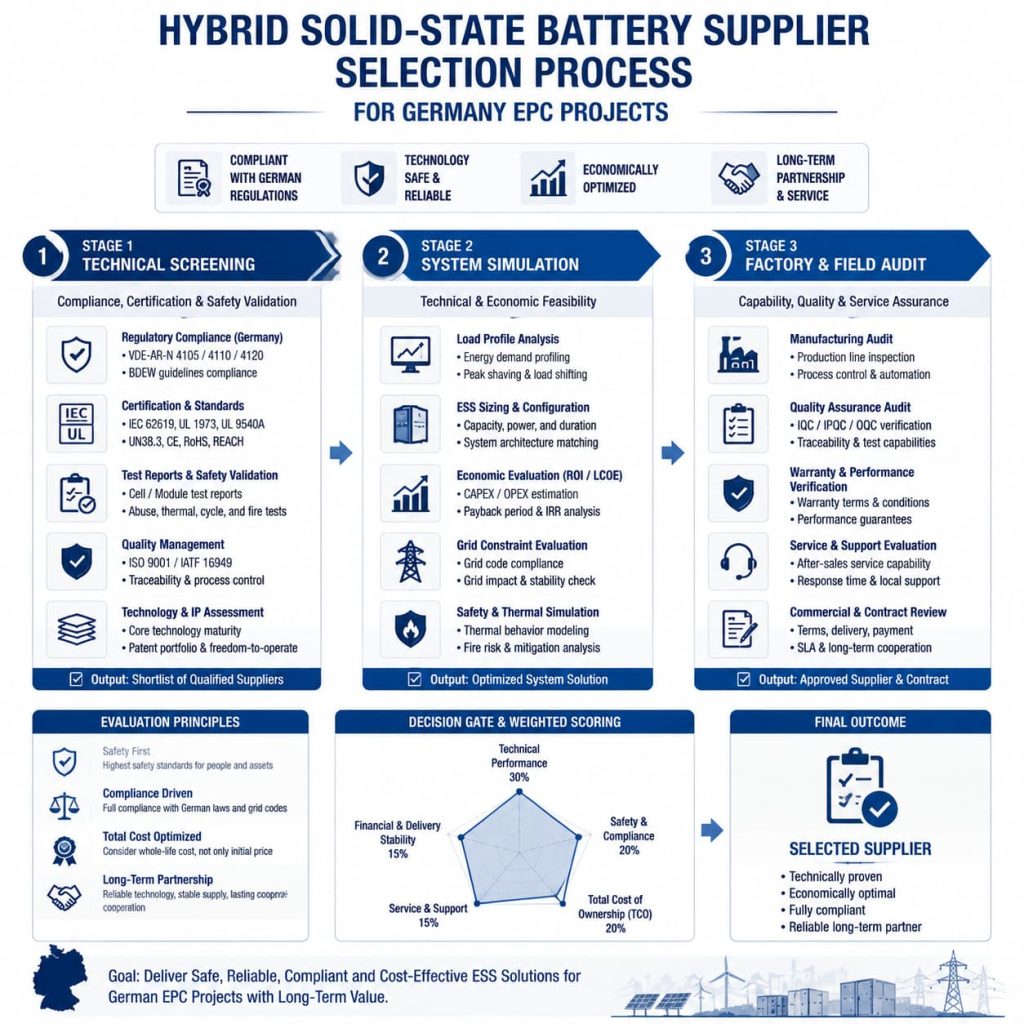
The Five Engineering Areas Every Commercial ESS Supplier Should Demonstrate
Instead of comparing brochures, buyers should evaluate suppliers across five engineering dimensions.
|
Engineering Area |
What Buyers Should Verify |
Procurement Risk if Missing |
|---|---|---|
| Manufacturing Capability | Factory ownership, production capacity, quality control | Delivery delays |
| Engineering Capability | ESS integration, PCS, EMS, BMS expertise | Commissioning failures |
| Compliance Capability | Certification and grid code documentation | Approval rejection |
| Documentation Capability | FAT, SAT, drawings, manuals | Project delays |
| Service Capability | Warranty, spare parts, technical support | Long-term operational risk |
Figure 1. Five engineering dimensions that determine supplier qualification.
Notice that battery chemistry itself occupies only one part of the evaluation process.
For commercial projects, documentation quality and engineering execution frequently have greater impact on project success than nominal battery specifications.
Why Some Commercial ESS Suppliers Fail Before Production Even Begins
Many suppliers advertise themselves as manufacturers.
However, buyers should distinguish between:
- Factory owners
- Assembly contractors
- Trading companies
- OEM coordinators
These business models have significantly different engineering capabilities.
Instead of asking whether a supplier owns a factory, procurement teams should verify whether the manufacturer controls critical production processes.
Typical verification points include:
- Battery module assembly
- Pack integration
- ESS cabinet integration
- Electrical testing
- Functional testing
- Factory Acceptance Testing (FAT)
- Traceability management
A qualified manufacturer should also demonstrate documented production quality systems rather than relying solely on marketing materials.
MegSolid's commercial energy storage portfolio includes integrated outdoor cabinet ESS, containerized systems, PCS equipment, and OEM manufacturing services, allowing engineering, manufacturing, and system integration to remain within the same product ecosystem rather than being sourced from multiple independent suppliers.
Engineering Documentation Should Be Reviewed Before Pricing
One of the most common procurement mistakes is requesting quotations before reviewing technical documentation.
Pricing cannot be evaluated accurately unless suppliers provide sufficient engineering evidence.
A complete commercial ESS supplier should normally provide documentation such as:
- Single Line Diagram (SLD)
- General Arrangement Drawing (GA)
- Battery System Architecture
- PCS Technical Datasheet
- EMS Functional Description
- Communication Protocol List
- Protection Logic
- Factory Acceptance Test Procedure
- Site Acceptance Test Procedure
- Operation & Maintenance Manual
- Warranty Scope Definition
The absence of these documents during supplier qualification often indicates that engineering resources may be outsourced or unavailable during project execution.
Procurement Tool: Supplier Qualification Review Matrix
Before inviting suppliers into the RFQ process, procurement teams can use the following engineering review matrix.
| Qualification item | Evidence to request | Rating | Reviewer notes |
|---|---|---|---|
| Factory and production capability | Factory ownership records, process flow and capacity data | 0 / 1 / 2 | |
| ESS integration capability | System architecture and integration responsibility matrix | 0 / 1 / 2 | |
| PCS and EMS capability | Datasheets, control description and communication documents | 0 / 1 / 2 | |
| Compliance readiness | Certificates, test reports and target-market requirements | 0 / 1 / 2 | |
| FAT capability | FAT procedure, test equipment and witness arrangements | 0 / 1 / 2 | |
| Warranty scope | Written coverage, exclusions and response responsibilities | 0 / 1 / 2 | |
| Spare-parts support | Recommended spare-parts list and availability | 0 / 1 / 2 | |
| Commissioning support | On-site and remote support procedure | 0 / 1 / 2 |
Use 0 for no evidence, 1 for partial evidence and 2 for complete, project-specific evidence. A high score does not replace engineering review, but it helps procurement teams compare suppliers on the same basis.
This matrix enables buyers to compare suppliers using objective engineering evidence instead of marketing claims.
Quality and Compliance Evidence: Match Records to the Offered System
Many suppliers highlight certification logos on brochures, but certification alone does not prove that a commercial ESS is suitable for a specific project.
For quality evidence, request serial or batch inspection records and model-specific FAT results. For compliance, match each report to the offered model, configuration and destination. A brochure, certificate number or blank test procedure does not establish that the supplied system passed the required checks.
Typical documents include:
- Product test reports
- Grid compliance reports
- Factory inspection records
- Battery transport documentation
- Fire protection specifications
- Component traceability records
For projects deployed in different regions, buyers should also confirm that the supplied system aligns with local regulatory and grid requirements instead of assuming that one certification package is universally applicable.
Questions Every EPC Should Ask During Factory Qualification
Before a supplier is invited into the RFQ stage, engineering and procurement teams should conduct a structured qualification review.
Instead of asking general questions such as "Do you own a factory?", ask questions that reveal engineering capability.
|
Qualification Question |
Why It Matters |
|---|---|
| Who integrates the complete ESS? | Confirms system integration capability |
| Can factory acceptance testing be witnessed? | Verifies quality management process |
| Are battery batches fully traceable? | Supports warranty and serviceability |
| Is the PCS developed in-house or integrated from third parties? | Determines system compatibility |
| What engineering documents are delivered before shipment? | Reduces commissioning uncertainty |
| How are firmware revisions managed? | Ensures lifecycle consistency |
The objective is not to identify the cheapest supplier, but to identify the supplier with the lowest engineering risk.
Procurement Risk Matrix
The table below illustrates how missing engineering capability can translate directly into project risk.
|
Missing Capability |
Typical Consequence |
Business Impact |
|---|---|---|
| Factory traceability | Warranty disputes | Higher lifecycle cost |
| FAT procedure | Undetected manufacturing defects | Delayed commissioning |
| Complete engineering documentation | Site redesign | Additional engineering hours |
| PCS integration capability | Grid compliance failure | Utility approval delays |
| Spare parts strategy | Extended system downtime | Reduced project availability |
| Technical response process | Slow troubleshooting | Customer dissatisfaction |
Figure 2. Procurement risks caused by incomplete supplier qualification.
Common Red Flags During Supplier Evaluation
Several warning signs appear repeatedly in commercial ESS procurement projects.
Buyers should proceed with caution when a supplier:
- Provides only marketing brochures but no engineering documentation.
- Cannot explain how battery modules, PCS, and EMS are integrated into a complete system.
- Refuses factory visits or witnessed FAT.
- Offers unusually short lead times without explaining manufacturing capacity.
- Provides warranty terms without defining exclusions or service responsibilities.
- Cannot identify who is responsible for commissioning support.
These indicators do not automatically disqualify a supplier, but they should trigger a deeper technical review before commercial negotiations continue.
Engineering Capability Should Be Verified Throughout the Procurement Process
Supplier qualification should not end once a quotation has been received.
Engineering verification continues throughout the project lifecycle, including:
- Technical clarification
- Design review
- Factory acceptance testing
- Shipping inspection
- Site acceptance testing
- Commissioning support
- Warranty service
Manufacturers capable of supporting each stage with documented engineering processes generally reduce project uncertainty compared with suppliers that focus only on equipment delivery.
Within this context, MegSolid provides integrated commercial ESS platforms, OEM/ODM manufacturing services, engineering documentation, and product families covering outdoor cabinet systems, containerized ESS, PCS equipment, and hybrid solid-state battery solutions, enabling EPC contractors to evaluate a consistent technology portfolio throughout supplier qualification.
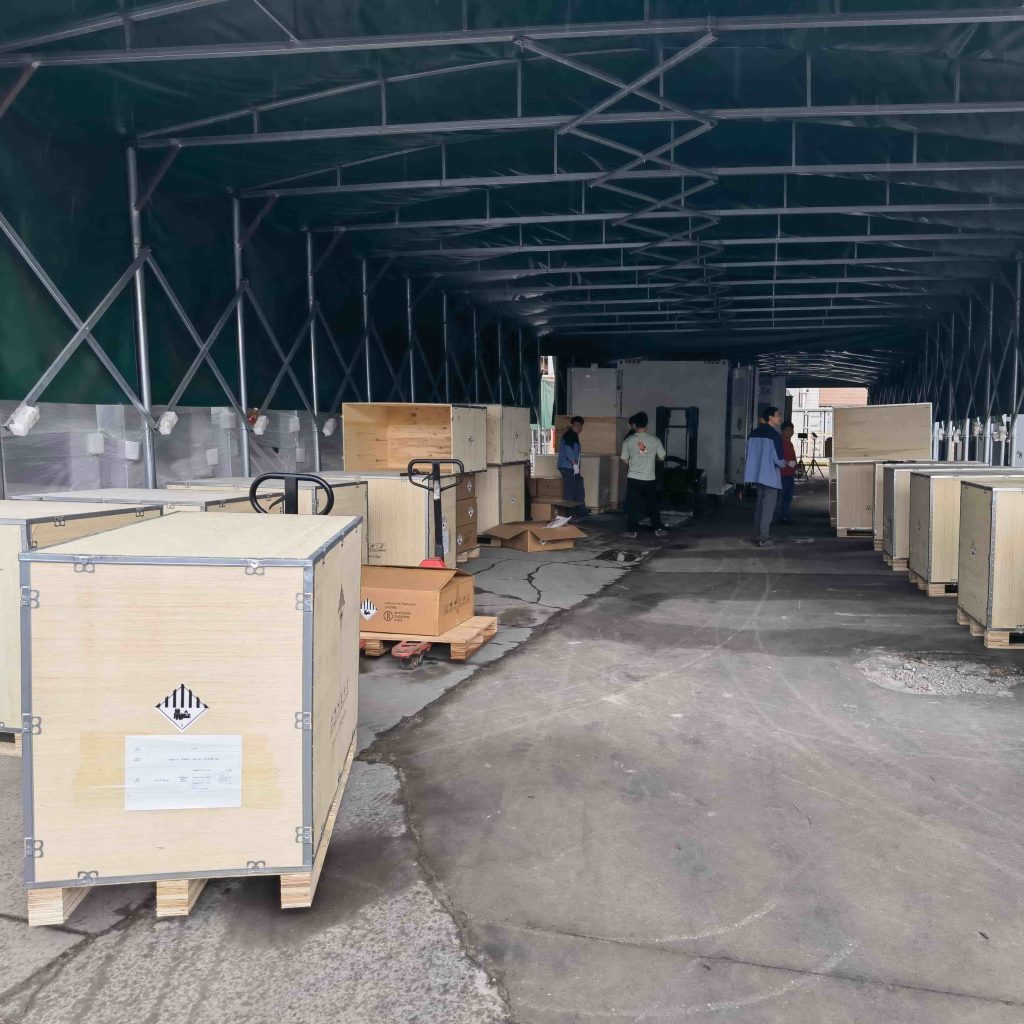
Summary
Selecting a commercial battery energy storage supplier is ultimately an engineering qualification process rather than a purchasing exercise.
Manufacturing capability, engineering documentation, compliance readiness, quality management, and delivery execution all have a greater influence on project success than comparing battery capacity or quotation alone.
By establishing a structured supplier qualification process before issuing an RFQ, EPC contractors and industrial project developers can reduce procurement uncertainty, improve commissioning efficiency, and lower long-term operational risk.
Manufacturers that openly provide engineering evidence, documented production processes, and project-specific technical information allow buyers to make decisions based on verifiable capability instead of marketing claims. MegSolid supports this evaluation process by providing documented manufacturing information and technical resources aligned with its commercial ESS product portfolio and OEM manufacturing capabilities.
FAQ
Q1: How can buyers verify whether a commercial ESS supplier is a real manufacturer instead of a trading company?
Before issuing an RFQ, buyers should evaluate manufacturing capability rather than relying on marketing claims. Request factory audit reports, production workflow documentation, quality management procedures, Factory Acceptance Test (FAT) protocols, and traceability information. A qualified manufacturer should be able to explain how battery modules, PCS, EMS, and complete ESS cabinets are integrated into a unified production process. MegSolid manufactures commercial ESS products including outdoor cabinet systems, containerized ESS, PCS equipment, and OEM/ODM solutions as part of an integrated product portfolio.
Q2: Should EPC contractors witness Factory Acceptance Testing (FAT)?
Yes.
For commercial energy storage projects, witnessed FAT significantly reduces project risk before shipment.
A complete FAT should verify:
Battery charging and discharging
performance
PCS operation
BMS protection logic
EMS communication
Alarm functions
Emergency shutdown
Thermal management
System communication
Projects that skip FAT often discover issues only after equipment arrives on site, increasing commissioning costs and delaying project schedules.
Q3: What engineering documents should buyers request before signing a commercial ESS contract?
Engineering documentation provides objective evidence of supplier capability before procurement decisions are finalized.
A complete documentation package should include:
General Arrangement Drawing (GA)
Single Line Diagram (SLD)
Battery Technical Datasheet
PCS Technical Datasheet
EMS Functional Description
Factory Acceptance Test Procedure
Site Acceptance Test Procedure
Communication Protocol List
Warranty Scope
Recommended Spare Parts List
Reviewing these documents before contract award helps engineering teams identify compatibility issues and reduce project risk.
Q4: How should buyers compare two commercial ESS suppliers offering similar battery capacities?
Battery capacity alone is not a reliable evaluation criterion.
Instead, compare:
Manufacturing capability
Engineering integration capability
Compliance documentation
Factory testing procedures
Project delivery capability
Technical support resources
Warranty coverage
Spare parts strategy
Two suppliers offering the same rated capacity may deliver very different levels of engineering quality, commissioning efficiency, and long-term lifecycle support.
Q5: Why is engineering documentation more important than marketing brochures?
Marketing brochures describe products.
Engineering documentation demonstrates how those products will perform in real projects.
Engineering teams should prioritize:
Electrical drawings
Protection logic
Communication architecture
PCS specifications
Battery parameters
FAT procedures
Commissioning documentation
These documents provide measurable engineering evidence that supports technical review before procurement decisions are made.
Q6: What PCS specifications should buyers evaluate during supplier qualification?
The Power Conversion System directly influences grid compatibility and overall system performance.
Buyers should review:
Rated output power
DC voltage range
Maximum conversion efficiency
Grid compatibility
Protection functions
Communication interfaces
Maintenance accessibility
MegSolid provides commercial PCS solutions covering multiple power classes with maximum efficiencies up to 97.5%, depending on the selected model.
Q7: Why is battery traceability important for commercial ESS projects?
Battery traceability is essential for warranty management and lifecycle support.
A complete traceability system should identify:
Battery batch numbers
Production dates
Component records
Manufacturing history
Quality inspection records
Maintenance history
Comprehensive traceability enables manufacturers to investigate failures more efficiently and provide more effective long-term technical support.
Q8: Should buyers evaluate system integration capability separately from battery manufacturing?
Yes.
Commercial battery energy storage systems are integrated electrical systems rather than standalone battery products.
Procurement teams should verify integration capability for:
Battery systems
PCS
EMS
BMS
Thermal management
Fire protection
Communication systems
Successful integration significantly improves commissioning efficiency, operational stability, and long-term system reliability.
Q9: How can buyers determine whether a supplier is capable of supporting international EPC projects?
International project capability should be verified through documented engineering resources rather than general export claims.
Buyers should request:
English engineering documentation
International certification packages
Factory testing procedures
Project delivery workflow
Remote technical support procedures
Warranty response documentation
These materials provide stronger evidence of global project capability than marketing presentations alone.
Q10: Why should supplier qualification be completed before issuing an RFQ?
Supplier qualification reduces procurement uncertainty before commercial negotiations begin.
A structured qualification process should verify:
Manufacturing capability
Engineering competence
Compliance readiness
Documentation quality
Factory testing capability
Project delivery process
After-sales support
Completing supplier qualification before issuing an RFQ allows procurement teams to compare only technically qualified manufacturers, improving project efficiency and reducing engineering risk.
Q11: How do EPC contractors qualify a commercial battery energy storage supplier?
EPC contractors typically evaluate suppliers across manufacturing capability, engineering integration, compliance documentation, factory testing, delivery execution, and long-term technical support. Qualification should be completed before issuing an RFQ to reduce engineering and procurement risks.
Q12: What documents should be requested before purchasing a commercial battery energy storage system?
Typical documents include the Single Line Diagram (SLD), General Arrangement Drawing, battery datasheet, PCS datasheet, EMS functional description, Factory Acceptance Test procedure, Site Acceptance Test procedure, warranty documentation, communication protocol list, and recommended spare parts list. Reviewing these materials helps buyers validate technical capability before contract award.
Q13: What is the most important factor when selecting a commercial ESS supplier?
There is no single deciding factor. Successful procurement depends on evaluating manufacturing capability, engineering competence, compliance readiness, documentation quality, project delivery capability, and lifecycle support together rather than focusing only on battery specifications or initial purchase price.
