 Skip to content
For EPC contractors, project investors, and facility owners, interface degradation is not merely a technical discussion.
It is a financial discussion.
Every percentage point of performance loss directly impacts project revenue, operational efficiency, and return on investment.
Unfortunately, many energy storage procurement decisions still focus almost entirely on:
- Initial purchase price
- Battery capacity
- Power output
- Warranty period
While these metrics are important, they do not tell the complete story.
The true value of an energy storage asset is determined by how effectively it performs over its entire operating life.
The Hidden Cost of Interface Degradation
When interfacial resistance gradually increases, several economic consequences emerge:
Reduced Usable Capacity
A battery system may still appear operational while delivering less usable energy.
For example:
A 215kWh system that experiences significant degradation may no longer provide its original daily discharge capability.
This reduces:
- Peak shaving benefits
- Demand charge savings
- Solar self-consumption rates
- Backup power duration
The owner receives less value from the same asset.
Lower Round-Trip Efficiency
As interface resistance increases:
- More energy is converted into heat
- Charging losses increase
- Discharging efficiency decreases
Even a small efficiency reduction can become significant over thousands of operating cycles.
For commercial facilities running daily charge-discharge operations, cumulative energy losses can amount to tens of thousands of kilowatt-hours over the system lifetime.
Increased Thermal Management Costs
Higher resistance generates additional heat.
Additional heat requires:
- More cooling energy
- Longer HVAC operation
- Increased maintenance frequency
This creates a secondary operating cost that is often ignored during project planning.
Accelerated Aging
Heat and degradation reinforce each other.
As resistance increases:
- Heat generation rises
- Material stress increases
- Capacity loss accelerates
This feedback loop can shorten the economic life of an ESS.
Procurement Decision Framework:
7 Questions Every Buyer Should Ask Before Choosing a Solid-State Battery Supplier
After evaluating hundreds of commercial and industrial energy storage projects, I have found that the most successful buyers rarely choose a supplier based solely on price.
They evaluate risk.
More importantly, they evaluate whether a manufacturer can continue delivering value long after installation is completed.
When assessing a solid-state or hybrid solid-state battery supplier, I recommend asking the following seven questions.
Question 1:
Does the Manufacturer Produce Cells or Only Assemble Systems?
Many companies market themselves as battery manufacturers.
In reality, they only purchase cells from third-party suppliers and assemble them into cabinets.
This creates several challenges:
- Limited control over cell quality
- Reduced visibility into degradation mechanisms
- Slower technical response times
- Less flexibility for customization
A supplier with deeper cell-level expertise typically understands interface stability more thoroughly.
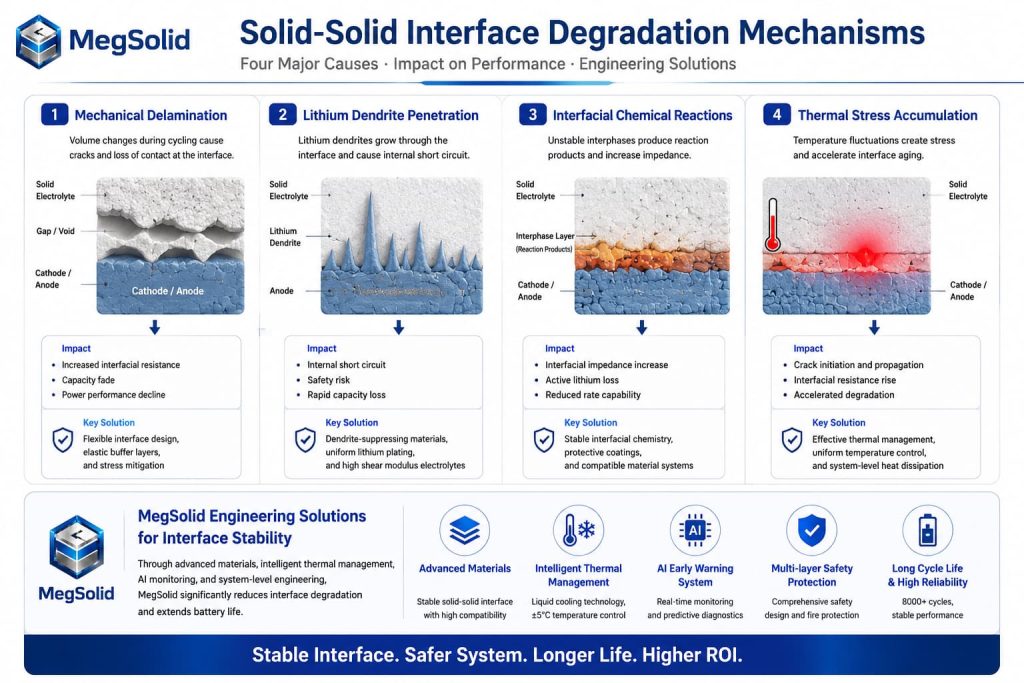
Because Solid-Solid Interface Degradation originates inside the cell itself, cell engineering knowledge matters.
Question 2:
How Does the Supplier Address Interface Degradation?
Most sales brochures discuss:
- Capacity
- Voltage
- Power
- Efficiency
Very few explain how degradation is controlled.
Ask directly:
"What engineering methods are used to reduce interfacial degradation?"
A serious manufacturer should be able to discuss:
- Thermal management
- Material compatibility
- Cell pressure management
- BMS strategies
- Monitoring systems
If the answer is vague, long-term reliability may be uncertain.
Question 3:
What Is the Real Cycle Life Under Commercial Operating Conditions?
Cycle life claims can be misleading when testing conditions are not disclosed.
Request information about:
- DOD conditions
- Operating temperature
- Capacity retention standards
- Charge/discharge rates
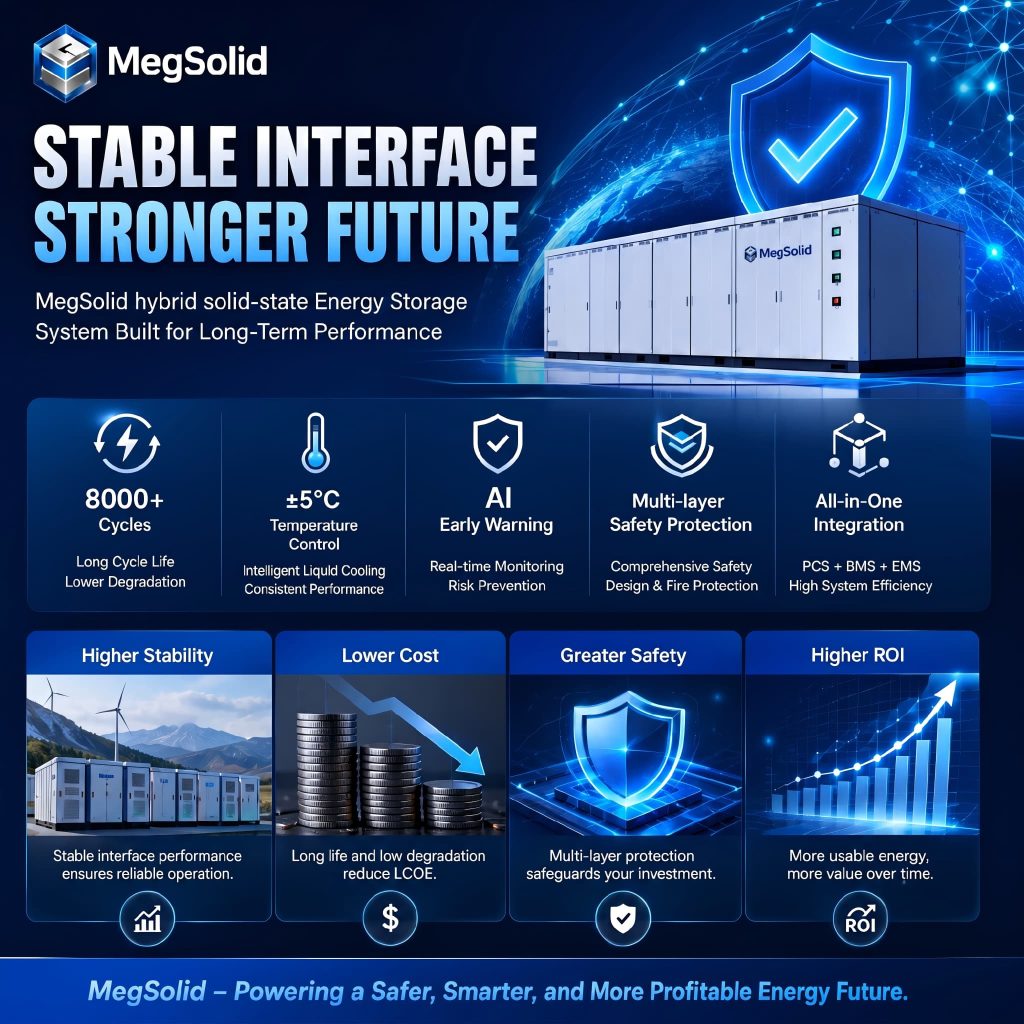
For example, MegSolid's 314Ah hybrid solid-state Battery is rated at 8,000 cycles under 80% DOD conditions, providing a realistic indicator for long-term energy storage operation.
The testing methodology is often more important than the headline number.
Question 4:
How Is Thermal Consistency Maintained?
Heat is one of the strongest drivers of battery aging.
Even small temperature differences can create:
- Uneven current distribution
- Accelerated degradation
- Increased interface stress
Ask suppliers:
- Is liquid cooling available?
- What temperature difference can be maintained?
- How is thermal balancing achieved?
MegSolid's Solid-Liquid ESS utilizes intelligent algorithms and liquid cooling to maintain temperature differences within ±5°C, helping improve long-term stability.
Question 5:
What Happens If Something Goes Wrong?
A battery system should be evaluated not only on normal operation but also on abnormal conditions.
Ask:
- Is there an AI warning system?
- What fault detection mechanisms exist?
- Is fire suppression integrated?
- What protections exist against thermal runaway?
MegSolid integrates AI early-warning functions, intelligent monitoring, and multi-layer fire protection architectures across commercial storage platforms.
Question 6:
Can the Supplier Support Future Expansion?
Many projects grow over time.
A battery supplier should be capable of supporting:
- Capacity expansion
- PCS expansion
- Additional battery clusters
- EMS upgrades
For example, MegSolid's Solid-Liquid Energy Storage platform supports parallel operation of up to 10 units, providing flexibility for future project growth.
A scalable architecture reduces future capital expenditure.
Question 7:
Will This Supplier Still Be a Partner Five Years From Now?
This is perhaps the most important question.
Energy storage is a long-term investment.
Buyers should evaluate:
- Technical support capability
- Manufacturing capacity
- OEM experience
- Global project experience
- Product roadmap
The lowest-cost supplier is not always the lowest-cost choice over the asset lifecycle.
A strong technology partner can significantly improve project ROI, reduce operational risks, and increase asset value.
Why More EPCs Are Choosing Engineering Transparency
The energy storage industry is entering a new phase.
Procurement decisions are no longer based solely on:
- Lowest price
- Highest capacity
- Largest marketing claims
Instead, professional buyers increasingly prioritize:
- Lifecycle economics
- Interface stability
- Thermal management
- Predictive maintenance
- Long-term support
This shift reflects a deeper understanding of what truly drives project profitability.
R&D Director's Recommendation
If you are evaluating solid-state or hybrid solid-state energy storage solutions today, focus less on laboratory records and more on engineering fundamentals.
Ask difficult questions.
Request technical explanations.
Examine how the manufacturer manages degradation, temperature, safety, and long-term performance.
The suppliers that can answer those questions with confidence are usually the ones capable of delivering sustainable value.
At MegSolid, we believe that the future of energy storage belongs not to the batteries with the most impressive specifications on paper, but to the systems that continue performing reliably year after year in the real world.
A Practical ROI Comparison
Consider two hypothetical 215kWh commercial ESS installations.
Project A
- Lower upfront investment
- Standard thermal management
- Basic monitoring
- Faster degradation profile
Project B
- Slightly higher upfront investment
- Advanced thermal control
- AI predictive monitoring
- Improved degradation management
At first glance, Project A appears more attractive.
However, after 10 years of operation:
Project B often delivers:
- Higher energy throughput
- Lower maintenance costs
- Reduced downtime
- Better residual asset value
- Greater cumulative revenue
In many commercial projects, lifecycle economics outweigh initial equipment savings.
Why MegSolid Focuses on Lifecycle Value
At MegSolid, we design energy storage systems around long-term operational performance rather than short-term specification competition.
Several engineering strategies contribute to this goal.
hybrid solid-state Battery Architecture
The MegSolid 51.2V 314Ah hybrid solid-state Battery combines:
- hybrid solid-state LiFePO4 chemistry
- 16.07kWh capacity
- 8000-cycle life at 80% DOD
This approach balances safety, reliability, and commercial viability.
AI Early Warning Technology
MegSolid's commercial energy storage platforms incorporate intelligent monitoring systems capable of detecting abnormal operating trends before they develop into major failures.
This helps operators:
- Reduce maintenance expenses
- Improve availability
- Extend system life
Intelligent Thermal Balancing
MegSolid's Solid-Liquid Energy Storage platform utilizes advanced liquid cooling technology and self-evolving algorithms capable of maintaining temperature differences within ±5°C.
Reducing thermal stress contributes directly to improved interface stability and more predictable ROI.
ROI Is Ultimately About Predictability
The most successful energy storage projects are not necessarily the ones with the highest headline specifications.
They are the projects that continue delivering predictable value year after year.
For investors, EPC firms, and facility owners, interface degradation should be viewed as a key financial variable.
Managing it effectively can mean the difference between a project that merely works and a project that consistently generates value throughout its lifecycle.
Procurement Decision Guide:
How to Evaluate Interface Reliability Before Purchasing a Solid-State Battery System
Many buyers ask:
"How can I know whether a manufacturer truly understands interface degradation?"
This is one of the most important questions in modern energy storage procurement.
The reality is that interface quality cannot be judged from marketing brochures alone.
A supplier may advertise:
- High energy density
- Fast charging
- Long cycle life
Yet still struggle with long-term interface stability.
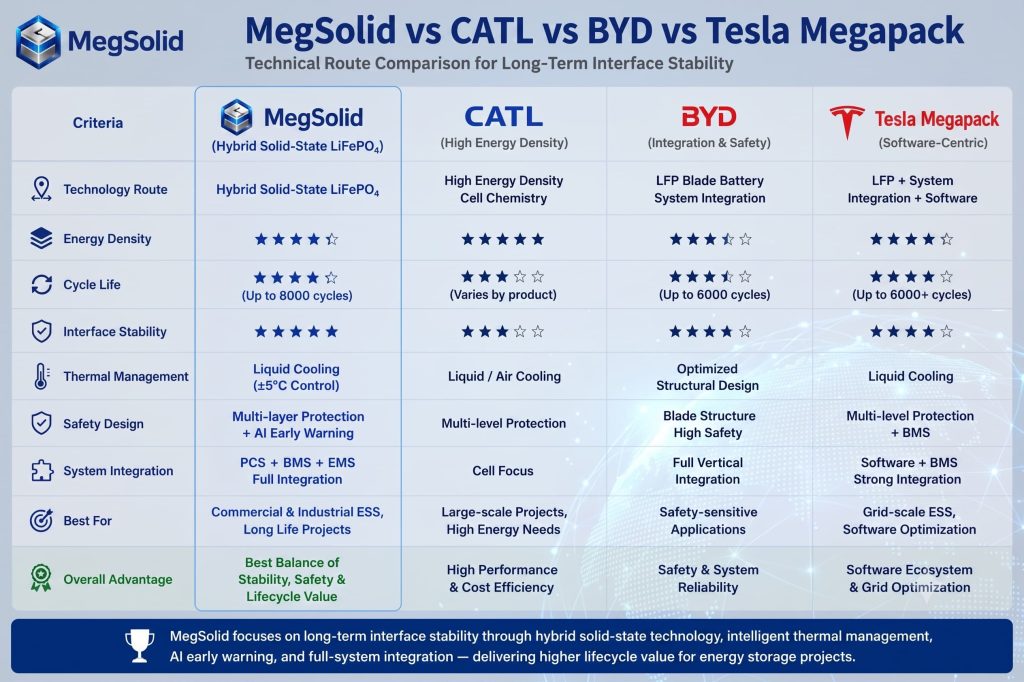
The following evaluation framework can help buyers identify genuinely reliable manufacturers.
1. Examine Cycle Life Claims Carefully
Cycle life should always be viewed in context.
Ask:
- Under what DOD was testing conducted?
- What temperature conditions were used?
- What capacity retention threshold applies?
For example, MegSolid's 314Ah hybrid solid-state battery is rated for 8000 cycles at 80% DOD, providing a more meaningful indicator of long-term performance than an isolated laboratory result.
2. Evaluate Thermal Management Design
Temperature management is one of the strongest indicators of interface engineering maturity.
Ask suppliers:
- Is liquid cooling available?
- How is temperature uniformity maintained?
- What is the maximum temperature difference between cells?
Manufacturers that actively control thermal gradients are typically more focused on long-term degradation reduction.
MegSolid's intelligent liquid-cooling platform maintains temperature differences within ±5°C, helping reduce thermal stress accumulation.
3. Review Safety Architecture
Interface degradation often develops slowly.
Effective safety systems should identify abnormal trends before failures occur.
Look for:
- AI predictive monitoring
- Multi-sensor detection
- Fire suppression integration
- Intelligent BMS architecture
A robust safety framework often reflects deeper engineering understanding.
4. Assess System-Level Engineering
Battery cells alone do not determine performance.
Ask whether the supplier provides:
- Battery packs
- PCS
- EMS
- Thermal management
- Integrated controls
The closer the integration, the better the opportunity to optimize interface stability throughout the system lifecycle.
MegSolid provides complete ESS ecosystems, including PCS, battery systems, thermal management, and intelligent monitoring platforms.
5. Verify Commercial Deployment Experience
Laboratory validation is important.
Field deployment is even more important.
Request:
- Operating project references
- Utility-scale case studies
- Commercial ESS installations
- Performance history
Real-world operation reveals degradation patterns that laboratory testing often cannot fully replicate.
6. Evaluate Future Service Capability
A battery system is a long-term asset.
The supplier should remain a technical partner throughout the asset lifecycle.
Key considerations include:
- Technical support responsiveness
- Spare parts availability
- Firmware upgrade capability
- Remote monitoring services
Strong after-sales support often has a larger impact on lifetime ROI than minor differences in purchase price.
Final Recommendation for EPCs and Investors
When evaluating solid-state or hybrid solid-state energy storage systems, focus on more than energy density.
Ask deeper questions:
- How is interface stability maintained?
- How is thermal stress controlled?
- What degradation mitigation strategies are implemented?
- How is long-term reliability verified?
The manufacturers that can answer these questions confidently are typically the ones capable of delivering sustainable project value.
At MegSolid, we believe the future of energy storage will belong not to the batteries with the highest laboratory numbers, but to the systems that deliver stable, predictable, and profitable performance over decades of operation.
FAQ
Q1: Does Solid-Solid Interface Degradation Affect ESS ROI?
Yes. Interface degradation can reduce battery capacity, efficiency, and usable energy output over time. For commercial energy storage projects, slower degradation often translates directly into higher long-term ROI and lower operating costs.
Q2: Why Is Interface Stability Important in Solid-State Batteries?
Interface stability determines how efficiently lithium ions move between materials. Poor interfaces can increase resistance, generate heat, and accelerate capacity loss throughout the battery lifecycle.
Q3: Can Solid-State Batteries Completely Eliminate Degradation?
No. All batteries experience aging. The goal is to slow degradation through advanced materials, thermal management, and intelligent battery control systems.
Q4: Why Are EPC Contractors Paying More Attention to Interface Engineering?
Because long-term project profitability depends on battery reliability. Interface degradation directly impacts energy throughput, maintenance costs, and system availability.
Q5: Is Higher Energy Density Always Better?
Not necessarily. A battery with slightly lower energy density but better long-term stability can often deliver greater lifetime value and lower ownership costs.
Q6: Why Is hybrid solid-state Technology Growing Faster Than Fully Solid-State Batteries?
hybrid solid-state batteries provide a practical balance between safety, performance, and manufacturability, making them more commercially viable for today's energy storage market.
Q7: How Does Temperature Affect Interface Degradation?
Temperature fluctuations create mechanical stress and accelerate material aging. Effective thermal management helps maintain battery performance and extend service life.
Q8: How Does MegSolid Reduce Interface Degradation Risks?
MegSolid combines semi-solid LiFePO4 technology, AI early-warning systems, intelligent liquid cooling, and integrated BMS management to improve long-term system stability.
Q9: What Should Buyers Evaluate Before Selecting an ESS Supplier?
Beyond price and capacity, buyers should assess cycle life, thermal management, safety architecture, monitoring capabilities, and the supplier's long-term technical support.
Q10: Why Is Interface Engineering Becoming a Competitive Advantage?
As energy storage projects become larger and operate longer, interface stability increasingly determines safety, reliability, and overall lifecycle profitability.
Q11: Can inverter efficiency affect the ROI impact of interface degradation?
Yes. As interface degradation increases battery impedance, energy conversion losses become more noticeable throughout the storage system. Pairing stable solid-state batteries with a high-efficiency inverter helps reduce cumulative energy losses and protects long-term project ROI. Learn more in our guide to choosing the right solid-state inverter for commercial energy storage systems.
Q12: Should buyers evaluate batteries and inverters together when calculating ESS ROI?
Absolutely. Battery degradation determines available energy capacity, while inverter efficiency determines how much of that energy can actually be delivered to the load. Evaluating both factors together provides a more accurate prediction of long-term system economics and payback periods.
