
Utility-scale engineering contractors specifying a 20-foot 5mwh 2500kw 2h bess benchmark the st5015kwh-2500kw-2h (ST5015UX-2H), positioned by Sungrow as the 2.5 MW / 5 MWh sungrow powertitan 2.0 5mwh liquid-cooled energy storage system.
While the ST5015kWh-2500kW-2h pairs 5,015 kWh of nominal DC capacity with a 2,500 kW rated AC active power output at 690 Vac, independent power producers (IPPs) and EPCs evaluate a second-source powertitan 2.0 alternative to diversify procurement or match higher active power dispatch targets.
Building on our commercial cabinet benchmark in Sungrow PowerStack Alternatives: Comparing 257–261 kWh C&I Battery Storage, this guide compares utility-scale 5 MWh container specifications side by side.
For grid-scale and industrial substation tenders, the MegSolid Containerized Energy Storage System 5000INTL delivers 5,015.9 kWh of rated energy and 2,700 kW (450 kW x 6) of rated AC output at 690 Vac inside a 20-foot ISO container.
Presented within our MegSolid Solid-State Energy Storage Systems portfolio, the MegSolid 5000INTL uses a published SHS180-314 battery type code in a 12P416S configuration; its exact cell chemistry and electrolyte architecture should be confirmed against the supplied project BOM and controlled cell specification:
- MegSolid 5000INTL (Utility Liquid-Cooled 20-ft Container): 2,700 kW (450 kW x 6 at 690 Vac, 50/60 Hz) / 5,015.9 kWh rated energy, 1,331.2V DC rated (12P416S, SHS180-314 battery type code), 87.5% maximum efficiency, IP55, 6,058 x 2,438 x 2,896 mm
- MegSolid ESSC0500B-1075 & ESSC1000B-2150 (Air-Cooled Containers): 500 kW / 1.0752 MWh (20-ft) and 1,000 kW / 2.1504 MWh (40-ft) 3.2V / 280 Ah LFP containerized systems for medium-scale industrial feeders
Datasheet Comparison: Sungrow ST5015kWh-2500kW-2h (IEC Reference) vs. MegSolid 5000INTL
Evaluating a utility containerized bess requires comparing published electrical, thermal, and mechanical parameters across defined regional datasheet versions.
Note that Sungrow publishes distinct regional specifications for the PowerTitan 2.0 (ST5015kWh-2500kW-2h / ST5015UX-2H) across Global/IEC and North American (US) markets, which differ in maximum altitude ratings (4,000 m vs. 4,500 m on select regional sheets), fire protection options, enclosure classifications (IP55 vs. Type 3S), and grid frequency settings.
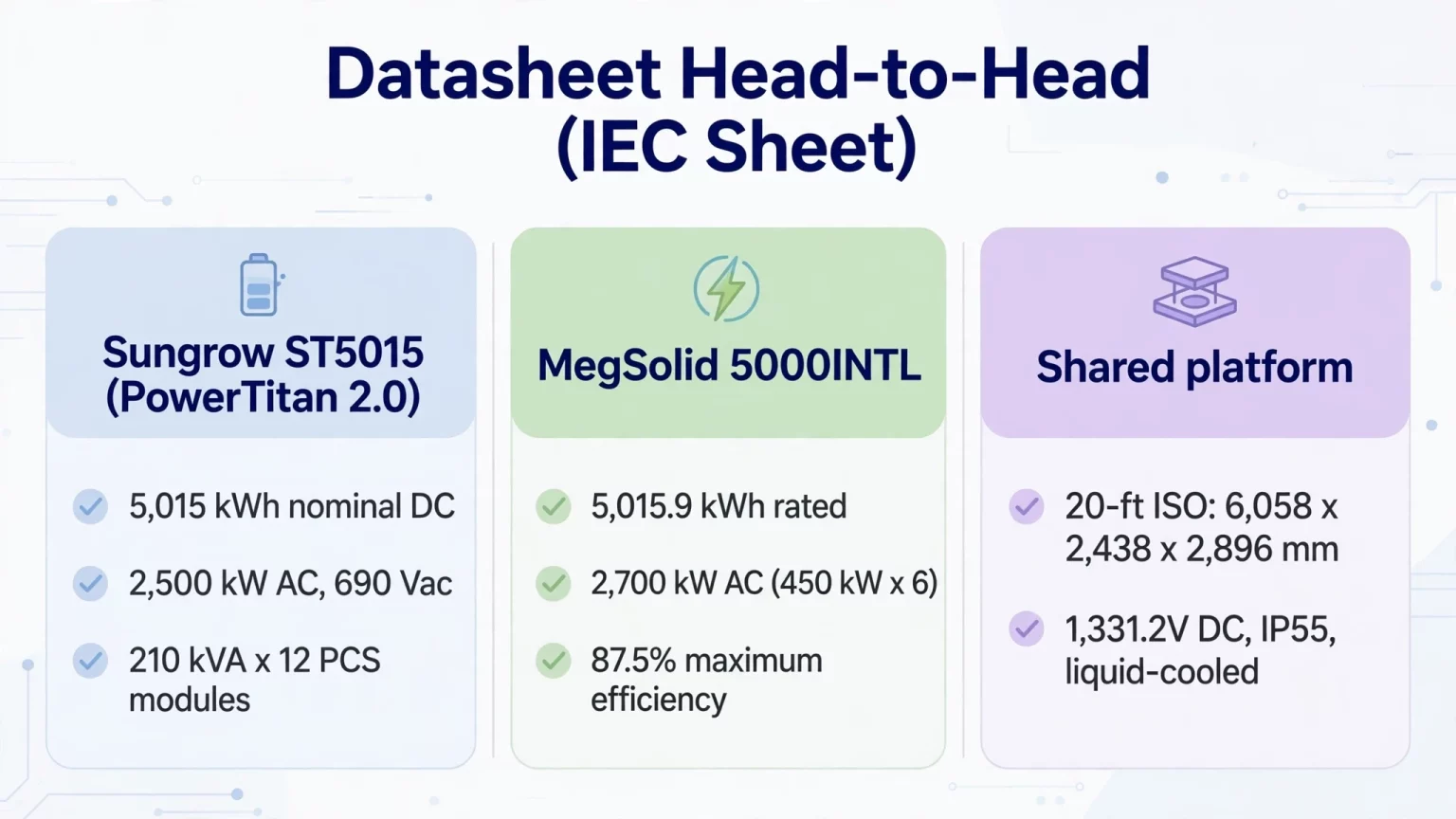
The table below references the Sungrow Global/IEC ST5015kWh-2500kW-2h (ST5015UX-2H) specification alongside published parameters for the MegSolid 5000INTL.
| Specification Parameter | Sungrow PowerTitan 2.0 (ST5015kWh-2500kW-2h IEC Sheet) | MegSolid 5000INTL Utility Container | Engineering & Sizing Notes |
|---|---|---|---|
| System Model Designation | ST5015kWh-2500kW-2h (ST5015UX-2H 2.5MW/5MWh) | 5000INTL | Both target 5 MWh-class 20-foot utility deployments |
| Nominal / Rated Energy Capacity | 5,015 kWh nominal DC capacity | 5,015.9 kWh rated energy | String math: 12 × 416 × 3.2V × 314Ah = 5,015.96 kWh |
| System Rated AC Active Power | 2,500 kW | 2,700 kW (450 kW x 6) | 5000INTL provides +200 kW (+8.0%) higher rated AC active power |
| PCS Apparent / Module Rating | 210 kVA x 12 = 2,520 kVA total apparent power | 450 kW x 6 multi-modular PCS | Distinguish system active power (kW) from PCS apparent power (kVA) |
| Nominal AC Voltage & Frequency | 690 Vac (621V to 759V IEC range), 50 Hz (60 Hz on US variant) | 690 Vac, 50/60 Hz | Both connect to the 690 Vac low-voltage winding of an MV transformer |
| Published Cell Type / Code | 3.2V / 314 Ah LFP | SHS180-314 published battery type code (derived 314 Ah at 1,331.2V / 12P416S) | Confirm 5000INTL cell BOM and electrolyte spec per project |
| Battery String Architecture | 416S12P (12 strings of 416S) | 12P416S (12 strings of 416S) | Identical series-parallel cell count (4,992 cells per container) |
| DC Voltage Window | 1,123.2V to 1,497.6V DC (1,331.2V nominal) | 1,331.2V DC rated (illustrative 416S window: 1,123.2V–1,497.6V at 2.7–3.6V/cell) | Maximum DC operating voltage approaches 1,500V DC |
| Published System Efficiency | Not stated as a single fixed figure on base sheet | 87.5% maximum efficiency | Align efficiency boundaries and auxiliary loads in LCOS models |
| Thermal Management | Intelligent liquid cooling | Smart liquid cooling | Liquid coolant loops regulate 416S battery strings |
| Enclosure Dimensions (W x D x H) | 6,058 x 2,438 x 2,896 mm | 6,058 x 2,438 x 2,896 mm | Standard 20-foot ISO High-Cube footprint (14.77 m² base area) |
| System Weight | ~42,500 kg (published on Sungrow datasheet) | Confirm via controlled project GA drawing | Size pads using controlled net weight, operating weight, and CoG drawings |
| Ingress Protection & Max Altitude | IP55, <= 4,000 m (up to 4,500 m on select regional sheets) | IP55, <= 4,000 m | Verify regional datasheet version for high-altitude sites |
| Communication Interfaces | Ethernet | Confirm SCADA/EMS interface per project specification | Verify communication port and register map before integration |
Key Architectural Differences: Power Ratings, Cell Configuration, and Delivered Energy
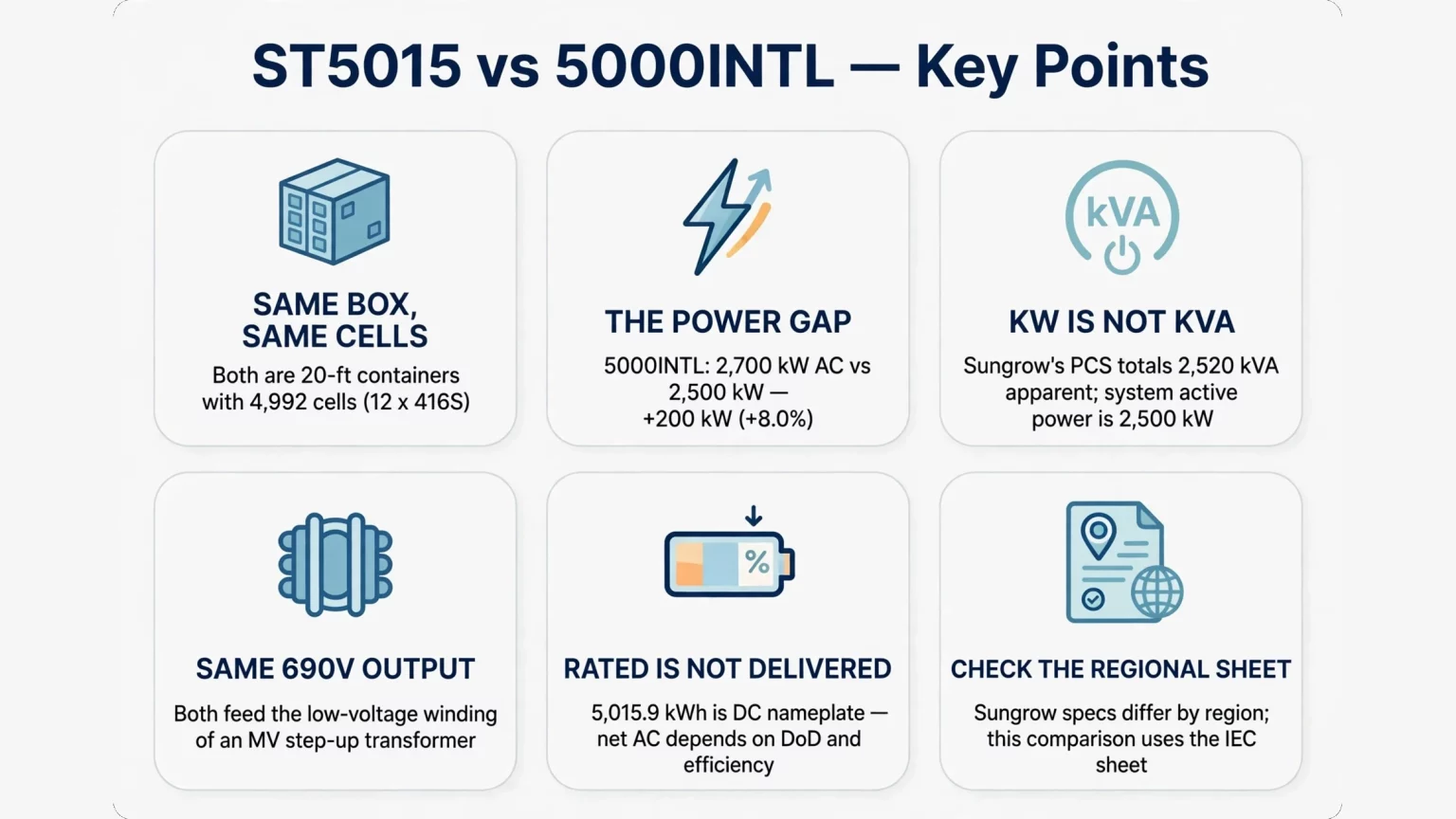
While both containers share an identical 6,058 x 2,438 x 2,896 mm envelope and a 4,992-cell (12 x 416S) layout, engineering teams must evaluate three technical distinctions during tender review.
1. System Active Power (kW) vs. PCS Apparent Power (kVA): 2,700 kW vs. 2,500 kW
On Sungrow's official specification sheet for the st5015kwh-2500kw-2h, system rated active power is 2,500 kW, while the twelve modular converters are rated in apparent power at 210 kVA × 12 = 2,520 kVA.
Engineers must keep active power (kW) and apparent power (kVA) distinct when modeling reactive power capability.
By comparison, the MegSolid 5000intl specifies six 450 kW power conversion units (450 kW x 6), delivering a combined rated AC active power of 2,700 kW at 690 Vac:
P_AC (5000INTL) = 6 × 450 kW = 2,700 kW (+200 kW, or +8.0% vs. 2,500 kW).
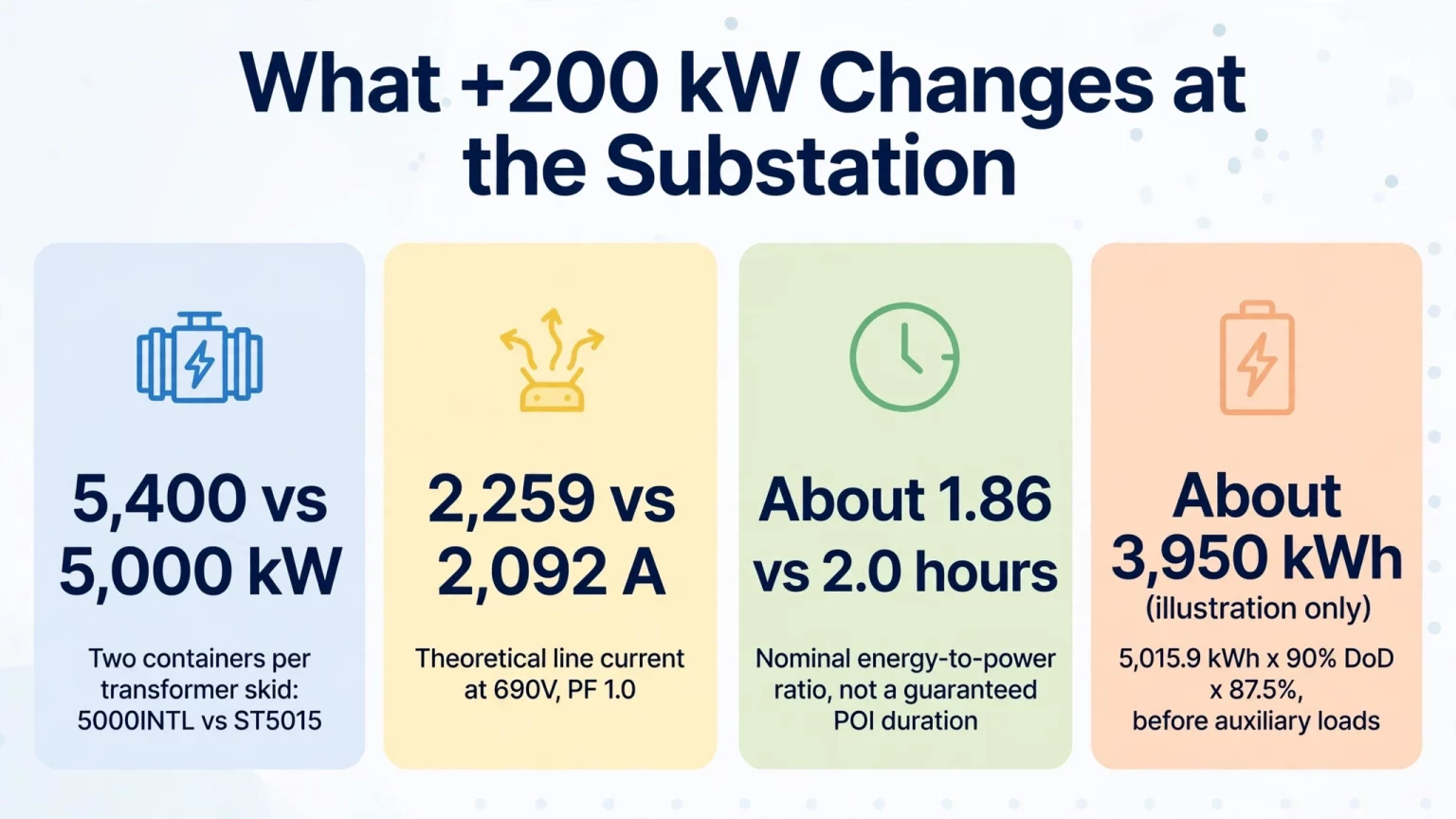
Note that nominal duration ratios such as 2.0 hours (5,015 kWh / 2,500 kW at a nominal 0.5P ratio) or ~1.86 hours (5,015.9 kWh / 2,700 kW) reflect the ratio of rated DC energy to rated AC power, and do not represent guaranteed point-of-interconnection (POI) AC discharge duration.
Whether the 5000INTL can sustain 2,500 kW or 2,700 kW at the POI for a contracted duration depends on usable depth of discharge (DoD), conversion efficiency, auxiliary cooling power, and cell degradation curves.
The additional 200 kW of rated active power may provide higher dispatch headroom, subject to the PCS overload curve, ramp-rate capability, battery current limits, grid-code requirements, and operating SoC.
Because the 5000INTL pairs 12 battery strings (12P416S) with six 450 kW PCS units (without public datasheet confirmation of whether two strings share a PCS DC bus or use separate DC/DC stages), electrical engineers must verify DC-side string grouping and fuse protection philosophy against factory single-line diagrams.
2. Cell Architecture: Sungrow Liquid LFP vs. MegSolid SHS180-314 Battery Configuration
The Sungrow ST5015kWh-2500kW-2h datasheet specifies 3.2V / 314 Ah liquid LFP cells arranged in a 416S12P configuration.
For the MegSolid 5000INTL, the official container specification confirms a 12P416S configuration using the SHS180-314 battery type code at 1,331.2V DC rated voltage and 5,015.9 kWh rated energy, paired with smart liquid cooling, AI early warning, and a three-dimensional protection system.
While MegSolid separately publishes a cell specification brief for the MegSolid 314Ah Hybrid Solid-State Battery (SHS180-314Ah, listing 3.2V / 314 Ah, 180 Wh/kg, 390 Wh/L, ACIR 0.18 +/- 0.03 milliohms, DCIR 0.4 +/- 0.1 milliohms, and >= 94.5% cell efficiency at 0.5P), the 5000INTL container page does not independently detail the complete electrolyte composition.
Therefore, procurement engineers should not automatically transfer all standalone cell brief metrics onto the container without confirming the exact cell chemistry, electrolyte architecture, and safety test reports against the supplied project BOM.
3. Distinguishing Rated DC Energy from Net Delivered AC Energy
Both the ST5015kWh-2500kW-2h (5,015 kWh) and the 5000INTL (5,015.9 kWh) express nameplate capacity as rated DC cell energy (12 × 416 × 3.2V × 314Ah = 5,015.96 kWh).
MegSolid publishes an 87.5% Maximum Efficiency figure for the 5000INTL, which does not specify whether the measurement boundary covers full-cycle AC-to-AC round-trip efficiency or includes auxiliary chiller power.
For illustration only, if 87.5% were assumed to represent the applicable DC-to-AC conversion efficiency, a 90% usable DoD would yield approximately 3,950 kWh before accounting for auxiliary consumption:
Illustrative delivered energy = 5,015.9 kWh × 90% DoD × 87.5% assumed efficiency ≈ 3,950.0 kWh (before auxiliary loads).
This is not a guaranteed AC-to-AC round-trip energy rating; actual project sizing must use verified efficiency curves across operating C-rates and deduct site-specific liquid-cooling auxiliary loads.
Balance-of-Plant (BoP) Engineering: 690V AC Step-Up Transformer Integration
Evaluating a powertitan 2.0 alternative requires checking how the container interfaces with medium-voltage (MV) collector substations.
Connecting to the 690V Low-Voltage Winding of an MV Step-Up Transformer
Both systems provide 690 Vac three-phase output for connection to the low-voltage winding of a suitably rated medium-voltage step-up transformer (where the medium-voltage primary winding steps up to 10 kV, 20 kV, 33 kV, or 34.5 kV).
In an illustrative substation topology where two containers feed a dual-split-winding step-up transformer skid:
- Two Sungrow ST5015kWh-2500kW-2h Units: 2 × 2,500 kW = 5,000 kW rated active power (2 × 2,520 kVA = 5,040 kVA PCS apparent rating)
- Two MegSolid 5000INTL Units: 2 × 2,700 kW = 5,400 kW rated active power at 690 Vac
Matching the 690 Vac nominal voltage does not mean an EPC can swap containers without re-verifying the transformer and low-voltage switchgear.
Engineers must check five electrical and mechanical interface parameters:
- Transformer MVA Capacity and Power Factor Range: Verify that the step-up transformer has sufficient MVA rating for 2 × 2,700 kW = 5.4 MW plus required reactive power (kVAr), or cap container dispatch at 2,500 kW via EMS control.
- Short-Circuit Impedance, Winding Vector Group, and Protection: Confirm transformer percentage impedance (Z%), winding connection group (such as Dyn11 or YNd11), fault current contribution, and relay coordination.
- PCS Grid-Code Control and Harmonics: Verify PCS harmonic distortion limits (such as THDi < 3% on Sungrow's sheet), anti-islanding protection, and SCADA/EMS communication register maps.
- Low-Voltage Breaker and Cable Sizing: At 690 Vac and unity power factor (PF = 1.0), theoretical three-phase line current (I = P / (√3 × 690V × PF)) is 2,092 A for 2,500 kW and 2,259 A for 2,700 kW; however, actual breaker and cable selection must be sized for rated power factor, maximum continuous current, temperature rise, ambient derating, and continuous load factors.
- Foundation Loads and Center-of-Gravity Drawings: While both containers share identical 6,058 x 2,438 x 2,896 mm outer dimensions (14.77 m² footprint) and Sungrow specifies ~42,500 kg, civil engineers must calculate pad bearing loads using controlled net weight, operating weight, and center-of-gravity (CoG) drawings for the exact supplied model.
Evaluating 1 MWh to 2 MWh Industrial Feeders: Air-Cooled Container Options
For industrial feeders that do not require a 5 MWh liquid-cooled block, MegSolid manufactures the MegSolid Containerized Energy Storage System (ESSC series) using 3.2V / 280 Ah LFP cells (>= 5,000 cycles) and intelligent temperature-controlled air cooling (IP54).
Across the ESSC product specification, maximum PV input power is published at the series level as selectable configuration options (600 / 660 / 720 / 1,200 / 1,320 / 1,440 kW, confirmed per model and MPPT order configuration):
- ESSC0500B-1075 (20-Foot Container): 500 kW rated AC power / 1.0752 MWh nominal energy, 6,058 x 2,438 x 2,896 mm, 21,000 kg (confirm selected PV input configuration option from series table)
- ESSC1000B-2150 (40-Foot Container): 1,000 kW rated AC power / 2.1504 MWh nominal energy, 12,192 x 2,438 x 2,896 mm, 38,000 kg (confirm selected PV input configuration option from series table)
How EPCs Model 20-Year Lifecycle Cost (LCOS) and Procurement Risk
When comparing the sungrow powertitan 2.0 5mwh against the MegSolid 5000intl for a multi-year Power Purchase Agreement (PPA), procurement teams must evaluate contracted testing protocols and verified financial model inputs.
Supply Chain Scheduling and Contractual FAT Protocols
On utility and industrial tenders, production slot allocation and shipping schedules directly impact Commercial Operation Date (COD) milestones.
EPCs procuring the 5000INTL can coordinate delivery schedules, SCADA protocol mapping, factory burn-in testing scope, and customer witness Factory Acceptance Testing (FAT) procedures according to the terms defined in the project supply contract and approved FAT plan.
Five Required Inputs for a Rigorous 20-Year Container LCOS Model
Building a bankable 20-year Levelized Cost of Storage (LCOS) comparison between two 5 MWh containers requires five project-specific inputs:
- Turnkey Equipment and BoP CAPEX: Confirmed container FOB/CIF pricing, MV transformer skids, civil foundations, and grid interconnection costs
- Full-Cycle AC Efficiency and Auxiliary Load Curves: Verified AC-to-AC round-trip efficiency curves at the project's C-rate and ambient temperature profile, minus liquid-cooling chiller consumption
- Warranted Cycle Life and Degradation Curves: Controlled annual State of Health (SoH) retention tables under the contracted cycling regime
- Augmentation Evaluation Variables: Modeling whether (and in which specific year) supplemental capacity or repowering is required to maintain contracted POI megawatt-hours
- Discount Rate and Delivered AC Energy Normalization: 20-year cumulative Net Present Value (NPV) of all CAPEX and OPEX divided by discounted net AC megawatt-hours delivered to the grid
FAQ
What are the confirmed specification differences between Sungrow ST5015kWh-2500kW-2h and MegSolid 5000INTL?
Both systems are 20-foot ISO High-Cube liquid-cooled containers (6,058 x 2,438 x 2,896 mm, IP55) storing approximately 5.015 MWh (5,015 kWh nominal for Sungrow vs. 5,015.9 kWh rated for MegSolid) across 4,992 cells (12 x 416S) with a 690 Vac three-phase output. The primary confirmed datasheet difference is rated AC active power: the MegSolid 5000INTL is rated at 2,700 kW (450 kW x 6), which is 200 kW (+8.0%) higher than the Sungrow ST5015kWh-2500kW-2h active power rating of 2,500 kW (2,520 kVA apparent power across 210 kVA x 12).
Why is the MegSolid 5000INTL rated at 5,015.9 kWh, and how is its cell type defined?
The 5000INTL uses a 12P416S configuration with a published SHS180-314 battery type code and a rated DC voltage of 416 × 3.2V = 1,331.2 Vdc, yielding 12 × 1,331.2V × 314Ah = 5,015.96 kWh (listed as 5,015.9 kWh rated energy). Its exact cell chemistry and electrolyte architecture should be confirmed against the supplied project BOM and controlled cell specification.
Does a 5,015.9 kWh rated container deliver 5 MWh of net AC energy to the grid?
No, 5,015.9 kWh is the rated DC capacity rather than net delivered AC energy at the point of interconnection. For illustration only, if 87.5% were assumed to represent the applicable DC-to-AC conversion efficiency, a 90% usable DoD would yield approximately 3,950 kWh before accounting for auxiliary consumption; this is not a guaranteed AC-to-AC round-trip energy rating.
Can the MegSolid 5000INTL connect to a 690V medium-voltage step-up transformer?
Both systems provide 690 Vac three-phase output for connection to the low-voltage winding of a suitably rated medium-voltage step-up transformer. However, replacing a 2,500 kW unit with a 2,700 kW unit requires verifying transformer MVA capacity, power factor and reactive power range, short-circuit impedance, winding connection group, protection coordination, and low-voltage breaker/cable sizing.
How do the PCS ratings differ between the 5000INTL and PowerTitan 2.0?
The Sungrow ST5015kWh-2500kW-2h datasheet specifies a 2,500 kW system active power rating and twelve 210 kVA modular PCS units (2,520 kVA total apparent power). The MegSolid 5000INTL specifies six 450 kW power conversion units (450 kW x 6) for 2,700 kW total rated AC active power, and engineers should confirm the internal DC string-to-PCS grouping against factory drawings.
How does the standalone SHS180-314Ah cell brief relate to the 5000INTL container?
MegSolid publishes a standalone cell technical brief for the SHS180-314Ah hybrid solid-state LFP cell (3.2V / 314 Ah, 180 Wh/kg, 390 Wh/L, ACIR 0.18 +/- 0.03 milliohms, DCIR 0.4 +/- 0.1 milliohms, >= 94.5% cell efficiency at 0.5P). Because the 5000INTL container page lists the SHS180-314 type code without detailing full electrolyte parameters, EPCs should verify the controlled cell specification in their project BOM.
What are the dimensions, weight, and altitude considerations for both containers?
Both containers share a 20-foot High-Cube footprint of 6,058 x 2,438 x 2,896 mm (14.77 m² base area) and an IP55 rating, with max altitude listed up to 4,000 m on standard IEC sheets (and 4,500 m on select Sungrow regional sheets). While Sungrow's datasheet lists a weight of ~42,500 kg, foundation and crane calculations for the 5000INTL must be based on MegSolid's controlled net weight, operating weight, and center-of-gravity drawings.
How should EPCs treat the 87.5% maximum efficiency figure on the 5000INTL?
MegSolid lists 87.5% as a Maximum Efficiency parameter on the 5000INTL specification sheet without defining full-cycle AC-to-AC round-trip boundaries. Financial models should request full-cycle AC-to-AC round-trip efficiency curves and auxiliary thermal load tables across project C-rates and ambient temperatures.
How should EPCs verify SCADA and EMS communication interfaces for the 5000INTL?
While Sungrow's ST5015kWh-2500kW-2h datasheet specifies Ethernet communication, MegSolid's base web summary for the 5000INTL does not list specific communication port protocols. EPC automation engineers should confirm the physical communication interface, protocol standard (such as Modbus TCP/RTU or IEC 61850), and SCADA register map in the project technical specification.
Does MegSolid offer smaller containerized BESS options for 1 MWh to 2 MWh projects?
Yes, MegSolid offers the air-cooled ESSC0500B-1075 (500 kW / 1.0752 MWh in a 20-foot container) and ESSC1000B-2150 (1,000 kW / 2.1504 MWh in a 40-foot container), with selectable series PV input options (600 / 660 / 720 / 1,200 / 1,320 / 1,440 kW) confirmed per order configuration.
Conclusion: Engineering a Reliable 5 MWh Utility Storage Deployment
Evaluating a sungrow powertitan 2.0 5mwh system against a powertitan 2.0 alternative requires verifying active vs. apparent PCS power ratings, 690 Vac low-voltage transformer winding compatibility, controlled BOM cell specifications, and net delivered AC energy.
For commercial and utility engineering comparisons across our product lineup, review Sungrow PowerStack Alternatives: Comparing 257–261 kWh C&I Battery Storage.
Explore full technical documentation for the MegSolid Containerized Energy Storage System 5000INTL and our complete range of MegSolid Solid-State Energy Storage Systems.