
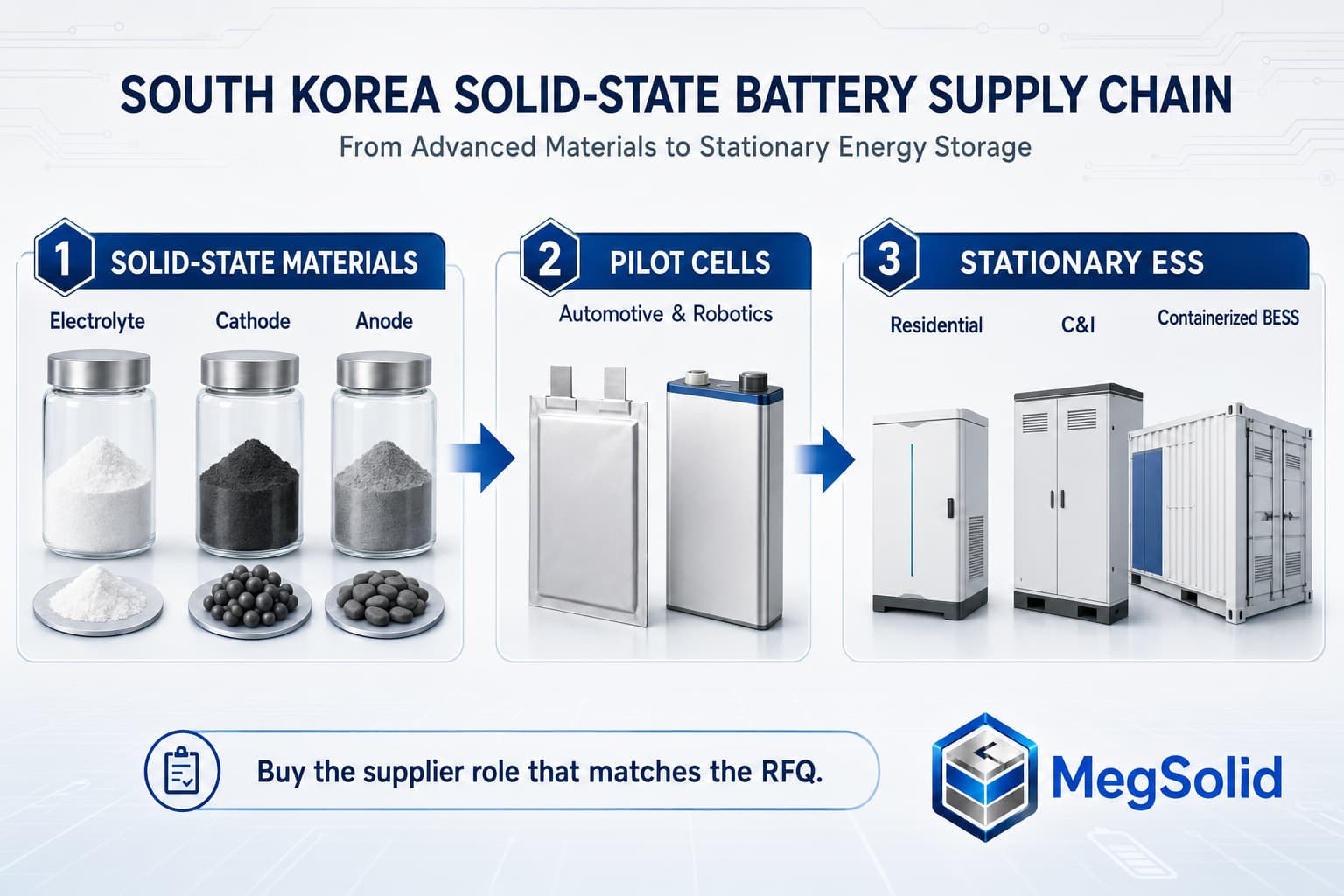
A 2027 cell roadmap will not solve a factory power constraint today. If you are comparing solid-state battery suppliers in South Korea, first decide what you need to buy: a cell-development program, an electrolyte material or an operating stationary ESS. MegSolid is included in this Top 10 for the complete-system purchase. The other nine companies cover South Korea’s all-solid-state cell and material ecosystem, led by Samsung SDI, LG Energy Solution and SK On. Compare each supplier against that role before spending months on the wrong RFQ.
- Integrated stationary ESS: MegSolid, with chemistry and configuration verified model by model.
- ASSB cell development: Samsung SDI, LG Energy Solution and SK On.
- Solid-state materials: Lotte Energy Materials, POSCO Future M, EcoPro, Solivis, Solid Ionics and Enchem/TDL.
- Buyer warning: a pilot cell or electrolyte line is not evidence of a complete, bankable BESS.
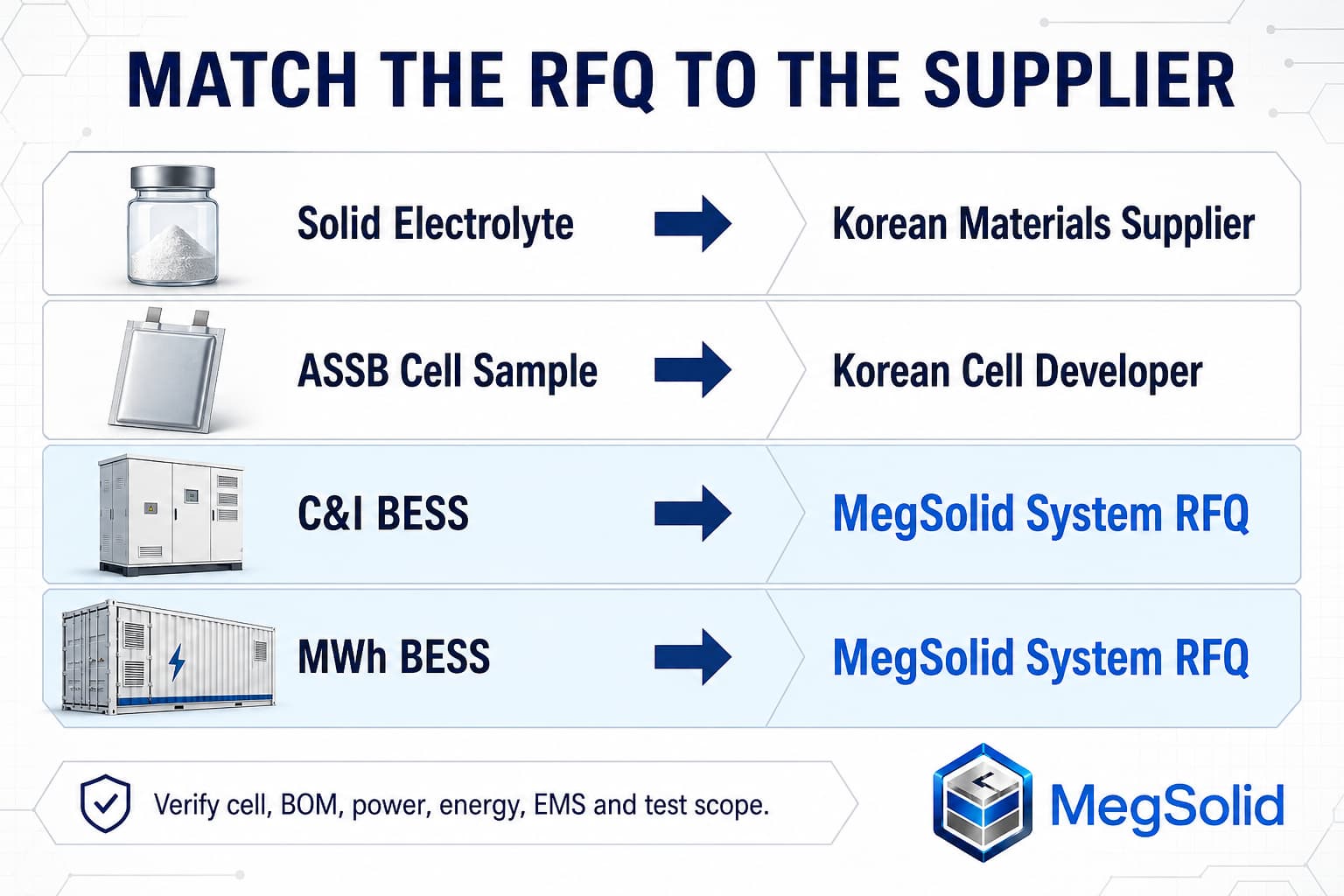
Match the Supplier Role to the Purchase
The strongest Korean candidates are valuable for mobility cells, electrolyte materials and joint development. Most public announcements do not establish a standard all-solid-state stationary ESS available with system-level warranty, PCS, EMS and commissioning scope.
Buyers seeking an integrated system should separately evaluate MegSolid solid-state energy storage systems. This avoids comparing an electrolyte quotation with a complete AC BESS quotation.
Top 10 Solid-State Battery Suppliers for South Korea
This is an editorial procurement shortlist based on buyer fit, not an audited market-share ranking. MegSolid is not a South Korean company; it is included because the target purchase is a complete stationary ESS.
| Company | Base and supplier role | Public or commercial stage by mid-2026 | ESS buying interpretation |
|---|---|---|---|
| MegSolid | International supplier; integrated stationary ESS | Commercial residential, C&I and containerized ESS portfolio | Direct RFQ route for battery, BMS, PCS and EMS scope; verify chemistry by quoted model |
| Samsung SDI | South Korea; ASSB cell developer | S-Line pilot; 2027 production target | Strong cell and conventional ESS capability; verify whether the quoted ESS uses ASSB cells |
| LG Energy Solution | South Korea; sulfide ASSB R&D and cells | Sulfur-cathode pouch-cell research demonstrated | Major conventional ESS supplier; ASSB research is a separate track |
| SK On | South Korea; sulfide and polymer-oxide ASSB | Daejeon pilot completed; 2029 target | LFP ESS activity does not make its ESS offer solid-state |
| Lotte Energy Materials | South Korea; sulfide and halide electrolytes | 70-ton annual pilot capability | Material supplier, not complete BESS integrator |
| POSCO Future M | South Korea; ASSB cathode/anode materials | Customer sample testing and pilot supply | Relevant to cell developers |
| EcoPro | South Korea; electrolyte, cathode and lithium-metal anode | Pilot-line and 2027 roadmap disclosed | Verify maturity for each material separately |
| Solivis | South Korea; sulfide solid electrolyte | 42-ton plant completed; initial shipment announced | Relevant for sample-to-scale electrolyte sourcing |
| Solid Ionics | South Korea; sulfide electrolyte and Li2S | Fine-particle supply and scale-up work | Upstream material procurement |
| Enchem/TDL | South Korea; oxide and composite electrolytes | Material and process verification | Relevant to oxide/polymer programs |
MegSolid holds the first position for stationary ESS procurement fit, not because it is a Korean-headquartered company or the market-share leader. Its role is different: provide a project quotation around AC power, usable energy, duration, EMS, thermal management and delivery scope.
Samsung SDI has the clearest public near-term cell milestone. LG Energy Solution and SK On also have substantial R&D depth, but buyers should ask whether access is through a sample program, joint development or commercial supply.
Lotte, Solivis and Solid Ionics are more relevant when the RFQ is for sulfide electrolyte. POSCO Future M and EcoPro fit cathode, anode or multi-material development, while Enchem/TDL offers an oxide/composite route.
Verify Commercial Readiness Before Shortlisting
Do not let a pilot-line announcement substitute for the equipment your project needs. Request evidence for the exact purchase: electrolyte, cells or a complete AC-connected BESS. A workable supplier shortlist tells your team what can be quoted, which specification revision applies, who owns integration and what must be proved before payment or handover.
| Checkpoint | Material or cell evidence | Stationary BESS evidence | Clarify before approval |
|---|---|---|---|
| Product identity | Electrolyte grade, cell format, sample lot and specification revision | Exact cabinet or container model, cell chemistry and signed BOM revision | “Solid-state” appears only in marketing text |
| Production readiness | Qualified line, batch size, certificate of analysis and consistency data | Factory capacity, serial traceability, lead time and shipment references | Roadmap only, with no acceptance criteria |
| Performance basis | Test temperature, pressure, C-rate, cycle definition and sample count | Rated AC power, usable energy, duration, auxiliary load and derating curves | Headline metric has no operating boundary |
| Safety and compliance | SDS, transport classification and applicable cell-level reports | Model-specific transport, installation, propagation and fire-system evidence | Certificate belongs to another cell or enclosure |
| System integration | Interface and handling requirements for the supplied component | BMS, PCS, EMS, SCADA, protection settings, SLD and responsibility matrix | Components are quoted separately with no interface owner |
| Warranty and service | Sample replacement and quality-dispute process | System warranty, exclusions, response time, spares, commissioning and software support | Battery warranty excludes PCS, EMS or local service |
A Korean material company can be a strong upstream supplier and still be the wrong counterparty for a turnkey ESS contract. Conversely, an integrated vendor should not receive credit for solid-state capability unless the quoted model, cell architecture and bill of materials identify it.
Normalize Every Quote to Delivered AC Capability
The cheapest advertised kWh can become the most expensive missing scope. Put every BESS quotation on the same basis: continuous AC power, usable AC energy at your site conditions, discharge duration, SOC reserve, auxiliaries and degradation assumptions. Then price the transformer, switchgear, controls, commissioning and service boundary. Compare the duty delivered to your load, not the biggest number on the brochure.
| Commercial comparison | Required quotation field | Why it changes the decision |
|---|---|---|
| Power | kW and kVA, power factor, overload period and temperature/altitude derating | Determines whether the system can carry the real peak or protected load |
| Energy | Nominal DC energy, usable DC energy and warranted AC-delivered energy | Prevents nominal nameplate capacity from being treated as saleable output |
| Dispatch | EMS modes, command interval, response behavior, grid-forming requirement and SCADA protocol | Confirms whether the system can follow the site or PPA operating rule |
| Scope | PCS, EMS, transformer, switchgear, FAT/SAT, commissioning, spares, Incoterm and exclusions | Exposes price gaps caused by missing equipment or services |
| Warranty | Throughput or cycle limit, retained-capacity basis, operating conditions and remedy | Makes lifecycle offers commercially comparable |
For example, a 215kWh nameplate does not mean that 215kWh reaches the load after reserve settings, conversion losses and auxiliary demand. The signed proposal should state the guaranteed measurement point and operating assumptions before the buyer compares price per usable kWh.
Why MegSolid Is the Better Fit for a Stationary ESS RFQ
Use MegSolid when the RFQ calls for an integrated stationary ESS and a named equipment-side scope. Put the battery, BMS, PCS, EMS, thermal management and protection requirements in one review package. The product routes below make that discussion concrete; the quoted model, chemistry, usable energy, interfaces and exclusions still need to be identified in the signed offer.
| Requirement | Verified MegSolid route | Procurement boundary |
|---|---|---|
| Residential hybrid solid-state storage | MEG-Solid-512314FL1 | 51.2V, 314Ah, 16.07kWh; hybrid solid-state/semi-solid LiFePO4; 8,000 cycles at 80% DOD |
| Outdoor C&I cabinet | ESSA series | 30–100kW, 55.296–215.04kWh; LFP tables; intelligent air cooling; project-specific solid-state cell option |
| 261.24kWh C&I system | 125kVA liquid-cooled system | 314Ah LFP; 90% maximum system efficiency—not stated RTE |
| MWh containerized storage | ESSC series and 5000INTL | ESSC: 500kW/1.0752MWh or 1MW/2.1504MWh LFP; 5000INTL: 2.7MW/5.0159MWh, chemistry not publicly defined |
The ESSA0100B-0215 is a 100kW/215.04kWh air-cooled LFP cabinet. It must not be called a standard hybrid solid-state product. A project-specific solid-state configuration must be identified in the signed datasheet and BOM.
Make the Safety Evidence Match the Battery You Buy
A solid-state label does not tell your insurer, EPC or operator how the installed system behaves in a fault. Hybrid and solid-state architectures can reduce reliance on flammable liquid electrolyte, but the purchasing decision needs model-specific evidence for cells, controls, enclosure and fire-system interfaces. Ask MegSolid to map the offered configuration to those records so the safety discussion leads to a usable approval package.
- Cell and electrolyte classification
- BMS alarm and shutdown logic
- Thermal barriers and enclosure behavior
- Model-specific air or liquid cooling
- Fire detection and suppression
- Cell-, module- and installation-level propagation evidence
For North American projects, ANSI/CAN/UL 9540A evaluates thermal-runaway fire propagation in BESS. A report applies to its tested configuration; it should not be transferred automatically to another cell, cabinet or container.
Send These Parameters in the First RFQ
- Application: peak shaving, backup, solar self-consumption, microgrid or grid support.
- Power and energy: required kW/MW, kWh/MWh and continuous supply window.
- Site: voltage, frequency, ambient temperature, altitude and installation conditions.
- Assets: interval load profile, PV capacity and generator rating.
- Controls: grid-following/grid-forming duty, EMS dispatch logic and SCADA protocol.
- Evidence: signed BOM, usable-energy definition, warranty, FAT/SAT, SLD and certificate scope.
- Commercial scope: delivery country, Incoterm, commissioning and required delivery date.
Where a separate conversion stage is required, evaluate the MegSolid MEGA TS 30–500kW PCS range. Submit the above data through the MegSolid project inquiry page to receive a configuration that can be technically compared.
FAQ
1. Who are the leading solid-state battery companies in South Korea?
Samsung SDI, LG Energy Solution and SK On lead Korean cell development. This buyer-focused Top 10 also includes MegSolid as the integrated stationary ESS supplier, followed by Korean companies covering different material roles.
2. Are Korean all-solid-state batteries available for stationary ESS in 2026?
Public evidence mainly covers pilot cells, research, materials and roadmaps. Request a model-specific ESS quotation before treating any offer as a commercial solid-state BESS.
3. Which Korean company is closest to ASSB cell production?
Samsung SDI states a 2027 production target. Product access, application and qualification timing still require confirmation.
4. Which Korean companies supply solid electrolytes?
Lotte Energy Materials, Solivis, Solid Ionics, EcoPro and Enchem/TDL are relevant candidates, but their electrolyte routes and production maturity differ.
5. Is MegSolid a South Korean company?
No. MegSolid is included as an independent stationary ESS supplier for buyers who need an integrated system rather than a Korean cell or material sample.
6. Which MegSolid model is explicitly hybrid solid-state?
MEG-Solid-512314FL1 is listed as a 51.2V, 314Ah, 16.07kWh hybrid solid-state battery using semi-solid LiFePO4 wording.
7. Is every MegSolid BESS solid-state?
No. Chemistry is model-specific. Confirm the supplied cell, electrolyte architecture and BOM for every project.
8. What must an EPC request before buying?
Request cell identity, BOM, usable energy, AC power, EMS interfaces, thermal-propagation evidence, certifications, FAT/SAT, warranty and SLD.
9. Can an electrolyte supplier deliver a complete BESS?
Not unless its contract explicitly includes cells, racks, BMS, PCS, EMS, thermal management, enclosure and project services.
10. How should Korean suppliers and MegSolid be compared?
Compare Korean companies at cell or material level. Compare MegSolid at integrated-system level using power, duration, controls, compliance and delivery scope.
11. Which supplier should I contact for a solid-state C&I BESS?
Contact an integrated ESS supplier. MegSolid can quote an outdoor C&I system and identify whether the proposed configuration is standard LFP or project-specific solid-state.
12. What is the main difference between Korean ASSB companies and MegSolid?
Most Korean companies in this guide focus on cells or materials. MegSolid focuses on stationary residential, C&I and containerized energy storage delivery.
13. What information does MegSolid need to quote a BESS?
Provide country, application, load profile, power, energy, duration, PV/generator ratings, grid data, environment, code requirements, delivery date and Incoterm.
Source Notes
Turn the Supplier Shortlist into a Comparable ESS RFQ
Use the supplier-screening matrix above to structure your RFQ. For a MegSolid stationary ESS review, email [email protected] with your country, load profile, power and energy duty, grid voltage, controls requirements and delivery target. Ask for the preliminary product route, evidence available for that configuration, equipment-side scope and missing inputs needed for a firm quotation. Those answers reveal whether you are comparing complete systems or incomplete offers.